
VANSON LEATHER Jackets vs Bespoke Custom Leather: Durability, Grain, and Craftsmanship Comparison
Compare Vanson leather jackets vs bespoke custom leather in 2026. Analyze competition-weight steerhide, track abrasion resistance, and custom tailoring value.
VANSON LEATHER Jackets vs Bespoke Custom Leather: Durability, Grain, and Craftsmanship Comparison
Key Takeaways
- Industrial Armor vs Bespoke Ergonomics: Vanson Leather jackets are legendary for ultra-dense, 3.5-to-4.0-ounce competition-weight steerhide engineered primarily for high-speed abrasion resistance, while bespoke artisan leather outerwear prioritizes anatomical drafting, balanced hide temper, and zero break-in discomfort.
- Hide Metallurgy & Tannage: Commercial competition steerhide relies on heavy chrome tanning and stiff polymer surface sealants to withstand high asphalt friction, whereas bespoke ateliers hand-select drum-dyed, full-grain virgin cowhides and supple vegetable-re-tanned leathers that develop rich personal patinas.
- Tensile Assembly & Seam Architecture: True protective roadwear demands bonded nylon or Kevlar thread rated at minimum v92 to v138 tensile strength, flat-felled double-needle structural seams, and heavy-gauge solid brass YKK hardware engineered to survive catastrophic slide impact without tearing.
- Anatomical Patterning & Rider Fatigue: Off-the-rack riding jackets enforce a standardized athletic or boxy drop that often causes neck pinching, sleeve binding, and lower-back bunching, whereas bespoke custom-tailored outerwear distributes leather weight evenly across the trapezius and shoulder girdle.
- Heirloom Longevity & Total Cost of Ownership: Both competition steerhide and artisan bespoke leather garments can easily survive 30 to 50 years of rigorous service, but bespoke garments deliver superior daily comfort and tailored aesthetic versatility across both street and highway contexts.
Artisan Independence & Trademark Notice: Lux Wearz is an independent bespoke leathercraft atelier. All brand names, logos, and trademarks mentioned in this article (including VANSON LEATHER® and related trademarks) belong exclusively to their respective trademark holders. Lux Wearz is not an authorized distributor, licensee, or affiliated partner of these brands. All brand references and historical retrospectives are made strictly for educational, comparative, and sizing review purposes under Fair Use. Lux Wearz specializes in custom-tailored, heirloom-grade genuine leather outerwear handcrafted individually in our private workshop.
How Do Vanson Leather Jackets Compare to Bespoke Handcrafted Leather in Durability, Hide Thickness, and Long-Term Value?
Vanson Leather jackets represent legendary industrial-grade protection built primarily from heavy 3.5-to-4.0-ounce competition-weight steerhide engineered for track-level abrasion resistance. In comparison, bespoke custom leather outerwear from an artisanal atelier like Lux Wearz offers tailored ergonomics, anatomical patterning cut precisely to your body measurements, virgin full-grain hides, and personalized luxury linings without the punishing multi-year break-in period.
Choosing between iconic industrial motorcycle armor and bespoke artisan outerwear requires a nuanced understanding of hide chemistry, grain behavior, seam mechanics, and structural tailoring. For over half a century, American motorsport culture has celebrated heavy, unyielding steerhide jackets designed to function as literal body armor against highway asphalt. At the same time, discerning leather aficionados and modern riders increasingly demand outerwear that offers robust protective integrity without sacrificing everyday mobility, aesthetic refinement, and custom-tailored silhouette lines. Understanding how these two distinct approaches to leathercraft diverge in hide selection, tanning philosophy, pattern geometry, and hardware longevity is critical before making an investment in heirloom outerwear.
The Historical Heritage and Archival Architecture of Vanson Leathers
The story of Vanson Leathers is inextricably linked to the American motorcycle racing revival and East Coast artisanal manufacturing. Founded in 1974 in Boston, Massachusetts, by Michael van der Sleesen and later establishing headquarters in the historic textile mill city of Fall River, Massachusetts, Vanson emerged during an era when off-the-rack motorcycle gear was plagued by thin imports and flimsy construction. Van der Sleesen recognized that road racers, flat-track champions, and metropolitan motorcycle police officers required gear engineered to withstand catastrophic high-speed slides on punishing tarmac.
From the outset, Vanson adopted an unyielding manufacturing standard centered on thick, competition-grade American steerhide, proprietary leather finishes, and labor-intensive single-needle workshop assembly. Unlike mainstream fashion brands that cut corners with lightweight split leather or bonded synthetic composites, Vanson built garments that weighed seven to ten pounds apiece. Each jacket was cut by hand from heavy hides, stamped with an individual serialized workshop registration number, and assembled using industrial machines capable of punching through multiple plies of four-ounce leather.
Throughout the 1980s and 1990s, the brand established iconic silhouettes that defined motorcycle counterculture and professional road racing. The SportRider series pioneered articulated sleeves and zippered ventilation systems; the Star Racing jackets became ubiquitous on NHRA drag strips; and municipal contracts with police departments—most notably the Boston Police Department—solidified the company's reputation for unbreakable tactical gear. The rugged, indestructible aura of these jackets transformed them from utilitarian track tools into coveted archival outerwear, prized by vintage collectors, cafe racer purists, and heritage fashion enthusiasts worldwide.
Comprehensive Silhouette and Fit Architecture: Comparing Iconic Cuts
Motorcycle jackets must balance wind deflection, impact protection, and ergonomic reach. When evaluating off-the-rack heritage models alongside custom bespoke alternatives, understanding how silhouette geometry affects mobility and drape is essential.
| Silhouette Model | Cut & Fit Type | Shoulder / Chest Offset | Ideal Body Profile | Leather Weight & Temper |
|---|---|---|---|---|
| SportRider Track Series | Aggressive Forward Pre-Curved | High forward rotation; +4 to +6 inch chest ease | Athletic, slim-to-muscular torso; tucked riding posture | 3.8 - 4.2 oz Competition Steerhide; extremely stiff temper |
| Boston Police Patrol MK2 | Traditional American Boxy Patrol Cut | Neutral shoulder slope; +5 to +7 inch chest ease | Broad-shouldered, athletic or stocky build; upright posture | 3.5 - 3.8 oz Firenze Top-Grain Cowhide; medium-firm temper |
| Flying Fortress B-3 Bomber | Oversized Archival Flight Silhouette | Dropped shoulders; +6 to +8 inch chest ease | Broad or heavy build; cold-weather layering | 15 - 18 mm Genuine Shearling Sheepskin; soft, plush temper |
| Cobra MK2 Aerodynamic Cruiser | Semi-Articulated Sport Touring Cut | Moderate forward drop; +3 to +5 inch chest ease | Average to athletic build; neutral to forward reach | 3.5 - 4.0 oz Perforated Competition Steerhide; firm temper |
| Villainess Women's Moto | Tailored Hourglass Motorcycle Cut | Tapered waist with lace-up side expansion gussets | Feminine athletic silhouette with defined bust-to-waist taper | 3.0 - 3.4 oz Supple Cowhide; medium temper |
| Lux Wearz Atelier Bespoke | 100% Custom Anatomical Draft | Drafted individually to exact shoulder slope and chest ease | Any physique; zero off-the-rack compromises | 3.0 - 3.8 oz Full-Grain Virgin Cowhide; customer-selected temper |
The foundational divergence between production-line motorcycle cuts and bespoke atelier patterning lies in chest-to-waist ease and armscye (armhole) positioning. Factory motorcycle jackets must accommodate a broad spectrum of human proportions within rigid standard sizing blocks (e.g., US 38 through 48). To ensure that a broad-shouldered rider can still zip the jacket, factory patterns incorporate generous lower-torso ease, resulting in excess leather that bunches around the belt line when seated on a motorcycle or walking down the street.
Furthermore, competition motorcycle patterns feature aggressively pre-curved sleeves rotated forward by 15 to 25 degrees. While this posture prevents sleeve hem pull-back when reaching for low clip-on handlebars on a supersport bike, it creates uncomfortable resistance and awkward fabric creasing across the pectoral muscles when the wearer relaxes their arms at their sides in an everyday environment. Bespoke pattern cutting solves this structural limitation by taking into account your specific riding posture, daily habits, arm span, and shoulder blade projection, crafting a jacket that articulates naturally without excess bulk.
Leather Hide Metallurgy, Tannage Chemistry, and Hardware Durability Matrix
To truly evaluate the lifespan and performance of premium leather outerwear, one must examine the raw materials at a molecular and mechanical level. The table below outlines the exact technical specifications of hide grades, tanning agents, tensile tolerances, and hardware alloys utilized in high-end leathercraft.
| Component / Hide | Leather Grade & Tannage | Thickness (mm) | Weather Resistance | Expected Longevity | Maintenance Needs |
|---|---|---|---|---|---|
| Competition Steerhide | Full-grain heavy steerhide; chromium sulfate mineral tannage with hard wax top-coat | 1.5 - 1.7 mm (3.8 - 4.2 oz) | Excellent water and road-grit shedding; stiff barrier against wind penetration | 40 - 60+ Years under rigorous riding conditions | Semi-annual conditioning with heavy lanolin or beeswax leather balms |
| Bespoke Virgin Full-Grain Cowhide | Uncorrected full-grain aniline or semi-aniline; combination chrome/vegetable tannage | 1.3 - 1.5 mm (3.2 - 3.8 oz) | High breathability; absorbs natural oils and develops deep, dimensional patina | 35 - 50+ Years with normal civilian and highway wear | Annual light conditioning with pH-balanced neat's-foot oil or cream |
| Firenze Semi-Dress Cowhide | Corrected-grain drum-dyed bovine leather; polyurethane light emulsion finish | 1.2 - 1.4 mm (3.0 - 3.4 oz) | High stain resistance and water repellency; uniform satin visual sheen | 25 - 35 Years before micro-creasing of polymer surface | Periodic wiping with damp microfiber cloth and neutral leather conditioner |
| Flying Fortress Shearling Hide | Full pelt sheepskin with intact fleece wool lining; vegetable/synthetic dual tannage | 15.0 - 18.0 mm fleece depth | Superior thermal insulation to -20°F; requires rain protection | 30 - 45 Years when stored in humidity-controlled environments | Specialized sheepskin suede brush and breathable seasonal garment bags |
| Structural Seam Thread | High-tensile bonded nylon v92 to v138; UV-resistant polyester monofilament core | Tensile break strength: 14.5 - 22.0 lbs per stitch | Immune to road grime and salt-spray rot; high abrasion resistance | 40+ Years without seam burst or thread dry-rot | Inspect annually along stress points, elbows, and shoulder yoke seams |
| Heavy-Duty Zipper Assemblies | Solid brass or antique nickel #8 and #10 YKK slider tracks; extruded brass teeth | 8.2 - 10.5 mm tooth width | Zero corrosion or tooth shear under extreme wind pressure and lateral torque | 30 - 50 Years; lifetime mechanical slider durability | Periodic lubrication with paraffin wax or silicone slider lubricant |
Chromium Mineral Tannage vs Artisan Combination Tannages
The legendary durability of Vanson's competition steerhide stems from an intensive mineral tanning process utilizing basic chromium sulfate salts. Mineral tanning cross-links collagen fibers within the bovine hide into a resilient, rot-resistant protein matrix within 24 to 48 hours. Chromium-tanned leather boasts an extraordinarily high hydrothermal shrinkage temperature (often exceeding 212°F / 100°C), making it virtually impervious to heat, engine exhaust splashes, and road friction heat generated during an asphalt slide.
However, mineral-tanned competition hide is inherently stiff, dense, and cold to the touch. To achieve uniform color and weather resistance, commercial tanneries spray the surface with acrylic pigment dispersions and hard wax sealants. This impermeable surface effectively locks out moisture, but it also inhibits the natural absorption of body oils, meaning the leather takes years of grueling wear to soften and crease around the wearer's joints. Many riders describe the first two years of wearing a new competition steerhide jacket as akin to wearing an orthopedic back brace.
In contrast, bespoke custom ateliers such as Lux Wearz frequently source virgin full-grain hides tanned through vegetable-mineral combination tannages or drum-dyed aniline methods. By incorporating natural plant extracts—such as mimosa, chestnut, and quebracho tannins—alongside gentle fat-liquoring emulsions, the hide retains its natural suppleness, porous breathability, and tactile warmth. The natural grain surface is left uncorrected by heavy synthetic sealants, allowing the unique epidermal grain variations, neck wrinkles, and fat wrinkles to show through. As the jacket encounters daily sunlight, body warmth, and atmospheric humidity, it develops an authentic vintage patina with deep amber, cognac, or obsidian undertones that cannot be replicated by factory machines.
Pre-Owned Inspection Checklist & Common Vintage Flaws
Because vintage Vanson jackets are highly sought after in the secondary market, prospective buyers must carefully inspect pre-owned garments for hidden structural deterioration. A vintage jacket may appear rugged on the surface while suffering from irreparable internal failure.
1. Seam Thread Dry-Rot and Acidic Breakdown
The most critical vulnerability in vintage leather outerwear manufactured prior to the widespread adoption of UV-stabilized bonded synthetics is thread dry-rot. Early production runs and poorly stored garments frequently feature cotton-wrapped polyester threads that break down when exposed to sweat acidity and atmospheric humidity over decades.
- Inspection Protocol: Firmly grasp the leather panels on either side of the main back seam or sleeve yoke and pull outward with moderate hand tension. If you hear a faint crackling sound or observe small white thread loops separating from the stitch holes, the thread has dry-rotted and the garment will require complete disassembly and restitching—a repair that often costs hundreds of dollars.
2. Leather Hardening and "Cardboard" Desiccation
When heavy steerhide is stored in an attic, basement, or non-climate-controlled storage locker, the vital fat liquors embedded within the collagen matrix evaporate. Once the internal moisture drops below approximately 10%, the collagen fibers weld together, causing the hide to stiffen into a brittle, cardboard-like state.
- Inspection Protocol: Gently flex the elbow area or lower kidney panel. If the leather resists bending or produces sharp, chalky surface micro-fissures rather than smooth, rounded folds, the hide is severely desiccated. While superficial surface conditioning can improve appearance, deeply desiccated competition hide can never fully regain its original structural tensile strength and may crack under stress.
3. Zipper Track Tooth Loss and Box Pin Separation
Motorcycle jackets subject main closure zippers to tremendous lateral wind pressure and road vibration. Heavy-duty #10 brass zippers are virtually indestructible along the metal teeth, but the cotton-twill tape holding the teeth to the leather is vulnerable to fraying and tear.
- Inspection Protocol: Inspect the bottom insertion pin and retaining box at the base of the zipper. If the twill tape is shredded, frayed, or separated from the metal box, the slider will jam or derail under tension. Replacing a heavy-gauge zipper in a four-ounce steerhide jacket requires an industrial post-bed sewing machine and substantial labor costs.
4. Pocket Lining Blowout and Sweat Salt Corrosion
Vintage riding jackets accumulate substantial quantities of salt and body oils inside the sleeve linings and pocket bags. Over time, salt crystals abrade delicate rayon, satin, or lightweight cotton linings, resulting in shredded sleeve cuffs and torn pocket interiors.
- Inspection Protocol: Turn the jacket completely inside-out. Check the armpit seams and wrist linings for dark salt rings, sour odors, or shredded fabric. A foul, mildewed lining indicates poor storage and potential bacterial contamination within the foam padding or leather flesh side.
Featured Silhouette Retrospective & Curated Collection
For collectors and enthusiasts exploring iconic motorcycle silhouettes, the Lux Wearz catalog curates a remarkable selection of specialized leather outerwear models. Each of these garments represents a distinct architectural response to the demands of speed, weather protection, and heritage styling.
1. The High-Speed Aerodynamic Pioneer: Cobra MK2 SportRider
The Vanson Leather Cobra MK2 SportRider Men's Leather Sport Motorcycle Jacket stands as a masterwork of aggressive sport-touring engineering. Tailored from competition-grade black steerhide, the Cobra MK2 features full-torso zippered ventilation channels, double-layer leather reinforcement across the shoulders and forearms, and an integrated kidney-support waistband. Its bi-swing back gussets provide unrestricted forward reach across sportbike clip-ons, while the heavy brass hardware ensures that high-speed airflow cannot force vents open unexpectedly.
2. High-Altitude Arctic Insulation: Flying Fortress Crew B-3
When extreme cold-weather protection is required, the Vanson Leather Flying Fortress Crew Men's Sheepskin Flight Jacket offers unrivaled thermal insulation. Built from thick, supple brown sheepskin shearling with a natural plush fleece interior, this archival silhouette pays homage to World War II heavy bomber crews operating in unpressurized cabins at 25,000 feet. The garment features twin leather throat-latch straps, heavy cowhide welted seams, and solid brass waist-adjustment buckles that seal out freezing drafts.
3. Tactical Municipal Authority: Boston Police MK2 Patrol Jacket
Engineered specifically for law enforcement motorcycle divisions, the Vanson Leather Boston Police MK2 Men's Leather Police-Style Jacket exemplifies tactical durability. Crafted from drum-dyed black Firenze cowhide, this jacket incorporates side equipment zips for duty-belt clearance, bi-swing shoulder pleats, an insulated zip-out thermal vest liner, and an extended drop-tail kidney protector designed to shield the rider's lower back from frigid road winds during high-speed highway patrol.
4. Track-Inspired Graphic Geometry: Cobra MK2 Star SportRider
For riders who demand bold visual presence alongside track-level abrasion protection, the Vanson Leather Cobra MK2 Star SportRider Men's Leather Sport Motorcycle Jacket features hand-inlaid leather star motifs stitched seamlessly into perforated competition-weight steerhide. The contrast leather panels are skived down at the seams to maintain a smooth internal surface, eliminating pressure points against armor inserts while optimizing airflow across the chest during warm-weather canyon carving.
5. Contoured Feminine Track Architecture: The Villainess Moto Jacket
Addressing the historic lack of dedicated ergonomic patterns for female riders, the Vanson Leather Villainess Women's Leather Motorcycle Jacket combines aggressive protective cowhide with an hourglass silhouette. The jacket features adjustable zippered hip expansion gussets, pre-curved sleeves, and an asymmetrical front closure that prevents tank scratching while maintaining an impeccably tapered profile both on and off the motorcycle.
To explore our complete archival curation of historic motorcycle outerwear, visit our dedicated Vanson Leather Brand Catalog, or browse our broader collection of handcrafted Men's Leather Jackets.
The Bespoke Handcrafted Custom Tailoring Alternative
While heritage mass-production jackets offer rugged nostalgia, they inevitably require compromises in personal fit, daily comfort, and stylistic versatility. A heavy four-ounce off-the-rack jacket that fits perfectly across the shoulders often leaves several inches of excess leather around the waist, causing an unflattering boxy silhouette and ballooning in highway wind. Conversely, a jacket sized down to fit the waist will constrict the chest, restrict shoulder mobility, and dig painfully into the armpits.
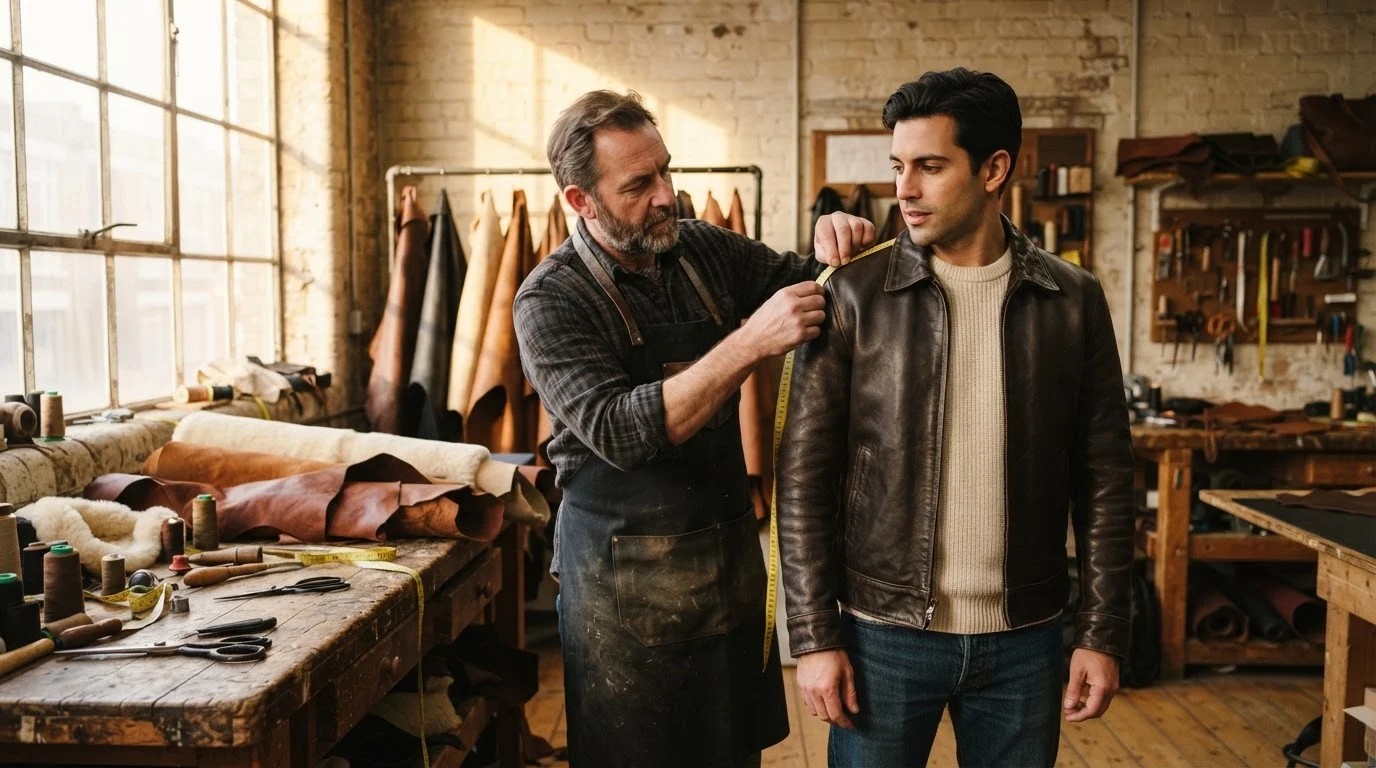
This fundamental sizing compromise is why discerning riders and collectors choose custom bespoke leathercraft. At the Lux Wearz private atelier, every bespoke leather jacket is treated as an individual commission of heirloom wearable architecture. We bypass standardized factory sizing entirely, cutting every pattern from scratch based on more than twenty precise anatomical body measurements.
1. Virgin Full-Grain Hides Without Factory Fillers
Commercial manufacturers often use corrected-grain hides buffed with sandpaper to erase natural scars and insect bites, then embossed with artificial grain patterns and coated in thick polyurethane. In the Lux Wearz workshop, we select only virgin full-grain hides sourced from ethical tanneries. The full dermal grain layer remains completely intact, ensuring maximum tensile strength, superior breathability, and an organic surface texture that ages gracefully with each passing season.
2. Anatomical Drafting and Shoulder Ease
Instead of forcing your body into a rigid pre-curved race posture, our master pattern makers draft custom armscye openings and shoulder pitches tailored to your exact posture. Whether you ride a forward-leaning cafe racer, an upright cruiser, or wear your leather primarily for metropolitan streetwear, the jacket moves like a second skin, eliminating uncomfortable binding and excess weight fatigue.
3. Luxury Interior Appointments and Metallurgy
Factory motorcycle jackets commonly feature synthetic polyester mesh or stiff nylon taffeta linings that trap sweat and chafe against shirt sleeves. Lux Wearz jackets feature bespoke interior appointments, including breathable Italian cupro, heavyweight satin, or quilted flannel linings, complemented by internal zippered leather gun-pockets, discreet smartphone pouches, and solid hand-burnished antiqued brass YKK hardware.
If you are ready to design a one-of-a-kind leather masterpiece tailored precisely to your measurements, submit your vision through our Bespoke Custom Order Portal. Before ordering, consult our comprehensive Online Size and Measurement Guide to record your anatomical dimensions accurately.
Long-Term Maintenance, Conditioning, and Patina Preservation
Whether you own an archival competition steerhide jacket or a bespoke heirloom custom piece, proactive leather care is the single most important factor determining whether your garment lasts ten years or seventy years. Leather is an organic, cellular material that requires balanced hydration, clean airflow, and periodic lipid replenishment.
1. Cleaning Road Grime and Insect Acid
Highway riding exposes leather jackets to acidic insect residue, road grime, salt spray, and petroleum exhaust deposits. If left untreated, insect acids digest leather tannins, causing localized discoloration and premature surface degradation.
- Cleaning Routine: After extended rides, wipe down the exterior surface with a soft microfiber cloth lightly dampened with warm distilled water. Never use household detergents, dish soap, or abrasive sponges. For stubborn grime, apply a specialized pH-balanced saddle soap or glycerin leather cleaner using a damp horsehair brush, working in gentle circular motions before wiping dry with a clean towel.
2. Lipid Replenishment and Conditioning Cycles
Mineral-tanned competition steerhide requires deep-penetrating leather balms containing natural tallow, beeswax, or pharmaceutical-grade lanolin to maintain fiber elasticity. Softer aniline and bespoke cowhides thrive on lighter, non-darkening leather conditioning creams formulated with neat's-foot oil or jojoba oil.
- Frequency: Condition your leather jacket twice annually—once in early spring before the riding season begins, and once in late autumn before winter storage. Apply conditioner sparingly using clean fingers or a cotton applicator cloth; allow the hide to absorb the oils for 24 hours, then buff thoroughly with a dry horsehair brush to restore a rich, satin luster.
3. Proper Seasonal Storage Protocols
Improper storage is the leading cause of permanent leather damage. Never store a heavy leather jacket on a thin wire or plastic hanger, as the concentrated weight will deform the shoulder padding and create permanent unsightly bumps.
- Storage Mandate: Always support heavy outerwear on a wide, contoured wooden suit hanger with substantial shoulder flares. Store the garment in a cool, dry, well-ventilated closet inside a breathable 100% cotton garment bag. Never seal leather in non-breathable plastic dry-cleaning bags, which trap ambient humidity and foster aggressive mildew growth.
For exhaustive step-by-step instructions on cleaning, deep conditioning, and weatherproofing your outerwear, review our official Leather Care and Restoration Guide. To view our complete collection of handcrafted outerwear, travel bags, and luxury accessories, explore the Lux Wearz Complete Catalog.
For an in-depth breakdown of diamond-quilted impact zones and iconic SportRider cuts, explore our VANSON LEATHER Archival Silhouettes & Quilted Craftsmanship Guide.
Explore The Full 2026 Leather Outerwear Collection
Vegetable-tanned full-grain cowhide, buttery New Zealand lambskin, and heritage Melton wool. Free express delivery across the USA with 30-day hassle-free returns.