
Vanson Leather Jackets: Archival Silhouettes & Sizing Guide [2026]
Explore Vanson Leather archival silhouettes, quilted steerhide construction, numbered sizing charts, vintage inspection checks, and custom bespoke alternatives.
Key Takeaways
- Forward-Rotated Pattern Geometry: VANSON LEATHER archival silhouettes rely on anatomical motorcycle drafting with pre-curved sleeves, bi-swing shoulder gussets, and tapered waist drops rather than boxy department-store blocks.
- Competition-Weight Steerhide Specs: Traditional track and street patterns use 3.5-to-4.0-ounce full-grain cowhide and steerhide (1.4 mm to 1.7 mm), delivering decades of abrasion resistance alongside a firm initial temper.
- Quilted Impact Architecture: Diamond-quilted and padded shoulder, elbow, and kidney panels reinforce high-friction zones while giving iconic SportRider and flat-track jackets their unmistakable sculptural depth.
- Numbered Chest Sizing Precision: Archival riding cuts follow even-numbered chest sizing (36 through 52) rather than generic alpha sizes, making exact torso, shoulder-width, and sleeve-length verification critical.
- Bespoke Made-to-Measure Advantage: When off-the-rack sleeve pitches or vintage dry-rot threaten fit and longevity, a custom-tailored heirloom leather jacket crafted from fresh virgin full-grain hide resolves every sizing compromise.
Artisan Independence & Trademark Notice: Lux Wearz is an independent bespoke leathercraft atelier. All brand names, logos, and trademarks mentioned in this article (including VANSON LEATHER® and related trademarks) belong exclusively to their respective trademark holders. Lux Wearz is not an authorized distributor, licensee, or affiliated partner of these brands. All brand references and historical retrospectives are made strictly for educational, comparative, and sizing review purposes under Fair Use. Lux Wearz specializes in custom-tailored, heirloom-grade genuine leather outerwear handcrafted individually in our private workshop.
What Defines VANSON LEATHER Archival Silhouettes, Quilted Craftsmanship, and Sizing Architecture?
VANSON LEATHER archival silhouettes are defined by heavy competition-weight steerhide, forward-rotated two-piece sleeves, quilted impact reinforcement panels, and numbered chest sizing engineered for an active riding posture. Understanding how cut geometry, hide temper, and seam density interact allows buyers to select the right ready-to-wear piece or commission a bespoke custom alternative.
For collectors, serious motorcyclists, and heritage outerwear enthusiasts, few names carry the mechanical credibility of Fall River leathercraft. Unlike fashion-house leather jackets built from thin, split-grain lambskin stretched over straight shirt blocks, true competition-derived outerwear treats leather as structural engineering. Every panel angle, gusset fold, zipper gauge, and quilted seam serves a biomechanical function when leaning forward over clip-on handlebars or bracing against sixty-mile-per-hour crosswinds. Yet that same technical rigor creates real sizing traps for buyers accustomed to casual streetwear proportions.
In this definitive atelier guide, we dissect the archival history of classic American sport-riding and flight silhouettes, examine the craft behind quilted panels and competition-grade hardware, map out exact silhouette-by-silhouette fit architecture, inspect pre-owned vintage failure points, and highlight how Lux Wearz curates both iconic pieces and made-to-measure bespoke leathercraft.
Historical Heritage: From East Coast Track Paddocks to Archival Street Icons
To appreciate why an archival SportRider or flat-track jacket hangs differently on a hanger than a conventional bomber, you have to trace its lineage back to mid-1970s American road racing. Founded in Boston in 1974 before moving to the historic granite textile mills of Fall River, Massachusetts, the workshop built its reputation solving a life-or-death problem: amateur and professional racers were sliding across abrasive tarmac in imported fashion hides that shredded on first contact.
Patternmakers responded by abandoning decorative shortcuts. Instead of multi-piece patchwork torsos with weak horizontal seams, they cut large, continuous chest and back panels from dense domestic steerhide. Sleeves were drafted at an aggressive forward pitch so excess leather would not bunch across the front deltoid when gripping motorcycle controls. Bi-swing action pleats were folded vertically behind the shoulder blades, allowing the upper back to expand up to two inches during full arm extension without pulling the hem above the rider's beltline.
Over the next four decades, those track-bred engineering principles branched into distinct archival families:
- The SportRider & Cobra Lineage: Short-waisted café and superbike silhouettes featuring snap-tab mandarin collars, gusseted cuffs, kidney-belt back drops, and high-visibility contrast leather striping or reflective piping.
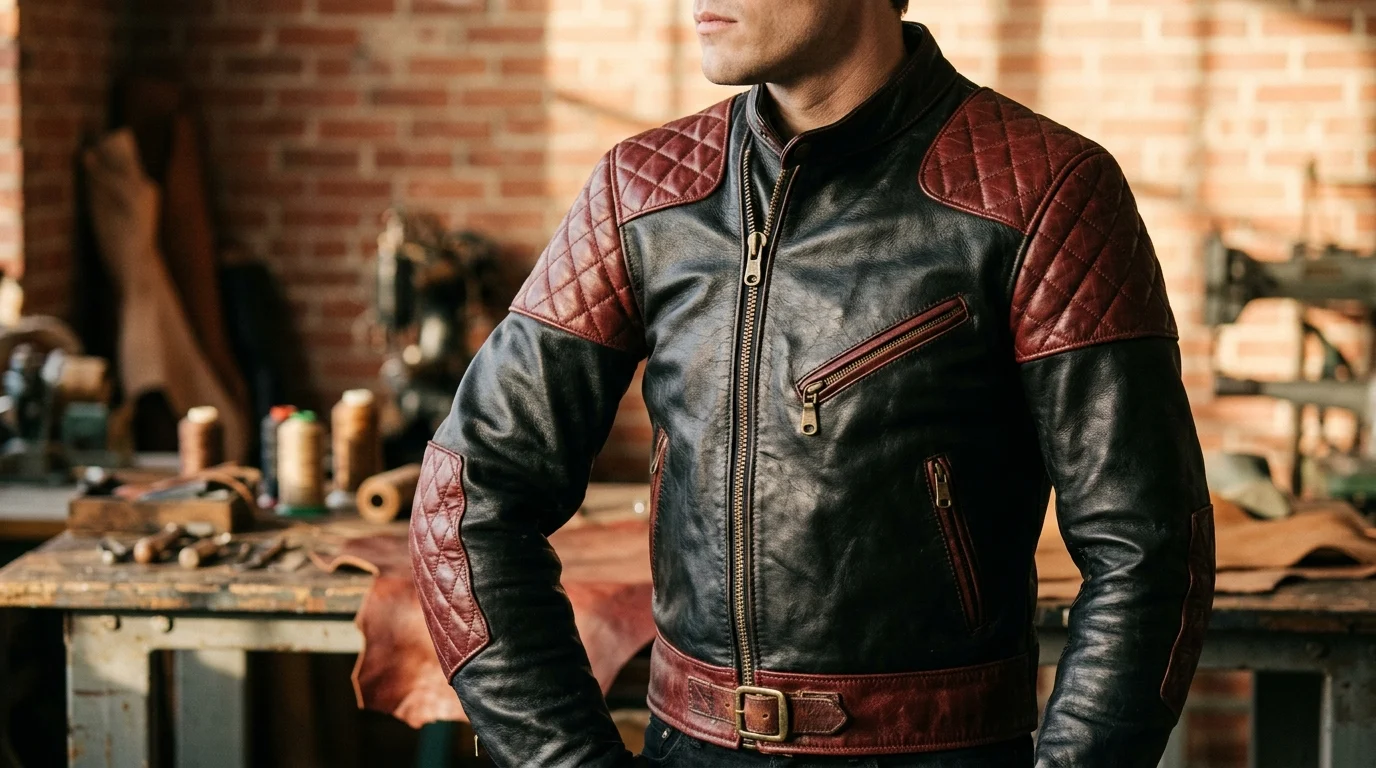
- The Flat-Track & Quilted Racer Lineage: Bold geometric inlays, diamond-quilted shoulders and elbows, and multi-tone star motifs inspired by dirt-track oval champions of the late 1970s and 1980s.
- The Municipal Patrol & Cruiser Lineage: Long-torso police-style asymmetrical and center-zip duty jackets built with side-lace or buckle waist adjusters to accommodate duty belts and heavy layering.
- The Heritage Shearling & Flight Lineage: Heavyweight B-3 sheepskin bombers and long leather officer greatcoats engineered for open-cockpit winter endurance rather than tarmac sliding.
Even when worn purely on city streets today, these archival silhouettes project unmistakable structural authority. The shoulders hold their own architecture, the torso tapers cleanly toward the hip, and the hide develops deep accordion creases along the inner elbows that reflect the wearer's exact posture. For a broader technical comparison of commercial competition hides versus artisan workshop construction, read our companion analysis on VANSON LEATHER vs Bespoke Custom Leather Durability.
Quilted Craftsmanship & Structural Seam Engineering Explained
Quilting on a heritage motorcycle jacket is far more than surface ornamentation. In poorly constructed fashion outerwear, quilted shoulders are often stitched through thin 0.7 mm chrome-tanned sheep leather backed with cheap polyester batting that flattens within one season. On archival competition and cruiser outerwear, quilted craftsmanship follows a disciplined multi-layer assembly:
1. Double-Layer Abrasion & Impact Stacking
When an artisan constructs a diamond-quilted shoulder yoke or elbow reinforcement, the outer face of full-grain steerhide or cowhide is laminated over high-density closed-cell or open-cell neoprene-grade foam before being stitched onto a secondary base leather shell. That means impact zones carry effectively double hide thickness—often exceeding 2.8 mm total leather depth—absorbing blunt force while preventing gravel and asphalt from wearing through to the lining.
2. Stitch Pitch & Tensile Thread Selection
Every needle perforation slightly weakens leather along the stitch line if spaced too tightly. Master leatherworkers calibrate quilting stitch length strictly between five and seven stitches per inch using v92 or v138 bonded nylon filament thread. Shorter stitch lengths risk creating a postage-stamp tear line under sudden lateral shear; wider stitch spacing allows foam cores to shift and buckle. Bonded nylon resists rot from sweat moisture, road salt, and ultraviolet light far better than cotton-core threads used in vintage 1960s garments.
3. Gusseted Waist Adjusters & Action-Back Pleats
Because competition-weight leather exhibits minimal mechanical stretch compared to woven wool or nylon, dynamic fit relies entirely on patterned pleats and adjustable hardware. Side-lace gussets, twin brass buckle straps, and zippered hip vents permit two to three inches of waist expansion so a jacket stays snug over a t-shirt in July yet still closes cleanly over a heavyweight flannel or thermal liner in November.
4. Heavyweight Hardware Metallurgy
Zipper failure is the single most common mechanical breakdown on heavy leather outerwear. Archival riding jackets pair thick steerhide plackets with solid brass or nickel-plated YKK #8 and #10 separating main zippers, reinforced with leather wind flaps behind the teeth and heavy-duty snaps at the collar and hem. Sleeve cuffs use zippered gussets with internal leather webs rather than open vents, sealing out wind chill at highway speeds.
Table 1: Silhouette & Fit Architecture Across Iconic Cuts
Choosing the correct archival pattern requires looking beyond chest tags to evaluate shoulder pitch, torso length, and leather temper. The fit matrix below breaks down the core silhouettes found across classic sport-riding, cruiser, and aviation outerwear.
| Silhouette Model | Cut & Fit Type | Shoulder / Chest Offset | Ideal Body Profile | Leather Weight & Temper |
|---|---|---|---|---|
| SportRider Cobra MK2 | Tapered athletic café-racer cut with dropped kidney tail | +2.5 in chest ease; aggressive forward sleeve pitch | Lean to athletic builds with 6–8 in chest-to-waist drop | 3.5–4.0 oz (1.4–1.7 mm) firm competition steerhide |
| Star & Flat-Track Racer | Contoured boxy-short waist with quilted shoulder overlays | +3.0 in chest ease; wide bi-swing upper back | Broad-shouldered, average torso height seeking vintage track drape | 3.5 oz full-grain cowhide/steerhide; medium-firm temper |
| Police MK2 & Cruiser Cut | Longline torso with side-adjuster waist straps or laces | +4.0 in chest ease for mid-layer or armor clearance | Tall, muscular, or fuller mid-section riders needing hip coverage | 3.2–3.8 oz supple Firenze or medium-temper cowhide |
| Women's Contoured Moto | Princess-seam tapered waist with side gussets & pre-curved arms | +2.0 in bust ease; narrower 15–16.5 in shoulder slope | Hourglass, athletic, or petite frames requiring zero waist pooling | 2.8–3.5 oz supple cowhide or perforated sport steerhide |
| B-3 Sheepskin Flight Bomber | Classic boxy aviation torso with deep raglan/set-in armholes | +5.0 in chest ease to house thick shearling wool pile | All body types seeking winter warmth without tight rib compression | 18–22 mm twin-face shearling sheepskin with leather tape seams |
| Lux Wearz Bespoke Made-to-Measure | Custom-drafted pattern mapped to 14 individual body points | Exact anatomical ease tailored to layering preference | Hard-to-fit shoulders, long arms, athletic V-tapers, or custom proportions | 2.5–3.8 oz virgin full-grain cowhide or soft lambskin |
Decoding Numbered Chest Sizing vs Alpha Sizing
One major reason online buyers misjudge vintage and competition-style jackets is the difference between traditional numbered chest sizing (38, 40, 42, 44) and modern alpha sizing (M, L, XL). A size 42 competition-cut jacket typically measures roughly 45 to 46 inches pit-to-pit doubled on the exterior shell. Once you subtract the thickness of 1.5 mm leather, internal seam allowances, and quilted lining, the interior chest cavity accommodates a true 41-to-42-inch human chest over a light base layer.
If you carry broad upper shoulders or a thicker midsection relative to your chest measurement, always verify three numbers before committing: shoulder seam to shoulder seam across the upper back, flat pit-to-pit width zipped shut, and sleeve length measured along the outer curve from shoulder crown to cuff edge. For exact measuring instructions before ordering, always reference the Lux Wearz Size Guide.
Table 2: Leather Hide & Hardware Durability Matrix
Not every leather jacket within an archival collection uses the same tannage or hide thickness. Selecting between full-grain competition steerhide, perforated summer hides, Firenze drum-dyed cowhide, deerskin gloves, and shearling sheepskin directly governs break-in time, weather performance, and maintenance intervals.
| Component / Hide | Leather Grade & Tannage | Thickness (mm) | Weather Resistance | Expected Longevity | Maintenance Needs |
|---|---|---|---|---|---|
| Competition Steerhide | Full-grain drum-dyed & heavy top-sealed chrome tannage | 1.4 – 1.7 mm | High wind block; sheds light rain when waxed | 35 – 50+ years | Deep balm conditioning every 6–12 months |
| Perforated Sport Steerhide | Full-grain laser/punch-perforated competition hide | 1.3 – 1.5 mm | Low rain barrier; engineered for hot-weather airflow | 25 – 40 years | Wipe sweat salt promptly; light lotion care |
| Firenze / Supple Cowhide | Full-grain aniline-finished softer drum-dyed cowhide | 1.1 – 1.3 mm | Moderate wind & drizzle resistance | 25 – 35 years | Twice-yearly pH-neutral conditioning |
| Twin-Face Shearling Sheepskin | Whole-pelt sheepskin with dense natural wool interior | 1.2 mm hide + 18 mm wool | Superior sub-zero thermal windblock; avoid soaking wet | 20 – 30 years | Suede brush exterior; dry-air ventilation only |
| Deerskin Gauntlet Hide | Full-grain oil-tanned North American deerskin | 0.9 – 1.1 mm | Naturally moisture-tolerant; stays soft after drying | 10 – 20 years | Occasional lanolin cream on palm seams |
| Solid Brass YKK #10 Zippers | Heavy-gauge forged brass teeth on woven polyester tape | 10 mm tooth width | Corrosion-resistant against road salt & humidity | Lifetime / replaceable | Dry paraffin or silicone-free zipper wax |
Understanding Hide Temper and Break-In Reality
Buyers encountering heavyweight steerhide for the first time are often startled by its stiffness out of the box. A genuine 1.6 mm competition jacket can literally stand upright on a wooden floor when zipped. That firmness—known in tanneries as high temper—is an intentional result of tight collagen fiber structure and protective wax stuffing. During the first 40 to 80 hours of wear, body heat and repetitive arm movement soften the dense tallow and oils inside the hide, molding the torso and sleeves into a tailored second skin. Conversely, supple cowhides and sheepskin garments deliver immediate shoulder comfort on day one while still outlasting synthetic textiles by decades.
Pre-Owned Inspection Checklist & Common Vintage Flaws
Because vintage competition leather jackets frequently circulate on secondary collector markets at high asking prices, knowing how to spot concealed structural decay can save you hundreds of dollars in irreversible repair bills. Before purchasing any pre-owned garment—or evaluating an heirloom jacket in your closet—run through this five-point workshop inspection:
1. Dry-Rot & Collagen Desiccation Test
Dry-rot occurs when decades of attic heat, radiator proximity, or neglected salt exposure strip the leather's natural fat liquors. Gently pinch and roll the leather along the back of the collar, the upper shoulder seams, and the underside of the forearms. Healthy leather flexes smoothly with fine micro-pebbling. Dry-rotted leather feels papery, emits faint crackling sounds, or reveals tiny dry cracks that open along the grain surface. Dry-rot is chemically irreversible; conditioning oils cannot rebuild fractured collagen fibers.
2. Seam Splitting & Needle-Hole Elongation
Inspect the stress triangle under both armpits and along the lower back kidney seam. On older jackets stitched with cotton-core thread, sweat acidity causes thread to snap cleanly, leaving rows of empty needle holes. Look closely to verify whether the leather itself has torn between holes (elongated slots). Re-stitching a popped seam is straightforward for a leather tailor, whereas torn leather edges require costly internal patching.
3. Zipper Track Separation & Slider Wear
Check the bottom pin and starter box of the main front zipper—this high-stress junction handles 100% of torque when zipping up in cold weather. If the woven tape around the pin is frayed or separating from the metal box, the entire zipper must be replaced. Replacing a heavy YKK #10 main zipper through double-layer leather plackets typically costs $120 to $200 at a specialized leather workshop because every stitch must align with existing needle holes.
4. Hardened Surface Sealants & Cracking Paint Stripes
Many vintage racing jackets feature bold contrast leather stripes, star appliqués, or painted graphics. Over time, older acrylic pigment coatings can stiffen and flake along elbow creases. Distinguish carefully between harmless top-coat crazing and deep structural hide cracking.
5. Lining Deterioration & Musty Odor Contamination
Viscose rayon and quilted nylon linings wear out far faster than steerhide shells. Check armpit linings, sleeve cuffs, and interior gun-pocket hems for shredding. Worse, jackets stored in damp basements often harbor deep mildew spores inside the wool or foam quilting layers—odors that conventional dry cleaning struggles to remove without damaging the outer hide.
If you are maintaining a collectible piece at home, follow the conditioning protocols in our Lux Wearz Leather Care Guide to keep fat liquors balanced and prevent premature stiffening.
Featured Silhouette Retrospective & Curated Collection
To see how these archival engineering principles translate into real garments ready for the road or collector rack, examine five standout models currently represented in the curated Vanson Leather Collection at Lux Wearz. Each model exemplifies a distinct facet of competition-weight construction, perforated airflow engineering, or heritage cold-weather craftsmanship.
1. Cobra MK2 Star SportRider — Perforated Steerhide Architecture
For warm-weather riders who refuse to drop below competition-grade hide thickness, the Vanson Leather Cobra MK2 Star SportRider Men's Leather Sport Motorcycle Jacket – Perforated Steerhide showcases precision ventilation engineering. Built on the low-drag SportRider chassis with forward-rotated sleeves and iconic star graphic panelling, strategic perforated steerhide zones channel ram-air cooling directly across the chest and torso while solid full-grain panels preserve abrasion integrity at the shoulders, elbows, and spine.
2. Cobra MK2 SportRider — Adjustable-Waist Track Precision
Riders seeking a clean, solid-panel sport profile with customizable mid-section tension gravitate toward the Vanson Leather Cobra MK2 SportRider Men's Leather Sport Motorcycle Jacket – Adjustable Waist. Its athletic chest-to-waist taper pairs seamlessly with low-profile side adjusters that eliminate fabric billowing at triple-digit highway wind speeds. Paired with a mandarin snap collar and zippered cuff gussets, this silhouette remains the benchmark for café-racer and sport-touring ergonomics.
3. Satellite MK2 SportRider — Reflective Piping & Night Visibility
Archival design also pioneered passive low-light visibility before neon textiles dominated touring gear. The Vanson Leather Satellite MK2 SportRider Men's Leather Sport Motorcycle Jacket – Reflective Piping embeds high-reflectance seam piping directly along anatomical contour lines across the arms and back. During daylight, the piping reads as a crisp architectural accent; after sunset, headlights illuminate the rider's exact shoulder and sleeve silhouette against dark asphalt.
4. Flying Fortress Crew B-3 — Heavyweight Sheepskin Flight Heritage
Moving from coastal tarmac to high-altitude winter warmth, the Vanson Leather Flying Fortress Crew Men's Sheepskin Flight Jacket – Brown Sheepskin honors classic WWII heavy-bomber outerwear. Constructed from thick twin-face brown shearling sheepskin reinforced with dark leather seam taping, buckled throat latches, and side cinch straps, this archival flight silhouette delivers unmatched thermal retention when temperatures plunge well below freezing.
5. Starlet Women's Jacket — Competition Steerhide Tailored for Female Geometry
Women's riding outerwear is too often compromised by thin fashion hides masquerading as protective gear. The Vanson Leather Starlet Women's Leather Jacket – Black and Red Competition-Weight Steerhide rejects that compromise by uniting genuine competition-weight black and red steerhide with a specifically contoured female block. Tapered waist darts, refined shoulder slope, and balanced hip clearance give riders real road armor without boxy men's-pattern bunching.
Beyond these flagship jackets, enthusiasts building a complete riding or heritage kit can explore Men's Leather Jackets and performance Racing Jackets across our entire storefront.
The Bespoke Handcrafted Custom Tailoring Alternative
Even when an archival silhouette speaks directly to your aesthetic taste, off-the-rack sizing inevitably forces compromises for anyone outside standard pattern ratios. Tall riders with a 40-inch chest and 36-inch sleeve reach frequently find that sizing up to a 44 for arm length leaves four inches of loose leather billowing around the waist. Broad-shouldered athletes often experience tight collar pinching in a size that fits their midsection cleanly. Meanwhile, riders seeking refined quilted shoulders without oversized vintage logos or punishing two-year break-in stiffness often struggle to find the exact balance in mass-produced stock.
That is precisely where Lux Wearz Custom Order Bespoke Leathercraft transforms the buying experience.
How Our Private Atelier Solves Off-the-Rack Fit & Material Compromises
When you commission a bespoke handcrafted leather jacket through our workshop, our master patternmakers draft an individual paper pattern from scratch around your exact body geometry rather than pulling a graded rack size:
- 14-Point Anatomical Pattern Drafting: We capture true chest circumference, upper-back bi-acromial shoulder span, bicep girth, forearm taper, front torso length, kidney drop, and riding-posture sleeve rotation so every seam lands effortlessly on bone and muscle.
- Virgin Full-Grain Hide Selection: Choose your ideal leather weight and temper—from supple 1.0 mm full-grain lambskin for daily urban drape to resilient 1.3–1.5 mm virgin drum-dyed cowhide built for decades of open-road wind and weather.
- Custom Quilted Panels & Functional Detailing: Specify diamond-quilted or channel-quilted shoulder and elbow overlays, custom leather stripe combinations, internal armor pockets, discreet concealed chest pockets, and breathable Bemberg cupro or quilted satin linings.
- Solid Brass & Antiqued Hardware: Every bespoke commission is finished with heavy-gauge YKK #8 or #10 solid brass or brushed gunmetal zippers, reinforced leather zipper pulls, and hand-set solid brass snaps.
- Zero Branding Clutter, 100% Heirloom Craft: You receive pure, timeless architectural leathercraft tailored exclusively to your frame—completely free from loud third-party billboard logos and backed by fresh, supple, unaged virgin hides.
Whether you are drawn to the unmistakable geometry of a quilted flat-track racer, the streamlined posture of a SportRider café silhouette, or the cold-weather stature of a shearling aviator, our artisans translate archival proportions into a bespoke jacket built to outlast trends and fit like an heirloom from the very first wear.
Ready to Experience Archival Leathercraft Tailored to You?
Explore our curated ready-to-wear Vanson Leather Storefront Collection, browse the full Lux Wearz All Products Catalog for jackets, vests, riding chaps, and leather bags, or verify your exact chest and sleeve measurements on our Official Size Guide. If you are ready for a one-of-a-kind jacket built precisely to your shoulders, waist drop, and hide preference, begin your bespoke specification today on our Custom Order Workshop Page.
Explore The Full 2026 Leather Outerwear Collection
Vegetable-tanned full-grain cowhide, buttery New Zealand lambskin, and heritage Melton wool. Free express delivery across the USA with 30-day hassle-free returns.