
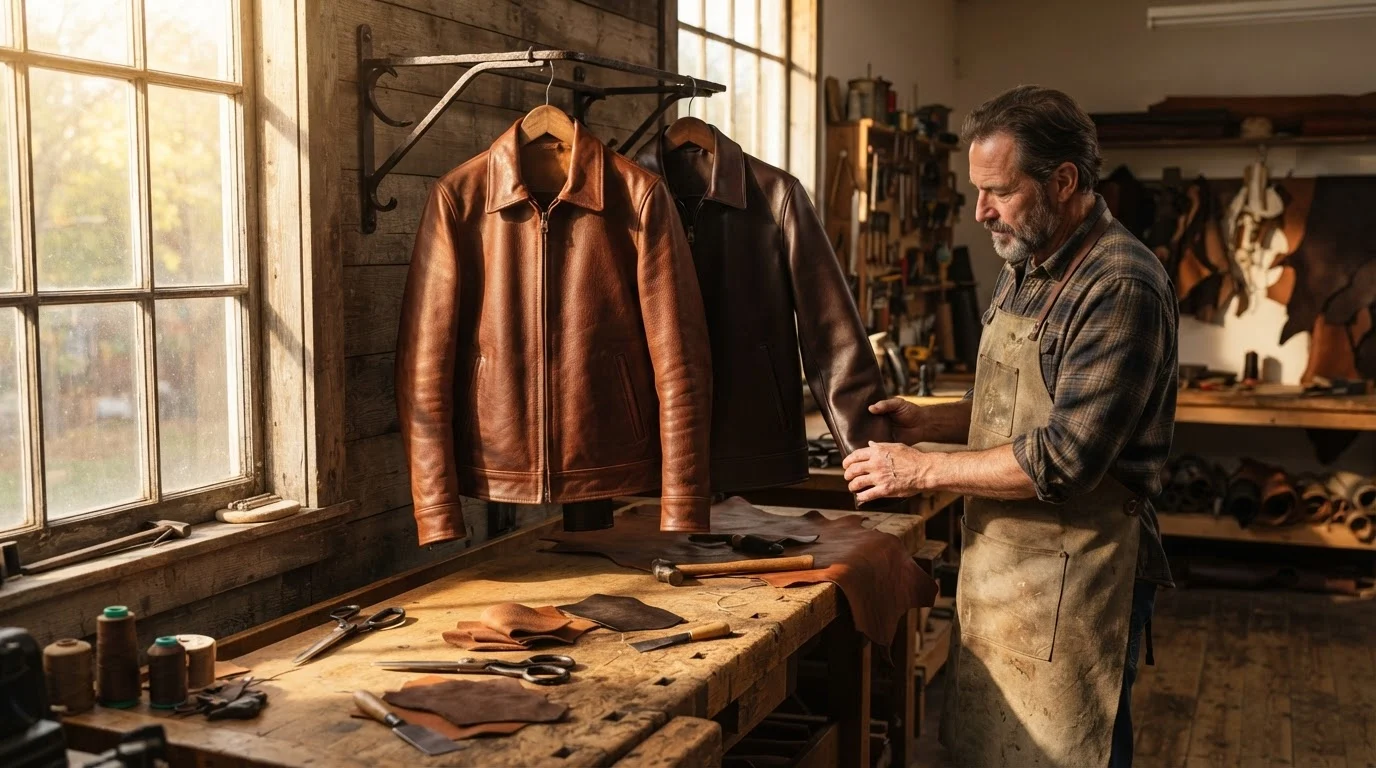
Is a Vintage Vanson Leather Jacket Still Worth Buying in 2026? Modern Value and Alternative Guide
Key Takeaways
- Evaluating a pre-owned Vanson leather motorcycle jacket requires understanding the extreme physical density of 3.5oz competition steerhide and the multi-season commitment demanded to break it in.
- Archival track garments engineered in Massachusetts feature severe forward-rotated sleeve geometry and short torso drops that feel restrictive during pedestrian streetwear use.
- Essential pre-purchase checks include inspecting heavy brass #10 Streamline zipper boxes, examining underarm expansion gussets for seam shear, and testing for dry-rot stiffness.
- Second-hand restoration expenses—including leather de-salting, specialized lining repair, and heavy zipper re-setting—routinely add $275 to $500 to initial auction purchase prices.
- Discerning motorcycle racers and leather enthusiasts desiring uncompromised abrasion resistance paired with bespoke anatomic patterning increasingly commission handcrafted custom leather alternatives.
Artisan Independence & Trademark Notice: Lux Wearz is an independent bespoke leathercraft atelier. All brand names, logos, and trademarks mentioned in this article (including VANSON LEATHER® and related trademarks) belong exclusively to their respective trademark holders. Lux Wearz is not an authorized distributor, licensee, or affiliated partner of these brands. All brand references and historical retrospectives are made strictly for educational, comparative, and sizing review purposes under Fair Use. Lux Wearz specializes in custom-tailored, heirloom-grade genuine leather outerwear handcrafted individually in our private workshop.
Is a Vintage Vanson Leather Jacket Still Worth Buying in 2026?
A vintage Vanson leather jacket is worth buying in 2026 if the competition-weight steerhide retains its natural internal oils, the heavy Streamline brass zippers operate smoothly, and the aggressive track-oriented cut matches your riding posture. However, notorious sizing stiffness, costly restoration requirements, and non-CE armor obsolescence make bespoke custom handcrafted leather alternatives a superior choice for tailored everyday comfort.
Among dedicated motorcycle road racers, flat-track competitors, and vintage apparel collectors, few names command the respect associated with Boston and Fall River, Massachusetts leather manufacturing. For five decades, competition-weight leather outerwear was constructed under uncompromising industrial specifications: heavy 3.5-ounce to 4.0-ounce full-grain steerhide, double-layered leather impact zones, reinforced underarm gussets, and heavy industrial brass hardware. Yet in 2026, the second-hand market presents prospective buyers with complex technical trade-offs.
Acquiring an archival road racing jacket is entirely different from buying casual vintage apparel. Competition steerhide behaves like armor plating when new, requiring hundreds of hours in the saddle before it yields to the rider's personal anatomy. When purchasing a vintage piece that has molded to someone else's physical frame over twenty or thirty years, the jacket resists your unique proportions. Furthermore, the effects of decades of road grit, sweat salt accumulation, and storage in non-climate-controlled garages can compromise hidden internal fibers. Dissecting the engineering realities behind these iconic garments is essential before investing your hard-earned funds.
Historical Heritage & Archival Silhouettes: Massachusetts Competition Craftsmanship
The origins of American road racing outerwear trace a rich trajectory through New England's textile and leathercraft manufacturing corridor. Founded in the mid-1970s during an era when motorcycling was rapidly evolving from counter-culture leisure to professional closed-circuit motorsport, competition leather manufacturing established new performance standards. While mass-market apparel producers gravitated toward lighter, fashion-grade skins, Massachusetts artisans doubled down on heavyweight domestic steerhide specifically tanned to survive high-speed asphalt slides.
Throughout the 1980s and 1990s, competition track suits and sport-rider jackets dominated American road racing circuits, AMA Superbike paddocks, and flat-track ovals. Riders relied on battle-tested designs such as the Cobra, Model B, and Starlet silhouettes to protect against severe frictional heat during crashes. Every pattern was drafted with utilitarian focus: full-torso ventilation ports, kidney protection extensions, snapped mandarin collars to prevent helmet strap interference, and heavy brass zippers engineered not to burst open under extreme tensile stress.
Municipal police departments across the northeastern United States took note of this extreme durability. Specialized patrol patterns, such as the Boston Police MK2, were commissioned to endure brutal winter patrol duties, daily cruiser abrasion, and firearm holster wear. These jackets utilized dense Firenze cowhide treated with water-resistant surface finishes capable of shedding winter sleet and road grime.
In the collector landscape of 2026, archival Massachusetts jackets occupy a unique tier. They are widely regarded as virtually indestructible garments that outlive their original owners. However, the exact qualities that make them legendary—ultra-heavy hide thickness, stiff leather temper, and severe road-racing ergonomic cuts—also create profound fit and comfort hurdles for modern buyers who expect immediate flexibility and casual streetwear versatility. Exploring our Men's Leather Jackets collection highlights how heritage protection principles have evolved into sophisticated modern luxury designs.
Silhouette & Fit Architecture: Track Ergonomics vs Street Wearability
Pattern engineering for road racing jackets differs fundamentally from standard street outerwear. When an artisan tailors a competition jacket, the garment is patterned around the "rider tuck"—a forward-crouched posture with hands extended toward low clip-on handlebars and elbows tucked close to the ribs. The sleeves are rotated forward at a pronounced angle, and the front torso is cut intentionally short to prevent the waistband from bunching up against the fuel tank at high speeds.
When a modern buyer attempts to wear an authentic vintage racing jacket for casual pedestrian walking, the jacket can feel awkward and uncomfortable. With arms resting naturally at the sides, forward-rotated sleeves cause excess leather to buckle across the front chest and armpits. Furthermore, the short front waist leaves the rider's belt exposed, while the extra-long rear kidney drop panel hangs low over the hips.
Understanding the difference between track silhouettes, patrol jackets, and casual flight styles is essential to selecting a garment that fits your daily lifestyle. Our comprehensive Size Guide outlines precise measurement techniques for determining your shoulder width, chest circumference, and torso drop.
| Silhouette Model | Cut & Fit Type | Shoulder / Chest Offset | Ideal Body Profile | Leather Weight & Temper |
|---|---|---|---|---|
| Cobra MK2 SportRider | Aggressive Track Tuck Contour | +2.0 to +3.0 inches chest ease; severe forward sleeve rotation | Athletic, lean upper torsos; dedicated sportbike ergonomics | 3.5–4.0 oz Competition Steerhide; ultra-stiff armor temper |
| Boston Police MK2 Patrol | Straight-Cut Tactical Duty Fit | +4.0 to +5.5 inches chest ease; bi-swing pleated back | Broad shoulders; designed to layer over body armor & duty belts | 3.2–3.6 oz Firenze Cowhide; medium-firm water-resistant temper |
| Flying Fortress B-3 Flight | Heavy Shearling Box Bomber | +5.0 to +6.5 inches chest ease; squared shoulder frame | Broad, stocky builds; extreme winter thermal protection | 15–18 mm Natural Sheepskin Shearling; plush, heavy temper |
| Starlet Racer (Women's) | Contoured Cafe Hourglass | +1.5 to +2.5 inches chest ease; tailored waist taper | Athletic female physique; contoured bust and high hip flare | 3.0–3.5 oz Competition Steerhide; firm protective temper |
| Villainess Cruiser (Women's) | Fitted Moto with Waist Gussets | +2.0 to +3.0 inches chest ease; adjustable zip hip flares | Versatile female riders; customizable hip and waist profile | 2.8–3.2 oz Milled Cowhide; supple broken-in temper |
The comparative fit architecture demonstrates why buyers frequently struggle when purchasing vintage racing garments online. A jacket marked "Size 40" in an aggressive track cut like the Cobra fits drastically tighter across the lats and shoulders than a "Size 40" in a relaxed patrol cut like the Boston Police MK2. If your body does not match the exact proportions of the jacket's previous owner, the dense competition leather will press painfully against your collarbones and ribs. For riders seeking uncompromising protection tailored to their individual posture, bespoke tailoring provides the definitive solution. Explore our dedicated Racing Jackets archive for specialized riding silhouettes.
Leather Hide & Hardware Durability Matrix: The Technical Specs
The legendary durability of New England competition outerwear is rooted in material specifications. Unlike commercial mass-market fashion brands that utilize thin 0.8mm splits or corrected-grain hides coated in pigment paint, competition leatherwear historically relied on uncorrected full-grain steerhide. These hides average 1.4mm to 1.7mm in thickness (equivalent to 3.5 to 4.5 ounces per square foot), offering tensile and tear resistance capable of surviving extensive slides across abrasive tarmac.
However, hide thickness alone does not guarantee eternal performance. Over thirty or forty years of exposure, the natural humectant oils inside chrome-tanned steerhide oxidize and dissipate. As moisture evaporates, the dense collagen bundles harden into a rigid state. If worn without meticulous re-hydration, the leather can develop stress fractures across flex zones. Furthermore, vintage competition garments were assembled with heavy industrial brass zippers, solid nickel buckles, and high-tensile threads that demand specialized maintenance.
| Component / Hide | Leather Grade & Tannage | Thickness (mm) | Weather Resistance | Expected Longevity | Maintenance Needs |
|---|---|---|---|---|---|
| Competition-Weight Steerhide | Full-Grain Chrome-Tanned Steer | 1.4 – 1.7 mm (3.5–4.2 oz) | Outstanding wind defense; high water resistance when waxed | 40–60 Years (near-indestructible hide core) | Intensive annual lipid replenishment; deep massage conditioning |
| Firenze Semi-Aniline Cowhide | Top-Grain Vegetable/Mineral Re-tan | 1.2 – 1.4 mm (3.0–3.5 oz) | High; factory protective wax topcoat repels road spray | 30–45 Years (suppler hand-feel than steerhide) | Semi-annual conditioning with natural beeswax balms |
| Heavy Mouton Wool Sheepskin | Full Natural Fleece with Suede Finish | 15.0 – 20.0 mm fleece depth | Superior thermal barrier; susceptible to waterlogging | 25–35 Years (fleece shedding in high-friction cuffs) | Professional furrier cleaning; avoid synthetic sprays |
| Industrial Brass #10 Zipper | Solid Cast Brass on Cotton/Poly Tape | Heavy #10 Gauge Track | Extreme tensile strength; immune to slider blowout | 30–50 Years (tape edge fraying is primary failure) | Regular paraffin wax lubrication; clean teeth with brass brush |
| Antiqued Nickel Streamline Zips | Plated Solid Brass Streamline Profile | Gauge #8 and #10 | High mechanical endurance; corrosion resistant | 25–40 Years of active track deployment | Annual graphite powder application; clear road grit |
| Bonded Nylon Structural Stitching | Heavy Gauge v92 / v138 Filament | 0.32 mm – 0.38 mm | Immune to rot, battery acid, fuel mist, and sweat salts | Indefinite; will not degrade or rot over decades | Zero maintenance required; inspect seam tension periodically |
As highlighted in the matrix, the primary structural failure point in archival racing jackets is rarely the hide itself—it is the zipper fabric tape and the interior cotton lining. While heavy #10 brass teeth remain indestructible, decades of upward strain cause the fabric tape at the starter box to fray. Once the tape separates, the slider jams, and replacing an industrial zipper through four plies of 4oz steerhide requires industrial sewing machinery capable of piercing nearly half an inch of solid leather. Learn proper conditioning protocols in our Leather Care Guide.
Pre-Owned Inspection Checklist & Common Vintage Flaws
Before finalizing a bid or purchasing a pre-owned competition leather jacket from an estate sale or vintage dealer, conduct a thorough five-point inspection. Because competition jackets were built for high-speed riding, many vintage examples have survived crashes, low-side slides, or harsh environmental neglect that may not be apparent in low-resolution photos:
1. The Pliant Bend Test & Leather "Boardiness"
Archival steerhide that has spent decades hanging in a dry attic or unheated shed often suffers from extreme "boardiness"—a state where the hide becomes as rigid as plywood. To assess the hide's health, take the forearm or kidney panel and bend it into a 90-degree curve. If the leather resists bending, emits a brittle crackling sound, or develops a network of micro-fractures along the surface finish, the internal moisture has evaporated. Extreme boardiness can occasionally be mitigated with repeated warm oil treatments, but if fibers have already fractured, structural integrity is lost.
2. Salt Crystallization and Liner Staining
Track and police patrol jackets endure massive amounts of rider perspiration. As sweat evaporates through the lining, body salts penetrate deep into the inner flesh side of the steerhide. Over time, these mineral salts crystallize within the collagen fibers, acting like microscopic glass shards that saw through the hide fibrils whenever the leather flexes. Inspect the interior armpits and neckline for white crusty deposits or stiff, crunchy leather. Salt-saturated leather requires specialized chemical desalting baths to prevent permanent rotting.
3. Crash Abrasion vs Natural Wear Patina
Differentiate between desirable cosmetic patina and structural crash damage. Natural patina consists of gentle fading along seam edges, subtle surface scuffs, and soft leather softening at the elbows. Crash damage, conversely, involves deep gouges that penetrate through the grain into the fibrous corium layer, melted nylon stitching from high-speed friction, or missing zipper pull tabs ground down by asphalt. A jacket with compromised structural seams in the shoulder or forearm will not protect you in a subsequent fall.
4. Pocket Lining Rot and Foam Pad Crumbling
Unzip every exterior pocket and reach deep into the lining bags. Vintage jackets frequently utilized rayon, acetate, or thin cotton twill for interior pockets, which tear easily under the weight of keys or pocket knives. Furthermore, if the jacket features interior kidney padding or quilted elbow insulation, squeeze the panels between your fingers. Vintage open-cell foam degrades into a sticky, tar-like sludge or crumbles into fine, toxic dust that sifts through the lining seams. Remediating disintegrated internal padding requires unpicking the entire jacket lining.
5. Zipper Starter Pin and Retaining Box Wear
Pay intense attention to the bottom two inches of the main front zipper. Because competition jackets utilize stiff, heavy leather, riders must pull firmly to align the zipper tracks. This force places severe shearing stress on the fabric tape immediately adjacent to the insertion pin and retaining box. If the fabric tape has developed even a 2-millimeter tear, the slider will jam or slip off the track. Replacing a heavy-gauge zipper in 3.5oz steerhide requires a professional leather artisan with a heavy-duty compound-feed sewing machine.
Economic Analysis: Vintage Restoration Costs vs Handcrafted Bespoke Value
Prospective buyers often assume that purchasing a vintage competition jacket on an online auction platform for $350 represents substantial savings compared to modern bespoke outerwear. However, vintage competition jackets almost always require extensive professional servicing before they become comfortable, hygienic, and road-ready.
Let us examine the realistic financial expenses involved in restoring an archival competition jacket:
- Complete professional leather cleaning, anti-fungal treatment, and deep sweat-salt extraction: $110 to $175.
- Multi-stage leather rehydration, lanolin replenishment, and hand-buffing: $75 to $110.
- Replacing an industrial #10 brass main zipper through heavy steerhide facing: $125 to $185.
- Replacing wrist cuff and pocket zippers (set of 3 or 4): $95 to $150.
- Stripping out rotted vintage lining and custom-tailoring a brand-new silken polyester or quilted lining: $180 to $260.
- Restitching blown shoulder or underarm stress seams with bonded nylon thread: $85 to $130.
When these restoration costs are combined with the initial $350 purchase price, the total investment quickly escalates to $1,020 to $1,360. In exchange for this significant outlay, the owner still possesses a jacket with historical wear patterns, potential sizing compromises across the shoulders and chest, and rigid leather that may require years to break in.
By contrast, commissioning a bespoke custom jacket from Lux Wearz allows you to enjoy virgin, hand-selected full-grain cowhide, customized sleeve articulation tailored to your handlebar reach, modern breathable linings with integrated CE-rated armor pockets, and zero prior wear history—all crafted to your exact anatomical specifications. Explore our entire outerwear catalog at the View All Products collection.
Featured Silhouette Retrospective & Curated Collection
To demonstrate how classic Massachusetts track and patrol styling translates into functional modern outerwear, we examine five iconic silhouettes currently available in the Lux Wearz curated inventory. Each design represents a masterclass in heavy-duty leathercraft, marrying archival protection with refined construction:
1. Vanson Leather Cobra MK2 SportRider Men's Leather Sport Motorcycle Jacket
The Vanson Leather Cobra MK2 SportRider Men's Leather Sport Motorcycle Jacket represents the pinnacle of American closed-circuit road racing engineering. Built from competition-weight black steerhide, the Cobra MK2 is patterned with an aggressive sport-riding silhouette that hugs the rider's torso to eliminate high-speed wind drag. Dual front zipper vents, zippered sleeve cuffs, and an articulated action-back provide exceptional climate control and shoulder mobility. Solid brass hardware and an adjustable waist belt ensure a snug, road-tested fit for high-performance riding.
2. Vanson Leather Boston Police MK2 Men's Leather Police-Style Jacket
Engineered for tactical municipal enforcement, the Vanson Leather Boston Police MK2 Men's Leather Police-Style Jacket translates utilitarian civil service requirements into an enduring street classic. Featuring heavy-duty Firenze leather that resists harsh winter moisture and road grime, this jacket incorporates bi-swing shoulder pleats for unrestricted arm extension, zippered side equipment vents, and a clean point collar. Its straight-drop torso provides ample room for layering over sweaters while projecting commanding heritage authority.
3. Vanson Leather Flying Fortress Crew Men's Sheepskin Flight Jacket
When sub-zero temperatures demand ultimate thermal defense, the Vanson Leather Flying Fortress Crew Men's Sheepskin Flight Jacket delivers unmatched cold-weather luxury. Crafted from thick, plush natural brown sheepskin shearling with a rugged nappa leather exterior finish, this B-3 inspired flight jacket features dual leather throat-latch straps, heavy-duty waist cinch belts, and shearling-lined storm cuffs. It effortlessly bridges archival WWII flight-deck heritage with modern cold-weather motorcycle touring.
4. Vanson Leather Starlet Women's Leather Jacket
A legendary design tailored specifically for female riders, the Vanson Leather Starlet Women's Leather Jacket combines striking black and red competition-weight steerhide with an hourglass racing cut. Patterned with an anatomical bust and tapered waist, the Starlet provides track-level abrasion defense without sacrificing feminine styling. Heavy brass zippers, a snap-tab racing collar, and padded kidney support make this jacket an enduring favorite among vintage enthusiasts and modern cafe-racer riders alike.
5. Vanson Leather Villainess Women's Leather Motorcycle Jacket
Balancing cafe-racer minimalism with customizable comfort, the Vanson Leather Villainess Women's Leather Motorcycle Jacket features dual zippered waist gussets that allow riders to adjust hip flare whether seated on a motorcycle or standing casually. Constructed from premium supple cowhide, the Villainess minimizes break-in time while providing dependable abrasion defense. Sleek lines, discreet pocket placement, and a clean mandarin collar make it an exceptionally versatile crossover piece. Discover the complete range across the Vanson Leather Outerwear Collection.
The Bespoke Handcrafted Custom Tailoring Alternative
While archival racing jackets hold undeniable historical appeal, contemporary riders increasingly demand outerwear that accommodates their personal body shape without enduring an agonizing multi-year break-in period. At Lux Wearz, our bespoke leathercraft atelier bridges the gap between legendary track-level abrasion protection and luxurious modern ergonomics.
When you commission a custom jacket through Lux Wearz, every stage of construction is personalized to your specifications:
- Virgin Full-Grain Leather Selection: We select virgin 1.3mm to 1.4mm full-grain naked cowhide and supple lambskin from artisan tanneries. These hides preserve the complete natural epidermal grain structure, providing extraordinary tear strength while remaining pliable and comfortable from day one.
- Rot-Resistant Structural Joinery: While vintage garments often suffer from degraded poly-cotton threads, our atelier stitches all structural load points using continuous-filament bonded nylon thread (size v92 and v138). These threads are impervious to moisture, road salt, engine oil, and UV degradation.
- Heavy Industrial Hardware: We fit custom garments with genuine heavy-gauge solid brass and antiqued nickel YKK zippers with reinforced polyester tape, ensuring smooth, snag-free slider action across tens of thousands of cycles.
- Anatomical Made-to-Measure Patterning: Whether you require extra room across the chest, specific armhole depth, customized sleeve lengths, or dedicated pockets for modern CE Level 2 armor inserts, our master pattern makers draft a custom pattern unique to your anatomy.
To begin your bespoke journey and create an heirloom-grade leather riding jacket crafted to your personal measurements, visit the Lux Wearz Custom Order atelier portal.
Strategic Decision Matrix: Which Path Should You Choose?
To assist you in making an informed purchasing choice, review our strategic decision matrix outlining four common buyer profiles:
1. The Archival Track Memorabilia Collector
- Profile: You are an avid collector of American motorsport history seeking an authentic competition suit or racing jacket from a historic racing season.
- Best Choice: Buy Vintage. Prioritize original manufacturer labels, intact factory brass zippers, and verified racing provenance. Accept that the garment may serve best as a display piece or vintage show exhibit.
- Investment: $400 to $1,500+ depending on provenance.
2. The Thrifty Project Restorer
- Profile: You enjoy hands-on leathercraft rehabilitation and are willing to invest time cleaning, rehydrating, and restitching a pre-owned bargain find.
- Best Choice: Buy Vintage Project. Ensure the competition steerhide has not suffered irreversible dry-rot cracks. Budget at least $250 to $400 for replacement zippers, seam restitching, and professional chemical cleaning.
- Investment: $250 initial purchase + $300 restoration = $550 total investment.
3. The Daily Commuter & Highway Sport Rider
- Best Choice: Choose Curated Inventory or Custom Bespoke. A curated modern jacket such as the Cobra MK2 SportRider or Boston Police MK2 provides proven protection without the hidden hazards of rotten seam threads or stiffened hide.
- Investment: $685 to $1,099 for curated pieces.
4. The Connoisseur of Perfect Ergonomic Fit
- Best Choice: Commission Bespoke Handcrafted Leathercraft. When standard sizing charts fail to match your chest-to-waist ratio or arm length, custom tailoring through Lux Wearz Custom Order guarantees a flawless fit, virgin premium hides, and decades of reliable performance.
- Investment: $595 to $950 for full bespoke tailor construction.
Seasonal Care Protocols for Heavyweight Competition Leather
Preserving heavy-gauge competition steerhide and fine cowhide requires adherence to proven seasonal maintenance protocols. Dense leather requires disciplined care to maintain moisture balance and prevent fiber stiffening:
- Post-Ride Dust & Road Film Removal: Following highway rides, wipe exterior leather surfaces with a microfiber cloth dampened with clean lukewarm water. Avoid household cleaners or alcohol wipes, which dissolve essential tanning waxes.
- Deep Bi-Annual Moisture Replenishment: Heavy steerhide requires deep-penetrating conditioning twice a year. Use rich lanolin or beeswax-based leather balms. Warm the leather slightly with a gentle breeze of warm air, apply the conditioner with a soft applicator sponge, and allow it to absorb for 24 hours before buffing off excess oils.
- Drying Wet Leather Naturally: If caught in heavy rain, allow the jacket to air-dry naturally on a wide, contoured wooden hanger in a well-ventilated room. Never expose wet leather to direct radiators, fireplaces, or space heaters, as rapid heat causes the collagen fibers to contract and turn brittle.
- Heavy Brass Zipper Maintenance: Inspect heavy-gauge #10 brass zipper tracks regularly for accumulated dirt. Brush the teeth with a soft nylon or brass brush, then lubricate the tracks with paraffin wax or beeswax to ensure effortless slider glide.
- Breathable Garment Storage: Hang your jacket inside a breathable cotton or canvas garment bag in a dry, temperate closet. Never store heavyweight leather outerwear in damp basements or sealed plastic bags that trap moisture and foster mildew growth.
Final Verdict & Buyer Recommendations
The secondary market for vintage competition leather jackets offers undeniable historical appeal, but navigating it successfully requires material diligence and realistic financial planning. While legendary Fall River craftsmanship produced some of the toughest outerwear in American history, the natural realities of dried collagen fibers, worn zipper starter pins, deteriorated pocket linings, and aggressive track-tuck sizing can turn a bargain into an expensive restoration headache.
For riders who appreciate New England racing heritage but demand immediate road-readiness, curated inventory models such as the Vanson Leather Cobra MK2 SportRider and the Vanson Leather Boston Police MK2 deliver peerless quality. And for riders who demand perfection in every stitch, personalized shoulder articulation, and virgin full-grain hides built to exact body measurements, bespoke custom tailoring from Lux Wearz stands in a class of its own.
Explore the complete Vanson Leather Outerwear Collection, consult our Size Guide, review proper preservation techniques in our Leather Care Guide, and commission your custom-tailored riding jacket today through the Lux Wearz Custom Order atelier.
Explore The Full 2026 Leather Outerwear Collection
Vegetable-tanned full-grain cowhide, buttery New Zealand lambskin, and heritage Melton wool. Free express delivery across the USA with 30-day hassle-free returns.