
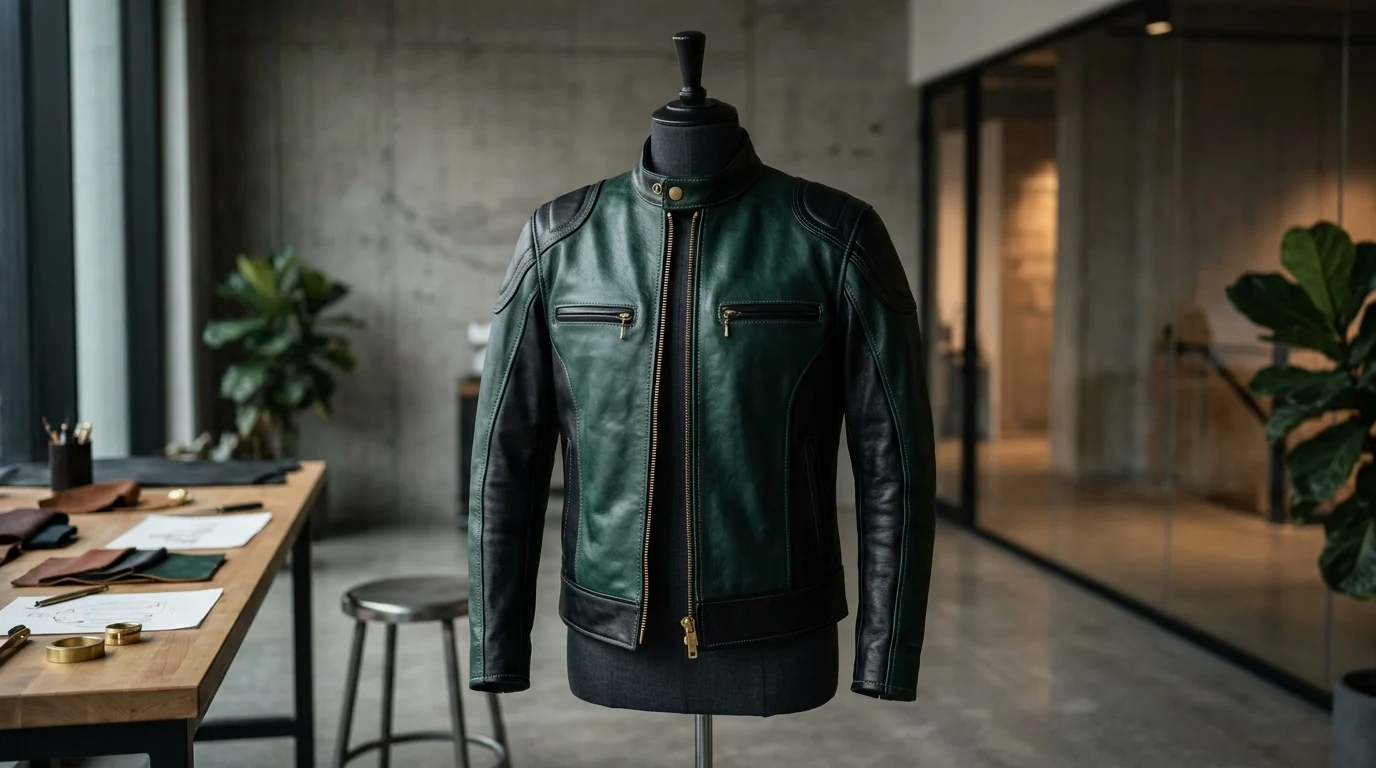
Kawasaki Leather Jackets vs Bespoke Custom Leather: Durability, Grain, and Craftsmanship Comparison
Compare Kawasaki motorcycle leather jackets vs bespoke custom leather. Discover hide thickness, bonded nylon stitching, CE armor, and bespoke tailoring specs.
Key Takeaways
- Commercial motorcycle racing apparel and production graphic leather jackets prioritize lightweight flexibility (1.1 to 1.3 mm split or corrected cowhide) and bold sponsor styling, whereas bespoke artisanal leather jackets emphasize virgin 1.3 to 1.5 mm full-grain cowhide engineered for maximum slide abrasion resistance and lifetime durability.
- High-stress impact zones on track-ready motorcycle garments require double- and triple-needle safety stitching with bonded nylon thread (size v69 or v92) to prevent seam blowout under friction heat, a structural specification standard in bespoke atelier construction but variable across commercial replicas.
- Off-the-rack racing jackets enforce aggressive pre-curved forward-rotated sleeve geometry designed specifically for sportbike clip-on posture, frequently causing uncomfortable shoulder pull, chest bunching, and wrist binding when worn casually off the bike.
- Bespoke custom tailoring bridges the divide between motorsport impact protection and street luxury by drafting individual paper patterns that accommodate internal CE Level 2 armor pockets without sacrificing an elegant, tailored silhouette.
- Long-term hide longevity hinges on tannage chemistry: drum-dyed vegetable and chrome-combination tanneries preserve natural grain collagen fibers for over thirty years of active road duty, outperforming synthetic surface-pigmented garments that crack over time.
Artisan Independence & Trademark Notice: Lux Wearz is an independent bespoke leathercraft atelier. All brand names, logos, and trademarks mentioned in this article (including Kawasaki® and related trademarks) belong exclusively to their respective trademark holders. Lux Wearz is not an authorized distributor, licensee, or affiliated partner of these brands. All brand references and historical retrospectives are made strictly for educational, comparative, and sizing review purposes under Fair Use. Lux Wearz specializes in custom-tailored, heirloom-grade genuine leather outerwear handcrafted individually in our private workshop.
Kawasaki Leather Jackets vs Bespoke Custom Leather: Which Offers Superior Durability and Value?
Kawasaki-inspired graphic leather motorcycle jackets deliver authentic superbike paddock aesthetics, bold team colorways, and lightweight riding utility, but bespoke custom leather jackets provide superior structural longevity, thicker virgin full-grain cowhide hides, and exact anatomical tailoring. For riders and enthusiasts prioritizing slide-abrasion resistance, repairable solid brass hardware, and lifetime durability without uncomfortable off-the-rack sizing compromises, bespoke handcrafted leather outerwear represents the superior long-term investment.
Motorcycle leather outerwear occupies a unique intersection within the broader fashion and protective apparel landscapes. Unlike civilian fashion bombers or lightweight urban jackets, riding outerwear must withstand intense mechanical stresses, atmospheric road grime, wind buffet shear, and the catastrophic friction heat generated during an asphalt slide. In recent years, vibrant graphic motorcycle jackets inspired by iconic Japanese sportbikes—most notably the razor-sharp Kawasaki Ninja and World Superbike championship platforms—have transcended track paddocks to become dominant high-visibility fashion statements.
However, prospective buyers frequently find themselves torn between purchasing commercial branded or replica graphic riding jackets and commissioning a bespoke made-to-measure leather jacket from an independent bespoke atelier. To make an informed sartorial and technical decision, one must dissect the engineering differences separating mass-produced motorcycle gear from custom handcrafted leathercraft across leather hide grade, seam construction, ergonomic fit architecture, and long-term repairability.
The Evolution of Japanese Superbike Paddock Styling
To appreciate the design philosophy underpinning Kawasaki-styled outerwear, one must examine the fierce competitive heritage of Japanese motorsport. Throughout the 1980s and 1990s, the battle for superbike supremacy produced legendary racing machinery, culminating in the iconic lime-green, white, and black racing liveries that dominated endurance championships and AMA Superbike series worldwide.
Motorcycle racing outerwear of that golden era was characterized by thick, hand-cut cowhide panels, high-contrast geometric blocking, oversized corporate sponsor badging, and heavy-duty accordion flex ribs. The aesthetic was unapologetically aggressive, engineered to maximize sponsor visibility on television broadcasts while providing riders with a second skin capable of surviving 150-mph spills.
As sportbike culture exploded into the mainstream during the 2000s and 2010s, these competition garments inspired a massive secondary market of civilian riding jackets and graphic streetwear pieces. Riders sought out jackets bearing the distinctive Ninja typography, H2 aerodynamic tributes, and vibrant color-blocked chest shields to match their high-performance machinery. Simultaneously, urban streetwear tastemakers recognized that the structural bulk, vivid contrasting leather inlays, and armored contours of motorcycle racing jackets provided an unmatched visual edge on the street.
Yet commercial mass production inevitably introduces compromises. To achieve accessible price points and meet mass-retail margins, factory-produced graphic jackets frequently substitute full-grain leather with corrected-grain splits, employ lightweight decorative stitching rather than structural safety seams, and utilize plastic or zinc-alloy zippers prone to tooth breakage. Discerning riders and collectors must understand how these manufacturing trade-offs affect real-world durability.
Silhouette and Ergonomic Fit Architecture: Track Posture vs Everyday Wear
The most pronounced difference between commercial racing outerwear and bespoke custom jackets lies in the underlying pattern drafting geometry.
Off-the-rack motorcycle racing jackets are cut specifically for aggressive track ergonomics. They feature forward-rotated shoulder sockets, severe pre-curved sleeves angled at roughly 45 to 60 degrees, an abbreviated front torso that terminates high above the belt buckle to prevent tank bunching, and an extended drop-tail kidney protector designed to cover the lower back in a full racing tuck.
While this architecture performs brilliantly when your hands are gripping low clip-on handlebars and your torso is pinned against a fuel tank, it creates acute discomfort when standing, walking, or sitting normally. The forward-rotated sleeve cut pulls uncomfortably across the upper back and shoulder blades, the high front waistband rides up awkwardly when upright, and the rigid elbow armor pockets restrict natural arm extension.
Bespoke custom leathercraft eliminates this fundamental ergonomic conflict. By drafting a customized pattern based on your exact body measurements and intended usage profile, an artisan atelier can engineer a versatile posture balance: providing subtle armhole ease and bi-swing back expansion for motorcycle operation while maintaining clean vertical drape and natural shoulder placement when off the bike.
| Silhouette Model | Cut & Fit Type | Shoulder / Chest Offset | Ideal Body Profile | Leather Weight & Temper |
|---|---|---|---|---|
| Factory One-Piece Racing Suit | Extreme Aggressive Race Tuck | -1 to +1 Inch (Skin-Tight) | Slender Athletic Track Rider | 1.3 – 1.4 mm Bovine, Stiff Temper |
| Graphic Track-Style Biker Jacket | Pre-Curved Sportbike Stance | +2 to +4 Inches Chest Ease | Lean to Muscular Rider Frame | 1.1 – 1.3 mm Cowhide, Medium Temper |
| Heritage Biker Riding Jacket | Classic American Touring Cut | +4 to +6 Inches Chest Ease | Broad Shoulders, Upright Posture | 1.3 – 1.5 mm Steerhide, Heavy Temper |
| Modern Bespoke Hybrid Moto | Anatomical Multi-Posture Fit | +3 to +4.5 Inches Chest Ease | Custom Drafted to User Frame | 1.2 – 1.4 mm Full-Grain, Supple Temper |
| Minimalist Urban Moto Bomber | Relaxed Casual Streetwear | +4 to +6 Inches Chest Ease | Universal Silhouette Profile | 1.1 – 1.3 mm Nappa / Cowhide, Soft Temper |
To achieve the optimal balance between riding comfort and casual wearability, proper dimensional measurement is paramount. Review our comprehensive leather jacket sizing guide to learn how shoulder slope, chest circumference, and sleeve reach dictate pattern performance.
Leather Hide Durability and Hardware Metallurgy Matrix
When evaluating leather durability, the superficial appearance of the surface finish is secondary to the underlying fiber density of the hide. True full-grain leather incorporates the uppermost layer of the animal skin—the epidermis—where collagen protein fibers are most densely interwoven by nature. This dense fiber network provides the hide with its extraordinary tensile strength, puncture resistance, and natural water repellency.
In contrast, commercial graphic jackets often utilize "top-grain" or split cowhide that has been mechanically sanded or split to remove natural surface scars, then coated with an opaque polyurethane or pigmented finish and stamped with an artificial pebble grain. While this process creates a uniform cosmetic finish, it eliminates the strongest structural layer of the hide, making the leather prone to surface micro-cracking, peeling, and rapid fiber degradation when subjected to road moisture and friction heat.
Review the comprehensive material comparison matrix below to examine how commercial racing hides compare against virgin full-grain artisan leather.
| Component / Hide | Leather Grade & Tannage | Thickness (mm) | Weather Resistance | Expected Longevity | Maintenance Needs |
|---|---|---|---|---|---|
| Commercial Graphic Cowhide | Corrected-Grain Pigmented Split | 1.1 – 1.2 mm | Moderate (Synthetic Topcoat) | 5–8 Years (Coating Cracking Risk) | Gentle Water Wipe, Avoid Solvents |
| Premium Track-Spec Bovine | Full-Grain Drum-Dyed Chrome | 1.3 – 1.4 mm | High (Durable Water Repellent) | 15–20 Years (Track Abrasion Spec) | Semi-Annual Conditioner Balm |
| Virgin Bespoke Full-Grain | Drum-Dyed Vegetable/Chrome | 1.3 – 1.5 mm | Superior (Dense Natural Oils) | 35+ Years (Develops Rich Patina) | Annual Light Leather Milk |
| Supple Lambskin Nappa | Aniline Dyed Full-Grain | 0.8 – 1.0 mm | Low (Absorbent Soft Surface) | 10–12 Years (Not for Crash Duty) | Frequent Fluorocarbon Protection |
| Track Safety Seam Stitching | Multi-Pass Bonded Nylon v92 | Dual / Triple | Very High (Thermal Heat Proof) | 30+ Years (Impervious to Rot) | Inspect for Surface Scuffing |
| Heavy Antiqued Brass Zippers | Solid Cast Brass #8 / #10 | 8.5 mm Width | Superior (Zero Rust Oxidation) | Lifetime (50+ Years Operation) | Occasional Beeswax Lubricant |
In a high-speed slide, asphalt friction generates surface temperatures exceeding 300 degrees Fahrenheit within fractions of a second. Low-grade synthetic threads melt, causing seams to burst open instantly. This is why bespoke motorcycle outerwear exclusively utilizes bonded nylon thread size v92 or v138, which retains tensile strength up to 450 degrees Fahrenheit, ensuring that protective leather panels remain locked together during impact.
The Seam Construction Divide: Safety Stitches vs Decorative Topstitching
The true hallmark of superior motorcycle leathercraft is invisible from five paces: it resides within the internal construction of load-bearing seams.
In standard retail outerwear and low-cost motorcycle replicas, panels are frequently joined with a simple single-needle chain stitch or standard lock stitch, followed by an external decorative topstitch. If the exposed outer thread is abraded against asphalt, the entire seam unravels, exposing the rider's skin directly to the road surface.
Professional track-standard and bespoke atelier construction enforces a strict multi-layer safety seam protocol:
- Hidden Structural Seam: Two leather panels are placed face-to-face and joined with a high-tension lock stitch using bonded nylon thread. This seam remains entirely recessed inside the garment, completely shielded from exterior friction abrasion.
- Folded Interlock Buffer: One edge of the leather seam allowance is folded over to create a dual-thickness barrier.
- Twin Topstitch Reinforcement: Two parallel rows of topstitching are sewn through both layers, locking the seam allowance flat against the garment body.
Even if a catastrophic crash grinds away the external topstitches, the hidden internal structural seam remains intact, preserving garment integrity. Furthermore, critical impact zones across the shoulders, elbows, and lower back must feature internal leather underlays to double the puncture threshold.
Tensile Tensometer Testing and Thread Metallurgy Under Dynamic Friction Heat
To truly appreciate motorcycle seam engineering, one must consider the extreme physics of a high-speed tarmac incident. Under ASTM D204 testing methodologies for industrial sewing threads, standard civilian polyester thread yields at roughly 8 to 11 pounds of breaking force per single strand, with a thermal degradation point around 380 degrees Fahrenheit. When an asphalt slide generates immediate kinetic friction, unbonded polyester threads soften, lose structural rigidity, and separate within milliseconds.
In contrast, the industrial bonded nylon size v92 and v138 threads utilized in bespoke motorcycle outerwear boast a minimum tensile strength of 15 to 22 pounds per strand, coupled with a heat-deflection threshold exceeding 460 degrees Fahrenheit. The bonding process coats individual nylon filaments with a specialized liquid resin, curing them into a monolithic strand that resists untwisting under multi-directional high-speed needle friction. Furthermore, the thread's high elasticity (26 to 32 percent elongation before failure) allows the seam to stretch during violent impact deceleration rather than shearing through the hide's stitch perforations.
Aerodynamic Speed Hump Engineering and Cervical Impact Management
Another notable feature pioneered by competitive superbike platforms is the rear aerodynamic speed hump. Originally introduced in Grand Prix paddocks during the 1990s, the dorsal hump bridges the low-pressure turbulent vortex created behind a racer's helmet in a high-speed crouch. By smoothing airflow over the rider's spine, it reduces aerodynamic drag by up to 7 percent and significantly mitigates helmet buffeting at speeds exceeding 140 mph.
However, modern protective philosophy recognizes an even more vital secondary role: cervical spine stabilization. Engineered with sculpted dual-density expanded polystyrene (EPS) or high-density memory foam encased within full-grain cowhide, the dorsal hump acts as a mechanical wedge that limits dangerous hyperextension of the neck if a rider slides feet-first on their back. In commercial fashion replicas, this complex safety element is frequently reduced to a hollow cosmetic foam wedge. In bespoke atelier construction, clients can specify functional impact-rated cores or choose a streamlined profile optimized for street riding comfort.
Curated Collection: Featured Racing-Style Leather Outerwear at Lux Wearz
For riders and motorcycle enthusiasts seeking dynamic track-inspired styling without sacrificing premium genuine leather construction, Lux Wearz offers a curated selection of motorcycle jackets and racing suits. Each piece is constructed from real bovine leather, reinforced with heavy-duty mechanical hardware, and inspected for structural dependability.
Discover five featured racing-inspired models currently available in the Lux Wearz collection:
1. Kawasaki Graphic Leather Motorcycle Jacket – Black White
Featuring a stark, commanding monochromatic design, the Kawasaki Graphic Leather Motorcycle Jacket – Black White is tailored from genuine drum-dyed black cowhide with high-contrast white leather panel inlays. Engineered for street riders seeking aggressive styling, it incorporates pre-curved sleeves, zippered ventilation vents across the biceps, an adjustable waist strap system, and heavy-duty front zip closure. At $350, it provides genuine leather protection and timeless sportbike presence at an accessible price point.
2. Men’s Kawasaki Ninja H2-Style Leather Jacket – Black Green
Paying homage to the supercharged pinnacle of modern motorcycling, the Men’s Kawasaki Ninja H2-Style Leather Jacket – Black Green pairs deep obsidian black leather with signature racing-green accents. Constructed from 1.2 mm genuine cowhide, this jacket features aerodynamic shoulder sliders, zippered waist gussets, padded kidney and lower back ribbing, and dedicated internal armor pockets for shoulder and elbow inserts. Priced at $350, it delivers head-turning superbike energy on the boulevard or winding backroads.
3. Kawasaki Racing Graphic Leather Jacket – Multicolor
For those who revere the vibrant energy of professional World Superbike racing, the Kawasaki Racing Graphic Leather Jacket – Multicolor delivers an authentic multi-panel team livery. Featuring precision-cut genuine leather sponsor-style color blocking across the chest, shoulders, and sleeves, this jacket incorporates heavy-duty brass hardware, an ergonomic mandarin racing collar with snap closure, and breathable mesh lining. Available for $350, it represents the definitive tribute to competitive road-racing heritage.
4. Kawasaki Ninja Graphic One-Piece Leather Racing Suit – Black
Engineered for closed-circuit track day enthusiasts and high-performance riders, the Kawasaki Ninja Graphic One-Piece Leather Racing Suit – Black provides comprehensive full-body slide protection. Cut from heavy 1.3 mm track-spec bovine leather, this one-piece suit features accordion leather stretch panels across the lower back and knees, aerodynamic speed hump along the upper spine, dual replaceable knee puck sliders, and internal CE impact armor. Priced at $500, it delivers track-grade engineering and unmatched road confidence.
5. Kawasaki Ninja Graphic Leather Jacket – Black Green White
Blending iconic team green highlights with crisp white shoulder contours and jet-black bovine leather, the Kawasaki Ninja Graphic Leather Jacket – Black Green White is a versatile riding essential. It features zippered sleeve cuffs with gussets, dual external hand pockets, an interior security phone pocket, and high-tensile safety stitching throughout. At $350, it combines iconic Japanese sportbike flair with genuine leather road resilience.
To explore all racing-inspired outerwear, browse our specialized racing jackets category, check the dedicated Kawasaki brand catalog filter, or survey our full range of outerwear at all products.
The Bespoke Advantage: Custom Made-to-Measure Outerwear at Lux Wearz
While off-the-rack motorcycle jackets serve standardized physiques, true riding comfort requires individualized tailoring. Every rider possesses distinct physical dimensions: longer arms, broader shoulders, or a narrower torso that off-the-rack sizing matrices simply cannot accommodate without awkward bunching or restrictive pinching.
At Lux Wearz, our private bespoke atelier offers riders and enthusiasts the opportunity to create custom-tailored leather jackets built from raw hides to exact personal specifications:
Hand-Selected Virgin Bovine Full-Grain Hides
We do not use pre-finished commercial leather remnants. Every custom order begins with the selection of virgin full-grain cowhide or steerhide, measured at 1.3 to 1.5 mm thickness. The leather is drum-dyed through its entire cross-section with natural oils, creating a hide that is supple upon arrival yet capable of withstanding intense road abrasion.
Customized Armor Integration
Unlike standard jackets with fixed armor pockets that frequently place elbow guards too high or low on the forearm, bespoke tailoring maps armor pocket locations directly to your anatomical joint centers. We create internal pockets tailored specifically to high-performance D3O, SAS-TEC, or Forcefield CE Level 2 viscoelastic armor, ensuring that protective inserts sit flush against your joints without shifting during a spill.
Tailored Hybrid Posture Drafting
Whether you ride an aggressive sportbike, a comfortable sport-tourer, or an upright naked roadster, our patternmakers adjust sleeve angle and torso drop to match your primary riding ergonomics while ensuring the jacket hangs cleanly when you step off the motorcycle.
Begin your custom bespoke motorcycle jacket design today by scheduling a personal consultation via Lux Wearz custom order.
Motorcycle Leather Maintenance and Road Care Protocol
Motorcycle leather outerwear operates in an extremely harsh environment, regularly bombarded by road grime, bug splatter, exhaust particulates, and rain. Proper routine care ensures your leather maintains its protective strength and supple temper for decades.
- Clean Bug Residue Promptly: Acidic bug matter can chemically etch into leather finishes if left uncleaned. After a long ride, wipe down high-impact chest and shoulder panels using a damp microfiber towel and lukewarm water. Never use harsh household detergents, degreasers, or bleach.
- Dry Naturally Away From Heat: If caught in a heavy downpour, hang your jacket on a wide, contoured wooden hanger in a well-ventilated room at ambient temperature. Never place wet leather near radiators, heaters, or open flames, which will cause the hide to shrink, warp, and harden.
- Re-Hydrate After Heavy Rain: Once completely dry, apply a moderate layer of specialized leather balm or conditioning milk containing natural beeswax and lanolin to replenish lost oils. Follow the expert recommendations outlined in our leather care guide.
- Lubricate Zippers Regularly: Highway dust can cause heavy metal zippers to bind. Apply a small amount of paraffin wax or silicone zipper lubricant along the teeth twice a year to ensure smooth, snag-free slider travel.
- Inspect Safety Stitching Annually: Regularly examine high-stress seams around the shoulder armholes and elbows for frayed threads or popped stitches. Address minor seam wear immediately before it compromises crash protection.
Final Verdict: Commercial Graphic Outerwear vs Bespoke Custom Leather
Making the right choice between a commercial track-style jacket and a bespoke handcrafted leather jacket depends on your operational priorities:
- Choose Commercial Track-Style Jackets If: You seek vibrant paddock team aesthetics, immediate off-the-rack delivery, budget-friendly acquisition pricing ($350 – $500), and casual street style or weekend canyon cruising on a matching sportbike.
- Choose Bespoke Custom Leather If: You demand uncompromising track-grade slide protection, refuse to accept generic off-the-rack sizing compromises, require precision armor placement matched to your anatomy, and desire a one-of-a-kind heirloom garment crafted from virgin full-grain bovine leather with lifetime durability.
Explore our comprehensive range of premium riding apparel in the men's leather jacket collection, or initiate your tailored commission today through our dedicated custom order portal.
Explore The Full 2026 Leather Outerwear Collection
Vegetable-tanned full-grain cowhide, buttery New Zealand lambskin, and heritage Melton wool. Free express delivery across the USA with 30-day hassle-free returns.