
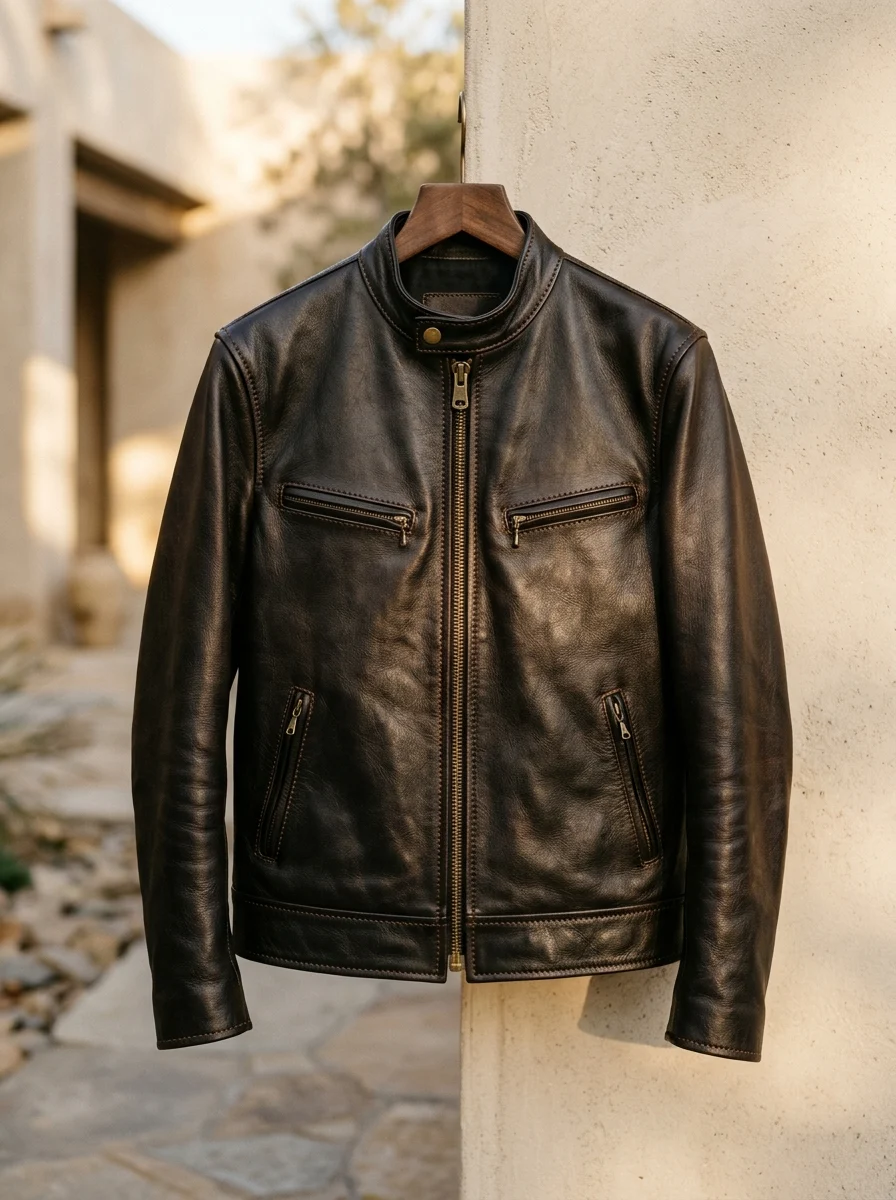
Wilsons Leather Jackets vs Bespoke Custom Leather: Durability, Grain, and Craftsmanship Comparison
Compare Wilsons Leather jackets with bespoke handcrafted leatherwear. Explore hide grades, grain durability, bonded nylon stitching, and custom tailoring.
Key Takeaways
- Leather Tannage & Hide Selection: Vintage and retail Wilsons Leather jackets predominantly utilized corrected-grain cowhide, split suede, or lightweight lambskin treated with pigmented surface acrylics, whereas bespoke atelier leathercraft relies exclusively on uncorrected full-grain steerhide, naked cowhide, or vegetable-tanned lambskin retaining intact epidermal pore structures.
- Tensile Seam Engineering: Mass-production apparel utilizes lightweight commercial polyester threads stitched at high factory speeds, while custom bespoke leather garments employ bonded nylon V-69 or V-92 ticket threads with reinforced dual-needle lockstitching to eliminate seam rupture under torsional strain.
- Hardware Metallurgy: Commercial retail zippers frequently feature cast zinc-alloy or stamped metal slides that fatigue over repeated cycling, compared to bespoke atelier builds engineered with solid extruded brass YKK #8 and #10 antique sliders, hand-peened rivets, and reinforced stop boxes.
- Aging Dynamics & Patina: Polymer-coated corrected leathers develop surface spider-web cracking and finish flaking over extended use, whereas natural full-grain bespoke hides absorb ambient conditioning oils to build an authentic, rich multi-tonal patina across decades.
- Custom Anatomical Tailoring: Bespoke leather outerwear eliminates the compromises of standardized grading scales by drafting individual paper patterns based on precise shoulder slope, bicep circumference, torso drop, and sleeve articulation.
Artisan Independence & Trademark Notice: Lux Wearz is an independent bespoke leathercraft atelier. All brand names, logos, and trademarks mentioned in this article (including Wilsons Leather® and related trademarks) belong exclusively to their respective trademark holders. Lux Wearz is not an authorized distributor, licensee, or affiliated partner of these brands. All brand references and historical retrospectives are made strictly for educational, comparative, and sizing review purposes under Fair Use. Lux Wearz specializes in custom-tailored, heirloom-grade genuine leather outerwear handcrafted individually in our private workshop.
How Does Wilsons Leather Compare to Bespoke Custom Leather in Durability and Hide Quality?
Wilsons Leather garments represent accessible commercial retail outerwear primarily built from lightweight corrected-grain cowhides, embossed split leathers, and soft lambskins engineered for immediate showroom drape, whereas bespoke custom leather outerwear is handcrafted from uncorrected full-grain hides (1.2mm to 1.6mm thickness) with bonded nylon structural stitching and solid brass hardware designed for multi-decade durability and authentic patina development.
When outerwear enthusiasts evaluate leather jackets, the discussion inevitably balances convenience and off-the-rack accessibility against heirloom artisanal construction. For decades, retail chains like Wilsons Leather brought leather jackets into mainstream suburban shopping centers across North America, introducing millions of consumers to cafe racers, flight bombers, and winter trench coats. However, as garments age and collectors examine seam integrity, hide tensile strength, and hardware longevity, the structural distinctions between mass-manufactured retail apparel and bespoke artisanal leathercraft become strikingly apparent.
Understanding these technical differences requires analyzing hide histology, tanning chemistry, thread engineering, and pattern architecture. Outerwear is not merely styled; it is engineered. A jacket built for commercial department stores must satisfy strict retail cost caps and prioritize immediate softness on the hanger. Conversely, an artisanal bespoke jacket crafted in a dedicated workshop prioritizes structural permanence, load-bearing seam architecture, and raw material purity.
The Archival Heritage and Commercial Evolution of Wilsons Leather
To understand the material choices in Wilsons Leather garments, one must trace the brand's expansive commercial trajectory. Originally established in Minneapolis during the late nineteenth century as Bermans The Leather Experts, the enterprise evolved through mergers and acquisitions, eventually becoming Wilsons The Leather Experts in the late 1980s. Throughout the 1990s and 2000s, Wilsons operated hundreds of retail stores across regional shopping malls and outlet centers throughout the United States.
The brand's business model required massive production volumes to stock storefronts nationwide. To satisfy this rapid commercial turnover, garment manufacturing shifted internationally to contract production facilities across Asia and Latin America. This transition necessitated leather selections that could be processed uniformly, cut with automated CNC dies across stacked hide plies, and sewn rapidly under standard industrial assembly-line metrics.
The design philosophy emphasized instant tactile gratification. Retail shoppers browsing mall racks wanted jackets that felt broken-in upon first try-on. This necessitated lighter leather substances, thinner gauges, and extensive mechanical milling or chemical softening baths. While this created buttery, pliable garments suitable for casual urban fashion, it inherently compromised the structural density and abrasion resistance found in heavy-duty utility outerwear.
In contrast, bespoke leathercraft never operated under the pressures of seasonal retail floor space or automated nesting algorithms. Every hide in a private atelier is hand-inspected, oriented along the backbone grain line, and individual pattern pieces are hand-cut with single-blade rotary knives to ensure directional stretch aligns harmoniously with bodily movement.
Structural Anatomy: Full-Grain Bespoke Hide vs Corrected Commercial Leather
The single most critical determinant of a leather jacket's lifespan is hide histology—the specific layer of the animal skin preserved during the tanning process. Animal hide consists of three distinct biological strata: the epidermis (the outer hair-bearing surface), the corium (a dense network of interlaced collagen fiber bundles), and the subcutaneous flesh layer.
The histological hierarchy of leather grades is structured as follows:
- Tier 1: Full-Grain Leather (Atelier Standard): Retains the entire intact epidermis and dense corium fiber matrix without buffing, sanding, or chemical coating.
- Tier 2: Top-Grain Leather (Commercial Standard): The surface epidermis is mechanically abraded to remove minor scars, followed by an applied polymer color coat.
- Tier 3: Split and Bonded Leather (Mass Market): Created from the weaker lower corium layers or bonded hide pulp backed by a polyurethane imitation skin.
Uncorrected Full-Grain Leather (The Bespoke Atelier Standard)
In artisanal custom leathercraft, the entire grain layer is preserved without mechanical buffing or artificial sanding. The epidermal junction contains the tightest, most densely concentrated collagen fibers in the hide. Because the skin remains intact, it retains natural micro-pores that allow the leather to breathe dynamically, expelling bodily moisture while resisting atmospheric water ingress.
Full-grain hides exhibit natural grain variation, subtle neck wrinkles, and organic surface variations that confirm authentic hide integrity. As the wearer moves, natural oils within the dense corium migrate across high-friction zones—such as elbow creases and shoulder panels—creating depth of color and developing an authentic, lustrous patina that cannot be replicated by synthetic dyes.
Corrected-Grain and Split Leather (Commercial Retail Methods)
In mass-market commercial outerwear, tanneries frequently utilize hides exhibiting surface imperfections, tick bites, or barbed-wire scuffs. To create a uniform, blemish-free cosmetic finish across thousands of garments, the natural grain is mechanically buffed away using industrial abrasive drums.
Once the natural epidermal shield is abraded, the porous corium beneath is sealed with multiple layers of pigmented acrylic paint, urethane binders, and heavy embossing plates that stamp artificial grain textures into the surface. While this produces a uniform color and smooth texture, the chemical coating suffocates the hide. Over five to ten years, as ambient humidity fluctuates and plasticizers evaporate, this synthetic surface coat stiffens, micro-cracks, and eventually flakes away from the underlying fibrous base, rendering standard leather conditioning creams ineffective.
Leather Hide and Component Specification Matrix
To evaluate how hide selections and hardware specifications directly influence longevity and performance, consider the technical comparison below:
| Component / Hide | Leather Grade & Tannage | Thickness (mm) | Weather Resistance | Expected Longevity | Maintenance Needs |
|---|---|---|---|---|---|
| Atelier Naked Cowhide | Full-Grain Drum-Dyed Aniline | 1.3 mm - 1.5 mm | High (Natural wax retention) | 30 - 50+ Years | Annual conditioning with natural tallow/beeswax balm |
| Atelier Vegetable Lambskin | Uncorrected Full-Grain Veg-Tan | 1.1 mm - 1.2 mm | Moderate (Supple breathability) | 20 - 35 Years | Biannual light lanolin or mink oil cream |
| Retail Corrected Cowhide | Sanded Top-Grain Acrylic-Coated | 0.9 mm - 1.1 mm | Moderate (Barrier finish) | 7 - 12 Years | Surface cleaner; conditioners struggle to penetrate finish |
| Retail Commercial Nappa | Chrome-Tanned Drum-Milled Lamb | 0.7 mm - 0.9 mm | Low (Prone to rain spotting) | 5 - 8 Years | Delicate water-resistant spray and specialized foam cleaner |
| Atelier Heavy Steerhide | Vegetable/Chrome Combination | 1.4 mm - 1.6 mm | Extreme (Windproof & abrasion-proof) | 40 - 60+ Years | Heavy wax dressing and seasonal seam inspection |
| Retail Split Suede | Drop-Split Fibrous Suede | 0.8 mm - 1.0 mm | Low (Absorbent fibrous pile) | 4 - 7 Years | Suede brass brush, crepe eraser, and silicone barrier |
Silhouette Architecture and Fit Engineering
Garment fit in leather outerwear is inextricably linked to pattern architecture. Because leather does not possess the natural mechanical stretch of woven wool or knitted fabrics, comfort and range of motion must be engineered entirely through 2D pattern geometry, seam placement, and panel curvature.
| Silhouette Model | Cut & Fit Type | Shoulder / Chest Offset | Ideal Body Profile | Leather Weight & Temper |
|---|---|---|---|---|
| Cafe Racer Silhouette | Streamlined Athletic Cut | +2.0 in to +2.5 in Chest Ease | Athletic to Slim Torso | 1.3 mm Semi-Firm Medium Temper |
| Classic Flight Bomber | Relaxed Boxy Blouson | +4.0 in to +5.0 in Chest Ease | Broad Shoulders / Universal | 1.2 mm Supple Pliant Soft Temper |
| Cropped Urban Biker | Cropped High-Waist Fit | +1.5 in to +2.0 in Chest Ease | Petite or Tapered Profiles | 1.0 mm Lightweight Supple Temper |
| Western Suede Trucker | Structured Straight Hem | +2.5 in to +3.0 in Chest Ease | Rectangular / Lean Frames | 1.1 mm Medium-Soft Velvet Nap |
| Belted Motorcyle Trench | Extended Full-Length Wrap | +3.5 in to +4.5 in Chest Ease | Tall / Proportionate Stature | 1.2 mm Pliant Drape Soft Temper |
Mass-Market Sizing vs Bespoke Drafting
Commercial outerwear brands rely on standardized grading increments. A base sample pattern (typically a Men's Medium or Women's Small) is digitally scaled upward and downward across grade rules. This linear scaling assumes that as chest circumference expands, armhole depth (armscye) and shoulder width expand at fixed mathematical ratios.
In reality, human body forms are non-linear. An individual with a 44-inch muscular chest may possess a 32-inch waist and compact 18-inch shoulders. Off-the-rack commercial sizing forces this wearer into an Extra-Large jacket to accommodate their chest circumference, resulting in excess torso billowing, dropped armholes that restrict arm movement, and sleeves that extend past the knuckles.
Bespoke custom leathercraft resolves this fundamental ergonomic compromise. In the atelier, master pattern makers measure over a dozen discrete anatomical points:
- True Bi-Deltoid Shoulder Span: Measured across the cervical vertebrae to ensure the shoulder seam sits precisely at the acromion bone.
- Armscye Depth and Pitch: High-armhole geometry provides unrestricted 360-degree arm articulation without pulling the body hem upward.
- Anatomic Torso Drop: Tapering the side seams directly from the latissimus dorsi down to the natural iliac crest eliminates unseemly leather bunching.
- Bicep Ease and Sleeve Articulation: Engineering subtle curve pre-shaping into the elbow seams allows natural arm resting posture without creasing tension.
To review sizing specifications and measuring techniques across our tailored silhouettes, consult the official Lux Wearz Size Guide.
Stitching, Tensile Thread Dynamics, and Seam Construction
The structural integrity of any leather jacket is determined by its weakest seam. While fabric garments can be easily re-stitched, leather is an unforgiving medium. Every puncture made by a sewing needle creates a permanent perforating hole in the hide matrix. If stitch density is too tight, the seam acts like a postage stamp tear-line, causing the hide to shear under load. If stitch density is too loose, seam slippage occurs, exposing inner threads to friction and particulate abrasion.
Thread Composition: Spun Polyester vs Bonded Nylon
Mass-production garment manufacturing favors standard spun polyester threads due to low spool costs and seamless feed through automated multi-needle high-speed sewing heads. However, spun polyester fibers degrade when exposed to ultraviolet solar radiation, atmospheric ozone, and frictional heating.
In contrast, bespoke leather crafting utilizes continuous-filament bonded nylon threads—specifically ticket sizes V-69 (tex 70) for garment shells and heavy-duty V-92 (tex 90) for load-bearing stress points. Bonded nylon threads feature a specialized polymer coating that binds the internal filaments together, preventing untwisting, fraying, and heat-induced snapping during needle penetration. Bonded nylon delivers superior tensile yield strength (often exceeding 11 to 14 pounds per single strand) and outstanding elongation recovery under dynamic stress.
Seam Reinforcement and Interior Skiving
In high-stress areas—such as armscye joints, pocket mouths, and shoulder yoke intersections—bespoke leathercraft incorporates invisible structural reinforcements. The perimeter edges of the leather panels are precision-skived (shaved down to half thickness) before folding to prevent uncomfortable bulky ridges.
Between the leather shell and the interior lining, master craftsmen cement woven cotton stabilizing tapes along critical seams. This prevents the leather from stretching out of shape permanently when strain is placed on zipper tracks or pocket openings. Standard commercial manufacturing regularly omits interior seam taping to reduce assembly cycle times, which leads to wavy, distorted zipper lines as the garment ages.
Hardware Metallurgy: Cast Alloys vs Solid Extruded Brass
Hardware failure is among the most frequent reasons consumers retire vintage retail leather jackets. When an off-the-rack jacket features an inferior zipper slider, the teeth misalign, the pull tab snaps, or the pin-and-box stop splits open, rendering the jacket unwearable without costly tailor intervention.
Commercial Zippers: Cast Zamak Zinc Alloys
To meet commercial price points, volume manufacturers commonly source zipper assemblies cast from Zamak—a composite alloy of zinc, aluminum, magnesium, and copper. While economical to mass-produce via high-pressure die casting, Zamak is inherently brittle. The internal slider flanges wear down through continuous friction against metal teeth. Once the internal tolerance widens by even 0.3 millimeters, the slider fails to interlock the teeth, causing the zipper track to split open behind the pull.
Bespoke Hardware: Precision Solid Brass YKK #8 and #10
Bespoke ateliers engineer garments with premium hardware systems. The gold standard for heirloom outerwear includes genuine YKK #8 and #10 antique brass or oxidized nickel zippers. These components are cold-forged and precision-machined from solid brass billet:
- Individually Polished Elements: Each zipper tooth is individually clamped onto heavy woven polyester tape and deburred, ensuring velvet-smooth glide without abrading the adjacent leather storm flap.
- Solid Extruded Sliders: The slider body is forged from solid brass, eliminating fatigue-induced metal fracture under torque.
- Heavy Gauge Snaps and Rivets: Atelier snap fasteners feature solid brass split-ring springs that maintain crisp, secure closure tension through thousands of snap-and-release cycles.
Pre-Owned Vintage Inspection Checklist: Spotting Structural Fatigue
Many collectors search estate sales, vintage boutiques, and secondary marketplaces for archival leather pieces. While pre-owned leather garments can exude undeniable vintage charm, buyers must thoroughly inspect structural elements to differentiate between light cosmetic wear and fatal material failure.
1. The Acid Rot and Dry Rot Examination
Leather dry rot occurs when natural fatty liquors and moisture balance inside the corium collagen network completely evaporate, often accelerated by storage in unconditioned attics or humid basements.
- The Tactile Pinch Test: Gently fold a small section of leather near the lower rear hem or underarm seam into a tight U-shape. Healthy leather flexes smoothly. Dry-rotted leather will emit faint crackling sounds, exhibit surface micro-fissuring, or snap outright. Once dry rot penetrates the full thickness of the corium, the leather cannot be rehydrated or restored.
- The Olfactory Check: Beware of pungent vinegar, mildew, or chemical solvent odors. Extreme mold infestations compromise the fibrous glue holding hide fibers together, leaving the hide prone to sudden tearing.
2. Underarm and Cuff Perspiration Salting
Human perspiration contains organic salts and acidic compounds. When an unlined or thinly lined vintage jacket absorbs sweat, the salts crystallize inside the corium fibers, drawing out moisture and turning the leather stiff, brittle, and dark. Check underarm panels for hardened, cardboard-like rigidity or salt tide marks.
3. Pocket Corner Tear-Out
Examine the top and bottom corners of waist welt pockets. In garments manufactured without internal stabilizing stays, years of resting hands in pockets place downward rotational torque on the seam. If the leather hide has begun tearing at the stitch holes, repairing the damage requires unsightly exterior patch stitching or replacing entire leather panels.
4. Lining Shredding and Collar Breakdown
Inspect the nape of the neck and cuff interiors. Body oils naturally degrade low-denier polyester or acetate linings over time, causing fraying along collar seams. Re-lining an entire leather jacket often exceeds the retail value of a mass-produced vintage garment.
For detailed protocols on maintaining healthy leather hides, conditioning formulas, and proper off-season storage, read the Lux Wearz Leather Care Guide.
Featured Silhouette Retrospective: Curated Lux Wearz Leather Outerwear
For outerwear enthusiasts seeking the distinct aesthetic styles popularized by vintage leather culture, but demanding modern structural engineering, virgin full-grain hides, and flawless artisan hardware, the Lux Wearz curated outerwear collection delivers unmatched craftsmanship. Every garment is individually tailored to exacting standards.
Explore these standout silhouettes from our current workshop lineup:
1. The Cafe Racer Heritage: Gianna Leather Striped Racer Jacket
The Gianna Leather Striped Racer Jacket captures the pure adrenaline and minimalist geometry of mid-century British cafe racing culture. Engineered from supple full-grain leather, this piece features bold contrast racing stripes across the chest and bicep sleeves, an ergonomic mandarin snap-tab collar, and heavy-duty zippered sleeve cuffs. Unlike vintage racers that constrain upper torso movement, our pattern incorporates articulated shoulder back-gussets to ensure complete comfort whether gripping motorcycle handlebars or navigating city avenues.
2. The Modern Cropped Statement: Twila Cropped Leather Bomber Jacket
Redefining the classic military flight silhouette for contemporary urban proportions, the Twila Cropped Leather Bomber Jacket features a high-waisted cropped hemline paired with generous chest ease and drop-shoulder tailoring. Crafted from premium drum-dyed lambskin with pliant medium temper, it features heavy ribbed-knit cuffs and waist hem that lock in thermal warmth while framing high-rise denim or tailored trousers. Solid antique brass hardware ensures smooth closure across daily wear.
3. All-Weather Adaptability: Belle Cropped Lightweight Hooded Jacket
Designed for transitional seasonal dressing, the Belle Cropped Lightweight Hooded Jacket integrates functional casual utility with luxury leathercraft. Utilizing featherweight genuine leather skived to a sleek 0.9mm thickness, this jacket incorporates an integrated leather hood, storm-flap front closure, and deep zippered utility welt pockets. It provides essential wind chill defense without the heavy bulk of winter-weight outerwear, making it an essential capsule wardrobe staple.
4. Rich Tactile Texture: Vivianne Lightweight Suede Trucker Jacket
For connoisseurs of velvet-soft hand-feel, the Vivianne Lightweight Suede Trucker Jacket reimagines the classic American Type III trucker silhouette in premium velvet-nap suede. Featuring pointed western chest flap pockets, vertical shank-button placket tailoring, and buttoned waist cinches, this jacket offers effortless layering over fine-gauge knitwear. The hide is treated with natural water-repellent finishing, bridging delicate tactile luxury with dependable everyday resilience.
5. Archival Cold-Weather Luxury: Women's Cropped Lightweight Leather Aviator Jacket
Drawing deep inspiration from WWII high-altitude aviator garments, the Women's Cropped Lightweight Leather Aviator Jacket pairs a robust genuine leather exterior shell with a plush shearling-lined turnover collar and twin buckled throat latches. The cropped torso profile balances the generous insulation volume, delivering an authoritative winter statement piece that protects against sub-zero drafts while maintaining an elegant, flattering silhouette.
To browse our complete archive of curated brand silhouettes, explore the Wilsons Leather Brand Catalog Filter, or inspect our wider range across the Lux Wearz Men's Leather Jackets Collection.
The Bespoke Custom Tailoring Alternative: Crafting Heirloom Leatherwear
While mass-produced retail jackets offer quick convenience, bespoke leather tailoring provides a fundamentally elevated ownership experience. When you commission a bespoke jacket from the Lux Wearz workshop, you bypass the compromises of factory mass-production and participate directly in the artisanal tradition.
Every custom commission proceeds through six rigorous craftsmanship stages:
- Stage 1: Individual Anatomical Measurement & Consultation: Capturing detailed bi-deltoid shoulder measurements, armscye depth, torso drop, and sleeve posture.
- Stage 2: Individual Pattern Drafting & Sloper Creation: Drafting an individualized paper pattern rather than relying on standardized commercial grade rules.
- Stage 3: Hand-Selection of Full-Grain Virgin Leather Hides: Inspecting raw drum-dyed steerhide, lambskin, or cowhide for consistent fiber density and grain integrity.
- Stage 4: Precision Cutting, Skiving, and Seam Taping: Hand-cutting leather panels with rotary blades, skiving edge bulk, and bonding internal stabilizing stays.
- Stage 5: Structural Lockstitching with Bonded Nylon Thread: Assembling structural seams with continuous-filament V-69 bonded nylon thread.
- Stage 6: Brass Hardware Setting, Lining Fit, & Final QA: Setting precision-machined solid brass zippers, hand-fitting silky Bemberg lining, and completing multi-point inspection.
Virgin Full-Grain Hide Selection
We do not use commercially re-constituted split leathers, bonded leather scraps, or chemically masked corrected hides. Clients choose between buttery lightweight Italian lambskin (ideal for drape and fashion versatility), durable naked cowhide (providing balanced structure and weather resistance), or heavy-gauge pull-up steerhide engineered to build legendary multi-decade patina.
Anatomical Precision Drafting
Rather than altering off-the-rack sizes, our pattern cutters draft a bespoke paper pattern unique to your anatomical posture. Whether you require extended sleeve lengths, broader shoulder blade room, a tapered waist drop, or specialized interior firearm/passport holsters, each element is engineered specifically to your lifestyle requirements.
Artisanal Thread and Hardware Assembly
Every seam is constructed using bonded nylon V-69 continuous filament thread, locked at 7 stitches per inch to ensure structural permanence without perforating the hide. All zipper closures utilize genuine heavy-gauge solid brass components with custom pull tabs, guaranteeing that your jacket performs flawlessly through decades of continuous wear.
Ready to create your own signature outerwear piece? Submit your personal specifications through the Lux Wearz Custom Order Studio and collaborate directly with our master leathercraft artisans.
Elevate Your Outerwear Collection with Lux Wearz
A premium leather jacket is an enduring investment in personal presence, craftsmanship, and timeless style. Whether you are seeking a meticulously engineered cafe racer, a plush winter aviator, or a fully bespoke one-of-a-kind custom creation, Lux Wearz brings heirloom-grade leathercraft directly to discerning collectors.
Explore our comprehensive resources and discover the pinnacle of bespoke leatherwear:
- View our complete catalog of handcrafted outerwear: Lux Wearz All Products
- Shop dedicated brand designs: Wilsons Leather Catalog Selection
- Order your tailored bespoke jacket: Lux Wearz Custom Order Portal
- Verify your ideal anatomical proportions: Lux Wearz Sizing Guide
- Maintain your investment for generations: Lux Wearz Leather Care Guide
Explore The Full 2026 Leather Outerwear Collection
Vegetable-tanned full-grain cowhide, buttery New Zealand lambskin, and heritage Melton wool. Free express delivery across the USA with 30-day hassle-free returns.