
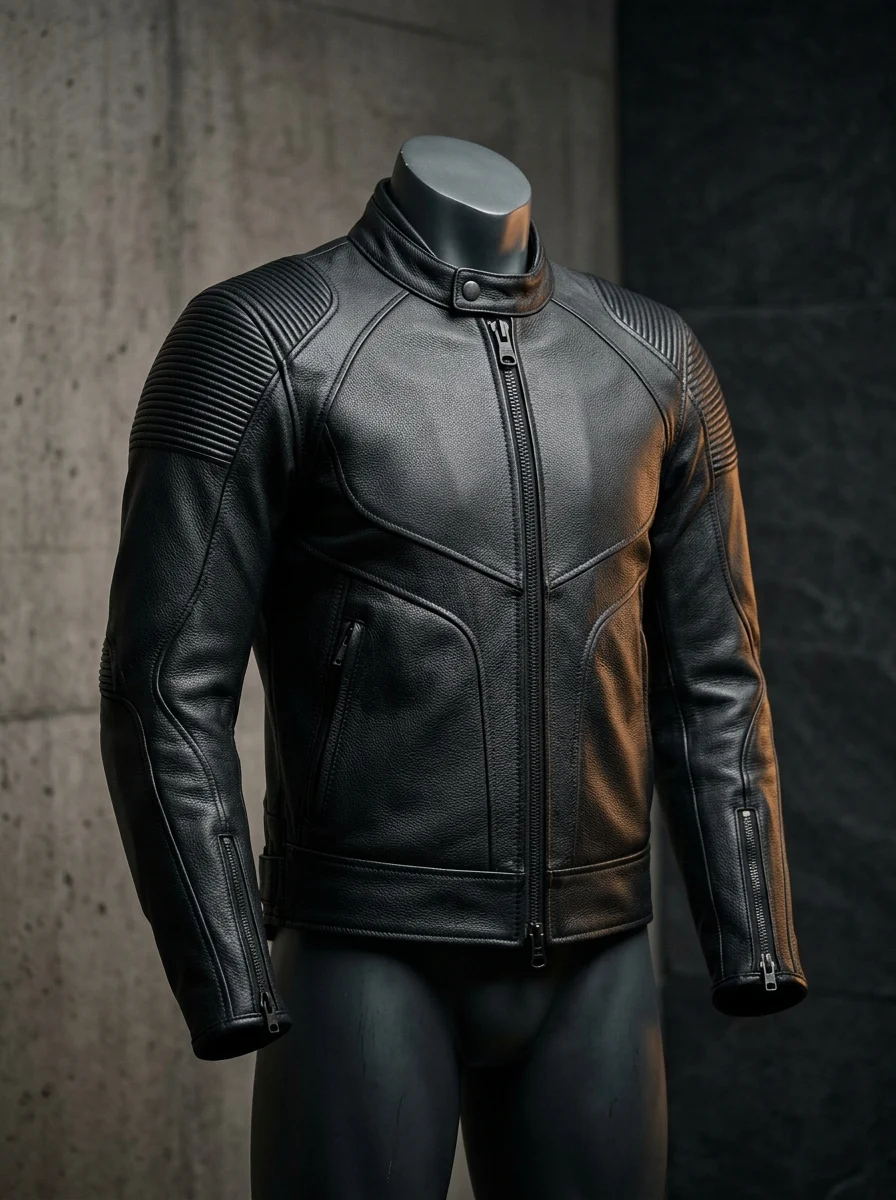
Alpinestars Leather Jackets vs Bespoke Custom Leather: Durability, Grain, and Craftsmanship Comparison
Key Takeaways
- Engineering Purpose Divergence: Alpinestars outerwear is designed as technical motorcycle protective equipment focused on impact absorption, whereas bespoke custom leather prioritizes anatomical fit, luxury hide temper, and heirloom durability.
- Hide Grade and Tannage Differences: Commercial motorcycle jackets utilize heavily treated, polymer-coated 1.2 mm to 1.4 mm cowhide for abrasion protection, whereas bespoke ateliers deploy virgin, drum-dyed full-grain cowhide that breathes naturally and forms an organic patina.
- Ergonomic Pre-Curve vs Daily Comfort: Factory track jackets incorporate extreme pre-curved sleeves and shoulder armor pockets optimized strictly for riding tuck positions, making them stiff and awkward for casual off-bike wear.
- Seam Construction Architecture: Both high-end racing jackets and artisan bespoke garments utilize multi-row safety stitching, but bespoke ateliers employ premium bonded nylon v69/v92 thread with reinforced internal leather facings.
- The Made-to-Measure Solution: Commissioning a custom bespoke jacket from Lux Wearz allows motorcycle enthusiasts and leather connoisseurs to combine heavy-duty protective hide thickness with personalized anatomical styling.
Artisan Independence & Trademark Notice: Lux Wearz is an independent bespoke leathercraft atelier. All brand names, logos, and trademarks mentioned in this article (including Alpinestars® and related trademarks) belong exclusively to their respective trademark holders. Lux Wearz is not an authorized distributor, licensee, or affiliated partner of these brands. All brand references and historical retrospectives are made strictly for educational, comparative, and sizing review purposes under Fair Use. Lux Wearz specializes in custom-tailored, heirloom-grade genuine leather outerwear handcrafted individually in our private workshop.
Alpinestars Leather Jackets vs Bespoke Custom Leather: Which Offers Superior Durability and Value?
Alpinestars leather jackets deliver exceptional track-focused abrasion protection engineered with pre-curved racing ergonomics, hard shoulder armor sliders, and technical stretch panels designed exclusively for the riding tuck. Conversely, bespoke custom leather from Lux Wearz provides superior heirloom longevity, anatomical everyday comfort, and uncompromised virgin full-grain hides crafted to individual body measurements without commercial synthetic fillers.
For motorcyclists, track enthusiasts, and discerning leather aficionados, selecting premium outerwear presents an intriguing dilemma. Alpinestars stands as a legendary titan in professional motorsport safety, clothing world champions across MotoGP, Superbike, and motocross circuits for decades. Their leather suits and riding jackets represent decades of crash laboratory data, CE certification standards, and high-speed road defense.
At the same time, the resurgence of artisan bespoke leathercraft has introduced a compelling alternative. Off-the-rack commercial motorcycle jackets are mass-produced to standardized European sizing blocks that rarely accommodate real-world proportions. Riders frequently find themselves forced to compromise: choosing a jacket that fits across the chest while flapping loosely at the waist, or one with correct sleeve length that pinches the shoulders. Comparing commercial high-performance riding gear with master bespoke leathercraft reveals fundamental differences in hide grading, structural metallurgy, stitch tensile specs, and wearable longevity.
Historical Heritage and Technical Evolution of Motorsport Leather
To understand the construction philosophy behind high-performance motorcycle apparel, one must examine the evolution of protective racing hides over the past six decades.
Founded in 1963 by Sante Mazzarolo in Asolo, Italy, Alpinestars originated as a hiking and ski boot manufacturer before revolutionizing motocross protection with the introduction of metal-plated motocross boots. By the late 1970s and 1980s, the brand transitioned into tarmac road racing, developing full-leather racing suits designed to protect riders sliding across asphalt at speeds exceeding one hundred miles per hour.
Over the decades, track racing demands pushed the industry toward specialized material hybridization. Pure leather outerwear evolved into multi-composite protective shells. Modern racing jackets integrate accordion leather flex inserts, aramid-reinforced synthetic stretch panels (such as HRSF - High Resistance Stretch Fabric), dynamic friction shields (DFS), internal dual-density foam protectors, and integrated electronic airbag systems (Tech-Air).
While these synthetic integrations solve critical high-speed track challenges—such as ventilation, mobility during knee-dragging cornering, and rapid airbag deployment—they fundamentally alter the garment's character. Modern commercial racing jackets contain substantial non-leather surface area, including nylon stretch textiles, thermoplastic polyurethane (TPU) shoulder sliders, and synthetic mesh linings. Over extended periods of sunlight exposure, road ozone, and daily friction, synthetic textiles degrade and fray long before thick animal hide experiences structural failure.
Bespoke artisan leathercraft preserves the timeless purity of 100% natural full-grain leather construction. By utilizing continuous hide panels without cheap synthetic inserts, an artisan atelier builds garments that rely on the organic tensile strength of nature's most resilient material, creating outerwear engineered to endure for half a century.
Leather Hide Anatomy: Commercial Polymer-Coated Cowhide vs Virgin Full-Grain
The fundamental difference between factory racing jackets and bespoke luxury outerwear lies within the cellular structure of the leather hide itself.
Animal hide comprises multiple microscopic layers. The uppermost surface—the grain—consists of tightly woven, high-density collagen protein fibrils. This top layer provides the hide's natural weather resistance, tensile tear strength, and capacity to develop a rich, lustrous patina over time. Beneath the grain lies the corium, a looser network of fibrous tissue that provides flexibility but significantly lower tear resistance.
Commercial Corrected-Grain Leather in Mass Production
To manufacture tens of thousands of jackets uniformly, commercial apparel corporations source hides in bulk from industrial tanneries. These hides inevitably carry natural imperfections, including insect bites, barbed-wire scratches, and brand marks. In mass production, tanneries sand away the top grain layer—a process known as buffing or correcting—to eliminate visual blemishes.
To replace the lost surface grain and impart uniform color, the hide is coated with synthetic polyurethane pigments, acrylic sealants, and embossed with an artificial mechanical grain roller. While this polymer coating provides uniform color and initial water repellency, it completely seals the leather pores. The hide cannot breathe, absorb conditioning balms, or develop a natural patina. Over five to eight years of thermal expansion and UV exposure, synthetic topcoats inevitably dry, crack, and delaminate from the underlying corium.
Virgin Full-Grain Artisan Tanning
In contrast, a bespoke atelier like Lux Wearz sources exclusively unbuffed, virgin full-grain cowhide and steerhide. The natural grain remains 100% intact, preserving the dense outer collagen network. The hides undergo drum-dyeing using deep aniline and semi-aniline tanning oils that penetrate completely through the hide cross-section rather than merely coating the surface.
When you touch a virgin full-grain garment, you feel the organic warmth, rich oily temper, and unique pebble grain of natural hide. As the garment ages, surface friction and natural oils create a stunning, individualized character that deepens each year. Most importantly, virgin full-grain leather readily absorbs nourishing lipid creams, allowing the fibers to remain pliable and tear-proof indefinitely.
| Material Characteristic | Commercial Track Racing Jacket | Artisan Bespoke Custom Atelier |
|---|---|---|
| Primary Hide Selection | Corrected-Grain / Pigment-Coated Cowhide (1.2 - 1.4 mm) | Virgin Full-Grain Naked Drum-Dyed Cowhide (1.2 - 1.4 mm) |
| Surface Treatment | Polyurethane / Acrylic Heavy Pigment Sealant | Deep Penetrating Aniline Dye & Natural Wax Micro-Finish |
| Breathability & Porosity | Low; Pores Sealed by Topcoat (Relies on Perforations) | High Natural Porosity; Organic Moisture Vapor Transmission |
| Aging & Patina Development | Polymer Topcoat Cracks & Fades; No Natural Patina | Exceptional Organic Patina; Deepens Richness Over Decades |
| Non-Leather Surface Area | 15% - 30% Polyamide Stretch Fabric & TPU Sliders | 0% - 5% (Continuous 100% Leather Construction) |
| Interior Lining Material | Bonded Polyester Fixed Breathable Mesh | Reinforced Quilted Satin, Cupro, or Custom Wool Plaid |
| Hardware & Slider Specs | Molded Plastic / Thin Cast Zinc Alloy Pullers | Heavy-Gauge Solid Brass, Antiqued Bronze, or Stainless YKK |
| Primary Ergonomic Intent | Aggressive 45-Degree Forward Riding Tuck | Tailored to Natural Posture & Anatomical Proportions |
Silhouette and Fit Architecture: Track Tuck vs Everyday Ergonomics
Pattern geometry is the defining factor that determines whether a leather jacket feels like an extension of your body or an uncomfortable physical restraint.
Track racing jackets are drafted with extreme forward pre-curvature. The sleeves are angled forward at the shoulder seam, mirroring the exact posture of a rider clutching clip-on handlebars on a supersport motorcycle. When seated on a sportbike in a full tuck, this pre-curved pattern functions brilliantly, eliminating bunching leather across the stomach and preventing sleeve ride-up.
However, the moment the rider dismounts the motorcycle and stands upright, this extreme racing pattern becomes awkward. The forward-rotated shoulder joints pull the chest panels tightly across the sternum, restricting natural arm drop. Excess leather bunches awkwardly across the upper back, while stiff internal elbow armor cups dig into the forearm tendons. For daily wear, commuting, dining, or social gatherings, an off-the-rack track jacket feels like wearing rigid armor.
| Silhouette Model | Cut & Functional Intent | Shoulder & Armhole Geometry | Recommended Riding / Daily Use | Leather Weight & Shielding |
|---|---|---|---|---|
| Alpinestars Dusk Airflow | Technical Hot-Weather Sport Cut | High-Armhole Pre-Curved Racing Sleeve | Urban Commuting, Warm-Weather Track | 1.2 mm Perforated Milled Cowhide, DFS Sliders |
| GP Plus R V4 Airflow | Aggressive Supersport Track Cut | Extreme Forward Articulation, Stretch Gussets | Sportbike Canyon Riding, Closed Course | 1.3 mm Premium Cowhide, Nucleon Flex Armor |
| Atem V5 High Performance | Professional Race-Derived Cut | Race-Fit Pre-Curve, Aerodynamic Back Hump | Track Days, Aggressive Sport Riding | 1.3 mm Track-Grade Cowhide, Multi-Composite |
| Dyno Classic Sport Rider | Modern Heritage Roadster Silhouette | Moderate Pre-Curve, Clean Shoulder Line | Naked Bikes, Cruisers, Casual Streetwear | 1.2 mm Supple Drum-Dyed Cowhide |
| GP Tech V4 Leather Suit | Full One-Piece Competition Suit | Maximum Track Tuck Articulation, Kangaroo Hybrid | Professional Racing, Sanctioned Competition | 1.3 mm Bovine & Lightweight Kangaroo Hides |
| Lux Wearz Custom Bespoke | Anatomical Made-to-Measure Pattern | Individualized Shoulder Slope, Neutral Armhole | Dual-Purpose: Spirited Riding & Luxury Daily Wear | 1.3 mm Virgin Full-Grain Cowhide, Zero Compromise |
Bespoke tailoring resolves this fundamental ergonomic contradiction. At Lux Wearz, our patternmakers engineer neutral anatomical shoulder slopes equipped with concealed bi-swing back gussets (action-backs). When reaching forward for motorcycle controls, the concealed accordion leather panels expand smoothly to provide full arm articulation without resistance. When you stand upright, the internal elastic gussets retract, restoring a sleek, bespoke silhouette.
To determine your precise measurements and understand anatomical drop ratios, consult our Comprehensive Outerwear Sizing Architecture.
Stitch Tensile Strength, Seam Engineering, and Hardware Metallurgy
When a motorcycle jacket impacts the pavement at highway speeds, the primary failure point is rarely the center of a leather panel—it is the structural seam. A single burst seam allows road abrasion to immediately contact bare skin.
Safety Stitching Discipline
Standard fashion jackets utilize single-row chain stitching with lightweight polyester thread. In a crash, frictional heat generated by sliding against coarse asphalt reaches temperatures exceeding 400°F (204°C). Standard synthetic threads melt instantaneously, causing panel separation within two seconds of contact.
High-performance motorcycle apparel employs specialized multi-row safety seam architecture:
- Concealed Structural Stitch: A hidden safety stitch joining the two leather facings beneath the surface seam, shielded from direct road contact.
- Topstitch Reinforcement: One or two visible parallel stitch lines anchoring the folded seam allowance flat against the garment.
- Thread Composition: Industrial-grade bonded nylon (v69 or v92) or aramid thread. Bonded nylon features a specialized resin coating that prevents ply untwisting, maximizes abrasion resistance, and resists environmental moisture rot.
At Lux Wearz, every load-bearing seam—including the shoulder cap, armhole scye, side panels, and back yoke—is assembled using heavy-duty bonded nylon v92 thread sewn at precisely seven to eight stitches per inch. This spacing is optimal: too few stitches creates loose seams vulnerable to snagging, while too many stitches perforates the leather like a postage stamp, creating a tear perforation line.
Hardware Metallurgy: Cast Alloy vs Heavy-Gauge Brass
Hardware durability is another area where commercial cost-cutting compromises garment longevity. Mass-market manufacturers frequently utilize cast pot-metal (zinc alloy) zipper sliders and thin-gauge wire teeth. Under repetitive pulling or cold-weather stress, cast sliders expand, slip off track, or fracture at the neck.
Bespoke custom leather utilizes authentic heavy-duty metal hardware:
- Zipper Assemblies: Industrial heavy-gauge YKK #8 and #10 brass, antiqued bronze, or stainless steel zippers with solid forged metal sliders.
- Pull Tabs: Solid metal reinforced pull tabs that withstand aggressive gloved operation without shearing.
- Snaps and Fasteners: Solid brass spring-loaded snap buttons anchored through reinforced leather stay-tape to prevent pull-through tear-out.
Maintaining your hardware is straightforward. Applying a light paraffin wax coating along metal teeth once a year ensures silky-smooth closure and prevents oxidization. For detailed cleaning protocols, review our Official Leather Care and Maintenance Guide.
Curated Silhouette Retrospective and Featured Collection
For riders and leather connoisseurs seeking to inspect the finest examples of track-proven engineering alongside bespoke artisan craftsmanship, examining specific flagship models illustrates how high-performance materials are utilized in real-world outerwear. Explore these five curated models available within the Lux Wearz catalog:
1. Alpinestars Dusk Airflow Leather Jacket
The Alpinestars Dusk Airflow Leather Jacket showcases state-of-the-art climate regulation in sport riding outerwear. Constructed from premium 1.2 mm bovine leather, this jacket features strategically mapped high-density localized perforation panels across the chest, back, and inner sleeves. It incorporates low-profile Nucleon Flex Plus CE Level 1 armor at the shoulders and elbows, paired with external dual-density dynamic friction sliders (DFS). For warm-weather sport riders demanding maximum airflow without sacrificing leather abrasion resistance, the Dusk Airflow sets an impressive benchmark.
2. Alpinestars GP Plus R V4 Airflow Leather Jacket
Engineered for track day enthusiasts and spirited canyon carvers, the Alpinestars GP Plus R V4 Airflow Leather Jacket represents the evolution of race-bred ergonomics. Utilizing race-derived 1.3 mm full-grain cowhide, this jacket integrates extensive A-CS Plus technical stretch panels along the torso and underarms, delivering 30% higher elongation and superior tear strength compared to standard nylon stretch fabrics. Equipped with GP Lite external shoulder protectors and pre-curved sleeves, it offers an aggressive race-ready fit optimized for aggressive sport riding.
3. Alpinestars Atem V5 Leather Jacket
Taking inspiration directly from premier world championship competition suits, the Alpinestars Atem V5 Leather Jacket is a tour de force in aerodynamic protection. Built with ultra-durable 1.3 mm premium bovine leather, it features an integrated aerodynamic back hump engineered to smooth airflow over the rider's helmet at high velocity. The garment includes full internal CE Level 2 armor protection, extensive accordion flex leather zones across the shoulder blades, and dual-compound DFS shoulder protectors tested under professional track conditions.
4. Alpinestars Dyno Leather Jacket
For riders who appreciate heritage roadster aesthetics combined with modern protective engineering, the Alpinestars Dyno Leather Jacket bridges track technology with timeless street elegance. Tailored from supple drum-dyed full-grain leather, this jacket features a relaxed sport-classic profile with subtle chest branding, clean waist adjusters, and low-profile internal shoulder and elbow armor. It pairs naturally with selvedge denim while maintaining robust highway slide protection.
5. Alpinestars GP Tech V4 Leather Suit
The pinnacle of closed-circuit motorcycle racing defense, the Alpinestars GP Tech V4 Leather Suit represents premier technical competition construction. Engineered from a hybrid blend of 1.3 mm premium bovine hide and ultra-lightweight high-tensile kangaroo leather along high-flex zones, this one-piece professional suit is engineered to accommodate the Tech-Air electronic airbag system. With seamless aramid underarm panels, GP-R internal protectors, and replaceable dual-density knee and elbow sliders, it delivers elite-tier track performance.
To explore our complete inventory of racing and sport riding outerwear, browse the dedicated Alpinestars Brand Showcase and discover our full range of technical apparel.
The Case for Bespoke: Why Discerning Enthusiasts Choose Custom Handcrafted
While commercial racing jackets excel on closed racetracks, thousands of motorcycle riders and style-conscious collectors discover that off-the-rack garments inevitably fail to deliver personal perfection.
Consider the reality of purchasing a standardized commercial jacket:
- The Proportional Mismatch: Motorcycle jacket brands grade their patterns around European athletic silhouettes (tall, slender, narrow waist). A rider with broader shoulders, a muscular chest, or a shorter torso finds that sizing up to fit the chest results in sleeves extending past the knuckles and leather pooling around the belly.
- Fixed Armor Placement: When off-the-rack sleeves are too long or too short, internal armor pockets shift out of alignment. An elbow protector resting against the forearm or tricep provides zero protection in a crash and creates painful pressure points during rides.
- Single-Season Aesthetic Obsolescence: Commercial styling is driven by seasonal trends: loud neon contrast accents, massive rubber corporate logos, and synthetic panels that look outdated within three years.
- Resale Value Depreciation: Mass-produced commercial jackets suffer immediate 50% to 70% depreciation upon purchase. Synthetic stretch panels wear, Velcro hook-and-loop fasteners fray, and outdated branding loses appeal.
In stark contrast, commissioning a made-to-measure bespoke leather jacket from Lux Wearz represents an investment in timeless permanence.
| Comparison Dimension | Off-The-Rack Commercial Motorcycle Jacket | Lux Wearz Handcrafted Bespoke Leather |
|---|---|---|
| Pattern Creation | Standardized Mass Production Sizing Blocks (S/M/L) | Individualized Pattern Drafted from 12+ Personal Body Measurements |
| Hide Quality & Tannage | Sanded Corrected-Grain Pigment-Coated Cowhide | 100% Virgin Full-Grain Drum-Dyed Aniline Cowhide |
| Armhole & Sleeve Fit | Fixed Forward Pre-Curve (Awkward Off-Bike) | Anatomical Bi-Swing Action Back (Fluid Mobility On & Off Bike) |
| Branding & Markings | Prominent Brand Logos, Screenprints, Rubber Badges | Pure, Sophisticated Minimalism; 100% Logo-Free Exterior |
| Custom Lining Options | Fixed Synthetic Polyester Mesh | Quilted Silk, Breathable Cupro, Thermal Detachable Vests |
| Hardware Specification | Cast Zinc Alloy Sliders & Molded Plastic Teeth | Forged Heavy-Gauge YKK #8 / #10 Solid Brass or Antiqued Bronze |
| Generational Longevity | 7 to 15 Years (Synthetic Panel Degradation) | 40 to 60+ Years (Heirloom Grade Virgin Natural Hide) |
The Lux Wearz Custom Atelier Process
At Lux Wearz, every custom leather jacket is handcrafted as an individual work of functional art. We unite the rugged abrasion-resistant durability required for open-road protection with the sophisticated sartorial refinement of a bespoke tailoring house.
Our creation journey follows four uncompromising stages:
1. Comprehensive Anatomical Consultation
Through our online Custom Leather Order Atelier, you submit detailed anatomical measurements, including chest circumference, shoulder blade breadth, sleeve length from acromion to wrist bone, bicep circumference, natural waist drop, and preferred torso length. You also designate your primary use profile: daily urban riding, spirited sport touring, or luxury streetwear layering.
2. Premium Hide Selection and Hand-Cutting
We hand-inspect dozens of virgin full-grain hides, selecting only those displaying optimal fiber density, uniform thickness (1.2 mm to 1.4 mm), and balanced temper. Our master leather artisans layout individual pattern pieces by hand, aligning grain direction across structural stress planes to guarantee maximum tear resistance.
3. Reinforced Structural Assembly
Your jacket is constructed on industrial walking-foot machines utilizing heavyweight bonded nylon thread. Concealed armor pockets tailored to accommodate your preferred CE Level 2 D3O or SAS-TEC armor inserts can be integrated into the elbows, shoulders, and back without disrupting the exterior lines. Critical stress zones are reinforced with concealed leather stay-tape and heavy-duty bar-tacks.
4. Custom Personalization and Hardware Finishing
You select your preferred hardware finish—antiqued brass, matte gunmetal, or bright chrome—along with pocket layouts, storm flap configurations, and interior lining materials. Whether you desire hidden concealed-carry pockets, fleece-lined handwarmers, or dedicated phone sleeves, every detail is tailored to your lifestyle.
Discover our full catalog of motorcycle and racing-inspired outerwear in our High-Performance Racing Jackets Collection and explore our complete inventory of handcrafted genuine leather outerwear across our Lux Wearz Master Catalog.
Long-Term Maintenance: Keeping Heavy Leather Pliable for Decades
To ensure that high-performance leather maintains its protective strength and supple feel across decades of highway riding and daily wear, consistent maintenance is paramount.
Removing Road Grime and Insect Debris
Motorcycle riding inevitably deposits acidic insect residue, road grime, and exhaust soot onto the leather grain. Never allow road grime to bake into the leather under sunlight. After spirited rides, gently wipe the jacket down using a microfiber cloth dampened with lukewarm distilled water. For stubborn road residue, use a specialized pH-balanced leather cleaner formulated for aniline hides.
Replenishing Deep Hide Lipids
Wind, rain, and solar radiation steadily evaporate the natural oils within leather fibers. Apply a premium lanolin and beeswax conditioning cream once every six months, or whenever the hide begins to feel dry and stiff. Work the cream into the grain in small circular motions using a soft horsehair brush, paying special attention to high-flex areas along the elbows and shoulder yokes. Allow the conditioner to absorb for four hours before buffing away excess with a clean cloth.
Drying Wet Outerwear Correctly
If you encounter a heavy downpour on the road, never dry your leather jacket using hair dryers, radiators, or direct heat vents. Excessive artificial heat shrinks collagen fibers, causing permanent warping and brittle stiffness. Hang the damp jacket on a broad, contoured wooden hanger in a well-ventilated room at room temperature, allowing the moisture to evaporate naturally over 24 to 48 hours before applying a fresh coat of conditioner.
For exhaustive maintenance protocols and seasonal storage guidance, consult our Official Leather Care and Maintenance Guide.
Final Verdict: Choosing Between Track Technology and Bespoke Excellence
Both commercial motorcycle racing jackets and bespoke handcrafted leather serve vital roles in the modern leather landscape. If your primary objective is competing in amateur track day events or aggressive supersport closed-circuit riding where external plastic sliders, aerodynamic humps, and electronic airbag integration are mandatory, an off-the-rack suit like the Alpinestars Atem or GP Plus provides exceptional specialized defense.
However, if you seek a magnificent, heirloom-grade leather jacket that offers robust highway protection, a flawless anatomical custom fit, and the timeless elegance required for daily life off the bike, mass-produced commercial gear cannot match the enduring luxury of bespoke craftsmanship. A custom-tailored leather jacket from Lux Wearz eliminates awkward sizing compromises, synthetic panel degradation, and excessive logos, delivering an heirloom masterpiece built exclusively for you.
Experience the unparalleled distinction of handcrafted leather tailored to your exact measurements. Begin drafting your bespoke outerwear piece today through our Custom Leather Atelier, or explore our curated Alpinestars Outerwear Collection to discover exceptional genuine leather outerwear.
Explore The Full 2026 Leather Outerwear Collection
Vegetable-tanned full-grain cowhide, buttery New Zealand lambskin, and heritage Melton wool. Free express delivery across the USA with 30-day hassle-free returns.