
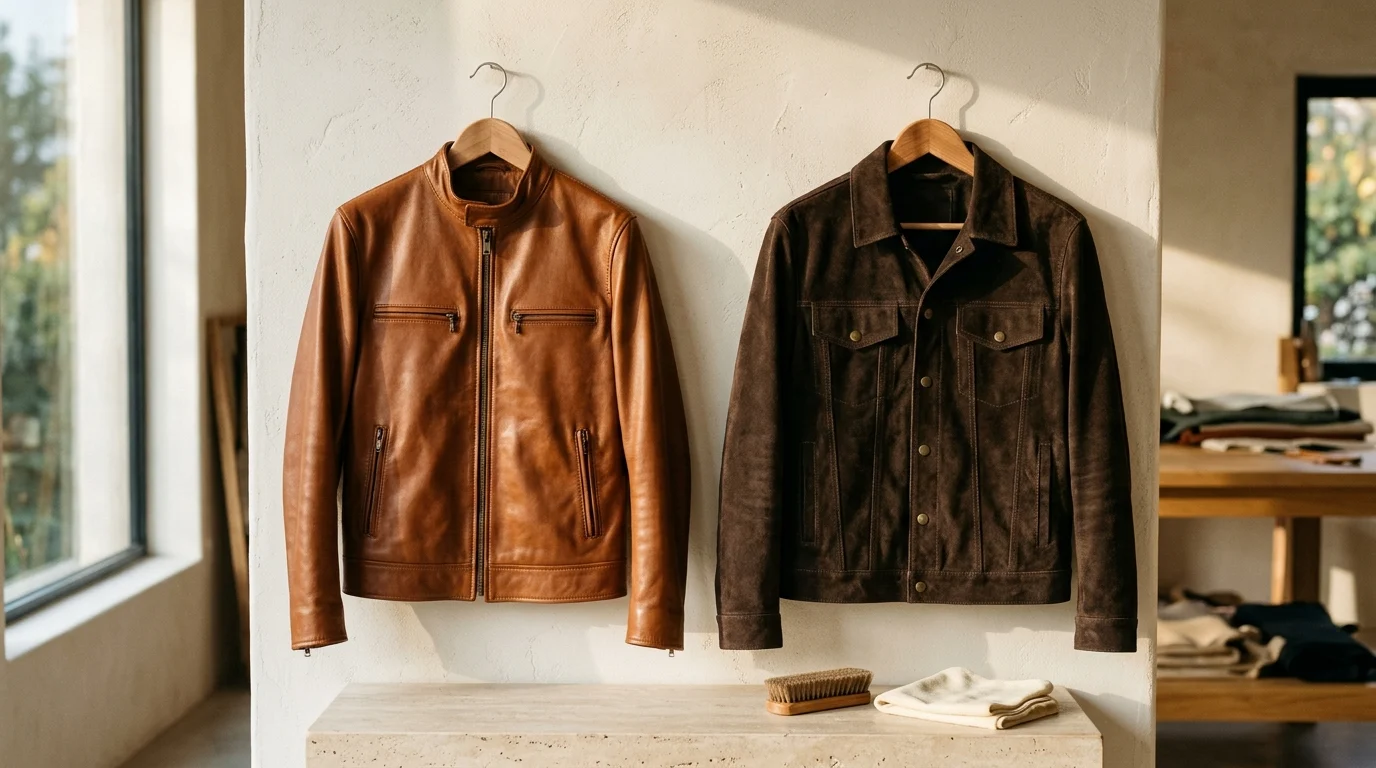
Wilsons Leather Jacket Care, Conditioning & Patina Guide [2026]
Complete Wilsons Leather care guide covering lambskin conditioning, brushed suede nap restoration, leather-denim hybrid cleaning, and heirloom patina care.
Key Takeaways
- Multi-Hide Care Precision: Wilsons Leather collections span ultra-soft 0.7–0.9 mm lambskin, brushed split suede, vintage heavier M. Julian cowhide, shearling-lined winter coats, and leather-denim hybrids—meaning each garment demands hide-specific chemistry rather than a single universal balm.
- Zero-Cream Rule for Suede: Brushed suede trucker and moto silhouettes must never touch liquid conditioners or wax pastes; mechanical nap lifting with crepe brushes and dry waterproofing mists keep velvet fibers pristine.
- Hybrid Garment Isolation: Leather-and-denim jackets require dry-zone separation during spot cleaning so indigo denim dye never bleeds into light trim and leather conditioners never stain woven cotton twill.
- Collar Sebum & Winter Salt Defense: Lightweight fashion lambskins oxidize rapidly along the neck fold and wrist cuffs; quarterly low-moisture pH-neutral wiping prevents brittle cracking before it begins.
- Heirloom Full-Grain Alternative: When older corrected-grain coats begin flaking or splitting, commissioning a made-to-measure virgin leather piece from Lux Wearz provides uninterrupted top-layer fiber strength built to your exact measurements.
Artisan Independence & Trademark Notice: Lux Wearz is an independent bespoke leathercraft atelier. All brand names, logos, and trademarks mentioned in this article (including Pelle Pelle®, Alpinestars®, Harley-Davidson®, Avirex®, Kawasaki®, Vanson®, Wilsons Leather®) belong exclusively to their respective trademark holders. Lux Wearz is not an authorized distributor, licensee, or affiliated partner of these brands. All brand references and historical retrospectives are made strictly for educational, comparative, and sizing review purposes under Fair Use. Lux Wearz specializes in custom-tailored, heirloom-grade genuine leather outerwear handcrafted individually in our private workshop.
How Should You Clean, Condition, and Maintain a Wilsons Leather Jacket?
Wilsons Leather jackets maintain their supple drape and rich color when owners match care methods to the exact hide: wipe smooth lambskin and cowhide with a barely damp pH-neutral cloth before applying light non-silicone lotion annually, brush suede exclusively dry with a crepe block, spot-clean leather-denim hybrids carefully, and store coats on wide contoured hangers.
Unlike single-purpose motorcycle brands built around uniform 1.3 mm highway cowhide, Wilsons Leather built its historical identity across an extraordinarily diverse spectrum of American mall and boutique outerwear. Over decades of production spanning classic vintage lines such as M. Julian, Maxima, and Pelle Studio alongside contemporary cropped racers, suede truckers, winter shearling coats, and mixed-media denim jackets, the label became synonymous with accessible everyday leather fashion. That material diversity creates a common pitfall in home garment care: a balm that nourishes a 1990s pebbled cowhide flight jacket will permanently stain a modern camel suede trucker, while a leather-and-denim hybrid will bleed indigo or pucker permanently if tossed into a washing machine.
At our leathercraft bench, we inspect dozens of casual fashion jackets each season that suffered avoidable damage—usually steam-iron scorching from someone trying to flatten sleeve wrinkles, greasy dark patches on suede cuffs from misguided shoe creams, or cracking along lightweight lambskin collars dried out by winter radiator air. Because lightweight fashion hides (typically 0.7 mm to 1.0 mm) contain thinner corium fiber networks than heavy riding steerhide, they respond dramatically to disciplined, low-moisture care—and suffer rapidly when neglected or treated with harsh household cleaners.
Material Heritage & Why Diverse Fashion Hides Age Differently
Tracing how Wilsons Leather silhouettes evolved helps explain why two jackets carrying the same label can behave like completely different materials under a polishing cloth. During the 1980s and 1990s, heavyweight cowhide and pigskin bombers dominated winter racks, often paired with quilted Thinsulate or zip-out wool-blend liners designed for harsh Midwestern cold. Those older drum-dyed cowhide shells possessed stout top-grain thickness capable of absorbing seasonal cream conditioners and developing deep, leathery patina across elbow creases and storm flaps.
By contrast, modern tailored café racers, cropped bombers, shirt jackets, and casual hooded silhouettes lean heavily toward ultra-supple lambskin (sheepskin), lightweight calfskin, velvet-nap split suede, and multi-panel denim-leather hybrids. Lambskin delivers immediate out-of-the-box drape with zero break-in stiffness, making it beloved for tailored cropped silhouettes and everyday street layering. Yet lambskin pores are noticeably larger and more open than dense bovine pores, meaning water droplets, hair oils, and heavy balms sink in instantaneously. Meanwhile, suede—crafted by buffing the underside flesh fibers or split corium into a raised tactile nap—lacks a sealed grain barrier entirely, turning moisture management and dry mechanical brushing into the entire game.
Winter outerwear categories—including shearling-trimmed coats, natural-fiber wool-blend car coats, and insulated leather winter jackets—introduce yet another layer of maintenance complexity. Wool-blend and shearling collars trap atmospheric dust, snow-melt minerals, and cologne residue that attract fabric moths during summer closet storage if uncleaned before spring pack-away. Recognizing which hide and lining architecture hangs in your wardrobe is the indispensable first step toward multi-decade wear.
Table 1: Wilsons Leather Silhouette & Hide Care Architecture
Use this structural reference to map the most common silhouettes in Wilsons Leather collections to their cut geometry, leather temper, and primary care profile.
| Silhouette Model | Cut & Fit Type | Shoulder / Chest Offset | Ideal Body Profile | Leather Weight & Temper |
|---|---|---|---|---|
| Cropped Striped Café Racer | Slim modern cropped block with mandarin snap collar | Close 0.25-inch tailored shoulder with tapered waist | Slim to athletic builds seeking sharp hip-length proportion | 0.8–0.95 mm supple lambskin or light cowhide; soft temper |
| Cropped Leather Bomber & Aviator | Relaxed shoulder with banded or rib-knit hem | +0.75 inch chest ease for knitwear layering | Balanced proportions wanting effortless waist blouson | 0.85–1.0 mm drum-dyed lambskin; buttery drape |
| Lightweight Suede Trucker & Moto | Structured collared Type-III trucker or asymmetrical moto | Crisp squared shoulder yoke with darted chest seams | Casual everyday wearers valuing velvety matte texture | 0.9–1.1 mm brushed split or full-reverse suede; dry nap temper |
| Leather & Denim Hybrid Jacket | Mixed-panel biker or trucker combining leather sleeves with twill body | Standard casual ease with contrast seam tension | Streetwear dressers wanting multi-texture contrast | 0.85 mm lambskin panels paired with 11–13 oz woven cotton denim |
| Vintage Leather Shirt & Winter Coat | Longer tunic or car-coat length with snap placket or shearling collar | +1.0 inch over-layering allowance for winter sweaters | Tall or layered winter wearers prioritizing torso coverage | 1.0–1.2 mm vintage cowhide or double-face shearling; medium temper |
If you are dialing in exact chest ease or sleeve measurements across cropped vs vintage cuts before purchasing or restoring a garment, cross-reference our Lux Wearz Size Guide and explore our dedicated Wilsons Leather Jackets Sizing & Fit Architecture Guide.
Smooth Lambskin vs. Brushed Suede vs. Hybrids: Diagnostic Care Rules
Before applying any cleanser or brush to a garment, perform a rapid surface audit under natural daylight. Smooth lambskin and semi-aniline calfskin exhibit a subtle, continuous pore pattern with a gentle satin reflection. Check whether the hide is sealed or naked by placing a pinhead drop of distilled water on an inside hem tab: if it darkens immediately, the hide is naked or lightly aniline-dyed and requires wax-free, ultra-light liquid lotion; if it beads up briefly, it carries a protective pigment finish suited to balanced cream emulsions.
Brushed suede feels fibrous and velvety to the fingertip, shifting shade slightly when you sweep your hand backward against the nap. Never apply liquids, oil balms, saddle soap, or alcohol wipes to suede. Even plain tap water leaves stiff, flattened water rings on untreated split suede if applied unevenly. Suede lives and dies by dry mechanical care and pre-emptive breathable mist protection.
Mixed-media leather-and-denim hybrids and hooded jersey-lined jackets require boundary discipline. Denim cotton absorbs oil-based leather conditioners instantly and holds onto greasy halo stains permanently, while leather sleeves stiffen and warp if immersed in water with denim detergent. Treat each panel according to its material class, masking off bordering seams with a clean dry cotton towel whenever conditioning leather edges or misting denim panels.
Table 2: Component, Hide & Finish Maintenance Matrix
Each leather grade, textile pairing, and hardware finish responds to strictly defined thickness tolerances and cleaning agents.
| Component / Hide | Leather Grade & Tannage | Thickness (mm) | Weather Resistance | Expected Longevity | Maintenance Needs |
|---|---|---|---|---|---|
| Supple Fashion Lambskin | Full-grain or lightly buffed chrome-tanned sheepskin | 0.70–0.95 mm | Moderate wind block; absorbs rain quickly if untreated | 10–18 years with careful collar care | Gentle pH-neutral wipe; light wax-free lotion every 12–18 months |
| Brushed Split Suede | Split or reverse-corium suede with brushed nap | 0.90–1.10 mm | Low moisture resistance; stains easily from rain or oil | 8–15 years if kept dry and brushed | Crepe/brass suede brush only; fluorocarbon-free hydrophobic spray |
| Vintage M. Julian / Heavy Cowhide | Drum-dyed top-grain or pebbled bovine hide | 1.10–1.30 mm | High wind and splash resistance | 18–30 years with seasonal conditioning | Horsehair brushing; breathable beeswax-lanolin balm annually |
| Leather & Denim Hybrid Panels | Lightweight cow/lambskin stitched to 12 oz cotton denim | 0.85 mm + twill | Fair dry-weather wear; avoid soaking rain | 10–15 years with separate spot care | Spot-clean denim cold; keep leather lotion off cotton seams |
| Shearling & Wool-Lined Collars | Sheepskin wool fleece or woven wool-blend winter trim | 6.0–12.0 mm fleece | High thermal retention; attracts summer moths if soiled | 12–25 years with breathable cedar storage | Gentle soft garment brush; dry clean wool professionally via specialist |
| Fashion Brass & Gunmetal Hardware | #5/#8 brass, nickel, or oxidized zinc alloy zippers & snaps | 1.5–2.5 mm teeth | Tarnishes slowly from humidity and cologne spray | 12–20 years with dry wax lubrication | Dry toothbrush track sweep; paraffin stick glide without liquid oils |
For a detailed engineering comparison showing how lightweight retail hides perform over multi-year cycles compared to thick workshop full-grain hides, read our Wilsons Leather vs Bespoke Custom Leather Durability & Grain Comparison.
Atelier Care Protocol 1: Smooth Lambskin & Vintage Cowhide
Lightweight lambskin jackets demand a light touch. Unlike thick cruiser hides that tolerate brisk rubbing, lambskin fibers tear or stretch permanently if scrubbed aggressively while wet.
Cleaning Without Stripping Finish
Begin every care session by sweeping the jacket dry with a soft horsehair brush or dry microfiber cloth to lift airborne city dust out of shoulder seams, pocket welts, and collar creases. Next, prepare a small bowl of lukewarm distilled water with two to three drops of pH-balanced leather cleanser (pH 4.5 to 5.5). Dip the corner of a white cotton cloth into the bowl and wring it dry until barely cool to the touch.
Wipe the collar facing, cuffs, and front zipper placket gently—these three zones accumulate 90 percent of human skin oils, sunscreen, and lotion residue that oxidize into dark greasy rings and eventual cracking. Avoid soaking through to the interior lining. Follow immediately with a clean cloth dampened solely in distilled water to lift residual soap surfactants, then pat dry with an absorbent towel and hang on a wide wooden hanger for twenty-four hours in a shaded, breezy room.
Conditioning Without Darkening Light Tones
Cognac, camel, olive, and distressed gray lambskins darken temporarily—and sometimes permanently—if hit with heavy neat's-foot oil, mink oil, or thick yellow wax balms. Always perform a nickel-sized patch test inside the lower front facing hem and wait two hours to confirm the tone dries back evenly before conditioning the full shell.
Work a pea-sized drop of light, oil-balanced emulsion lotion into a clean cotton flannel cloth until the cloth looks uniformly dampened rather than wet with cream. Glide smoothly over the sleeves, shoulders, and torso panels in broad overlapping strokes. Focus slightly more attention on elbow bends and shoulder crowns, while barely touching pocket flaps or pleated cuffs. Wait twenty minutes, wipe away any unabsorbed film with a dry flannel towel, and buff briskly with a soft horsehair brush to raise a clean, natural satin sheen.
Atelier Care Protocol 2: Brushed Suede Truckers & Moto Jackets
Brushed suede jackets offer unmatched visual depth and tactile warmth, yet suede anxiety stops many owners from wearing their favorite pieces. Mastering dry suede maintenance transforms delicate-looking nap into resilient everyday outerwear.
Pre-Treat Before First Wear
Before stepping outdoors in a new suede trucker or moto jacket, mist the entire exterior evenly from eight to ten inches away using a non-silicone, fluorocarbon-free water-and-stain barrier spray designed specifically for suede and nubuck. Hold the can moving steadily so no single spot turns wet or mottled. Allow the mist to cure completely overnight in a well-ventilated space before wearing. Reapply twice a year—at the start of autumn and early spring—after brushing away surface dust.
Daily Nap Lifting & Dry Stain Extraction
After wear, spend thirty seconds brushing flattened zones—typically forearms, pocket edges, and the lower back panel where car seats compress the nap—using a rubber crepe suede brush or soft-bristle wooden brush. Always stroke lightly in one direction first to lift compacted dust, then sweep gently back and forth to restore velvety loft.
If you catch a raindrop ring or dried mud splash, allow the spot to dry 100 percent undisturbed—never rub wet suede, which smears grit deeper into the fibrous mesh. Once bone dry, gently break the crusted stain with a crepe eraser bar or dry natural sponge, then brush the area vigorously with your suede brush until the surrounding nap blends seamlessly. For an accidental grease or food oil drop, immediately bury the spot beneath a thick mound of dry cornstarch or unscented talcum powder and leave it untouched for twelve to twenty-four hours so capillary action draws the oil out of the leather fibers before brushing the powder clean.
Atelier Care Protocol 3: Hybrids, Shearling & Winter Outerwear
Winter and mixed-media pieces require careful attention to the seam lines where genuine hide meets textile, fleece, or natural wool.
Leather-and-Denim Hybrid Maintenance
Never put a leather-sleeved denim jacket into a washing machine, even on a cold delicate cycle. Water agitates leather fatliquors out of the sleeves while indigo dye bleeds from wet denim onto stitching and collar tabs. Spot-clean denim chest and back panels manually using a lightly dampened sponge and mild colorless liquid detergent, blotting immediately with a dry bath towel so moisture never wicks onto adjacent leather cuffs or shoulder yokes. Air-dry flat or on a wide contoured hanger, then apply a trace of leather lotion solely to the hide panels using a folded cloth edge.
Shearling, Wool Coats & Winter Salt Protection
Winter wool car coats, shearling-collared aviator jackets, and leather winter parkas face snow slush, sleet, and magnesium chloride sidewalk salt. Brush wool panels top-to-bottom after wear with a stiff boar-bristle garment brush to remove salt crystals and lint before they embed in the weave. If snow dampens a shearling collar, shake the droplets off briskly and allow slow air drying away from fireplaces or heating vents—heat shrinks natural sheepskin pelts tightly and mats wool fleece into hard dreadlocks. Once completely dry, fluff the shearling curls gently using your fingertips or a wide-tooth metal pet/shearling comb without snagging the leather backing.
Wrinkle Removal, Rain Recovery & Off-Season Closet Architecture
Shipping folds and closet creases are among the most common cosmetic frustrations for leather jacket owners. Never hold a handheld garment steamer against genuine leather: hot steam penetrates open pores, cooks collagen fibers at 212°F, and creates irreversible puckered blisters across smooth lambskin. Likewise, hanging a jacket inside a steamy bathroom traps damp humidity inside linings without safely relaxing wrinkles.
Instead, let gravity and gentle ambient warmth do the work. Hang the jacket on a broad, padded or sculpted wooden hanger that fills out the shoulder slope, zip it closed, and let it hang freely in a bedroom closet with two inches of clearance on either side. Ninety percent of folding creases relax naturally within seventy-two hours. For an acute stubborn lapel crease on smooth lambskin or cowhide, lay a dry unbleached cotton pillowcase or brown kraft paper sheet over the leather and press briefly with a household iron set strictly to its lowest dry setting (no steam, under 180°F) for two to three seconds at a time, checking continuously with your hand.
When storing any leather or suede jacket between seasons, throw away thin wire dry-cleaner hangers immediately; wire hooks carve permanent dimples into thin lambskin shoulders within weeks. Use wide contoured cedarwood hangers (which naturally deter wool-loving moths around shearling and wool trims), slip a breathable unbleached cotton garment cover over the shoulders, and store in a dark closet maintaining 45 to 55 percent relative humidity.
Pre-Owned Inspection Checklist & Common Vintage Flaws
If you hunt secondhand marketplaces for vintage M. Julian bombers, 1990s leather shirt jackets, or archival suede motos, run through this five-point bench audit before paying:
- Surface Coating Delamination (Faux vs. Split Grain Peeling): Gently flex the forearm or inner elbow near a seam. True full-grain or top-grain leather wrinkles into organic micro-lines. Heavily corrected split hides coated in thick polyurethane paint show plastic-like flaking or bubbling sheets peeling off a fuzzy grey backing—impossible to repair seamlessly.
- Collar & Cuff Grease Oxidation: Inspect the inside neck fold on cognac, tan, or black lambskin. Dark, stiff, crusty discoloration along the neck line signals years of uncleaned sweat oxidation; once lambskin hardens like stiff cardboard, conditioning rarely restores softness without tearing.
- Matte Suede Shine & Ink Staining: Check cuffs, pocket openings, and front plackets on vintage suede jackets for dark glossy burnishing. Once natural oils polish suede flat into hard glossy streaks, even a brass brush cannot resurrect lost fibers.
- Quilted & Thinsulate Lining Integrity: Inspect armhole seams and inside lower hem corners where keys and phones rub lining taffeta raw. Re-lining a vintage jacket professionally runs $150 to $250—factor that into pre-owned pricing.
- Musty Basement Mildew & Moth Holes: Smell inside the sleeve cuffs and inspect wool-blend or shearling trims carefully for tiny moth tracks or white powdery mold dots inside dark closets.
For a complete cost-benefit evaluation of vintage retail coats versus modern heirloom construction, read our companion analysis: Is a Vintage Wilsons Leather Jacket Still Worth Buying in 2026?
Featured Silhouette Retrospective & Curated Store Collection
Each garment in the curated Wilsons Leather collection at Lux Wearz showcases distinct hide textures, seam placements, and seasonal trims that benefit directly from the care techniques detailed above:
1. Gianna Leather Striped Racer Jacket
A crisp interpretation of classic motorsport street tailoring, the Gianna Leather Striped Racer Jacket highlights sleek cafe-racer lines, contrast racing stripes, and close-fitting sleeve tailoring. Because contrast leather stripes meet base panels along exposed piping seams, owners should apply light conditioning lotion gently along each color zone separately using a clean cloth corner so dark pigment never transfers onto lighter stripe panels during buffing.
2. Twila Cropped Leather Bomber Jacket
Engineered for effortless high-waisted layering, the Twila Cropped Leather Bomber Jacket features supple fashion-weight leather paired with classic bomber volume across the sleeves and cropped waist finishing. Support this silhouette on a broad hanger to preserve clean shoulder blouson drape, wipe the cropped lower hem regularly against denim dye transfer, and condition sparingly once a year to keep its signature buttery hand-feel intact.
3. Vivianne Lightweight Suede Trucker Jacket
Showcasing the unmistakable tactile richness of brushed suede in a timeless Type-III silhouette, the Vivianne Lightweight Suede Trucker Jacket demands 100 percent dry-care discipline. Mist the velvety nap with a breathable suede protector before seasonal wear, keep liquid creams completely away from its snap plackets and chest flaps, and revive high-touch forearm nap regularly with a crepe suede brush.
4. Sean Vintage Leather Racer Jacket
Blending retro band-collar minimalism with pre-broken-in vintage character, the Sean Vintage Leather Racer Jacket shines as an everyday staple that builds richer tonal warmth with every season. Wipe collar sebum cleanly after high-rotation autumn wear, lubricate its front zip teeth annually with dry paraffin wax, and buff lightly with a horsehair brush to bring out warm burnished luster along seams and pocket welts.
5. Joss Suede Moto Jacket
Combining asymmetrical biker attitude with soft brushed suede texture, the Joss Suede Moto Jacket turns heads through matte surface depth and tailored lapel proportions. Protect its wide asymmetric lapels against makeup, rain spots, and scarf friction using pre-emptive hydrophobic suede spray and directional brushing, keeping its metallic snap hardware clean with a dry microfiber cloth.
Browse our complete range of tailored racers, bombers, hybrids, and suede silhouettes in the Wilsons Leather Collection, or explore all styles across our Men's Leather Jackets and Racing Jackets categories.
Bespoke Handcrafted Custom Tailoring Alternative at Lux Wearz
Mass-market fashion jackets inevitably require compromises: sleeves cut an inch too long for petite frames, chest blocks sized for generic averages, or delicate split hides chosen to hit retail price targets rather than multi-decade longevity. When a cherished vintage piece reaches the end of its structural life—or when you simply want a custom café racer, suede trucker, or shearling-lined winter coat tailored strictly to your body—bespoke workshop craft eliminates every compromise.
At Lux Wearz, our artisans hand-cut each custom jacket individually to your exact shoulder width, chest drop, waist taper, and sleeve length from virgin full-grain lambskin, heavy cowhide, or velvety full-reverse calf suede. Every panel is stitched with high-tensile bonded nylon v69/v92 thread, lined in breathable Bemberg cupro or custom quilted insulation, and anchored with solid antiqued brass zippers that never snag or oxidize prematurely. Because we use unsplit, uncorrected virgin hides free of fragile synthetic paint coatings, a custom Lux Wearz jacket responds effortlessly to simple annual care—developing an authentic, museum-worthy patina across twenty to thirty years of continuous wear. For complete workshop-tested maintenance standards, bookmark our Lux Wearz Leather Care Guide.
Ready to Preserve or Commission Your Ideal Leather Outerwear?
- Shop Curated Silhouettes: Explore ready-to-ship pieces in our Wilsons Leather Catalog or view the full Lux Wearz Storefront.
- Commission Custom Bespoke Leather: Design a made-to-measure full-grain lambskin, cowhide, or suede jacket through the Lux Wearz Custom Order Studio.
- Check Exact Sizing Ratios: Reference chest, shoulder, and sleeve charts on our Official Size Guide.
- Dive Deeper Into Archival Styles: Read our companion guide on Wilsons Leather Jackets: Archival Silhouettes, Quilted Craftsmanship, and Sizing Architecture or explore How to Style Wilsons Leather Jackets for Streetwear.
Explore The Full 2026 Leather Outerwear Collection
Vegetable-tanned full-grain cowhide, buttery New Zealand lambskin, and heritage Melton wool. Free express delivery across the USA with 30-day hassle-free returns.