
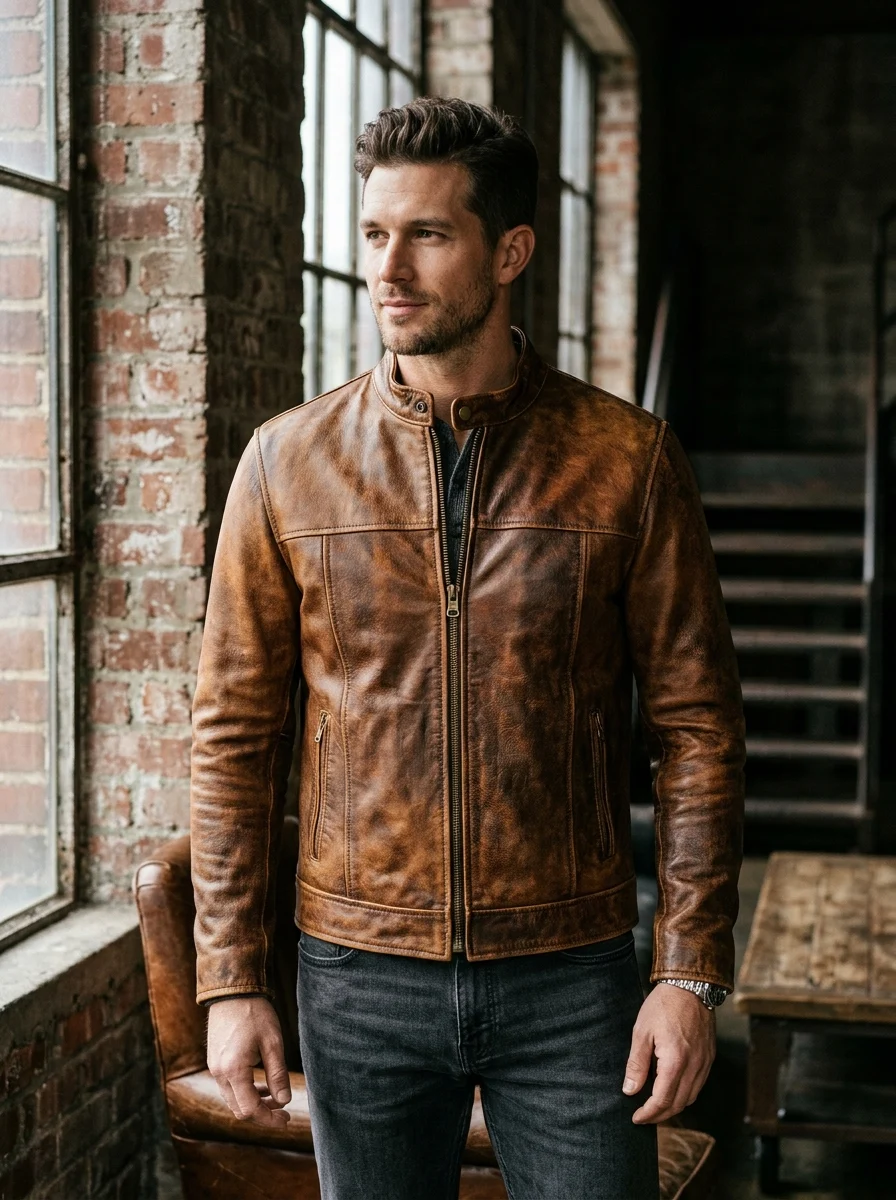
Wilsons Leather Jackets Sizing, Fit Architecture, and Style Heritage Guide
Comprehensive Wilsons Leather sizing chart, fit architecture, and heritage guide. Compare racer, bomber, and trucker silhouettes, hide grades, vintage inspection, and bespoke custom tailoring.
Key Takeaways
- Traditional American Sizing Foundations: Wilsons Leather silhouettes are built upon standardized North American pattern blocks, providing comfortable 3 to 5-inch chest ease across classic cuts.
- Era-Specific Pattern Variations: Vintage 1980s and 1990s pieces feature wide shoulder drops and boxy torsos, whereas post-2010 models feature slimmer, modern urban profiles.
- Silhouette Diversity: Fit architecture varies dramatically between high-armhole Cafe Racers (slim, aerodynamic), A-2 Flight Bombers (blouson drape with ribbed hem), and Suede Truckers (tailored box cut).
- Material Longevity Spectrum: Heavy vintage steerhide models easily achieve 30+ years of operational durability, while lightweight fashion lambskins require delicate seasonal maintenance.
- Artisanal Bespoke Solutions: For enthusiasts seeking heirloom construction without off-the-rack sizing discrepancies, Lux Wearz crafts made-to-measure outerwear from virgin full-grain hides.
Artisan Independence & Trademark Notice: Lux Wearz is an independent bespoke leathercraft atelier. All brand names, logos, and trademarks mentioned in this article (including Pelle Pelle®, Alpinestars®, Harley-Davidson®, Avirex®, Kawasaki®, Vanson®, Wilsons Leather®) belong exclusively to their respective trademark holders. Lux Wearz is not an authorized distributor, licensee, or affiliated partner of these brands. All brand references and historical retrospectives are made strictly for educational, comparative, and sizing review purposes under Fair Use. Lux Wearz specializes in custom-tailored, heirloom-grade genuine leather outerwear handcrafted individually in our private workshop.
What Is the Sizing Architecture of Wilsons Leather Jackets?
Wilsons Leather jackets follow classic American outerwear sizing architecture, engineered with 3 to 5 inches of chest circumference ease on standard contemporary cuts and 1.5 to 2.5 inches on cafe racer models. Archival vintage models from the 1980s and 1990s incorporate relaxed armholes and broad shoulder yokes, fitting slightly roomier than modern European-cut leather outerwear.
The Heritage of American Leather Outerwear: The Evolution of Wilsons Leather
The story of mainstream American leather outerwear is inextricably tied to the commercial expansion of specialized retail leather ateliers in the 20th century. Tracing its organizational roots back to Berman's The Leather Experts in 1930s Minneapolis and the later consolidation into Wilsons Leather in 1988, the brand became the premier shopping destination for millions of Americans seeking accessible leather fashion.
During the peak retail mall era of the 1990s, Wilsons Leather operated hundreds of storefronts across the United States. Their retail presence demystified leather garments for the broader public, transitioning leather outerwear from a subcultural uniform worn exclusively by outlaw motorcyclists, military aviators, and punk rock icons into an essential staple of everyday suburban and urban wardrobes.
From rugged cowhide motorcycle jackets engineered for highway wind-blocking to luxurious lambskin car coats and tailored blazers, the brand developed pattern templates that accommodated the diverse morphological spectrum of the American populace. Understanding this heritage is crucial when navigating vintage acquisitions or selecting contemporary leather garments, as the brand's pattern blocks underwent significant anatomical modifications across distinct manufacturing decades.
Core Silhouette Architectures and Fit Profiles
Outerwear performance and visual elegance depend on pairing your body mechanics with the correct silhouette template. Wilsons Leather developed three primary outerwear archetypes, each with distinct tailoring requirements:
1. The Cafe Racer & Asymmetrical Moto Jacket
Rooted in post-war British motorcycle racing culture, the cafe racer features a clean, upright mandarin collar secured by a solid brass or nickel snap, vertical zip chest pockets, and zippered sleeve gussets. The silhouette is streamlined and athletic, featuring a slight 2-inch drop from chest to waist. Because racer cuts are designed to prevent wind resistance at high velocity, they feature higher armscyes and narrower shoulder offsets. If you possess broad shoulders or muscular upper arms, selecting your standard dress shirt size in a racer cut may result in restricted bicep movement.
2. The Classic Flight Bomber (A-2 / G-1 Heritage)
Modeled after historic military aviation jackets, the flight bomber features a fold-down leather shirt collar (or detachable shearling accent), dual entry snap-flap front patch pockets, and heavy-gauge elasticized knit cuffs and waistband. The body is cut as a blouson, providing generous chest and back ease that pools slightly over the ribbed waist. This silhouette is exceptionally forgiving for individuals with muscular chests, stockier midsections, or those who frequently layer heavy fleece hoodies beneath their outerwear.
3. The Trucker & Western Shirt Jacket
Borrowing the iconic structural lines of 1960s denim trucker jackets, the leather trucker features pointed chest flap pockets, vertical front felled seams, and buttoned or snapped cuffs. Constructed from either supple split suede or tumbled lightweight cowhide, the trucker features a crisp, square shoulder silhouette with zero torso taper. It serves as an exceptional transitional mid-layer for spring and autumn layering.
Silhouette & Fit Architecture Matrix
The following matrix outlines the fundamental proportional differences, shoulder drops, and ease distributions across classic outerwear styles:
| Silhouette Model | Cut & Fit Type | Shoulder / Chest Offset | Ideal Body Profile | Leather Weight & Temper |
|---|---|---|---|---|
| Cafe Racer Jacket | Trim Athletic Moto | +2.5" to +3.5" Chest Ease; True Shoulder | Slim, Athletic, Lean Upper Frames | Medium-Heavy (1.2 mm), Firm Temper Cowhide |
| Flight A-2 Bomber | Blouson Relaxed Volume | +4.5" to +6.0" Chest Ease; 1.0" Drop Shoulder | Broad Chest, Muscular, or Stocky Builds | Medium (1.1 mm), Supple Drum-Dyed Cowhide |
| Suede Trucker Jacket | Tailored Square Box | +3.0" to +4.0" Chest Ease; Crisp Shoulder Line | Slim to Average Builds, Layered Outfits | Lightweight (0.9 mm), Velvety Cowhide Suede |
| Suburban Car Coat | Straight Thigh-Length | +4.0" to +5.5" Chest Ease; Natural Slope | Tall, Broad, or Professional Demographics | Supple (1.0 mm), Aniline Tumbled Lambskin |
| Bespoke Lux Wearz Atelier | Ergonomically Tailored Made-to-Measure | Calibrated to Exact Anatomy (+3.5" Ease) | All Body Types & Custom Dimensions | Ultra-Premium (1.2 mm) Virgin Full-Grain Cowhide |
Technical Sizing Architecture: Chest Circumference, Sleeve Pitch, and Torso Length
Selecting the correct size requires evaluating four distinct anatomical axes: horizontal chest circumference, shoulder blade span, vertical torso length, and sleeve forward-articulation pitch.
1. Chest Circumference and Bicep Clearance
When assessing off-the-rack sizing, the exterior chest measurement (pit-to-pit doubled) must provide adequate clearance for your pectorals, latissimus dorsi, and scapular expansion. A common failure point in vintage jacket shopping is overlooking bicep circumference. Many vintage cafe racers feature tapered sleeves that measure only 14 to 15 inches around the upper bicep in a size Medium. If your flexed arm measures 14.5 inches, the leather will bind uncomfortably across your triceps when bending your arms.
2. Forward Sleeve Pitch and Motorcycle Articulation
Unlike formal suit jackets where sleeves hang vertically parallel to the torso, motorcycle-inspired jackets incorporate a pre-curved forward sleeve pitch. The sleeve pattern is rotated 15 to 25 degrees forward at the shoulder seam to accommodate the reaching posture of gripping handlebars or steering wheels. When wearing a jacket with forward sleeve pitch while standing upright, slight folds naturally appear behind the triceps; this is not a tailoring defect but an intentional ergonomic feature designed to prevent binding across the back when reaching forward.
3. Torso Drop and Waist Placement
The relationship between back length and waist placement determines whether a jacket visually elongates your legs or cuts your torso awkwardly. Cafe racers and cropped bombers are designed to terminate exactly at the beltline (approximately 24 to 26 inches back length on a standard size Medium). This high stance prevents the leather from bunching up into your stomach when seated in a vehicle. Conversely, car coats and suburban jackets extend 30 to 34 inches, covering the hip line and upper thighs for enhanced thermal protection against wind.
4. Armscye Depth and Mobility Thermodynamics
The armscye—the circular seam where the sleeve joins the jacket torso—exerts an enormous influence on upper body mobility. Low-cut armholes, common in mass-market fashion jackets, allow easy entry for various body shapes but cause the entire body of the jacket to lift upward whenever you raise your arms. Higher, ergonomically curved armholes keep the jacket torso anchored firmly in place while allowing full 360-degree shoulder rotation. In bespoke tailoring at Lux Wearz, armscyes are precision-cut to the client's shoulder depth, maximizing freedom of movement without generating unsightly armpit bulk.
5. Shoulder Yoke Geometry and Clavicle Pitch
The slope of a person's shoulders varies from square (near horizontal) to sloped (steep drop). Standard mass-production outerwear utilizes an averaged 18-degree shoulder slope. Wearers with athletic square shoulders frequently experience collar pulling against the base of their neck, while wearers with sloped shoulders find diagonal wrinkles radiating from the collar to the armpits. Understanding your shoulder angle is vital before selecting between structured cafe racer shoulders and relaxed drop-shoulder flight jackets.
Material Metallurgy, Hide Tannages, and Tensile Performance
The real-world lifespan of a leather jacket is dictated by the cellular density of the hide, the tanning method employed, and the tensile strength of the stitching thread. The following matrix compares the structural performance of various hide categories and component trims:
| Component / Hide | Leather Grade & Tannage | Thickness (mm) | Weather Resistance | Expected Longevity | Maintenance Needs |
|---|---|---|---|---|---|
| Heavyweight Cowhide | Full-Grain Drum-Dyed Chrome Tannage | 1.2 - 1.3 mm | High; dense fiber barrier | 35+ Years | Annual conditioning with natural balm |
| Tumbled Lambskin | Aniline-Dyed Naked Lambskin | 0.8 - 0.9 mm | Moderate; susceptible to scuffs | 12 - 18 Years | Delicate cream treatment every 6 months |
| Split Cowhide Suede | Buffed Chrome-Tanned Split | 1.0 - 1.1 mm | Low; requires water repellent spray | 15 - 25 Years | Suede brush and rubber eraser cleaning |
| Dual-Density Wool Knit | Acrylic / Spun Wool Blend | 3.0 mm Gauge | Moderate; prone to friction pilling | 8 - 12 Years | Wool de-pilling comb and dry storage |
| Antiqued Brass Zippers | Heavy Gauge Solid Brass (YKK #8) | N/A | Outstanding; zero teeth breakage | Lifetime | Paraffin wax slider lubrication |
| Thermal Satin Lining | Polyester Twill / 100g Batting | 1.5 mm Lofty | High abrasion resistance | 20+ Years | Spot cleaning and dry hanging |
Tannage Science: Chrome Tannage vs Semi-Aniline Patina Dynamics
Modern consumer leather jackets utilize chrome tanning (chromium sulfate mineral salts) because it yields supple, water-resistant hides with uniform coloration and high thermal resilience. Chrome-tanned cowhide withstands sudden rain showers without spot staining and retains pliable drape in sub-zero winter temperatures. Conversely, pure vegetable tanning uses tree bark extracts to yield dense, rigid leather that softens gradually and absorbs ambient oils over decades. At Lux Wearz, our bespoke atelier utilizes semi-aniline drum-dyed full-grain hides. This tanning technique preserves the natural open pore grain of virgin cowhide while infusing nourishing micro-waxes, delivering the instant softness of chrome leather with the magnificent patina-developing potential of traditional heritage tannages.
Pre-Owned Vintage Inspection Checklist: Spotting Structural Defects
Vintage retail leather jackets from the 1990s and early 2000s are readily available on online resale platforms. While many represent great bargains, uneducated buyers often purchase garments requiring hundreds of dollars in restoration work. Follow this practical four-point inspection framework before buying:
1. Collar Grease and Sweat Saturation
The neck collar absorbs more human sebum, hair oils, and skin perspiration than any other zone on a leather jacket. Over decades of unconditioned wear, these oils oxidize and turn the leather dark, tacky, and rigid. Run your fingers along the interior collar fold. If the leather feels stiff, gummy, or emits an unpleasant rancid odor, the collagen fibers have sustained permanent lipid contamination that cannot be washed away.
2. Sleeve Cuff Lining Shredding
Because cuffs experience constant friction against watch bands, jewelry, and coat sleeves, the delicate polyester or acetate lining fabric at the interior cuff opening is frequently frayed to ribbons on pre-owned jackets. Replacing cuff linings requires dismantling the sleeve seam and installing new fabric rings, which can cost $60 to $100 per sleeve at a leather alterations atelier.
3. Pocket Welt Tear Stress
Inspect the upper and lower corners of horizontal slash hand pockets. Because previous owners routinely stuffed their hands into pockets while walking, immense downward torque is exerted on the corner bar-tacks. If the exterior leather grain has torn past the stitch line, repairing the hole requires installing an unsightly exterior patch or an interior hide reinforcement anchor.
4. Corrected Grain Peeling vs True Patina
Authentic full-grain leather develops a rich, luminous patina over decades as natural friction buffs the surface. In contrast, lower-tier corrected-grain leather—which was sanded flat and coated with an artificial polyurethane pigment film—does not develop a patina. Instead, the plastic coating cracks and peels away in micro-sheets, revealing pale, fibrous split leather underneath. Once plastic-coated leather begins delaminating, it cannot be conditioned or repaired.
Featured Silhouette Retrospective: Curated Heritage Leather Outerwear
For modern style enthusiasts who appreciate the enduring silhouettes of classic American leather outerwear but demand pristine leather quality, contemporary tailored proportions, and virgin craftsmanship, Lux Wearz offers a distinctive curated selection of genuine leather jackets. Explore these highlighted designs currently featured in our store:
1. Racing Dynamism: Gianna Leather Striped Racer Jacket
A striking homage to retro motorsport velocity, the Gianna Leather Striped Racer Jacket features contrast racing sleeve striping, an upright snap collar, and zippered hand pockets. Handcrafted from supple drum-dyed black cowhide, its tailored cut delivers an assertive silhouette that transitions effortlessly from open highway rides to elevated evening social styling.
2. Cropped Urban Edge: Twila Cropped Leather Bomber Jacket
Modernizing classic aviation blouson proportions for contemporary streetwear, the Twila Cropped Leather Bomber Jacket features a high-waisted cropped hem, relaxed drop shoulders, and a heavy-gauge central zipper. Crafted from glove-soft leather, it balances structural volume with modern feminine tailoring.
3. Velvety Western Elegance: Vivianne Lightweight Suede Trucker Jacket
Presenting a rich tactile profile, the Vivianne Lightweight Suede Trucker Jacket reimagines the timeless American trucker jacket in plush, fine-nap suede. Featuring pointed chest flap pockets and tonal stitch accents, it provides the ideal lightweight layer for transitional spring and fall ensembles.
4. Flight Deck Authority: Women's Cropped Lightweight Leather Aviator Jacket
Channeling authentic military aviator heritage with an updated silhouette, the Women's Cropped Lightweight Leather Aviator Jacket features an expansive shearling-accented collar, buckle throat latch, and asymmetric zipper closure. It delivers cold-weather insulation without the excessive weight of vintage military flight jackets.
5. Timeless Casual Sophistication: Monty Shirt Collar Zip Jacket
A masterclass in understated elegance, the Monty Shirt Collar Zip Jacket showcases a refined fold-down shirt collar, clean vertical slash pockets, and a streamlined front zip closure. Tailored from premium full-grain leather, it is the consummate versatile jacket for professional, casual, and travel occasions.
Handcrafted Bespoke Tailoring at Lux Wearz: Perfect Fit Without Compromise
The primary challenge with off-the-rack leather outerwear has always been anatomical variance. Standard sizing blocks assume that a person with a 42-inch chest has standard 34-inch sleeve lengths and a 34-inch waist. In reality, athletes, tall individuals, and broad-shouldered enthusiasts routinely find off-the-rack garments either too short in the sleeves, too tight across the back, or billowing excessively around the midsection.
At the Lux Wearz artisan workshop, we solve this dilemma through our bespoke made-to-measure program. By commissioning your outerwear through our Custom Order Atelier, you collaborate directly with leathercraft specialists who draft a one-of-a-kind pattern tailored to your body:
- Virgin Full-Grain Leather Sourcing: We bypass cheap split leathers and bonded scrap materials entirely, selecting only virgin drum-dyed full-grain cowhide and lambskin that will age gracefully and endure decades of wear.
- Bespoke Anatomical Drafting: Every garment is cut based on your precise chest circumference, shoulder width, armhole depth, sleeve length, and torso drop, guaranteeing a fit that moves with you like a second skin.
- Industrial Metallurgy: We utilize solid brass and antiqued nickel YKK zippers with reinforced sliders, ensuring smooth, snag-free closure and lifetime durability.
- Thermal & Aesthetic Customization: Choose your preferred lining weight—from lightweight breathable silk satin for temperate climates to diamond-quilted 150g Thinsulate thermal batting for freezing winters.
Initiate your bespoke project today by visiting our Custom Order Portal or reviewing our comprehensive sizing specifications in our Online Size Guide.
Practical Outerwear Sizing Protocol: Step-by-Step Measurement Guide
To ensure complete sizing accuracy when ordering from our Wilsons Leather Collection or creating a custom jacket, utilize the following standardized measurement procedure:
1. Chest Circumference
Stand naturally with arms relaxed at your sides. Wrap a cloth tailor's tape horizontally around the fullest part of your chest, passing directly beneath your armpits and across your shoulder blades. Ensure the tape is snug but not constricting. Note the exact circumference.
2. Shoulder Seam Width
Measure across the upper back from the tip of the left acromion bone (the bony prominence at the shoulder edge) to the tip of the right acromion bone. On tailored cafe racers, the jacket seam should align exactly with this bone. On blouson bombers, the seam may drop 0.75 to 1.5 inches outward to facilitate arm rotation.
3. Sleeve Length from Shoulder to Wrist
With your arm slightly bent at a 45-degree angle, measure from the shoulder seam point down the outer curvature of your elbow to the prominent bone on the outside of your wrist. Add 0.5 inches to this measurement to allow for natural leather creasing along the elbow over time.
4. Back Torso Length
Measure from the base of the back collar (the prominent C7 cervical vertebra at the base of your neck) straight down to your desired termination point at your beltline or mid-hip.
Preserving Your Leather Outerwear: Cleaning, Conditioning, and Storage
Proper leather maintenance is essential to prevent fiber desiccation and preserve hide flexibility over the lifetime of your garment:
- Conditioning Frequency: Apply a small amount of premium, wax-free leather conditioner to full-grain cowhide once per year. Work the conditioner in circular motions with a soft microfiber cloth, allowing it to penetrate for 24 hours before buffing off excess residue.
- Suede Care Discipline: Never apply oil-based conditioners to suede or nubuck leathers. Use a dedicated brass-bristle suede brush to raise the nap and remove surface dust. Treat suede garments with a fluorocarbon-free water-repellent spray prior to wearing in wet conditions.
- Proper Off-Season Storage: Store your jacket in a cool, dry closet away from direct UV sunlight. Always utilize wide, contoured wooden hangers to distribute the weight across the shoulder pads, and encase the garment in a breathable cotton garment cover.
For additional leather preservation techniques, review our complete Leather Care Guide.
Discover Artisan Leather Outerwear at Lux Wearz
Whether you are drawn to the timeless appeal of classic cafe racers, the utilitarian comfort of flight bombers, or the tactile elegance of fine suede truckers, quality leather outerwear is a foundation piece that elevates every wardrobe.
Explore our curated Wilsons Leather Outerwear Selection, browse our broader catalog of handcrafted Men's Leather Jackets, or collaborate with our master tailors on a personalized piece via our Custom Order Atelier.
Visit our Main Product Catalog today and experience the timeless durability and bespoke elegance of genuine leather outerwear crafted by Lux Wearz.
Explore The Full 2026 Leather Outerwear Collection
Vegetable-tanned full-grain cowhide, buttery New Zealand lambskin, and heritage Melton wool. Free express delivery across the USA with 30-day hassle-free returns.