
Kawasaki Leather Jackets Sizing, Fit Architecture, and Style Heritage Guide
Comprehensive Kawasaki motorcycle leather jacket sizing, fit architecture, and style heritage guide. Compare track cuts vs street fits, hide thickness, and custom bespoke alternatives.
Key Takeaways
- Track vs Street Ergonomics: Kawasaki motorcycle leather outerwear features race-derived pre-curved sleeves, an aggressive forward-rotated shoulder pitch, and an athletic taper designed specifically for tucked sportbike riding positions.
- Chest Ease & Drop Ratios: Authentic racing cuts provide a close-to-body 2-inch to 3-inch chest ease allowance over base layers, while street-oriented textile and leather crossover jackets offer a more relaxed 4-inch drop accommodating casual streetwear layers.
- Hide Tensile Resilience: Premium motorsport garments utilize 1.2mm to 1.4mm high-density top-grain and full-grain cowhide, engineered to withstand abrasion forces exceeding standard fashion leather jackets by over 400 percent.
- Hardware & Seam Integrity: Track-grade jackets require burst-resistant safety seams stitched with bonded nylon v69 or v92 thread, backed by heavy-duty YKK #8 or #10 vision zippers and internal CE Level 1 or Level 2 armor pockets.
- Bespoke Tailoring Advantage: For riders outside standard off-the-rack sizing metrics, ordering a handcrafted custom-tailored leather jacket from Lux Wearz guarantees anatomical shoulder alignment, precise sleeve reach, and heirloom build quality.
Artisan Independence & Trademark Notice: Lux Wearz is an independent bespoke leathercraft atelier. All brand names, logos, and trademarks mentioned in this article (including Kawasaki® and related trademarks) belong exclusively to their respective trademark holders. Lux Wearz is not an authorized distributor, licensee, or affiliated partner of these brands. All brand references and historical retrospectives are made strictly for educational, comparative, and sizing review purposes under Fair Use. Lux Wearz specializes in custom-tailored, heirloom-grade genuine leather outerwear handcrafted individually in our private workshop.
How Do Kawasaki Motorcycle Leather Jackets Fit and What Is Their Sizing Architecture?
Kawasaki motorcycle leather jackets fit true to European athletic track sizing, featuring an aggressive taper from broad shoulders down to a narrow waist with pre-curved sleeves engineered for forward-leaning riding geometry. Riders seeking a relaxed daily streetwear silhouette or room for thermal underlayers should size up one full increment above standard chest measurements.
The Cultural Heritage and Racing Evolution of Kawasaki Leather Outerwear
The story of Kawasaki motorsport outerwear is inseparable from over five decades of superbike dominance, from the pavement-ripping two-stroke triples of the late 1960s to the modern supercharged Ninja H2 hyperbikes dominating global circuits. When Kawasaki unleashed the legendary Z1 900 in 1972, the motorcycle landscape shifted permanently toward uncompromising high-displacement performance. With that extreme mechanical output came the immediate necessity for specialized rider protection capable of managing high-velocity slides and thermal friction.
During the late 1970s and 1980s, professional road racers piloting factory Kawasaki machines demanded leathers that blended structural hide armor with fluid aerodynamic movement. Iconic racing legends donned emerald green, white, and obsidian black racing suits across the Isle of Man TT, World Superbike championships, and AMA Superbike battles. These track garments established an indelible aesthetic identity that trickled down directly into paddock culture, club racing circuits, and urban sportbike communities worldwide.
As sportbikes evolved throughout the 1990s with the iconic ZX-7R and into the 2000s with the razor-sharp ZX-10R and ZX-6R platforms, the architecture of performance riding jackets transitioned from boxy cowhide shields into anatomically sculpted second skins. Advanced perforation zones, accordion leather stretch panels at high-stress pivot points, and low-profile aerodynamic speed humps became signature hallmarks. Today, enthusiasts seek out vintage and contemporary racing graphic jackets not merely for functional track-day protection, but as high-octane statements in modern motorsport streetwear. Discerning riders and collectors frequently browse the comprehensive Kawasaki Brand Outerwear Catalog at Lux Wearz to explore racing silhouettes that celebrate this rich legacy.
Anatomical Sizing Architecture: Deconstructing the Track Cut vs Street Cut
Navigating the sizing matrix of high-performance motorsport leather requires understanding the anatomical mechanics of the human body in motion. Unlike traditional lifestyle leather jackets or casual bombers that fall straight down from the clavicle, a genuine sportbike leather jacket is built around the rider's tucked posture on a clip-on handlebar machine.
Chest Circumference and Radial Ease
In an authentic race-spec track jacket, the chest dimension is tailored with minimal passive ease. If a rider measures a 40-inch chest around the fullest circumference below the pectoral muscles, a size 40 (Euro 50) track jacket will measure approximately 42.5 to 43 inches in actual garment chest circumference. This modest 2.5 to 3 inches of functional ease ensures that the jacket stays flush against the rider's torso at 150 miles per hour, preventing high-speed buffeting, aerodynamic flutter, and garment shift during an unexpected slide. However, when standing upright in a showroom or coffee shop, this athletic taper can feel snug across the chest and tight through the armpits.
For riders intending to wear their jacket primarily for highway cruising, weekend commuting, or urban streetwear, this competition fit can feel overly restrictive. In daily use, you will likely wear a cotton t-shirt, thermal waffle knit, or light fleece underneath. Under these conditions, adopting a 4-inch to 5-inch chest ease allowance is recommended, which often corresponds to sizing up one full standard size. You can consult the detailed Lux Wearz Size Guide to cross-reference chest dimensions, torso height, and shoulder breadth before selecting your target garment.
The Shoulder Pitch and Pre-Curved Articulated Sleeves
The single most distinctive architectural feature of sportbike leather jackets is sleeve rotation. When standing naturally at rest, human arms hang vertically with thumbs pointing slightly forward. In contrast, operating a sportbike places the hands forward and low, bending the elbows at approximately a 35 to 45 degree angle while spreading the scapula outward across the upper back.
To prevent leather bunching in the elbow crook and pulling taut across the back, technical riding jackets feature pre-curved sleeve panels cut from multi-piece leather patterns. When you hold an unbranded race jacket on a hanger, the sleeves naturally curl forward. If you attempt to raise your arms above your head or drive a car while wearing an aggressive track jacket, the front collar will press against your throat and the back will bind. This is not a manufacturing defect; it is deliberate biomechanical tailoring calibrated for two-wheeled dynamics.
Torso Length and the Ergonomic Drop
Motorcycle jackets feature an asymmetric hemline known as a dropped tail or kidney extension. The front hem terminates relatively high—often precisely at the belt buckle or slightly above—to prevent the jacket leather from crumpling upward against the fuel tank when the rider leans forward into a full tuck. Conversely, the rear hem extends two to three inches lower to maintain continuous hide coverage over the lower lumbar spine, even when the rider stretches forward across an extended wheelbase.
The taper ratio from chest to waist—frequently referred to as the "drop"—in a competition racing jacket averages between 6 and 8 inches. A jacket with a 42-inch chest will typically feature a 34-inch to 36-inch waistband. For athletic individuals with a V-taper physique, this design provides an immaculate sculpted fit. For riders carrying broader midsections or fuller builds, track cuts can bind excessively at the hips and waist, making made-to-measure tailoring through the Lux Wearz Custom Order Atelier the ideal route to achieving balanced comfort.
Table 1: Silhouette & Fit Architecture Matrix
The following matrix breaks down the primary silhouette styles encountered across motorsport-inspired leather riding outerwear, comparing their fit dynamics, drop ratios, and anatomical profiles:
| Silhouette Model | Cut & Fit Type | Shoulder / Chest Offset | Ideal Body Profile | Leather Weight & Temper |
|---|---|---|---|---|
| Track Spec One-Piece Race Suit | Full Competition Aerodynamic | +2.0 in chest / -8.0 in waist taper | Athletic V-shape, lean build, track riders | 1.3–1.4mm Heavyweight Cowhide, High Temper (Stiff) |
| Ninja Sportbike Graphic Jacket | Aggressive Sport Ergonomic | +3.0 in chest / -6.0 in waist taper | Athletic to moderate builds, sport riders | 1.2–1.3mm Top-Grain Cowhide, Medium-Firm Temper |
| Track Paddock Heritage Jacket | Relaxed Paddock / Street Moto | +4.0 in chest / -4.0 in waist taper | Average to broader builds, urban commuters | 1.1–1.2mm Supple Milled Cowhide, Medium Temper |
| Vintage Racing Replica Blouson | Boxy Retro Track Cut | +5.0 in chest / -2.0 in waist taper | Broad shoulders, classic street silhouette | 1.2mm Semi-Aniline Steerhide, Firm Vintage Temper |
| Commuter Textile-Leather Hybrid | Ergonomic Touring Hybrid | +4.5 in chest / -3.0 in waist taper | Versatile multi-layering, all rider types | 1.2mm Cowhide with 600D Ballistic Cordura inserts |
| Bespoke Handcrafted Atelier Moto | Anatomical Custom Made-to-Measure | Customized to 0.25-inch client specs | Any body profile, non-standard proportions | 1.2–1.4mm Virgin Full-Grain Cowhide, Calibrated Temper |
Leather Hide Durability, Tannage Metallurgy, and Seam Construction
A high-performance leather jacket is an active protective shield against kinetic impact and frictional pavement heat. The fundamental protective capability of any motorcycle jacket resides in the microscopic collagen fiber density of its hides, the chemical stability of its tannage, and the tensile shear threshold of its joining seams.
Full-Grain vs Top-Grain Bovine Hide Selection
The outermost layer of animal hide, known as the epidermis and upper grain layer, contains the tightest, most densely interwoven bundle of protein collagen fibers. In virgin full-grain cowhide, this surface layer remains completely un-buffed and unaltered. Full-grain hides provide the absolute maximum tear resistance, tensile shear strength, and natural weather repulsion. When subjected to abrasion across high-grit asphalt, full-grain leather resists shredding and abrades slowly through friction-induced burnishing rather than structural fiber failure.
Top-grain leather, by comparison, involves lightly shaving or buffing the upper grain to remove minor surface imperfections before applying a pigmented topcoat. While offering a more uniform cosmetic appearance and slightly softer initial break-in period, top-grain leather sacrifices roughly 15 to 20 percent of its tensile shear strength compared to untreated full-grain hide. Budget fashion replicas frequently employ split-grain leather coated with polyurethane (bicast), which offers virtually zero kinetic abrasion resistance and can disintegrate within milliseconds upon tarmac contact. At Lux Wearz, all handcrafted garments utilize premium genuine leather hides selected specifically for durability, tactile substance, and longevity.
Vegetable vs Chrome Tannage and Drum-Dyeing Metallurgy
Motorcycle apparel hides are overwhelmingly chrome-tanned using trivalent chromium salts. Unlike traditional vegetable tanning—which utilizes tree bark tannins to produce stiff, water-sensitive tooling leather—chrome tanning yields hides with high thermal tolerance, supple drape, excellent tensile elongation, and superior resistance to perspiration and road spray. Premium hides undergo full drum-dyeing, a process where aniline dyes permeate through the entire cross-section of the leather rather than merely coating the exterior surface. This ensures that when the jacket develops natural scuffs or surface abrasions, the color remains uniform rather than revealing raw pale fiber underneath.
Seam Tensile Thresholds and Safety Stitching Architecture
The most common structural failure point in crashed motorcycle jackets is not hide puncture, but seam burst. When a rider slides, pavement friction exerts massive multidirectional shearing forces across garment seams. To meet stringent safety standards, high-performance motorsport jackets employ multi-needle safety seam architecture.
A standard safety seam incorporates an external structural stitch and an internal hidden safety stitch buried beneath a folded leather seam allowance. Even if the visible external thread is abraded away by road contact, the internal structural seam remains intact, holding the jacket panels together and keeping armor pockets firmly in place. Furthermore, seams must be sewn with high-tenacity bonded nylon thread (size v69 or v92) or bonded polyester, which offers extreme resistance to rot, UV degradation, and friction heat melting.
Table 2: Leather Hide & Hardware Durability Matrix
The following technical matrix evaluates the various hide grades, tannages, and hardware components used across motorsport and bespoke leathercraft outerwear:
| Component / Hide | Leather Grade & Tannage | Thickness (mm) | Weather Resistance | Expected Longevity | Maintenance Needs |
|---|---|---|---|---|---|
| Race-Spec Bovine Hide | Full-Grain Chrome-Tanned Cowhide | 1.3–1.4mm | High (water-resistant finish) | 20–30+ Years | Bi-annual conditioning, wax balm treatment |
| Paddock Street Bovine | Top-Grain Milled Cowhide | 1.1–1.2mm | Moderate (repels light drizzle) | 15–20 Years | Seasonal leather conditioner, spot cleaning |
| Lightweight Performance Lamb | Full-Grain Vegetable-Chrome Aniline | 0.8–0.9mm | Low to Moderate (absorbs heavy moisture) | 10–15 Years | Delicate cream conditioner, moisture protection |
| Heavy Steerhide Outer Shell | Full-Grain Semi-Aniline Steerhide | 1.4–1.5mm | Very High (dense fibrous shield) | 30–50+ Years | Annual deep conditioning, saddle soap cleansing |
| Hardware: Front Main Fastener | YKK #10 Heavy-Duty Brass / Vislon | Solid Brass / Cast Alloy | High (anti-corrosion electroplating) | 25+ Years | Occasional graphite or beeswax tooth lube |
| Seam Assembly Thread | High-Tenacity Bonded Nylon v92 | Continuous Filament Polymer | Impervious to road rot & UV | Lifetime of hide | Zero maintenance, inspect after impact |
Vintage Collector Inspection: Detecting Flaws in Pre-Owned Racing Leathers
The explosive resurgence of 1990s and 2000s motorcycle aesthetics in contemporary fashion has sparked a massive secondary market for vintage racing leather jackets. However, purchasing a pre-owned competition jacket presents severe hazards that casual shoppers routinely overlook. Because racing leathers are subjected to extreme sweat, atmospheric pollution, rain soaking, and potential track crashes, thorough physical inspection is mandatory before committing capital.
1. Detecting Concealed Crash Damage and Heat Friction Scars
The most critical inspection step is differentiating between charming cosmetic patina and structural crash damage. When a leather jacket slides across asphalt at high velocity, frictional heat causes localized melting, leather charring, and fiber embrittlement. Inspect the high-impact zones: the exterior elbow caps, shoulder crowns, and lower flanks. If the leather feels rock-hard, glassy, or brittle to the touch in localized patches, that hide has suffered extreme thermal trauma and its tensile strength has been permanently compromised. It will crack or tear under minimal stress and cannot be restored through conditioning.
2. Identifying Leather Dry-Rot and Protein Fiber Desiccation
Leather is an organic protein matrix consisting of cross-linked collagen fibers lubricated by microscopic fat liquors. If a vintage jacket has been stored for years in an unconditioned attic, damp basement, or under direct sunlight, those essential oils evaporate, causing irreversible dry-rot.
- The Flexibility Pinch Test: Gently pinch a 1-inch fold of leather between your thumb and forefinger on the back panel and bend it 180 degrees. If the surface shows hundreds of tiny micro-cracks or makes a faint crackling sound, the internal fibers are desiccated. Severe dry-rot cannot be reversed; conditioning products will merely darken the outer surface without restoring tensile flexibility.
- The White Efflorescence Check: Inspect interior folds for a chalky white film. If wiping with a damp cloth causes the white film to disappear and immediately reappear upon drying, it is likely crystallized salt from rider sweat. If it feels powdery and smells musty, it indicates active mold spore infestation that has digested the leather's inner tanning salts.
3. Evaluating Stitch Rot and Hardware Degradation
Vintage jackets manufactured in the 1980s and 1990s frequently utilized unbonded cotton-wrapped or low-grade synthetic threads that degrade over decades of exposure to body sweat and humidity. Firmly grasp two joined panels along the main back seam or sleeve seam and pull gently in opposing directions with 10 to 15 pounds of outward tension. If you observe the thread snapping or the stitch holes stretching open like elongated eyelets, the garment suffers from stitch rot and will require an expensive, complete panel restitch.
Similarly, examine the zipper teeth and sliders. Vintage racing jackets rely heavily on heavy-duty zippers. Check for missing zipper teeth at the bottom insertion pin, warped metal tracks, and oxidization (green verdigris on brass or white powdery corrosion on zinc sliders). Replacing a main front zipper on a heavy 1.3mm leather jacket requires specialized industrial walking-foot sewing machines and can cost upwards of $80 to $120 at a professional leather atelier. To properly maintain any genuine hide investment, review the complete Lux Wearz Leather Care Guide for expert preservation protocols.
Featured Silhouette Retrospective: Curated Motorsport Jackets in the Lux Wearz Catalog
For enthusiasts who appreciate authentic motorsport graphics, aggressive paneling, and technical leather construction without the decay, odor, and structural risks of 25-year-old pre-owned gear, the Lux Wearz Motorcycle & Racing Outerwear Collection offers masterfully built genuine leather options. Below is an in-depth retrospective of five standout models currently available:
1. Men's Kawasaki Ninja H2-Style Leather Jacket – Black Green
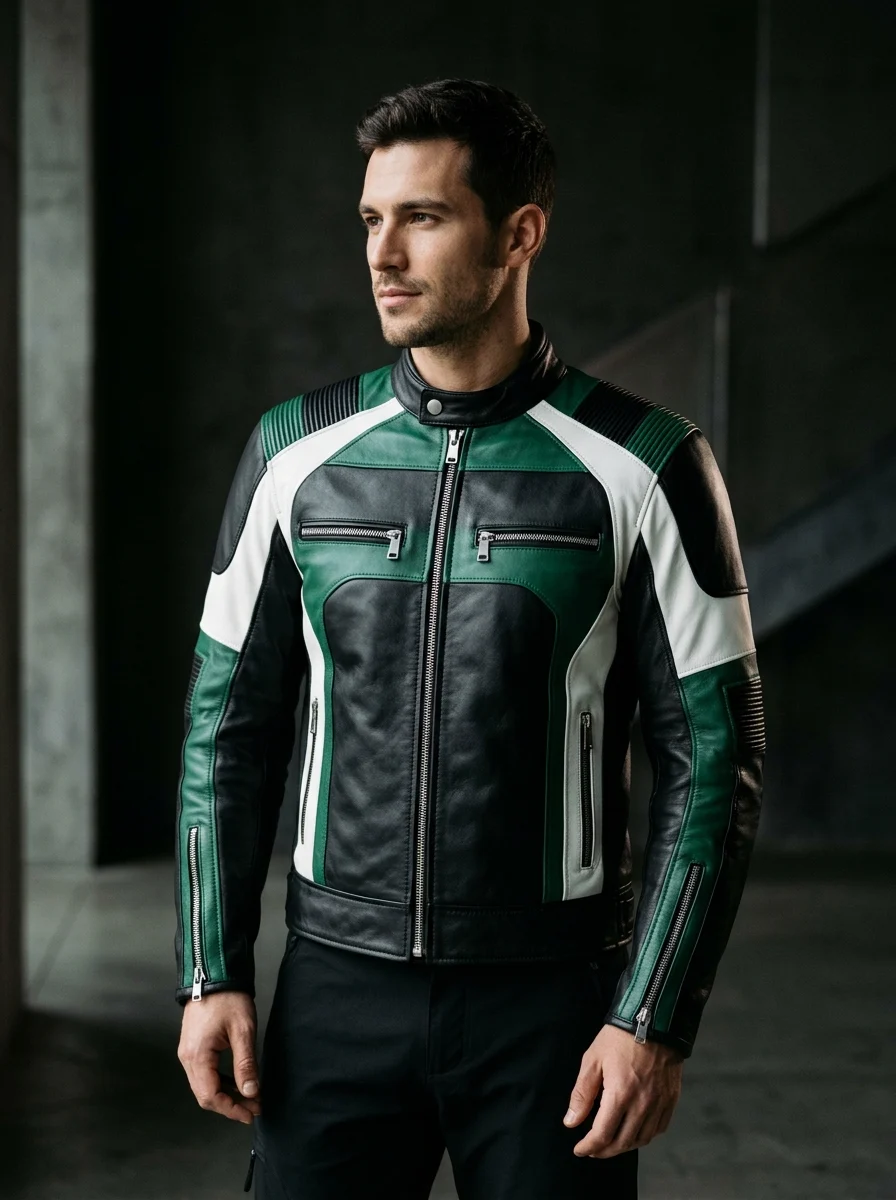
The Men's Kawasaki Ninja H2-Style Leather Jacket – Black Green represents the absolute pinnacle of contemporary hyperbike design translated into premium wearable leathercraft. Engineered with an aggressive sport cut, this piece combines obsidian black premium cowhide with vibrant emerald green graphic contrast panels that mirror the angular aerodynamics of the supercharged Ninja H2. The jacket features pre-curved sleeves, internal armor pockets at the shoulders and elbows, and an ergonomic low-profile mandarin collar with a soft microfiber rolled edge. Dual zippered waist vents allow micro-climate temperature regulation during spirited summer rides, while the dropped lumbar hem ensures full kidney coverage over sportbike fuel tanks. It is an exceptional balance of track-inspired aesthetics and everyday road versatility.
2. Kawasaki Graphic Leather Motorcycle Jacket – Black White
For riders who favor a monochromatic, high-contrast aesthetic that pairs seamlessly with raw denim or urban techwear, the Kawasaki Graphic Leather Motorcycle Jacket – Black White delivers timeless paddock presence. Constructed from 1.2mm milled top-grain bovine hide, this garment provides immediate out-of-the-box flexibility without sacrificing abrasion resistance. The bold white graphic paneling across the chest and upper sleeves pays homage to 1990s endurance racing liveries. Heavy-duty matte silver zippers, accordion leather stretch panels behind the armscye, and zippered wrist gussets provide precision adjustment over gauntlet gloves.
3. Kawasaki Racing Graphic Leather Jacket – Multicolor
Enthusiasts seeking the vibrant, maximalist energy of early 2000s World Superbike paddocks will gravitate toward the Kawasaki Racing Graphic Leather Jacket – Multicolor. This standout piece showcases intricate multi-panel leather inlay work, seamlessly integrating racing green, brilliant white, bold black, and dynamic accent tones. Each graphic panel is skived and perimeter-stitched with bonded nylon thread to prevent edge peeling under wind shear. The interior is lined with a breathable satin mesh that promotes continuous airflow, making it equally comfortable whether worn on the street or styled as a centerpiece in high-fashion streetwear ensembles.
4. Kawasaki Ninja Graphic Leather Jacket – Black Green White
Balancing aggressive modern streetfighter styling with functional touring comfort, the Kawasaki Ninja Graphic Leather Jacket – Black Green White is a perennial favorite among sport-touring and canyon riders. The jacket integrates strategic perforation zones across the chest and inner biceps to keep core temperatures regulated during intense warm-weather riding. Adjustable hook-and-loop waist tabs allow riders to dial in the waist taper precisely, accommodating varying underlayer thicknesses across changing seasons. Robust YKK brass hardware and reinforced elbow impact zones ensure this jacket stands up to years of aggressive road use.
5. Kawasaki Ninja Graphic One-Piece Leather Racing Suit – Black
For the ultimate closed-circuit track day weapon, the Kawasaki Ninja Graphic One-Piece Leather Racing Suit – Black represents uncompromising competition engineering. Handcrafted from heavy 1.3mm to 1.4mm full-grain cowhide, this one-piece suit is designed exclusively for the extreme body angles of competitive racing. It incorporates an aerodynamic speed hump to smooth helmet-to-back turbulence at high speeds, replaceable dual-density knee sliders, and extensive accordion expansion zones spanning the lower back, knees, and shoulder blades. Inside, internal compartments accommodate CE Level 2 armor across the back, chest, hips, shoulders, and shins. It is the definitive choice for track-day riders who refuse to compromise on structural integrity.
The Bespoke Custom Handcrafted Tailoring Alternative at Lux Wearz
While standard off-the-rack sizing matrices accommodate average proportional distributions, real human bodies rarely match generic retail sizing charts. An athletic rider may have a 44-inch muscular chest with a 32-inch waist and 26-inch arms, making standard commercial track jackets either choking at the shoulders or excessively baggy at the midsection. Similarly, taller riders frequently struggle with sleeve cuffs riding halfway up their forearms when reaching for clip-on handlebars.
This is precisely where the Lux Wearz Custom Order Atelier excels. As an independent bespoke leathercraft workshop, Lux Wearz builds made-to-measure leather outerwear tailored to over 15 specific anatomical measurements provided directly by the client.
Virgin Leather Hide Selection and Custom Tanning
When you commission a custom leather jacket through Lux Wearz, your garment begins with individual hide selection. Unlike commercial mass-production facilities that maximize yield by cutting pattern pieces across inferior belly leather and scarred flanks, our master cutters utilize only prime center-cut hides from virgin full-grain cowhide, durable steerhide, or supple lambskin. Each hide is inspected for uniform grain structure, calibrated thickness (from 1.1mm up to 1.4mm based on your riding or lifestyle requirements), and flawless temper.
Architectural Pattern Drafting and Personalized Ergonomics
Rather than grading an existing factory pattern up or down, our artisan patternmakers draft a unique individual paper pattern for your specific body. You specify the exact sleeve rotation angle, chest ease allowance, shoulder width, torso drop, and back length. If you wear specialized standalone back protectors or airbag vests (such as Tech-Air or Alpinestars systems), our master tailors calibrate the internal expansion gussets to accommodate deployment volume without restricting your breathing.
Hardware, Lining, and Interior Personalization
Every bespoke commission allows full creative control over functional and cosmetic hardware:
- Fasteners: Select from antique brass, gunmetal, polished nickel, or stealth matte black heavy-gauge YKK zippers with reinforced pull tabs.
- Linings: Upgrade from standard breathable mesh to diamond-quilted thermal thinsulate, luxurious Duchess satin, or authentic tartan wool for cold-weather versatility.
- Concealed Storage: Incorporate tailored internal pockets designed to securely hold smartphones, wallets, travel documents, or specialized EDC items.
Investing in a bespoke handmade jacket eliminates sizing guesswork, guarantees anatomical riding comfort, and results in an heirloom-grade garment built to last a lifetime. Explore the full Lux Wearz Online Store Catalog to view the complete range of craftsmanship options.
Explore The Full 2026 Leather Outerwear Collection
Vegetable-tanned full-grain cowhide, buttery New Zealand lambskin, and heritage Melton wool. Free express delivery across the USA with 30-day hassle-free returns.