
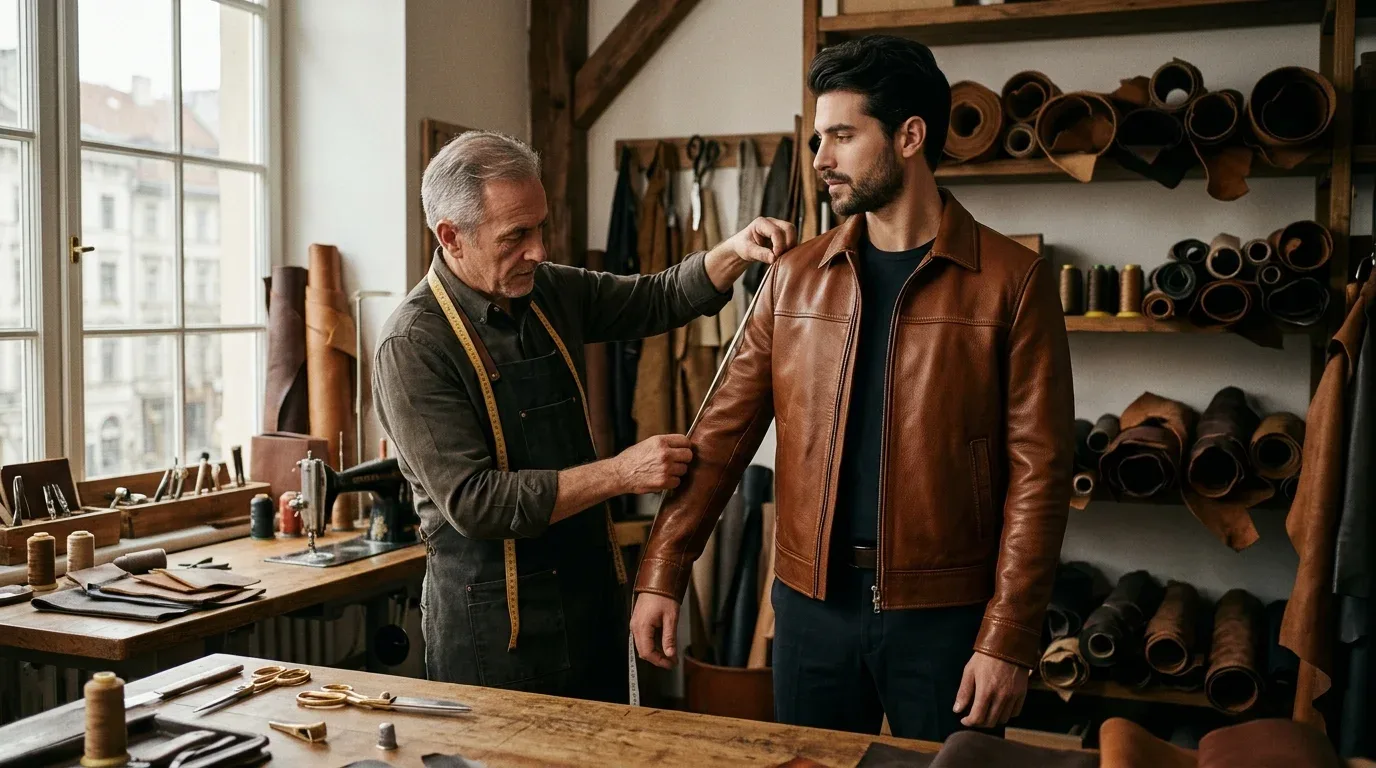
How Should a Leather Jacket Fit? The Size Guide That Actually Helps
Leather relaxes across the back and never in the shoulders — which changes how you should size it. Seven fit checkpoints, how to measure yourself, and what to do when you are between two sizes.
A properly fitting genuine leather jacket is unlike any other garment in your wardrobe. While textile coats, wool overcoats, and cotton denim jackets maintain predictable geometric lines, high-grade leather possesses living biological elasticity. When you slip on a handcrafted full-grain leather jacket for the first time, you are not merely wearing outerwear—you are beginning a physical molding process where the hide stretches, creases, softens, and permanently contours to your exact bone structure and movement habits.
However, sizing miscalculations in leather outerwear carry high consequences. Unlike soft knitwear, leather cannot simply shrink in the wash if it feels baggy, nor can a tailor easily recut the armholes or reshape the shoulder yoke without deconstructing the entire garment at considerable expense. Understanding exactly how a leather jacket should fit across the shoulders, chest, sleeves, and torso ensures you invest in an heirloom piece that flatters your silhouette on day one and feels like a bespoke second skin for decades to come.
Key Takeaways for Leather Jacket Sizing:
- Shoulder Seam Alignment is Non-Negotiable: The shoulder seam must terminate precisely at the tip of your acromion bone. Shoulder seams cannot be stretched or easily altered.
- Snug Chest with 2 to 3 Inches of Functional Ease: When zipped fully, the chest should sit close to the torso without horizontal pulling or lapel buckling.
- Sleeves Must Reach the Base of the Thumb: In a resting position, sleeves should end just past the wrist bone to accommodate the natural upward pull when raising your arms or riding.
- The Waistband Should Rest at the Belt Line: Classic biker, racer, and bomber silhouettes should sit at the natural waist or upper hip; only car coats, dusters, and parkas extend down to mid-thigh.
- Hide Tannage Dictates Sizing Strategy: Lightweight lambskin stretches rapidly (yielding up to 0.75 inches across stress zones), whereas heavy naked cowhide yields minimally and demands accurate measurements from day one.
How Should a Leather Jacket Fit on Your Body?
A leather jacket should fit snugly across your shoulders and torso, sitting significantly closer to your body than a conventional fabric winter coat while allowing unrestricted arm rotation. The shoulder seams must align directly with the outer edge of your shoulder bone, the sleeves should graze the base of your thumb, and the hem should rest cleanly at your belt line without flaring outward at the lower back.
When zipped completely, the jacket should feel pleasantly firm across your ribcage and chest—resembling a firm handshake rather than a constricting corset. There should be zero excess billowing leather bunched around the underarms, and no tension lines straining across the zipper teeth.
The Four Anatomical Anchor Points of Proper Leather Fit
Achieving an impeccable fit requires evaluating four critical anatomical anchor zones. If any of these four points are misaligned, the jacket will feel uncomfortable and drape poorly regardless of the leather quality.
1. The Shoulder Yoke & Acromion Point
The shoulder is the single most critical measurement on any leather jacket. If the shoulders do not fit, the entire jacket is the wrong size.
- The Correct Alignment: Locate the bony protrusion at the very outer edge of your shoulder (the acromion process). The top seam of the jacket sleeve must sit directly on top of this bone.
- The Oversized Symptom: If the seam droops over the curve of your upper arm into the triceps area, the jacket is oversized. This causes the chest to sag, creates unsightly vertical folds down the front torso, and makes you appear broader in an unflattering, slouchy manner.
- The Undersized Symptom: If the seam sits inward toward your neck on the clavicle, the armhole will dig into your anterior deltoid and armpit, severely restricting forward arm movement and causing the leather to bunch awkwardly when zipped.
- Tailoring Reality: While a skilled leather artisan can adjust chest waist seams, recutting a leather shoulder yoke involves removing both sleeves, cutting back the collar, and reshaping the front chest panels—a complex alteration that rarely preserves the jacket's original balance.
2. Chest Ease & High Armhole Depth
Chest measurement determines the functional circumference of the jacket when zipped. In tailoring, "ease" refers to the extra circumference built into a garment beyond your actual physical body measurement.
- Tailored / Slim Silhouette (+2.5 to +3.5 Inches of Ease): For cafe racers, minimalist trucker jackets, and modern double riders, the garment's flat chest pit-to-pit measurement multiplied by two should be 2.5 to 3.5 inches larger than your bare chest circumference. This provides a sleek, athletic silhouette intended to be worn over a t-shirt or fine merino sweater.
- Classic / Layered Silhouette (+4.0 to +5.5 Inches of Ease): For flight bombers, winter shearling aviators, and heavier riding jackets, 4 to 5.5 inches of total ease is necessary to accommodate chunky cable knits, thermal layers, or protective back armor without straining the front zipper.
- The High Armhole Advantage: Premium leather jackets utilize high, oval-cut armholes (scyes). A high armhole ensures that when you raise your arms, only the sleeve moves, keeping the torso of the jacket seated firmly on your body. Low, cheap armholes cause the entire jacket hem to lift up to your chest whenever you reach forward.
3. Sleeve Pitch & Wrist Break Geometry
Sleeve length in leather outerwear behaves differently than in cotton shirting or wool suiting because leather develops deep accordioned "creasing" along the inner elbow crease with wear.
- The Resting Position: When standing with your arms relaxed at your sides, the sleeve cuff should extend past the wrist styloid bone and rest cleanly between the base of your thumb and your first knuckle.
- The Creasing Shortening Effect: As full-grain cowhide or lambskin breaks in over the first several weeks, the leather compresses into permanent micro-rolls at the elbow. This organic creasing naturally pulls the cuff upward by 0.5 to 0.75 inches. If a leather jacket cuff ends precisely at your wrist bone when brand new, it will inevitably become too short once broken in.
- The Forward Reach Test: Extend both arms straight out in front of you parallel to the floor (simulating riding a motorcycle or holding a steering wheel). The cuffs should not ride up past your wrist bone, and the upper back leather across your shoulder blades should tighten comfortably without feeling like it will burst the center back seam.
4. Hemline Drop & Torso Taper
The vertical length of the jacket establishes the proportions of your entire outfit, visually elongating or truncating your leg line.
- Cropped / Waist-Length Cuts (Bikers & Bombers): Double riders and traditional flight bombers should terminate right at the top of your waistband or belt buckle (approximately 23 to 26 inches down from the base of the collar for an average male frame). This prevents the stiff leather from bunching up into your stomach when seated in a car or on a motorcycle.
- Mid-Hip Cuts (Truckers & Field Jackets): Casual shirt-collar leather jackets and trucker cuts sit slightly lower, reaching the middle of the back trouser pockets (25 to 27.5 inches in back length).
- Back Flare Inspection: Fasten the front zipper and inspect your reflection from the side profile. The back hem must hug the contour of your lower lumbar spine. If the back panel flares outward like a bell or creates a hollow tent behind your waist, the waist circumference is too large for your hip drop.
Table 1: Silhouette-Specific Fit Architecture Matrix
Different leather jacket archetypes demand distinct fit tolerances depending on their historical military or utilitarian origins:
| Silhouette Cut | Primary Cut Type | Chest Ease (Over Body) | Shoulder Offset Tolerance | Ideal Hem Position | Layering Capacity |
|---|---|---|---|---|---|
| Double Rider Biker | Asymmetrical Slim / Tapered | +2.5" to +3.5" | Exact acromion bone | Top of belt buckle | Single tee, thermal, or thin knit |
| Cafe Racer / Moto | Streamlined Minimalist | +2.0" to +3.0" | Exact acromion bone | Across mid-belt line | T-shirt or lightweight henley |
| A-2 Flight Bomber | Athletic Blouson / Ribbed Hem | +3.5" to +4.5" | 0.25" dropped ease | Natural waistline (ribbed) | Flannel shirt, sweatshirt, light knit |
| B-3 Shearling Aviator | Boxy Insulated Heavyweight | +5.0" to +6.5" | 0.5" dropped shoulder | Lower hip / crotch level | Heavy winter woolens & hoodies |
| Leather Trucker | Straight Torso Workwear | +3.0" to +4.0" | Exact acromion bone | Mid-rear pocket line | Heavy flannel, chambray, or tee |
| Leather Car Coat / Trench | Structured Tailored Drape | +4.5" to +6.0" | 0.5" shoulder drop | Mid-thigh to knee level | Tailored suit jacket or chunky knit |
Leather Hide Tannage & Elasticity Yield: How Different Hides Break In
One of the most widespread myths in menswear is that "all leather stretches equally." In reality, the tensile yield and stretching potential of a leather jacket are dictated by animal species, hide thickness, and the chemical tanning method employed.
1. Naked Full-Grain Cowhide (1.2mm – 1.4mm)
Full-grain cowhide is the global standard for rugged heritage outerwear and protective riding gear. Cowhide features an extremely dense collagen fiber weave that offers phenomenal abrasion resistance.
- Initial Fit Requirement: Must fit comfortably snug in the shoulders from day one.
- Yield Potential: Cowhide will stretch approximately 0.5 inches in high-stress zones (across the shoulder blades, upper chest, and elbow knuckles) where constant bodily tension is applied. It will never stretch in overall sleeve length or vertical torso length.
- Break-In Curve: Expect 40 to 60 hours of active wear before the stiff leather fibers begin yielding into custom molded creases.
2. Italian Plongé Lambskin (0.7mm – 0.9mm)
Lambskin originates from young sheep, producing an exceptionally fine grain with minimal natural scarring and an opulent, silky hand feel.
- Initial Fit Requirement: Must fit very close—almost tightly—when brand new.
- Yield Potential: Lambskin possesses high natural elasticity. Within two weeks of regular wear, lambskin relaxes noticeably, expanding up to 0.75 to 1.0 inch across the chest and upper back. If a lambskin jacket feels roomy or loose in the fitting room, it will look baggy and shapeless within a month.
- Break-In Curve: Virtually zero break-in period; molds to the wearer within 3 to 5 wearings.
3. Full-Grain Steerhide & Horsehide (1.3mm – 1.6mm)
Horsehide and heavyweight steerhide are dense, fibrous, and historically utilized in archival military flight gear and police motorcycle jackets.
- Initial Fit Requirement: Exact sizing is mandatory. Never buy a small horsehide jacket hoping it will "stretch to fit."
- Yield Potential: Minimal elasticity (less than 0.25 inches). Horsehide molds in three-dimensional contours and deep rolling arm creases rather than stretching outward.
- Break-In Curve: Extensive break-in required (often months of consistent wear).
4. Suede & Roughout Leather (1.0mm – 1.2mm)
Created by buffing the interior split of the hide, suede offers extraordinary drape, velvety texture, and immediate breathability.
- Initial Fit Requirement: True to size with moderate ease.
- Yield Potential: Because suede lacks the dense epidermal grain layer of full-grain leather, it exhibits high stretch and low memory resistance. Overstretching suede by wearing oversized bulky hoodies underneath can cause the elbows to permanently bag out.
Table 2: Leather Hide Stretch, Break-in Curve & Fit Behavior Matrix
| Leather Hide & Tannage | Leather Thickness (mm) | Initial Hand Temper | Tensile Stretch Yield | Break-In Hours Required | Sizing Strategy on Day One |
|---|---|---|---|---|---|
| Naked Full-Grain Cowhide | 1.2 – 1.4 mm | Firm & Structured | 0.4" – 0.6" (Torso stress points) | 40 – 60 hours | Snug across chest; exact shoulders |
| Plongé Italian Lambskin | 0.7 – 0.9 mm | Butter-Soft & Supple | 0.75" – 1.0" (Chest & waist) | 5 – 10 hours | Fitted & slim; lean smaller if between |
| Chrome-Tanned Goatskin | 0.9 – 1.1 mm | Flexible Pebble Grain | 0.3" – 0.5" (Cross-back) | 15 – 25 hours | True to size; flexible out of box |
| Heavy Archival Horsehide | 1.4 – 1.6 mm | Rigid & Board-Like | 0.2" (Negligible stretch) | 80 – 120 hours | Exact measurements; zero margin for error |
| Split Calf Suede | 1.0 – 1.2 mm | Velvety & Fluid Drape | 0.6" – 0.8" (High stretch risk) | Immediate | True to size; avoid heavy layered tension |
How to Accurately Measure Yourself for a Leather Jacket
Never use the tag size of your casual cotton t-shirts or sportswear to determine your leather jacket size. A t-shirt labeled "Large" often measures 44 to 46 inches across the chest with massive stretch, whereas a tailored size 42 leather jacket measures precisely 42 inches.
Use a flexible fabric tailor's measuring tape and record these four vital dimensions while wearing the base layer you plan to wear most frequently underneath:
┌────────────────────────────────────────────────────────┐
│           ANATOMICAL MEASUREMENT PROTOCOL              │
│ 1. Chest Circumference: Widest point under armpits     │
│ 2. Shoulder Width: Bone-to-bone across upper back      │
│ 3. Sleeve Length: Shoulder bone to wrist base          │
│ 4. Back Length: Base of collar seam to lower hem       │
└────────────────────────────────────────────────────────┘- Chest Circumference: Stand naturally with your arms hanging at your sides. Wrap the tape measure horizontally around the fullest part of your chest, just under your armpits and across your shoulder blades. Keep the tape level with the floor and breathe out normally. Add 2.5 to 3.5 inches to this number to find your ideal jacket chest size.
- Across-Shoulder Width: Turn around and have a partner measure straight across the upper back from the tip of your left acromion shoulder bone to the tip of your right acromion shoulder bone, following the natural curve of your upper traps.
- Sleeve Outseam Length: Place the tape at the tip of your shoulder bone and run it down the outside of your arm, passing over the elbow with a slight natural bend, down to the prominent bone of your wrist (the ulnar styloid). Add 0.5 inches for the break-in creasing factor.
- Center Back Length: Measure down the center of your back from the base of the collar seam straight down to your natural belt line.
For complete measurement walkthroughs and international conversions, consult our dedicated Size and Fit Architecture Guide.
The Layering Dilemma: How to Fit for Both T-Shirts and Hoodies
The most common sizing dilemma is choosing whether to size your leather jacket for a lightweight t-shirt or a heavyweight winter hoodie.
If you size up to accommodate a thick fleece hoodie, the jacket will look sloppy, boxy, and dropped in the shoulders on the 70% of days when you only wear a t-shirt underneath. Conversely, if you size strictly for a skin-tight t-shirt, wearing a light sweater will cause uncomfortable armpit constriction and horizontal zipper tension.
The Professional "Two-Finger Rule" Solution:
When testing the fit of a zipped leather jacket over your standard everyday shirt:
- Slide your flat hand inside the front chest panel. You should be able to slide two fingers comfortably between your chest and the leather.
- If you can fit an entire clenched fist inside without stretching the leather, the chest is too roomy.
- If you cannot slide two fingers flat against your sternum without straining the zipper seams, the jacket is too tight and will restrict circulation when seated.
- This two-finger tolerance provides the exact margin required to slip on a fine-gauge cashmere sweater or lightweight flannel shirt without altering the jacket's sleek exterior drape.
Featured Handcrafted Silhouettes in the Lux Wearz Atelier
At Lux Wearz, every outerwear piece is engineered around distinct anatomical fit profiles. When selecting your next leather heirloom, explore these masterfully crafted silhouettes from our live collection:
- Varsity & Oversized Architectural Fit: If you favor an athletic, drop-shoulder silhouette with bold heritage panelling, examine the Pelle Pelle Detroit Quilted Jacket or the iconic archival Pelle Pelle Picasso Plush. These cuts incorporate relaxed chest ease and wide ribbed cuffs engineered for effortless layering.
- Streamlined Cafe Racer Architecture: For riders and urban minimalists demanding a second-skin torso profile with high-speed wind resistance, explore the Gianna Leather Striped Racer Jacket. This silhouette utilizes forward-rotated sleeves and zero waistband bulk for maximum aerodynamic agility.
- Clean Workwear Shirt-Collar Cut: For everyday versatility that pairs effortlessly with tailored trousers or raw denim, the Monty Shirt Collar Zip Jacket provides clean vertical seams with generous mid-torso comfort.
- Modern High-Waist Cropped Silhouette: For contemporary streetwear styling that elongates the leg line, the Twila Cropped Leather Bomber Jacket delivers an impeccably tailored high-hip break with premium antiqued brass hardware.
To explore all silhouettes across heritage racing, varsity cuts, and classic bombers, browse our Complete Men's Leather Jacket Collection or inspect our Full Storefront Catalog.
Common Leather Fit Flaws & Alterations Reality
Before buying or keeping a leather jacket, run through this troubleshooting checklist to verify whether fit imperfections can be remedied:
- The Upper Back "Batwing" Bulk: If large folds of leather sag below your shoulder blades when your arms are resting, the back panel circumference is too wide for your frame.
- The Sleeve Bicep Balloon: If the sleeve upper circumference billows out like a flight suit while the wrist is tight, the sleeve pitch was cut for heavy muscular arms. Narrowing leather sleeves is possible but requires opening the lining and underarm seam.
- Can Leather Sleeves Be Shortened? Yes, but design details dictate feasibility. Plain-cuff sleeves without zippers can be shortened easily from the cuff. However, sleeves featuring functional wrist zippers, snap gussets, or cuff ribbing must be shortened from the top of the sleeve cap at the shoulder—a precision alteration requiring an expert master furrier or leather craftsman.
- Maintaining Supple Fiber Health: To prevent rigid leather from hardening, cracking, or losing its anatomical memory, clean and condition your jacket bi-annually following our archival Leather Care and Conditioning Guide.
The Bespoke Advantage: Handcrafted Custom-Tailored Leather
Off-the-rack standard sizing systems (S, M, L, XL) are designed around statistical population averages. However, human bodies rarely conform to standardized templates. Athletes with broad 44-inch chests and 32-inch waists find standard large jackets billowing like tents at the waist. Taller individuals with long arms frequently find that sizing up for sleeve length leaves them with an oversized, unflattering chest.
At Lux Wearz, we eliminate the compromises of mass-produced sizing through our Private Workshop Bespoke Tailoring Service. Every custom piece is drafted from individual shoulder slope, chest drop, armhole circumference, and sleeve pitch measurements. Handcrafted individually from virgin full-grain cowhide, buttery lambskin, solid brass YKK hardware, and personalized satin or quilted linings, our custom service guarantees a flawless fit from the first day you put it on.
To submit your exact anatomical measurements or discuss creating a one-of-a-kind bespoke heirloom jacket, visit our Custom Made-to-Order Atelier Service.
Explore The Full 2026 Leather Outerwear Collection
Vegetable-tanned full-grain cowhide, buttery New Zealand lambskin, and heritage Melton wool. Free express delivery across the USA with 30-day hassle-free returns.