
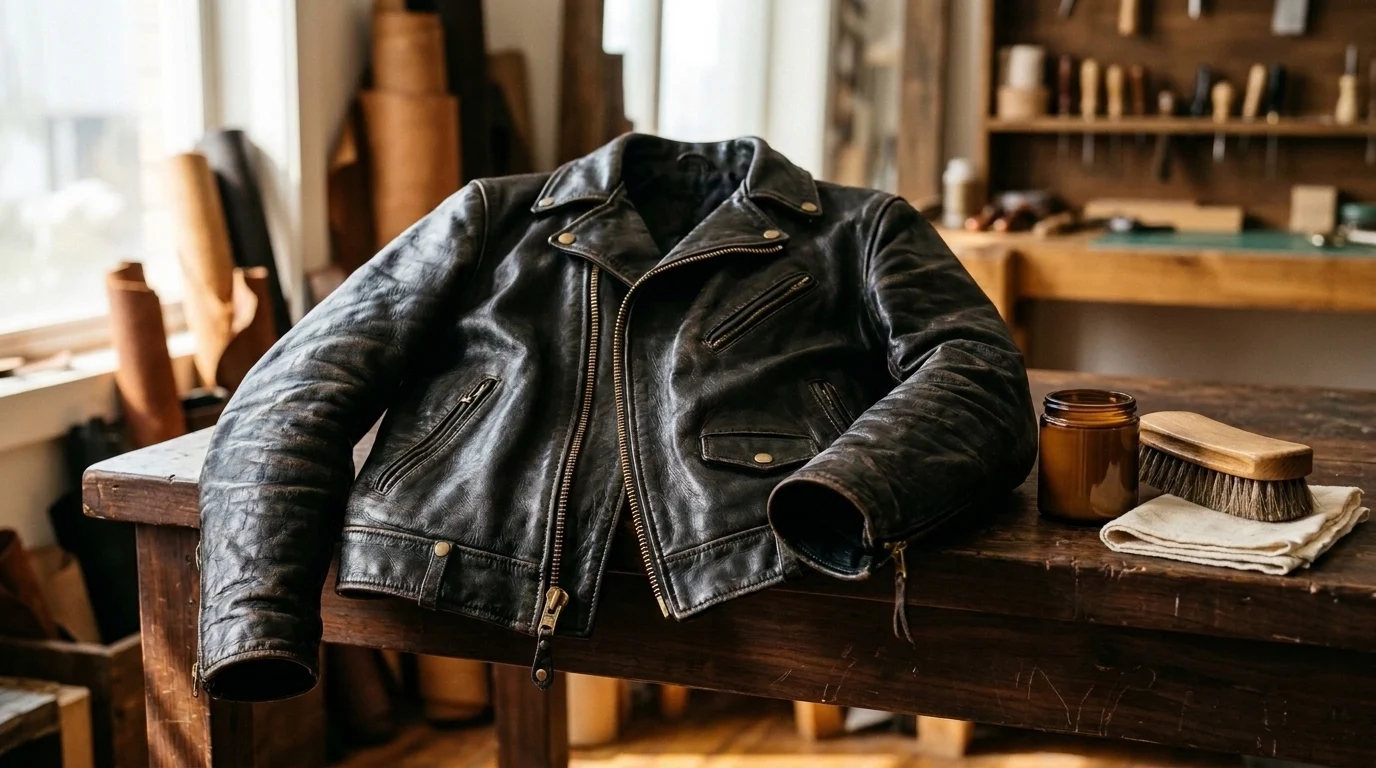
VANSON LEATHER Jackets Leather Care, Conditioning, and Patina Maintenance: Atelier Guide
Master Vanson competition-weight steerhide care, pH-balanced conditioning, dry-rot prevention, brass zipper maintenance, and natural patina preservation in this atelier guide.
Key Takeaways
- Respect Drum-Dyed Steerhide Tannage: Heavyweight 3.5-to-4.0 oz (1.4 mm to 1.7 mm) competition-grade steerhide leaves the tannery loaded with internal waxes and fatliquors; over-conditioning during the first 24 months softens the architectural stand and clogs grain pores.
- Dry Heat and Sealed Plastic Are the True Enemies: Never dry a rain-soaked leather jacket near radiators, space heaters, or hair dryers, and never seal it inside vinyl or dry-cleaner plastic bags that trap condensation and trigger mold or dry rot.
- Maintain Hardware and High-Friction Zones Separately: Brass #8 and #10 zippers, throat-latch snaps, and collar sweatbands require dry brushing, neutral pH wipe-downs, and occasional beeswax/paraffin lubrication rather than heavy oil saturation.
- Condition Sparingly with Neutral Oils & Beeswax: Apply thin coats of pH-balanced beeswax, lanolin, or neat's-foot-free balm only every 12 to 18 months—or strictly after heavy rain exposure—buffing thoroughly with a horsehair brush.
- Know When Restoration Loses to Bespoke Craft: While surface scuffs and dry grain revive cleanly, salt-petrified armpits, rotted V69 seams, and cracked pigment coatings often cost more to rebuild than commissioning a fresh heirloom piece in our Custom Order Studio.
Artisan Independence & Trademark Notice: Lux Wearz is an independent bespoke leathercraft atelier. All brand names, logos, and trademarks mentioned in this article (including VANSON LEATHER® and related trademarks) belong exclusively to their respective trademark holders. Lux Wearz is not an authorized distributor, licensee, or affiliated partner of these brands. All brand references and historical retrospectives are made strictly for educational, comparative, and sizing review purposes under Fair Use. Lux Wearz specializes in custom-tailored, heirloom-grade genuine leather outerwear handcrafted individually in our private workshop.
How Should You Care for and Condition VANSON LEATHER Jackets?
Caring for VANSON LEATHER jackets centers on regular dry dust brushing with a soft horsehair brush, gentle damp-cloth wiping after road or city grime exposure, and light annual conditioning with a neutral, silicone-free wax balm. Avoid over-oiling heavyweight competition steerhide, dry wet hides slowly at room temperature on a broad contoured hanger, and store exclusively in breathable cotton garment bags.
Heavyweight American motorcycle leather represents one of the most chemically resilient yet physically demanding garments ever engineered. Unlike thin fashion lambskin that begins tearing at 0.7 mm if neglected for two winters, 1.4 mm to 1.7 mm competition-weight steerhide and heavy cowhide are designed to survive asphalt abrasion, monsoon downpours, and decades of flexion. Yet even armor-grade steerhide ages poorly when treated with the wrong household shortcuts—silicone aerosol sprays, petroleum saddle soaps, mink oil overdoses, or closet humidity swings.
Understanding what happens inside the hide matrix at a microscopic level separates genuine patina development from premature fiber breakdown. True patina is not cracking, chalky dryness, or blackened grease buildup around the cuffs; it is the gradual burnishing of raised grain peaks, high-contrast creasing along the elbow stacks, and subtle warm undertones emerging as internal waxes migrate through wear. Whether you are preserving an archival piece from our VANSON LEATHER brand catalog, maintaining a daily rider from our men's leather jackets collection, or caring for a newly commissioned jacket from our Custom Order Studio, disciplined atelier maintenance can keep a single heavyweight hide structurally sound for forty years or longer.
The Tannage & Heritage Behind Heavyweight Steerhide Longevity
To care properly for heavyweight American moto hides, you must first understand why they feel almost sculptural straight out of the box. Founded in Boston in 1974 and later anchored in Fall River, Massachusetts, the classic Vanson competition silhouette was engineered around thick, drum-dyed top-grain and full-grain steerhide—frequently hovering between 3.5 and 4.0 ounces per square foot (roughly 1.4 mm to 1.7 mm thick).
During traditional combination tanning and hot-stuffing, heavy steerhides are drum-infused with tallows, waxes, and emulsified oils while still wet. When the hide dries and undergoes glazing or light surface sealing, those lubricants lock deep inside the corium fiber bundle. That internal reservoir is the exact reason a brand-new competition jacket feels rigid during week one, molds precisely to your chest and elbow bend by month six, and develops mirror-bright creases along the forearms by year three.
Modern garment care problems usually begin when owners treat dense, wax-stuffed steerhide like dry, untreated rawhide. Pouring liquid oil onto a new or lightly broken-in competition jacket floods the already saturated corium, turning crisp shoulder lines soggy, darkening contrast racing stripes permanently, and weakening the friction grip around bonded-nylon stitch holes. Good care respects the hide's built-in chemistry and intervenes only when evaporation, sweat salt, UV exposure, or road grit actually deplete the outer grain.
For additional context on how these heavyweight patterns break in across body types and urban wardrobes, pair this care manual with our VANSON LEATHER archival silhouettes and sizing guide and our VANSON LEATHER streetwear styling and layering guide.
Routine Cleaning, Rain Recovery, and Conditioning Cadence
Effective leather maintenance operates in three distinct tiers: routine post-wear surface hygiene, periodic moisture and lipid replenishment, and emergency recovery after soaking rain or road salt exposure.
Tier 1: Post-Wear Dry Maintenance (After Every 5–10 Wears)
Most visible wear degradation begins with microscopic silica dust and urban soot settling deep inside the flex creases of the inner elbow and collar fold. Every time your arm bends, abrasive grit acts like 1,000-grit sandpaper against the topcoat and stitching thread.
- Hang Correctly Immediately: Never drape a 7-pound steerhide jacket over a thin wire coat hanger or sharp chair back; narrow wire bends the shoulder seam padding permanently. Use a broad, contoured cedar or heavy beechwood hanger at least 2 inches thick at the shoulder tips.
- Horsehair Dust Sweep: Spend 60 seconds sweeping a soft 100% horsehair brush across the collar crease, sleeve stacks, pocket flaps, and back kidney panel to lift dry road grit before it grinds into the grain.
- Damp Microfiber Wipe-Down: If you caught urban road spray or café spills, wipe the affected panel lightly with a barely damp (never dripping) distilled-water microfiber cloth, then buff dry immediately with an unbleached cotton rag.
Tier 2: Conditioning Cadence (Every 12–18 Months—Never Monthly)
Unless you ride daily through arid desert heat or harsh coastal mist, heavyweight steerhide needs conditioning only once every 12 to 18 months. Over-conditioning is ten times harder to reverse than mild dryness.
- Test First on an Inner Facing: Always test any balm on the interior wind flap behind the main zipper to verify it does not turn matte black leather overly glossy or darken contrasting bone or red stripes.
- Apply Sparingly with Bare Hands or Cotton Pad: Warm a pea-sized dab of neutral beeswax-and-lanolin leather balm between your fingertips and work it into high-flex zones first—elbows, shoulder caps, cuffs, and collar edge—before lightly sweeping remaining residue across the chest and back.
- Wait 2 Hours, Then Buff Hard: Allow the hide to absorb only what its fibers actually require. After two hours at room temperature, brush briskly with a clean horsehair brush and buff with a dry cotton cloth so zero sticky surface film remains to attract dust.
- Never Use Silicone, Mineral Oil, or Mink Oil Blends: Petroleum distillates strip natural tannery lipids over time, while silicone seals pores permanently and blocks future breathability. Pure mink oil also tends to go rancid inside warm closets and weakens natural seam fibers over multi-year timelines.
Tier 3: Rain Soaking & Salt-Line Protocol
Getting caught in an unexpected downpour will not ruin quality full-grain steerhide—how you dry it afterward determines whether it survives intact.
- Blot, Never Rub: Press clean cotton towels firmly against soaked panels to wick surface water.
- Air-Dry Slowly Away from Heat: Hang the jacket on a broad wooden hanger in a well-ventilated room at 65°F–72°F with a gentle oscillating fan nearby if humidity is high. Never place wet leather near radiators, wood stoves, hair dryers, or direct summer sunlight—rapid forced evaporation shrinks collagen fibrils irreversibly, leaving leather brittle as cardboard.
- Neutralize White Salt Rings Promptly: If winter road slush or heavy perspiration leaves chalky white salt lines along the hem or underarms, wipe with a 50/50 solution of distilled water and white distilled vinegar on a damp cloth, wipe again with plain distilled water, dry slowly, and apply a micro-coat of conditioner once completely dry.
Table 1: Silhouette & Fit Architecture (Wear Stress & Patina Mapping)
Different Vanson-style silhouettes experience entirely different creasing mechanics, flex loads, and care priorities depending on cut geometry and hide weight.
| Silhouette Model | Cut & Fit Type | Shoulder / Chest Offset | Ideal Body Profile | Leather Weight & Temper |
|---|---|---|---|---|
| Classic Asymmetric Double Rider (C2 / Star Cut) | Cropped boxy biker cut with storm lapels & kidney belt | +2.5 to +3.5 in chest ease; square forward shoulder | Broad-shouldered riders & classic heritage wearers | 1.4–1.7 mm competition steerhide; rigid initial temper |
| Stand-Collar Café Racer (Dominator / Comet) | Tapered straight torso with minimal gussets & mandarin collar | +2.0 to +2.5 in chest ease; crisp anatomical armhole | Athletic & lean builds seeking clean vertical lines | 1.3–1.5 mm medium-heavy cowhide/steerhide; firm temper |
| Articulated SportRider Touring Cut | Forward-pitched sport jacket with accordion stretch panels | +1.75 to +2.5 in chest ease; rotated racing sleeve head | Active sportbike riders & tapered torso proportions | 1.3–1.5 mm solid or perforated steerhide; structured temper |
| Heavyweight Flat-Track & Striped Heritage | Straight retro racing block with contrast bone/red stripes | +2.5 to +3.0 in chest ease; relaxed mid-bicep room | Collectors & heritage streetwear builds | 1.4–1.6 mm drum-dyed steerhide with inlaid stripe hides |
| Contoured Women's Moto & Waist-Gusset Cut | Tailored princess-seam waist with expandable hip gussets | +1.5 to +2.25 in chest ease; tapered shoulder slope | Curated hourglass & athletic female silhouettes | 1.2–1.4 mm supple competition steerhide; balanced temper |
| Perforated Summer Sport Chassis | Precision airflow pin-punched torso & inner arm panels | +1.5 to +2.25 in chest ease; snug wind-free waist | Warm-weather riders prioritizing ventilation | 1.25–1.4 mm die-perforated top-grain steerhide |
Hardware, Thread, and Lining Preservation
Even when outer steerhide remains supple at year twenty, heavy jackets fail first at their hardware interfaces and interior linings. Treating zippers, snaps, and linings with the same rigor as the hide eliminates 90 percent of premature repair bills.
Brass & Nickel Zipper Care (#8 and #10 Heavy-Gauge)
Heavy-duty #8 and #10 solid brass zippers endure immense torque whenever you zip up over a thick sweater or crouch on a motorcycle tank. Road dust and oxidized green verdigris (copper carbonate buildup on brass) increase slider drag until teeth start skipping or separating from the bottom box.
- Dry Toothbrush Cleaning: Twice a year, open the zipper fully and scrub along both rows of metal teeth and inside the slider channel with a dry soft-bristle nylon toothbrush.
- Dry Paraffin or Beeswax Glide: Run a dry stick of pure paraffin wax or solid beeswax lightly up and down the zipper teeth (never liquid WD-40 or oily sprays, which stain surrounding cotton zipper tape and attract grit).
- Align the Bottom Pin Completely: 70 percent of zipper box failures happen from forcing the slider upward before the male pin is seated flush at the bottom of the retaining box. Always hold the bottom box steady with your left thumb while engaging the pin cleanly.
Sweatband & Collar Conditioning Without Discoloration
Mandarin and snap-down collars absorb continuous skin oils and perspiration salt directly at the back of the neck. Twice per season, wipe the inside edge of the leather collar with a cloth lightly misted with a pH-neutral saddle cleaner (never foaming alkali soaps), let dry overnight, and dab a tiny speck of neutral balm strictly along the dry outer fold. When styling in warm weather, wearing a collared shirt or thin neck gaiter prevents direct sweat saturation altogether.
Rayon, Cotton Twill, and Quilted Liner Hygiene
High-twist rayon and cotton twill linings allow heavyweight jackets to slide cleanly over knitwear, but sweat salts and deodorant residue in the underarm lining stiffen and weaken seams over time. Never submerge a leather jacket in a washing machine or send it to a conventional perchloroethylene dry cleaner—dry-cleaning solvents strip every molecule of internal tannery fatliquor and shrink the lining at a different rate than the hide. Instead, air the jacket inside-out on a wide wooden hanger in shaded breeze for 12 hours, mist the interior lining lightly with a textile-safe vodka-and-distilled-water deodorizing spray (1:3 ratio, avoiding leather facings), and allow it to evaporate completely before hanging in a breathable cotton bag.
Table 2: Leather Hide & Hardware Durability Matrix
Use this atelier specification matrix to calibrate conditioning products, moisture protection, and expected service intervals across every hide and structural component.
| Component / Hide | Leather Grade & Tannage | Thickness (mm) | Weather Resistance | Expected Longevity | Maintenance Needs |
|---|---|---|---|---|---|
| Competition-Weight Steerhide | Drum-dyed, hot-stuffed combination-tanned full-grain steerhide | 1.40–1.70 mm | Very High; shrugs off wind, sleet, and severe road abrasion | 30–50+ years as an heirloom garment | Dry horsehair brush quarterly; light beeswax balm every 12–18 months |
| Perforated Competition Steerhide | Die-perforated full-grain steerhide over breathable liner | 1.25–1.40 mm | Low-Moderate; maximum airflow, porous in heavy rain | 20–30 years if kept free of wax-clogged holes | Microfiber wipe & brush only; avoid thick paste waxes in pinholes |
| Contrast Bone / Red Inlay Stripes | Pigment-finished or semi-aniline full-grain cowhide | 1.20–1.40 mm | High; sealed pigment topcoat resists surface staining | 20–35 years (protect against heavy edge scraping) | Neutral non-darkening cream only; never apply dark waxes or oils |
| Deerskin & Elk Touring Panels/Gloves | Chrome- or brain-style soft oil-tanned full-grain deerskin | 1.00–1.25 mm | Moderate; breathes naturally, stretches smoothly | 12–20 years with gentle moisture balance | Light lanolin lotion once yearly after winter storage |
| Heavy Bonded Nylon Thread (V69 / V92) | Twisted continuous-filament UV-resistant nylon | 0.30–0.45 mm gauge | Very High; immune to mildew and perspiration rot | 25–40+ years (far outlasts vintage cotton thread) | Visual inspection at elbow gussets and cuff hems annually |
| #8 / #10 Solid Brass Hardware | Cast brass or nickel-plated brass teeth & sliders | 8.0–10.0 mm track | High; tarnishes naturally into warm vintage patina | 20–35+ years (slider bodies easily swapped by cobbler) | Dry brush teeth twice yearly; rub light dry paraffin wax along track |
Pre-Owned Inspection Checklist & Common Vintage Flaws
If you are evaluating a pre-owned heavyweight motorcycle jacket—or checking an older jacket pulled from long-term garage storage—inspect these five critical structural zones before investing in conditioning balms or tailor repairs:
1. Dry-Rot Cracking & Fiber Powdering
Pinch and gently flex the leather along the top of the shoulder yoke and the inside of the elbow stack under bright light. Healthy aged steerhide bends smoothly with fine micro-pebbles; dry-rotted hide exhibits crisp spiderweb surface fractures, flaky grey dryness under the topcoat, or stiff paper-like creaking. Once collagen fibrils oxidize past their tensile limit, conditioning oils merely darken the cracks temporarily without restoring tear strength.
2. Sweat-Petrified Underarm Gussets
Check the leather panels directly beneath the armpit football gussets. Years of dried perspiration salt dehydrate and harden leather until it feels rigid as rawhide—and often shrinks the armhole by half an inch. If the underarm leather feels crispy or shows white salt crusts baked deep into the grain, standard conditioning will not soften it back safely.
3. Seam Splitting & Elongated Needle Holes
Pull gently perpendicular to the rear action-back pleats and forearm zippers. Look for needle perforations that have stretched into tiny slits ('cheese-wiring'), or frayed cotton stitching on pre-1990s garments. Re-stitching heavy 1.5 mm double-layered steerhide requires a heavy walking-foot industrial cylinder machine—home tailors cannot penetrate those seams cleanly.
4. Zipper Tape Fraying & Pin Delamination
Inspect the woven cotton/poly tape right above the bottom starter pin. Even when solid brass teeth look flawless, frayed cloth tape beside the retaining box makes the zipper pop open from the bottom upward whenever you sit down. Replacing a #10 brass main zipper on a thick leather jacket typically runs $140 to $240 at a specialist leather workshop.
5. Mould, Mildew Spores, and Musty Basement Odor
Smell the interior rayon lining and check inside handwarmer pockets for faint white or greenish-grey mildew dusting. Surface mildew on finished leather can be killed with a diluted white vinegar wipe and UV-free airflow, but deep mold spores embedded inside foam shoulder pads or quilted batting often linger permanently.
For broader maintenance diagnostics and product-safe cleaning steps across all hide types, bookmark our complete Lux Wearz Leather Care Guide.
Featured Silhouette Retrospective & Curated Collection
Each silhouette in the Lux Wearz Vanson collection places unique maintenance demands on its hide, contrast trim, and hardware. Explore these five standout models—all verifiable inside our store catalog—to see how care practices map to real-world construction.
1. Vanson Leather Model C2 Men's Leather Motorcycle Jacket – Black Rayon Lining
As an iconic benchmark of American double-rider geometry, the Vanson Leather Model C2 Men's Leather Motorcycle Jacket – Black Rayon Lining pairs heavyweight black hide with wide storm lapels, heavy brass-tone snap hardware, and a smooth black rayon interior. Because its broad asymmetric front overlap exposes double layers of thick leather across the chest, keep conditioner applications ultra-light along the lapel folds so the collar snaps stay crisp and the rayon lining remains airy and fresh.
2. Vanson Leather Dominator-2 Men's Leather Motorcycle Jacket – Black Competition-Weight Steerhide
Designed around streamlined café-racer minimalism, the Vanson Leather Dominator-2 Men's Leather Motorcycle Jacket – Black Competition-Weight Steerhide channels all its visual power into unbroken expanses of dense black steerhide and a clean stand collar. Without busy chest flaps, its large back and torso panels showcase mirror-like grain creasing—making quarterly dry horsehair brushing and annual neutral beeswax buffing the ideal routine to cultivate a deep charcoal-black sheen.
3. Vanson Leather Cobra MK2 Star SportRider Men's Leather Sport Motorcycle Jacket – Perforated Steerhide
Built for warm-weather sport riding, the Vanson Leather Cobra MK2 Star SportRider Men's Leather Sport Motorcycle Jacket – Perforated Steerhide introduces perforated airflow zones alongside heavy articulated armor panels. Never spread thick paste conditioners directly over perforated sections, where waxy clumps clog ventilation pinholes and trap summer sweat. Instead, rely on damp microfiber wipe-downs and dry brushing across the perforations while conditioning only the solid shoulder and elbow caps.
4. Vanson Leather Starlet Women's Leather Jacket – Black and Red Competition-Weight Steerhide
Featuring bold black and crimson color blocking in competition-weight steerhide, the Vanson Leather Starlet Women's Leather Jacket – Black and Red Competition-Weight Steerhide demonstrates why color-safe care matters. Treat the red and black zones with separate clean cotton buffing cloths using a strictly neutral, dye-free cream so dark surface patina never transfers onto vibrant red accent panels.
5. Vanson Leather Villainess Women's Leather Motorcycle Jacket – Adjustable Waist Gussets
Tailored with contoured shaping and zippered waist-expansion gussets, the Vanson Leather Villainess Women's Leather Motorcycle Jacket – Adjustable Waist Gussets concentrates daily flex along its side-gusset panels and wrist zippers. Run a dry stick of paraffin wax along the side-gusset teeth twice a year and wipe the inside collar band regularly to keep the tailored waist operating smoothly for decades.
Explore every available model, sizing chart, and hide specification in our complete VANSON LEATHER brand catalog or browse across all handcrafted silhouettes in the full Lux Wearz catalog.
The Bespoke Handcrafted Custom Tailoring Alternative
While faithful care keeps healthy steerhide vibrant for generations, no leather balm on earth can fix a jacket whose original sizing pinches your shoulders, flares at the waist, or suffers from irreversible vintage dry rot. When restoration quotes for relining, zipper replacement, and odor remediation climb past $350, stepping into bespoke leathercraft becomes both the smarter financial decision and the cleaner wardrobe upgrade.
At the Lux Wearz Custom Order Studio, every garment is drafted individually to your exact body measurements from virgin, freshly tanned full-grain hides—meaning zero hidden salt damage, zero degraded foam, and 100 percent fresh fiber elasticity:
- Calibrated Hide Weight for Your Climate: Select monumental 1.5 mm heritage steerhide for decade-spanning riding armor, or specify supple 1.2 mm drum-dyed full-grain cowhide for effortless daily urban break-in.
- Custom Hardware & Seam Metallurgy: Every bespoke jacket is assembled with high-tensile V69/V92 bonded nylon stitching and heavy-gauge solid antiqued brass or gunmetal YKK #8/#10 zippers that glide cleanly out of the box.
- Breathable Personal Linings: Replace aging synthetic taffeta with durable cotton drill, rich Bemberg cupro, or removable seasonal wool-quilted liners engineered for easy airing and long-term hygiene.
- Precision Fit Without Compromise: Dial in your exact chest ease, bicep room, torso back length, and wrist taper using our Lux Wearz Size Guide, ensuring natural creasing forms exactly at your true anatomical elbow and waist points—the foundation of authentic, symmetrical patina.
Long-Term Storage & Seasonal Preservation Checklist
Between riding seasons or hot summer months, proper closet storage protects your steerhide investment just as effectively as active conditioning. Hang your jacket buttoned or zipped halfway on a wide contoured wooden hanger with at least two inches of airspace on either side inside a cool, dry closet away from damp exterior walls. Slip a breathable unbleached cotton or linen garment cover over the shoulders to block dust while letting moisture vapor escape freely, toss a small cedar block nearby, and never store heavyweight leather folded inside cardboard boxes or sealed plastic tubs. With simple seasonal discipline—dry brushing, minimal neutral wax nourishment, and clean hardware upkeep—your heavyweight leather outerwear will reward every mile with deeper luster and tailored permanence. Visit our Custom Order Studio or browse the VANSON LEATHER collection to start your next heirloom piece.
Explore The Full 2026 Leather Outerwear Collection
Vegetable-tanned full-grain cowhide, buttery New Zealand lambskin, and heritage Melton wool. Free express delivery across the USA with 30-day hassle-free returns.