
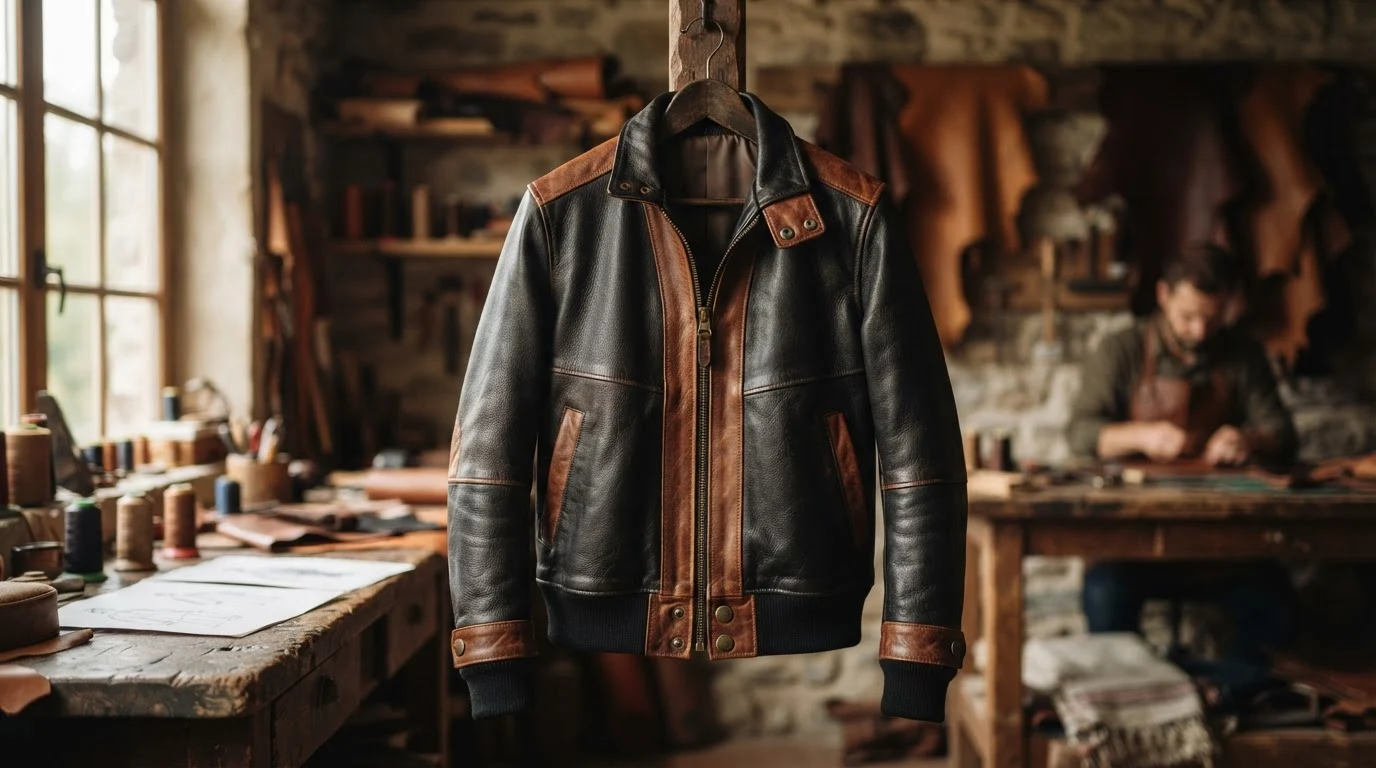
Pelle Pelle Leather Jackets vs Bespoke Custom Leather: Durability, Grain, and Craftsmanship Comparison
Compare vintage Pelle Pelle leather jackets with bespoke custom leather outerwear. Analyze drum-dyed top-grain cowhide vs virgin full-grain steerhide, patina development, and solid brass hardware.
Key Takeaways for Collectors and Leather Enthusiasts
- Pelle Pelle vintage jackets represent an iconic pinnacle of 1990s and 2000s urban luxury outerwear, engineered with heavyweight top-grain drum-dyed cowhide, exaggerated boxy proportions, and complex multi-layered leather appliqué embroidery.
- Commercial vintage retail garments frequently suffer from progressive hide desiccation, pigment enamel micro-cracking, and nylon thread dry-rot after two decades in unconditioned storage, requiring costly restorative leather nourishment.
- Bespoke custom leather outerwear from specialized ateliers utilizes 1.2 mm to 1.4 mm virgin full-grain vegetable-tanned or chrome-tanned steerhide that develops an organic patina rather than flaking or delaminating over decades of wear.
- Structural hardware in heirloom bespoke leathercraft incorporates solid forged brass teeth and heavy-duty YKK number ten gauge sliders, avoiding the pot-metal casting failures common in aging pre-owned garments.
- Discerning outerwear collectors who love vintage streetwear silhouettes increasingly turn to custom leather jacket tailoring to achieve tailored chest-to-waist ratios, immaculate shoulder fit, and zero hide decay.
Artisan Independence & Trademark Notice: Lux Wearz is an independent bespoke leathercraft atelier. All brand names, logos, and trademarks mentioned in this article (including Pelle Pelle® and related trademarks) belong exclusively to their respective trademark holders. Lux Wearz is not an authorized distributor, licensee, or affiliated partner of these brands. All brand references and historical retrospectives are made strictly for educational, comparative, and sizing review purposes under Fair Use. Lux Wearz specializes in custom-tailored, heirloom-grade genuine leather outerwear handcrafted individually in our private workshop.
How Do Pelle Pelle Leather Jackets Compare to Bespoke Custom Leather in Long-Term Durability and Grain Quality?
Pelle Pelle leather jackets utilize heavyweight drum-dyed top-grain cowhide finished with pigmented coatings and decorative leather appliqué panels designed for dramatic streetwear presence, whereas bespoke custom leather outerwear utilizes virgin full-grain hides, uncorrected grain pores, bonded nylon structural stitching, and hand-fitted anatomical patterns engineered for generational longevity, natural patina formation, and zero surface delamination.
Understanding the fundamental trade-offs between collector retail heritage and bespoke artisanal construction requires an unvarnished examination of hide selection, tannery chemical processes, stitch tension engineering, and the physical degradation curves of aged luxury garments. While vintage outerwear holds undeniable cultural nostalgia, bespoke outerwear solves the persistent fit compromises and structural fatigue inherent to decades-old clothing.
The Archival Heritage of Marc Buchanan's Leather Outerwear Architecture
Founded in 1978 by designer Marc Buchanan, the Pelle Pelle label revolutionized luxury streetwear by transforming heavy leather outerwear into a dynamic canvas for artistic expression. Prior to Buchanan's bold intervention, the commercial leather outerwear market was dominated by utilitarian flight jackets, utilitarian motorcycle jackets, and conservative car coats. Buchanan recognized that the emerging hip-hop cultural movement in New York, Detroit, and Chicago demanded an entirely new aesthetic vocabulary characterized by oversized silhouettes, drop-shoulder armholes, vibrant color-blocking, and intricate leather-on-leather appliqué lettering.
Throughout the late 1980s, the 1990s, and the turn of the millennium, iconic releases such as the American Bruiser, the City of Knicks collaboration with FISLL, and the Immortal series captured the imagination of urban tastemakers, professional athletes, and global musicians. These garments were intentionally overbuilt, featuring massive shoulder pads, thick rib-knit waistbands, and dozens of individual leather cutouts satin-stitched across the chest, back, and sleeves.
However, the very elements that made these garments visually legendary also introduced unique structural vulnerabilities. When hundreds of separate leather appliqués are stitched onto a base hide, thousands of needle perforations weaken the tensile cohesion of the underlying leather. Over twenty to thirty years of exposure to atmospheric moisture, ultraviolet light, and oxidation, those thousands of perforation points become prime vectors for seam separation and micro-tearing. For collectors exploring curated vintage selections in our curated Pelle Pelle catalog or considering a bespoke rebuild, understanding this archival engineering history provides essential context for modern wearability.
Architectural Sizing and Silhouette Profiles
Archival urban leather jackets from the late twentieth century were proportioned around an entirely different body silhouette than modern outerwear. Understanding these dimensional offsets is crucial when evaluating pre-owned pieces against contemporary size guide specifications.
The classic urban bomber silhouette featured an extreme shoulder drop, often measuring two to four inches wider than the wearer's natural acromion bone. The armholes were cut exceptionally deep, creating a distinctive batwing effect that allowed maximum freedom of movement when worn over heavy fleece hoodies, tracksuits, or chunky cable-knit sweaters. Concurrently, the chest circumference was engineered with eight to twelve inches of positive ease over the actual chest measurement.
In contrast, the waistbands were tightly cinched with elasticated leather casings or thick acrylic-wool ribbing. This generated a dramatic balloon silhouette that tapered sharply from an expansive chest down to a snug hip. While this cut created an imposing, athletic presence, modern wearers often find that standard vintage sizing creates excess bulk around the midsection while leaving the sleeve lengths either awkwardly short or excessively bunched at the wrists.
Sizing and Silhouette Comparison Architecture
| Silhouette Model | Cut & Fit Type | Shoulder / Chest Offset | Ideal Body Profile | Leather Weight & Temper |
|---|---|---|---|---|
| Archival Heavyweight Urban Bomber | Exaggerated Boxy Vintage Fit | +4.0 in Drop Shoulder / +10 in Chest Ease | Broad athletic frame; relaxed streetwear layering | 1.3 to 1.5 mm Heavy Top-Grain Cowhide; Firm Temper |
| American Bruiser Varsity Cut | Structured Stadium Silhouette | +3.0 in Shoulder / +8 in Chest Ease | Classic muscular build; casual oversized drape | 1.2 to 1.4 mm Drum-Dyed Cowhide with Wool Felt Body; Medium-Firm |
| City of Knicks Stadium Edition | Full Athletic Commemorative Cut | +3.5 in Shoulder / +9 in Chest Ease | Tall athletic frame; dramatic graphic presence | 1.2 mm Pigmented Cowhide; Medium Temper |
| Immortal Heavyweight Biker | Asymmetrical Moto Hybrid | +2.0 in Shoulder / +6 in Chest Ease | V-taper physique; sculpted riding profile | 1.4 mm Semi-Aniline Steerhide; Extra-Firm Temper |
| Archival Zip-Front Blouson | Relaxed Mid-Weight Casual Cut | +2.5 in Shoulder / +6 in Chest Ease | Regular to broad torso; everyday casual styling | 1.1 to 1.3 mm Drum-Dyed Cowhide; Soft-Medium Temper |
| Bespoke Custom Atelier Silhouette | Anatomical Tailored Cut | Laser-Calibrated 0.0 in Shoulder Offset / +3.5 to +4.5 in Custom Chest Ease | Mapped exactly to client shoulder slope, chest circumference, and torso length | 1.2 to 1.4 mm Virgin Full-Grain Vegetable-Tanned Steerhide; Supple Malleable Temper |
Material Dissection: Top-Grain Drum-Dyed Cowhide vs Virgin Full-Grain Hide
The definitive difference between mass-market luxury outerwear and bespoke atelier leathercraft lies directly within the microscopic cellular structure of the raw animal hide. To evaluate durability with precision, one must inspect how the corium and grain layers are treated during tanning and finishing.
Understanding Top-Grain Processing in Archival Garments
Mass-produced branded leather jackets of the 1990s and 2000s predominantly utilized top-grain cowhide. In commercial leather manufacturing, raw hides that display superficial insect bites, barbed-wire scratches, or natural branding scars undergo a process called light buffing or sanding. By abrading away the outermost one-tenth of a millimeter of the epidermis, tanneries achieve a perfectly uniform, blemish-free surface across thousands of square feet of leather.
Following buffing, the hide is drum-dyed to introduce base color through the cross-section of the leather fibers. However, to seal the buffed surface and achieve bold, uniform hues like electric blue, bright yellow, or pure optic white, tanneries apply a topcoat of acrylic binders, pigmented polyurethane enamel, and synthetic lacquer. While this creates an eye-catching, glossy finish that resists immediate rain spotting on retail display racks, it effectively seals the natural pores of the hide.
Because the microscopic pores are occluded by synthetic binders, top-grain leather cannot breathe naturally. Over ten to twenty years, the volatile plasticizers embedded within the polyurethane topcoat gradually evaporate into the surrounding atmosphere. As the coating loses its elastic polymers, it becomes brittle. The leather underneath begins to starve of atmospheric moisture, and the surface lacquer develops microscopic spider-web fractures, ultimately leading to surface flaking, peeling, and chalky discoloration that cannot be reversed by topical conditioning creams.
The Superior Cellular Integrity of Virgin Full-Grain Leather
In stark contrast, true bespoke leathercraft begins exclusively with virgin full-grain hides. In full-grain leather, the uppermost layer of the epidermis remains completely intact. No buffing, sanding, or mechanical abrasion is ever applied to alter the natural surface. Only the top five percent of cattle hides worldwide possess the exceptional structural clarity and grain density required to qualify for full-grain finishing.
The epidermis layer contains the highest concentration of intertwined collagen fibers anywhere in the mammalian skin. These collagen bundles are cross-linked in a dense, multidirectional lattice that provides astonishing tensile resistance, tear prevention, and puncture toughness. When you touch a full-grain hide, you are feeling the authentic, unaltered texture of the living skin, complete with natural follicle pores, subtle grain variations, and organic fat wrinkles.
Rather than being smothered under acrylic lacquers, full-grain bespoke leather is treated with pure aniline or semi-aniline drum dyes and conditioned with natural fats, beeswax, and vegetable extracts derived from mimosa, chestnut, or quebracho bark. Because the natural pores remain completely open, the hide breathes effortlessly, allowing natural conditioning oils to penetrate deep into the collagen core during routine leather care maintenance. Over decades of rigorous wear, full-grain leather does not crack or peel; instead, it absorbs skin oils, ambient humidity, and frictional contact to develop a deep, lustrous, irreplaceable amber-gold patina that grows richer with every passing year.
Leather Hide and Hardware Durability Matrix
The engineering specifications of genuine leather outerwear determine whether a jacket will survive two decades or half a century. The following matrix details the precise metallurgical, tannage, and tensile differences across premium hide categories and structural hardware components.
| Component / Hide | Leather Grade & Tannage | Thickness (mm) | Weather Resistance | Expected Longevity | Maintenance Needs |
|---|---|---|---|---|---|
| Virgin Full-Grain Steerhide | Vegetable & Chrome Re-Tanned Virgin Grade A Hide | 1.3 to 1.5 mm | High natural water resistance; sheds rain when conditioned with natural beeswax | 50+ Years; develops rich heirloom patina | Annual conditioning with pure neatsfoot or lanolin leather balm |
| Drum-Dyed Top-Grain Cowhide | Chrome-Tanned Top-Grain with Pigmented Polyurethane Finish | 1.1 to 1.3 mm | Moderate; initial water resistance provided by synthetic topcoat | 15 to 25 Years; susceptible to topcoat micro-cracking | Semi-annual cleaning; delicate moisturizing to prevent surface flaking |
| Italian Nappa Lambskin | Chrome-Tanned Drum-Dyed Nappa Hide | 0.9 to 1.1 mm | Low to Moderate; delicate grain requires immediate drying if soaked | 20 to 30 Years; exceptional drape and buttery hand-feel | Quarterly conditioning with lightweight neutral leather lotion |
| Heavy Naked Steerhide | Heavy Oil-Tanned Full-Grain Steerhide | 1.4 to 1.6 mm | Exceptional; saturated with paraffin waxes and natural tallow oils | 60+ Years; impenetrable wind and abrasion barrier | Periodic waxing; virtually maintenance-free under normal conditions |
| Bonded Nylon Structural Thread | Continuous Filament Bonded Nylon V69 / V92 Gauge | 0.30 to 0.35 mm | Completely immune to rot, mildew, and perspiration acids | 40+ Years; retains 95% tensile strength | Zero maintenance required; impervious to environmental decay |
| Solid Forged Brass Hardware | Solid Brass Alloy 260 / Antiqued Bronze Heavy Gauge | No. 8 and No. 10 Gauge Sliders | 100% rustproof; self-lubricating teeth resist oceanic salt air | 50+ Years; zero tooth breakage under extreme lateral tension | Occasional paraffin wax application along zipper teeth track |
The Mechanics of Patina Formation vs Pigment Enamel Breakdown
One of the most consequential distinctions between vintage commercial outerwear and bespoke artisan construction is how the material matures over time. Every leather garment undergoes a constant chemical and physical dialogue with its environment.
When an unaltered full-grain leather jacket is exposed to daily friction, body heat, sunlight, and air, the natural oils inside the hide migrate dynamically toward the surface. Areas of high contact, such as the elbow creases, cuff edges, storm flap rims, and collar fold, undergo continuous polishing from frictional wear. At the same time, ambient ultraviolet radiation subtly oxidizes the vegetable tannins within the hide, darkening lighter undertones into warm walnut, mahogany, and burnished espresso hues. This process is called patina formation. Far from degrading the garment, patina enhances the dimensional depth of the hide, making a ten-year-old jacket noticeably more beautiful and visually arresting than it was on the day it emerged from the workshop.
Conversely, pigmented top-grain finishes do not form a true patina. Because the surface is coated in an impermeable layer of synthetic paint, friction does not polish the collagen fibers; instead, friction abrades the paint away. In vintage streetwear jackets featuring heavy yellow, red, or white leather paneling, thirty years of wear typically results in the paint rubbing off entirely at the cuffs and collar, exposing a dry, fuzzy, greyish suede underlayer. When owners attempt to treat these abraded zones with standard leather conditioners, the exposed fibrous corium absorbs the oil unevenly, turning into dark, blotchy stains while the intact painted areas repel the conditioner completely. Restoring such garments requires professional deglazing, color matching, and spray-gun re-pigmentation, an expensive intervention that often robs the jacket of its supple drape and authentic vintage hand-feel.
Structural Hardware and Metallurgy: Commercial Castings vs Solid Brass
A leather jacket is only as durable as the closure mechanism that holds it together. A broken zipper slider or a snapped tooth transforms a thousand-dollar luxury garment into an unwearable relic until an expensive full-front zipper replacement can be executed.
Commercial production runs in the 1990s and 2000s frequently relied on cast zinc alloy zippers, commonly known in metallurgical manufacturing as pot metal or Zamak alloy. Cast zinc zippers are manufactured by injecting molten zinc into steel molds. While this production method allows intricate brand insignias and decorative zipper pulls to be produced at minimal cost, cast zinc has severe metallurgical limitations. It is inherently crystalline and brittle, with very low fatigue resistance under lateral torque. Furthermore, cast zinc sliders are prone to intergranular corrosion, especially when stored in humid basements or coastal environments. Over years of use, the slider body widens, causing the zipper to separate from the bottom up, or the pull tab snaps clean off at the pivot hinge.
In elite bespoke leathercraft, zippers are treated as critical mechanical components engineered for lifetime reliability. An authentic artisan workshop exclusively installs precision-machined, solid forged brass zippers, such as genuine YKK number eight and number ten Excella or heavy-duty industrial series. In these zippers, every individual brass tooth is stamped from solid brass wire, individually polished to eliminate burrs, and clamped securely onto a heavy-duty polyester-cotton twill tape.
Solid brass possesses natural lubricity; each time the slider traverses the track, microscopic amounts of brass glide smoothly against one another without galling. Solid brass will never rust, never suffer intergranular embrittlement, and never shatter under cold weather impact. If an artisan builds an outerwear piece intended to last fifty years, solid forged brass hardware is the only metallurgical standard that matches the extraordinary lifespan of virgin full-grain steerhide.
Internal Linings, Insulation Batting, and Climate Versatility
While exterior leather shields the wearer from wind and abrasion, the interior lining system dictates daily comfort, breathability, and thermal regulation. Archival streetwear garments and bespoke custom creations take radically different approaches to interior architecture.
Archival commercial jackets typically featured heavy polyester satin linings quilted over thick synthetic polyester batting. In cold winter climates, this construction provided substantial warmth, acting as a formidable barrier against freezing winds. However, synthetic polyester is completely non-porous. When the wearer moves into an indoor environment, steps into a subway train, or experiences a mild autumn afternoon, body moisture becomes trapped inside the garment. Because the polyester cannot wick water vapor, the interior lining quickly becomes clammy, causing the wearer to overheat and trap perspiration acids against the back of the leather hide. Over decades, trapped sweat salts can penetrate the leather from the inside out, causing the hide to stiffen and rot along the inner armpits and lower back seams.
In contrast, modern bespoke outerwear constructed by Lux Wearz allows the client to select custom interior lining configurations tailored precisely to their local climate and lifestyle:
- Pure Cupro Bemberg Lining: For mild climates and four-season versatility, bespoke tailors utilize Cupro Bemberg, a natural regenerated cellulose fiber derived from cotton linter. Cupro feels smoother than silk, glides effortlessly over knitwear, and possesses remarkable moisture-wicking properties, ensuring the wearer stays cool, dry, and comfortable across fluctuating temperatures.
- Heavyweight Yarn-Dyed Cotton Twill: For rugged utilitarian durability, dense cotton twill provides exceptional tear resistance and breathable insulation that softens with repeated wear without ever feeling synthetic.
- Detachable Genuine Shearling or Wool Liners: For maximum cold-weather performance without sacrificing four-season utility, custom bespoke builds can incorporate a detachable button-out vest liner handcrafted from genuine shearling sheepskin or pure Melton wool, transforming a sleek autumn jacket into an impenetrable winter fortress in seconds.
Pre-Owned Inspection Protocol: Detecting Hidden Dry-Rot and Leather Hardening
For collectors browsing vintage markets, estate sales, or online auction portals for archival streetwear Grails, conducting a rigorous physical inspection is essential before committing significant capital. Millions of garments produced in the late twentieth century have spent the last fifteen years forgotten in damp basements, sweltering attics, or plastic dry-cleaning bags, conditions that accelerate chemical hide degradation.
Here is the professional leather artisan's six-step diagnostic protocol for evaluating pre-owned leather outerwear:
Step 1: The Olfactory Decay Test
Bring the collar and armpit seams directly to your nose. Authentic conditioned leather emits an earthy, rich, sweet aroma reminiscent of wood bark and natural oils. If the garment emits a sharp vinegar-like stench, a pungent mildew odor, or an acrid chemical scent, the hide has suffered advanced fungal colonization or chemical plasticizer decomposition. Once mold spores penetrate the dense collagen lattice of a leather hide, they can never be fully eradicated without destructive chemical immersion.
Step 2: The Flex and Spring-Back Examination
Gently pinch a fold of leather between your thumb and forefinger on the lower back panel and bend it into a tight U-shape with the grain facing outward. Healthy, well-nourished leather will bend effortlessly with supple elasticity, revealing fine, temporary micro-wrinkles that disappear immediately upon release. If you feel resistance resembling cardboard, or if microscopic cracks emerge across the grain line as you bend the leather, the hide is in the grip of progressive dry-rot. Once collagen fibers have desiccated to the point of fracturing under light finger pressure, no conditioner on earth can re-fuse the broken protein chains.
Step 3: Needle Perforation Seam Stress Analysis
Examine the perimeter seams of intricate leather appliqués and multi-panel intersections. Hold the seam between both hands and apply gentle lateral tension. In well-preserved garments, the stitching remains taut, with zero separation between the leather layers. If you observe the needle holes stretching into oblong slits, or if tiny leather bridges between adjacent stitches have snapped, the hide has lost its structural tensile strength. The weight of the heavy jacket will inevitably cause the seams to rip open during active wear.
Step 4: The Hardware and Track Alignment Audit
Inspect the base pin and insertion box at the bottom of the main front zipper. In heavily worn vintage jackets, the reinforced fabric tape around the insertion pin is frequently frayed, delaminated, or split down the center. If the fabric tape has failed, the zipper cannot be repaired; the entire front zipper must be cut out and replaced by a master leather technician, a labor-intensive operation that requires opening the main facing seams and matching existing needle perforations.
Step 5: Knit Elasticity and Ribbing Memory
Pull the rib-knit cuffs and hemband outward to their maximum stretch and release them abruptly. High-grade knitwear should snap back instantly to its original circumference. If the ribbing remains stretched, limp, and wavy, the internal elastane threads have perished from age and heat exposure. Replacing knitted cuffs and waistbands requires disassembling the lower hem of the jacket, an expense that must be factored into the purchase price.
Step 6: Lining Armpit and Neckline Residue
Turn the jacket completely inside out and inspect the lining fabric along the armhole seams, back of the neck, and lower kidney panel. Dark salt staining, brittle stiffening of the fabric, or fabric tears along the armhole reveal years of unwashed sweat accumulation. Perspiration acids degrade not only the lining fabric but also eat into the back of the leather hide, turning it brittle and prone to catastrophic tearing under the arms.
The Economics of Vintage Outerwear Restoration vs Bespoke Handcrafted Commission
When evaluating whether to acquire a vintage designer leather jacket or invest in a brand-new custom creation, discerning buyers must calculate the total cost of ownership. The collector market for pristine vintage outerwear has exploded in recent years, with sought-after archival pieces routinely commanding between eight hundred and twenty-five hundred dollars on pre-owned luxury resale platforms.
However, purchasing a vintage garment is rarely the final expenditure. Consider the realistic balance sheet of restoring an authentic 1990s or 2000s leather jacket to safe, wearable condition:
- Initial Vintage Acquisition Cost: $800 to $1,800 for a desirable archival model in fair to good condition.
- Professional Deep Cleaning and Ozone Deodorization: $150 to $250 to neutralize decades of accumulated odors, smoke residue, and mold spores.
- Full-Hide Nourishment and Rehydration Treatment: $120 to $180 utilizing specialized artisan balms to restore malleability to stiffened leather panels.
- Appliqué Seam Re-Stitching and Structural Repair: $200 to $450 to re-secure loose decorative patches, mend pocket welt blowouts, and reinforce stressed shoulder seams.
- Full-Front Zipper Replacement (Hardware & Labor): $150 to $220 to cut out a failing cast zipper and install a heavy-duty brass closure.
- Total Restored Investment: $1,420 to $2,900.
After spending nearly two thousand dollars and weeks of waiting for artisan repairs, the vintage owner is still left with an inherently compromised garment: an oversized, boxy 1990s silhouette that does not match their personal anatomical measurements, aging leather that must be babied in adverse weather, and the persistent anxiety that a sudden movement could rip a fragile thirty-year-old seam.
For the exact same capital investment, or often substantially less, an outerwear enthusiast can commission a master artisan at Lux Wearz to build a completely unique, handcrafted bespoke leather jacket. By ordering through our dedicated custom order portal, the client enjoys pristine virgin full-grain leather, solid brass hardware, a bespoke pattern cut specifically to their individual torso, sleeve, and shoulder measurements, and decades of effortless, worry-free wear.
How Lux Wearz Engineers Heirloom Bespoke Custom Leather Outerwear
At Lux Wearz, we do not operate high-speed commercial assembly lines or mass-produce generic garments for warehouse storage. Instead, our private atelier functions as an authentic bespoke leathercraft workshop where master artisans treat each jacket as an individual architectural commission.
Every jacket we craft begins with your unique vision. Whether you wish to re-imagine the imposing, powerful silhouette of an archival 1990s urban bomber, construct a sleek minimalist moto blouson, or build a heavy-duty flight jacket lined with natural shearling, our master patternmakers translate your aesthetic desires into a bespoke paper pattern drafted to your exact millimeter dimensions.
The Six Stages of Lux Wearz Bespoke Construction
- Anatomical Measurement Mapping: Rather than forcing your body into arbitrary standard sizing (S, M, L, XL), we collect eleven critical body measurements, including chest circumference, natural waist, sleeve length from shoulder seam to wrist bone, shoulder point-to-point breadth, front torso length, and bicep circumference. Our bespoke cutting team accounts for your posture, shoulder slope, and desired layering thickness to ensure a flawless drape that flatters your natural physique.
- Individual Hide Selection and Grain Matching: Once your pattern is finalized, our master cutter personally selects matched hides from our inventory of virgin full-grain steerhides, supple cowhides, and buttery Italian lambskins. Because leather is a natural material, grain texture varies across different regions of a single hide. We meticulously match the grain density and color tone across symmetrical panels, ensuring that the left chest, right chest, sleeve caps, and back panel look perfectly harmonious under direct sunlight.
- Hand-Shearing and Edge Skiving: Each leather panel is cut individually using razor-sharp artisan shears and rotary knives. Critical seam edges are passed through an Italian precision skiving machine, which bevels the edge of the leather down to half its thickness. By skiving the seam allowances, we eliminate bulky, uncomfortable ridges where multiple layers intersect, producing clean, sculptural seamlines that lay completely flat against your body.
- Heavy-Duty Bonded Nylon Construction: We construct our jackets using industrial high-torque walking-foot sewing machines threaded with bonded nylon V69 and V92 thread. Bonded nylon possesses extraordinary tensile strength, resisting hundreds of pounds of lateral force without breaking. Every high-stress seam, including armholes, pocket openings, and shoulder caps, is reinforced with concealed stay-tape and finished with precision double-row topstitching.
- Forged Solid Brass Hardware Installation: We hand-install genuine solid brass zippers featuring heavy-duty gauge tracks, custom antiqued brass snap closures, and solid-milled buckle hardware. Every pocket zipper is equipped with leather pull tabs secured with brass rivets, providing effortless tactile operation even when wearing winter gloves.
- Hand-Rubbed Conditioning and Final Atelier Inspection: Before leaving our workshop, your completed jacket is hand-rubbed with natural organic leather conditioners containing pure beeswax and lanolin. This nourishes the fibers, enhances the water-shedding properties of the hide, and imparts a luxurious, supple temper from the very first wear. The garment is inspected across twenty-four distinct quality control checkpoints before being carefully packaged and dispatched directly to your doorstep.
Whether you are seeking a bold modern interpretation of archival urban style or a timeless everyday staple, browse our complete selection of men's genuine leather jackets or explore our full leather outerwear catalog to discover the unparalleled satisfaction of true bespoke leathercraft.
Styling Modern Bespoke Leather: From Streetwear to Tailored Sophistication
A custom-built leather jacket offers unmatched styling versatility. Because bespoke construction eliminates the excessive, unflattering bulk of vintage off-the-rack garments while retaining heroic shoulder architecture, you can effortlessly transition your jacket across diverse wardrobe aesthetics.
The Elevated Urban Streetwear Ensemble
To honor the cultural heritage of archival urban outerwear while maintaining a crisp, contemporary aesthetic, pair a heavyweight black full-grain leather bomber jacket with a relaxed-fit charcoal French terry hoodie, heavyweight 16-ounce raw Japanese selvedge denim jeans, and pristine white minimalist leather sneakers. The structured drape of the jacket anchors the relaxed silhouette of the denim, creating an intentional, powerful street aesthetic that stands out without shouting.
The Refined Smart-Casual Layering Strategy
For evening dinners, gallery openings, or weekend travel, style an unbranded dark brown or cognac leather blouson over an ivory cashmere turtleneck sweater, tailored wool flannel trousers in heather grey, and hand-burnished espresso leather Chelsea boots. The rich natural grain of the full-grain steerhide provides a luxurious textural counterpoint to the soft weave of the cashmere, demonstrating that artisanal leather outerwear belongs equally in formal metropolitan environments.
The Minimalist Monochrome Transition
For a sharp, modern downtown look, execute an all-black monochrome ensemble. Combine a bespoke black cowhide jacket featuring antiqued brass or matte black hardware with a fine-gauge black merino crewneck, slim-tapered black cotton chinos, and black leather combat boots. This understated palette directs all visual focus to the sculptural architecture of the jacket and the breathtaking natural pebble grain of the leather hide.
Caring for Your Leather Outerwear Investment
Whether you own a prized vintage collector's piece or a brand-new Lux Wearz bespoke creation, proper maintenance determines whether your garment will endure for decades or succumb to premature environmental deterioration. Leather is a dynamic, organic biomaterial that requires regular hydration, ventilation, and gentle cleaning.
To maximize the life of your outerwear:
- Always Use a Wide Contoured Wooden Hanger: Never hang a heavy leather jacket on a thin wire or plastic hanger. The concentrated weight of the garment on a narrow edge will stretch the leather along the shoulder line, creating unsightly bumps called hanger nipples that permanently deform the shoulder padding. A wide, contoured cedar hanger supports the entire shoulder cap and helps absorb interior moisture.
- Store in a Breathable Cotton Garment Bag: Never store leather inside synthetic plastic dry-cleaning bags or non-breathable vinyl covers. Plastic traps ambient humidity, creating an ideal incubator for mold and mildew growth, while simultaneously accelerating the evaporation of essential hide plasticizers. Always use a 100% breathable cotton garment bag in a cool, dark, well-ventilated closet away from heating radiators.
- Wipe Down After Rain Exposure: If you are caught in a sudden rainstorm, do not panic. Virgin full-grain leather naturally resists light water. When you return indoors, gently shake off surface droplets and wipe the jacket down with a clean, dry microfiber towel. Hang the jacket on its wooden hanger in an open room at normal ambient temperature. Never place a wet leather jacket near a radiator, space heater, or use a hair dryer; rapid forced heat evaporates the internal natural oils, causing the leather fibers to shrink, warp, and stiffen irreversibly.
- Annual Conditioning Schedule: Once a year, preferably at the beginning of autumn before cold dry weather sets in, apply a light, even coat of high-grade natural leather balm containing beeswax, lanolin, and seed oils. Work the conditioner into the hide using circular motions with a soft cotton cloth, pay extra attention to high-friction zones around the cuffs, collar, and elbows, let it absorb for two hours, and buff off any excess with a horsehair brush. For complete step-by-step instructions and recommended artisan balms, consult our comprehensive leather care guide.
Final Verdict: Archival Nostalgia vs The Bespoke Atelier Future
The legacy of late-twentieth-century urban outerwear remains an indispensable chapter in the history of global fashion. Brands like Pelle Pelle proved that leather could be rebellious, flamboyant, artistic, and iconic. For dedicated museum curators and passionate vintage collectors, preserving an original archival piece is an act of cultural stewardship.
However, for the modern enthusiast who demands an impeccably fitted garment that can be worn daily without fear of seam failure, dry-rot, or sizing awkwardness, bespoke custom tailoring represents the ultimate evolution of the craft. By combining the heroic silhouettes and bold design heritage of classic streetwear with virgin full-grain hides, solid brass hardware, and laser-precise custom sizing, Lux Wearz bridges the gap between historical reverence and modern luxury excellence.
Begin your journey into custom outerwear today by exploring our custom order atelier, or review our full catalog of handcrafted heirloom garments at Lux Wearz.
Explore The Full 2026 Leather Outerwear Collection
Vegetable-tanned full-grain cowhide, buttery New Zealand lambskin, and heritage Melton wool. Free express delivery across the USA with 30-day hassle-free returns.