
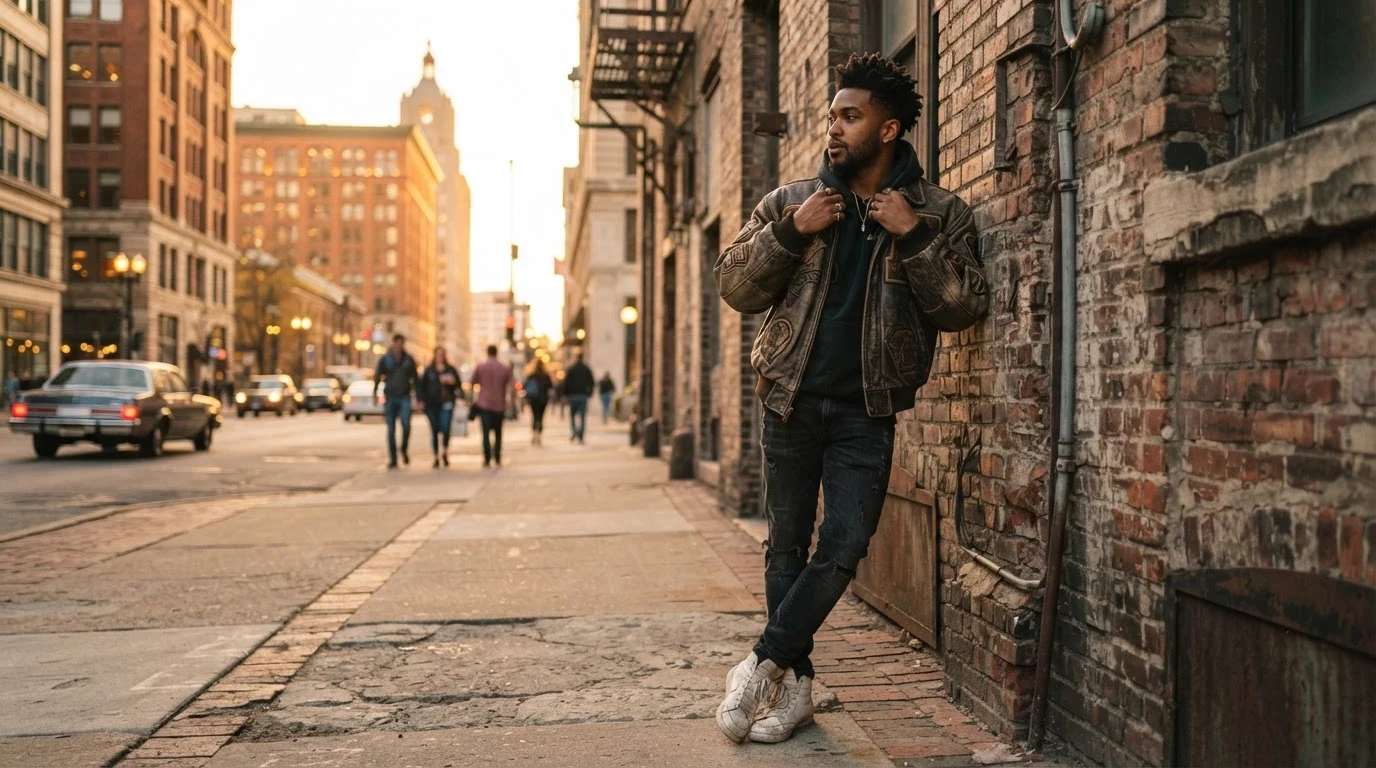
Pelle Pelle Leather Jackets Sizing and Style Heritage Guide
Master Pelle Pelle leather jacket sizing, archival streetwear cuts, and leather temper specs. Learn chest ease rules and custom handcrafted alternatives.
Key Takeaways
- Archival Box Fit: Original vintage Pelle Pelle leather jackets feature an exaggerated 90s streetwear drop shoulder with an extra 4 to 6 inches of chest ease compared to standard contemporary leather outerwear.
- Heavyweight Hide Specs: Vintage and collector pieces utilize dense 1.2mm to 1.4mm milled cowhide or heavy grain nappa, weighing between 5.5 and 8 pounds depending on leather appliqué layers.
- Sizing Adjustments: Shoppers looking for a tailored modern aesthetic typically need to size down one full size, while collectors desiring the true 1990s hip-hop silhouette should select their true-to-size chest measurement.
- Pre-Owned Inspection: Check armpits, lower hem ribbing, and elbow creases for dry-rot and stiffness before acquiring vintage garments on secondary collector marketplaces.
- Bespoke Alternative: Discerning collectors who require flawless custom sleeve lengths, tailored waistlines, and virgin full-grain cowhide can order bespoke custom handcrafted garments through custom made-to-order jackets.
Artisan Independence & Trademark Notice: Lux Wearz is an independent bespoke leathercraft atelier. All brand names, logos, and trademarks mentioned in this article (including Pelle Pelle® and related trademarks) belong exclusively to their respective trademark holders. Lux Wearz is not an authorized distributor, licensee, or affiliated partner of these brands. All brand references and historical retrospectives are made strictly for educational, comparative, and sizing review purposes under Fair Use. Lux Wearz specializes in custom-tailored, heirloom-grade genuine leather outerwear handcrafted individually in our private workshop.
How Do Pelle Pelle Leather Jackets Fit and What Is Their Sizing Architecture?
Pelle Pelle leather jackets fit with an oversized boxy silhouette engineered with dropped shoulder seams, generous armhole circumferences, and significant positive chest ease measuring between four and six inches over body measurements. This generous proportion represents the authentic 1990s urban outerwear profile, requiring modern buyers seeking a streamlined fit to measure chest width carefully against modern garment charts.
When examining the historical construction of Marc Buchanan garments from the late 1980s through the mid-2000s, pattern makers drafted leather panels specifically to accommodate thick fleece hoodies and heavyweight knitted sweatshirts underneath. This foundational design choice distinguishes archival streetwear leathercraft from European cafe racer jackets or British biker cuts, which are drafted with high armholes and minimal negative chest ease. Understanding this fundamental architectural difference is essential for collectors, vintage enthusiasts, and modern sartorial dressers who appreciate iconic leather outerwear.
Understanding Chest Ease and Garment Proportions
Garment ease is defined in technical pattern making as the difference between the wearer's actual body circumference and the physical measurement of the finished garment. In modern slim-fit leather jackets, ease ranges from two to three inches across the chest to allow basic mobility while maintaining a skin-skimming contour. In archival Pelle Pelle leather jackets, ease routinely measures five to seven inches across the chest pit-to-pit.
A labeled men's size Large (which traditionally corresponds to a 42-inch to 44-inch human chest) will frequently measure 26 inches across the chest from armpit seam to armpit seam when laid flat. Multiplying this flat dimension by two yields a total garment circumference of 52 inches. For a wearer with an athletic 42-inch chest, this pattern drafting results in a full 10 inches of total ease around the torso. While this creates the legendary slouch and swagger celebrated across golden-era hip-hop culture, modern wearers unaccustomed to archival silhouettes may find the volume overwhelming if they expect a tailored contemporary cut.
Shoulder Drop and Armscye Geometry
The shoulder construction of vintage urban leather outerwear is drafted with an extended shoulder slope, often referred to as a dropped shoulder. Rather than resting directly on the acromion bone at the tip of the shoulder, the sleeve head seam falls one to two inches down the upper bicep.
This drop shoulder is paired with an exceptionally deep armscye (armhole). The lowered armhole depth facilitates effortless layering over bulky winter garments and enables free arm articulation without pulling the bottom waistband upward. However, for everyday modern wearing without heavy underlayers, an oversized armhole causes excess leather bunching underneath the armpit. Discerning shoppers can review complete sizing charts on our size and fit guide to compare classic drop-shoulder measurements against precision modern tailored cuts.
The Archival Legacy of Marc Buchanan and the Birth of Luxury Urban Leatherwear
The history of luxury urban leather outerwear in the United States is inextricably tied to the creative vision of Marc Buchanan, who founded Pelle Pelle in Detroit, Michigan, in 1978. During an era when designer leather jackets were predominantly restricted to minimalist motorcycle jackets or utilitarian aviator coats, Buchanan recognized an underserved cultural demographic that craved expressive, vibrant, and opulent leather garments.
Detroit in the late 1970s was an industrial powerhouse with a rich history of automotive craftsmanship, metalworking, and textile innovation. Buchanan capitalized on local artisanal leather tanning techniques to create garments that fused European leather tanning quality with American urban swagger. The brand name itself—Italian for "Leather Leather"—signaled an unapologetic commitment to genuine animal hide craftsmanship.
The 1978 Detroit Foundation: Moving from Denim to Heavyweight Leather
While the brand initially experimented with premium embellished denim and sportswear tracksuits, Buchanan quickly transitioned his atelier focus toward heavy leather outerwear. Detroit winters required substantial thermal insulation, demanding leather garments that could withstand sub-zero wind chills off Lake Huron while looking undeniably prestigious on city streets.
Buchanan rejected the thin, corrected-grain pigskins and bonded split leathers commonly used in commercial retail jackets during the early 1980s. Instead, he sourced heavy full-grain steerhides and dense cowhides capable of holding elaborate multi-colored leather inlays. Leather panels were skived by hand around the perimeter to reduce seam bulk before being stitched together with heavy industrial sewing machinery, establishing a precedent for durable American outerwear construction.
The 1990s Hip-Hop Renaissance: Stadium Jackets and Intricate Appliqué
By the early 1990s, the brand transitioned from a regional Midwest phenomenon into a global cultural juggernaut. Iconic hip-hop artists, professional athletes, and cultural tastemakers adopted heavyweight leather jackets as the ultimate status symbol of urban success.
The aesthetic shifted toward intricate leather appliqué, raised embroidery, studded hardware, and multi-layered leather lettering. Models such as the American Bruiser, the Soda Club, the Chi-Town Varsity, and the Immortal became prized cultural artifacts. Owning an authentic heavyweight leather jacket was not merely a seasonal wardrobe purchase; it was an investment in artistic craftsmanship that retailed for upwards of $800 to $1,500 in 1990s currency—equivalent to over $2,500 in today's purchasing power.
For enthusiasts seeking to explore similar bold silhouettes, you can browse our curated catalog of vintage and contemporary outerwear to study iconic design lineages and styling references.
Pelle Pelle Sizing Architecture: Chest Ease, Shoulder Drop, and Cut Types
Navigating brand sizing across different manufacturing decades requires understanding the evolution of apparel grading standards. Garments produced in the 1990s follow vastly different dimensional ratios than garments produced in the late 2000s or modern contemporary re-issues.
Archival Sizing Proportions by Size Tag:
- Medium Tag: Fits 46 to 48 inch actual chest circumference, 21.5 to 22.5 inch shoulder width, and 27.0 to 27.5 inch back length.
- Large Tag: Fits 50 to 52 inch actual chest circumference, 22.5 to 23.5 inch shoulder width, and 28.0 to 28.5 inch back length.
- X-Large Tag: Fits 54 to 56 inch actual chest circumference, 23.5 to 24.5 inch shoulder width, and 29.0 to 29.5 inch back length.
- 2X-Large Tag: Fits 58 to 60 inch actual chest circumference, 25.0 to 26.0 inch shoulder width, and 30.0 to 30.5 inch back length.
- 3X-Large Tag: Fits 62 to 64 inch actual chest circumference, 26.5 to 27.5 inch shoulder width, and 31.0 to 31.5 inch back length.
Traditional Vintage Box Cut vs Modern Contemporary Tailoring
The traditional vintage box cut features a zero-taper waist. In tailored menswear, a jacket's "drop" refers to the reduction in inches between the chest measurement and the waist measurement (typically a 6-inch drop in athletic European tailoring). Archival urban leather jackets feature a zero drop or a reverse taper, meaning the waist circumference matches or slightly exceeds the chest dimension before being pulled snug by an elasticized leather hem band or heavy acrylic rib-knit border.
This pattern block creates a distinctive barrel or balloon silhouette when zipped closed. The heavy leather blousons outward above the hip, providing complete freedom of movement while sealing body warmth around the lower abdomen. In contrast, modern contemporary leather jackets feature tailored high armholes, tapered side seams, and anatomical shoulder slopes that conform to the natural human torso.
The American Bruiser and Encrusted Varsity Fit Analysis
The legendary American Bruiser jacket serves as the quintessential benchmark for heavy leather outerwear engineering. Characterized by prominent block-letter leather appliqué across the chest, heavy contrast shoulder stripes, and multi-layered back embroidery, this model carries immense physical weight.
Because the front and rear panels are laden with thousands of individual stitches holding multi-tonal leather patches, the jacket body has minimal natural drape. The leather panels act like structural armor, holding their three-dimensional boxy shape whether worn open or zipped to the chin. Wearers must account for this rigidity: while a softer lambskin jacket will collapse naturally against the shoulders, an American Bruiser demands deliberate styling with relaxed-fit denim, cargo trousers, and substantial winter boots to balance the visual proportions.
Pelle Pelle Archival Silhouette & Sizing Comparison Table
To assist collectors and buyers in evaluating different garment models, the following comparison matrix details five iconic archival silhouettes, their technical drafting ease, ideal body profiles, and physical garment weights.
| Silhouette Model | Cut & Drafting Style | Chest / Shoulder Ease | Ideal Body Profile | Leather Weight & Temper | Primary Styling Context |
|---|---|---|---|---|---|
| American Bruiser | Traditional oversized box bomber with heavy front and rear appliqué | +6 to +8 inches chest ease; 2.5-inch shoulder drop | Broad, muscular, or tall frames; builds powerful upper-body mass | 1.3mm - 1.4mm Heavy Cowhide; Firm temper with stiff drape | Statement streetwear; cold weather layering; raw denim pairing |
| Chi-Town Varsity | Heritage baseball jacket silhouette with leather body and striped wool collar | +5 to +6 inches chest ease; 2.0-inch shoulder drop | Athletic to broad shoulders; versatile everyday proportion | 1.2mm Milled Cowhide; Medium temper with supple drape | Elevated casual wear; tailored sweatpants; retro athletic sneakers |
| 1978 Archival Moto | Stand-collar motorcycle racer with articulated elbow padding | +3 to +4 inches chest ease; 1.0-inch shoulder drop | Athletic, lean, and medium builds; clean vertical profile | 1.3mm Naked Steerhide; Firm temper breaking in over years | Cafe racer styling; dark slim-straight trousers; leather combat boots |
| Soda Club Plush | Embellished plush bomber with studded metal hardware accents | +6 to +7 inches chest ease; 2.0-inch shoulder drop | Average to stocky builds; generous midsection room | 1.2mm Soft Nappa; Mellow temper with voluminous blouson | Luxury evening streetwear; bold collector events; winter outerwear |
| Big & Tall Heavyweight | Extended torso and widened bicep girth for larger frames | +8 to +10 inches chest ease; 3.0-inch shoulder drop | Big and tall frames (48+ chest); extended torso length | 1.4mm Heavy Steerhide; Stiff temper engineered for heavy wear | Maximum cold-weather protection; relaxed layering; heavy winter knitwear |
For shoppers looking for versatile classic cuts that transition seamlessly between casual and formal occasions, explore our comprehensive catalog of men's leather jackets to discover time-tested outerwear crafted for daily elegance.
Leather Hide Engineering: Milled Nappa, Heavy Cowhide, and Hardware Metallurgy
The longevity of luxury leather outerwear depends entirely on the metallurgical and biological integrity of its raw components. Understanding the technical specifications of leather tannage, grain integrity, and zipper metallurgy enables buyers to distinguish between genuine heirloom investments and transient commercial fashion.
Key Technical Specifications:
- Primary Hide Component: Full-grain drum-dyed cowhide engineered for 30+ years of active durability.
- Appliqué Inlay Leather: Chrome-tanned milled nappa skived to 0.9mm to eliminate edge fraying while retaining maximum flexibility.
- Zipper Closure Metallurgy: Heavy-gauge #8 or #10 solid antique brass teeth tested for 15,000+ mechanical cycles.
- Structural Sewing Thread: Size V-69 and V-92 bonded continuous filament nylon with a 14-pound single-strand tensile breaking strength.
- Insulated Thermal Lining: 400T tear-resistant quilted polyester twill packed with lightweight thermal batting.
Hide Temper, Tensile Strength, and Leather Thickness (1.2mm to 1.4mm)
Leather thickness in luxury outerwear is measured with precision thickness calipers and expressed in millimeters or ounces (where 1 ounce equals approximately 1/64th of an inch or 0.4mm). Mass-market commercial leather jackets sold in department stores frequently utilize leather split to 0.7mm to 0.9mm (approximately 1.75 to 2.25 oz). While this thin leather feels soft on the retail hanger, it lacks structural tensile strength, punctures easily, and tears along needle perforation lines after a few seasons of active wear.
In contrast, archival urban outerwear utilizes drum-dyed full-grain cowhide measuring 1.2mm to 1.4mm (3.0 to 3.5 oz). This thickness threshold provides exceptional abrasion resistance, wind impermeability, and thermal retention. The "temper" refers to the leather's pliability. Milled cowhide undergoes a specialized mechanical tumbling process in large wooden tanning drums, which breaks down the collagen fiber stiffness without sacrificing tensile strength. This produces a hide that possesses substantial heft and drape while feeling supple against the body from the very first wear.
Hardware Specifications: Antiqued Brass Zippers, Heavy Snaps, and Reinforced Seams
A leather jacket is only as durable as its mechanical closure mechanisms. The immense weight of a 6-pound leather garment exerts continuous lateral stress across the center front zipper when the wearer sits, bends, or stretches.
Iconic vintage jackets employ heavy-gauge #8 or #10 metal zippers forged from antiqued solid brass or cast zinc alloy. These oversized zipper teeth interlock with deep engagement depth, preventing teeth separation under load. Furthermore, storm flaps, collar throat latches, and pocket welts are reinforced with spring-loaded brass snap buttons backed by leather reinforcement washers inside the lining. This multi-layered construction prevents the metal snap studs from ripping through the face leather during aggressive unfastening.
Leather Durability, Weight, and Tannage Matrix
The following technical matrix compares the primary hide varieties utilized in luxury outerwear, outlining their tannage methods, thickness measurements, weather resilience, and maintenance requirements.
| Component / Hide Variety | Leather Grade & Tannage | Thickness (mm) | Weather Resilience | Expected Lifespan | Care & Maintenance Frequency |
|---|---|---|---|---|---|
| Full-Grain Milled Cowhide | Top-layer hide, drum-dyed chrome tannage with tumbled pebble grain | 1.2mm - 1.4mm (3.2 oz) | Excellent rain and wind protection; natural water repellency | 30 to 50+ Years with conditioning | Clean annually; condition twice yearly with natural beeswax balm |
| Plush Lambskin Nappa | Aniline-dyed juvenile ovine hide with butter-soft hand feel | 0.9mm - 1.0mm (2.4 oz) | Moderate; delicate surface susceptible to heavy downpours | 15 to 25 Years of careful wear | Keep away from road salt; condition quarterly with gentle lanolin cream |
| Heavyweight Steerhide | Unsplit bovine hide with dense fibrous collagen matrix | 1.4mm - 1.6mm (3.8 oz) | Superior; impenetrable to cold winds and heavy abrasion | 50+ Years; true multi-generational heirloom | Heavy initial break-in; apply heavy leather conditioner once per year |
| Suede / Split Nubuck | Velvet buffed corium layer with rich fibrous nap | 1.1mm - 1.3mm (2.8 oz) | Sensitive to water spotting; requires silicone-free barrier | 15 to 20 Years with proper care | Brush regularly with crepe brush; apply specialized suede water proofer |
| Bonded / Corrected Grain (Avoid) | Scraped split hide coated with polyurethane synthetic finish | 0.7mm - 0.9mm (1.8 oz) | Poor; synthetic coating delaminates and cracks in cold | 2 to 4 Years before peeling occurs | Cannot be conditioned; oils cannot penetrate synthetic top barrier |
To maintain the pristine luster and fiber flexibility of your investment garments, review our comprehensive leather care guide for professional step-by-step cleaning and conditioning methodologies.
Pre-Owned Inspection Checklist: Detecting Dry-Rot, Cracking, and Hardware Fatigue
Because original Pelle Pelle production spanned multiple decades, the vast majority of jackets available on secondary collector marketplaces (such as Grailed, eBay, and specialized vintage boutiques) are between 15 and 30 years old. Inspecting an archival leather piece requires a meticulous physical examination to avoid acquiring an unwearable garment suffering from irreversible fiber decay.
The Five-Point Vintage Inspection Protocol:
- Step 1: The Squeeze and Rebound Test: Pinch armpit leather between two fingers to assess internal moisture retention and supple fiber spring.
- Step 2: The 180-Degree Bend Test: Fold the leather along the inner elbow crease around your finger; watch for chalky white stress lines or microscopic cracking.
- Step 3: The Interior Olfactory Audit: Smell the lining and armpit cavities carefully to distinguish clean tanning oils from persistent, rotting basement mildew.
- Step 4: The Zipper Slider Box Inspection: Cycle the center front zipper several times; check for missing brass teeth, slider wobble, or torn insertion pins.
- Step 5: Ribbing Elasticity Check: Pull the acrylic cuffs and waist hem outward; if the knit remains slack or displays wavy ripples, the elastic core has broken down.
The Bending and Flex Test for Archival Leather
Leather is an organic material consisting of cross-linked collagen protein fibers lubricated by microscopic fat liquors introduced during the tanning process. Over decades of improper storage in dry attics or unventilated closets, these essential oils evaporate. Once the moisture and oil content falls below critical thresholds, the fibers become brittle—a condition known as dry-rot.
To perform the bend test, pinch a fold of leather between your thumb and index finger in a high-flex area, such as the inner elbow or underarm gusset, and flex it backward 180 degrees. If the leather feels supple and bounces back without leaving a chalky crease, the internal fiber matrix remains healthy. However, if the finish feels papery, emits a faint crunching sound, or reveals tiny hairline cracks along the grain surface, the hide has begun to rot. Dry-rot is chemically irreversible; topical conditioners will darken the surface but cannot rebuild broken collagen chains.
Lining Deterioration and Seam Stress Check
Inspect the interior lining, particularly around the armhole circumferences and inner cuff openings. Archival jackets frequently utilized silky polyester satin or acetate linings quilted over lightweight fiberfill insulation.
Look for acid staining from body perspiration, which rots cotton thread stitching over time. Check the bottom hem where the leather body attaches to the elasticized ribbing: heavy wear creates friction tears along the lower seam line. If the ribbing is permanently stretched out and wavy (resembling bacon), the internal elastane threads have snapped and will require total replacement by a master leather tailor.
Bespoke Leathercraft: Crafting Custom-Tailored Streetwear Outerwear at Lux Wearz
While vintage archival jackets hold immense cultural nostalgia, acquiring an original piece in pristine wearable condition poses major challenges: unpredictable collector pricing, lingering vintage odors, questionable hide hydration, and awkward 1990s sizing that swallows modern body proportions.
At Lux Wearz, we bridge the gap between iconic golden-era streetwear aesthetics and precision bespoke luxury. Our master leathercraft atelier specializes in constructing custom made-to-measure leather jackets crafted individually by skilled artisans who uphold old-world bench-made standards.
Our Atelier Difference vs Commercial Production:
- Raw Hide Selection: We utilize exclusively premium 1.2mm to 1.4mm full-grain virgin cowhides and supple nappa, rejecting thin industrial splits and bonded scraps.
- Anatomical Body Mapping: Every garment is drafted from a bespoke 12-point individual measurement profile, eliminating awkward sleeve bunching and excess torso baggage.
- Structural Reinforcement: High-stress pocket corners and collar latches are reinforced with internal split-leather backing discs and heavy bonded nylon threads.
- Premium Hardware Integration: All garments feature genuine heavy-duty antiqued brass zippers and reinforced metal snap closures engineered for decades of daily cycling.
- Luxurious Finishing: Hand-skived perimeter edges, bespoke interior embroidery, and breathable Japanese silk-blend or quilted thermal satin linings.
Made-to-Measure Chest, Sleeve, and Torso Tailoring
One of the greatest frustrations of purchasing vintage box-cut jackets is sleeve length. A vintage size XXL may provide the relaxed chest girth you desire, but the sleeves are drafted so long that they completely cover the wearer's hands.
Through our personalized custom tailoring service, clients submit exact body measurements—including neck-to-wrist sleeve length, center back length, shoulder width, chest circumference, and bicep girth. Our pattern makers draft a unique paper pattern for each client, ensuring that your jacket captures the bold, muscular drop-shoulder silhouette of classic streetwear while fitting your specific sleeve and torso proportions with surgical accuracy.
Virgin Full-Grain Leather Selection and Artisan Craftsmanship
Every bespoke garment at Lux Wearz is constructed using pristine, virgin full-grain cowhide, buttery lambskin, or rugged steerhide sourced from certified ethical tanneries. We never utilize pre-worn garments, bonded scraps, or chemically altered split leather.
Our master artisans hand-skive every leather seam edge, sew stress points with heavy bonded nylon threads (Size V-69 and V-92), and install solid antiqued brass hardware engineered to endure decades of continuous wear. When you commission a bespoke jacket from our atelier, you are not merely purchasing an outfit—you are creating an heirloom piece that will develop a rich, personalized patina across your lifetime.
Ready to bring your dream leather jacket to life? Explore our custom made-to-order jackets to begin your consultation with our master leathercraft artisans today.
Modern Styling Blueprint: How to Wear Bold Urban Leather in 2026
Styling bold, voluminous leather outerwear in contemporary fashion requires a conscious understanding of visual silhouette balance. The days of pairing an oversized boxy leather jacket with baggy puddle denim and giant athletic sneakers are evolving into more refined, intentional styling paradigms.
The Proportion Contrast Technique
When wearing a heavy leather bomber with dropped shoulders and a boxy torso, ground the lower half of your outfit with clean, structured tailoring. Pair an oversized leather jacket with straight-leg raw selvedge denim or tapered heavyweight wool trousers. This creates an architectural triangle silhouette that accentuates broad shoulders without making the wearer look sloppy or shapeless.
Avoid ultra-skinny jeans, which create an unbalanced top-heavy appearance that makes the jacket look disproportionately giant. Similarly, select footwear with substantial visual weight—such as Goodyear-welted service boots, lug-sole Chelsea boots, or classic leather court sneakers—to anchor the garment's commanding presence.
Contemporary Color Blocking and Layering
If your jacket features bold multi-color leather panels or intricate contrast piping, allow the jacket to remain the undisputed focal point of your ensemble. Keep underlying garments understated: a clean heavyweight white cotton crewneck t-shirt, an charcoal merino wool turtleneck, or a minimalist black loopback cotton hoodie provide the perfect neutral canvas.
For an elevated evening aesthetic, zip the jacket three-quarters of the way up, pop the leather collar slightly to frame the jawline, and pair with dark charcoal pleated trousers and polished black calfskin boots. To explore our full collection of versatile luxury outerwear, visit our complete catalog to find the perfect piece for your individual wardrobe aesthetic.
Explore The Full 2026 Leather Outerwear Collection
Vegetable-tanned full-grain cowhide, buttery New Zealand lambskin, and heritage Melton wool. Free express delivery across the USA with 30-day hassle-free returns.