
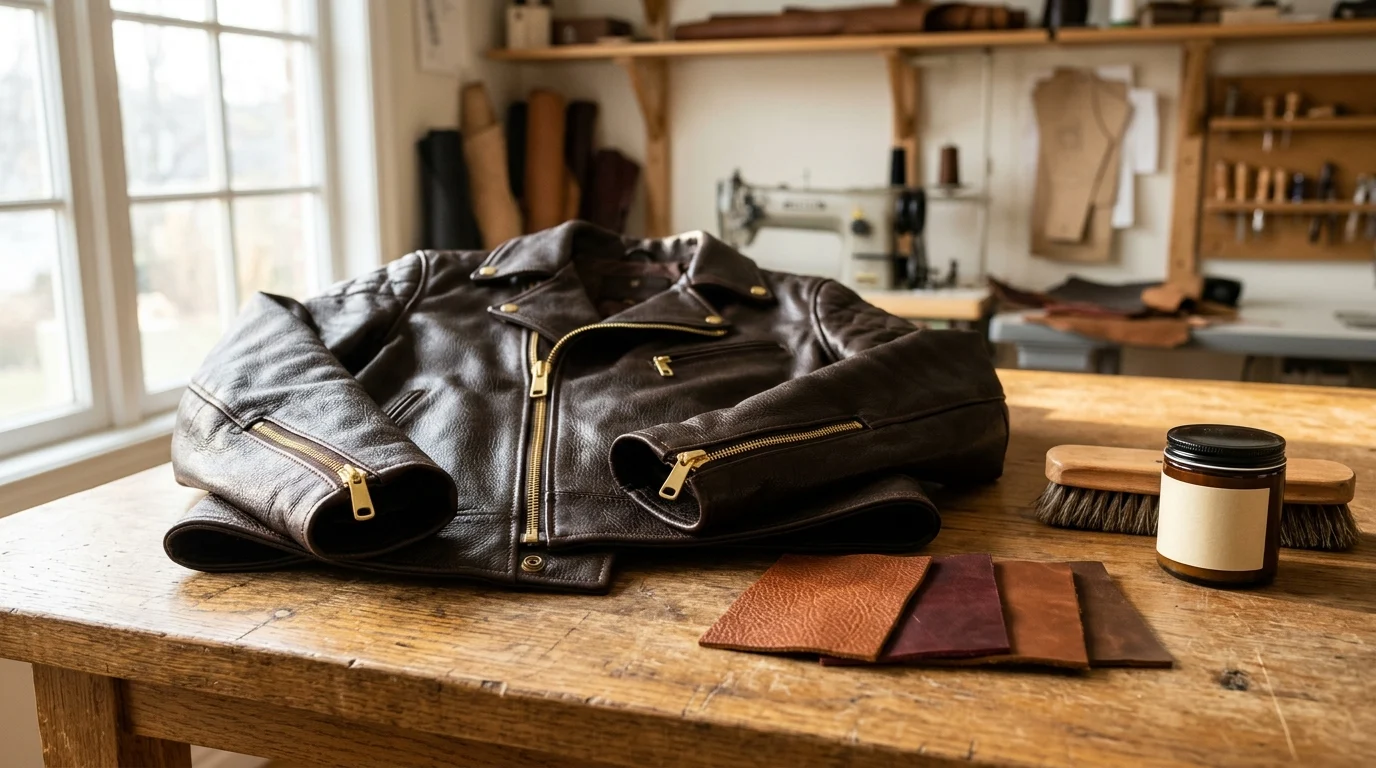
Kawasaki Leather Jackets Care, Conditioning, and Patina Maintenance: Atelier Guide [2026]
Complete 2026 leathercare manual for Kawasaki-inspired motorcycle jackets and racing suits: cleaning road grime, pH-balanced conditioning, perforated panel care, brass zipper maintenance, patina preservation, and bespoke full-grain cowhide tailoring at Lux Wearz.
Key Takeaways
- Surface Chemistry Matters: Pigmented and semi-aniline sportbike cowhide used in Kawasaki-style riding jackets relies on a flexible polyurethane micro-topcoat; harsh saddle soaps, alcohol wipes, and petroleum solvents strip that barrier and accelerate cracking at elbow flex zones.
- pH-Balanced Conditioning Schedule: Condition heavy 1.2–1.4 mm motorcycle cowhide every 4 to 6 months—or immediately after prolonged rain exposure—using water-based lanolin or beeswax-neatsfoot emulsions that nourish collagen fibers without clogging perforated ventilation panels.
- Zero-Heat Drying Rule: Never dry a rain-soaked leather riding jacket near radiators, space heaters, or direct sunlight; rapid moisture evaporation shrinks dermal fiber bundles and permanently stiffens armor pockets and accordion stretch zones.
- Hardware & Thread Preservation: High-tensile bonded nylon v69/v92 seams and solid brass YKK #8/#10 zippers outlast the hide itself only when road grit is brushed from zipper teeth and lubricated quarterly with dry paraffin or silicone-free beeswax.
- Bespoke Heirloom Upgrade: When vintage or mass-produced racing outerwear suffers dry-rot, delaminating pigment, or worn armor gussets, commissioning a made-to-measure jacket through Lux Wearz Custom Order delivers virgin drum-dyed cowhide cut to your exact riding posture.
Artisan Independence & Trademark Notice: Lux Wearz is an independent bespoke leathercraft atelier. All brand names, logos, and trademarks mentioned in this article (including Kawasaki® and related trademarks) belong exclusively to their respective trademark holders. Lux Wearz is not an authorized distributor, licensee, or affiliated partner of these brands. All brand references and historical retrospectives are made strictly for educational, comparative, and sizing review purposes under Fair Use. Lux Wearz specializes in custom-tailored, heirloom-grade genuine leather outerwear handcrafted individually in our private workshop.
How Should You Clean and Condition a Kawasaki Leather Jacket Without Damaging the Finish?
Kawasaki leather jackets should be cleaned with a slightly damp microfiber cloth and a diluted, pH-neutral leather cleanser, air-dried at ambient room temperature away from direct heat, and nourished twice yearly with a thin coat of non-greasy beeswax or lanolin balm to maintain fiber suppleness, colorfastness, and abrasion resistance.
The Architecture of Sportbike Leather: Why Care Begins With Tannage and Cut
Maintaining a Kawasaki-inspired motorcycle jacket requires understanding what differentiates sportbike leather from casual fashion lambskin. Road-oriented leather outerwear is built to survive high-velocity wind shear, bug impacts, ultraviolet exposure, exhaust heat, and sudden rainstorms while remaining pliable enough for an aggressive forward-leaning riding tuck. Unlike light fashion garments cut from 0.7 mm sheep nappa, true riding jackets rely on 1.1 mm to 1.4 mm full-grain or heavy top-grain cowhide—often drum-dyed and finished with a protective semi-aniline or pigmented polymer seal to preserve signature lime-green, obsidian-black, and crisp white racing contrast panels.
That multi-tone construction creates distinct maintenance challenges. White and high-visibility green leather panels show road film, chain lube mist, and insect protein stains faster than black hides, yet aggressive scrubbing can rub through the surface pigment or bleed dark dye into adjacent white stripes. Meanwhile, perforated chest and underarm zones expose the raw corium layer directly to sweat salts, humidity, and road dust. If you apply thick waxy pastes onto perforated panels, the wax plugs every pinhole, trapping perspiration inside the lining and breeding odor and mold.
Fit architecture also dictates where stress fatigue appears first. Sport-cut jackets—with pre-curved sleeves, dropped tails, and accordion-pleated shoulder blades—flex thousands of times per ride along the inner elbow crease, lower collar edge, and cuff gussets. Browse the Lux Wearz Kawasaki Collection alongside our broader Men's Leather Jackets catalog to compare how racing-cut jackets distribute panel seams compared with heritage café racers. When those flex zones dry out, microscopic collagen fibrils snap under tension, creating spiderweb surface fissures that no surface polish can reverse.
Historical Evolution of Sport-Touring & Ninja-Inspired Leather Care Standards
Early track and superbike leather garments from the late 1970s through the 1990s were predominantly thick, drum-dyed steerhide finished with wax-heavy oils designed for weatherproofing rather than breathability. Riders conditioned them with heavy tallow greases and pure neatsfoot oil—compounds that kept water out but gradually softened stitched seams and darkened bright team colors into muddy amber tones. As modern superbike ergonomics evolved around tucked aero humps, CE-rated internal armor pockets, and multi-panel color-blocking inspired by iconic green-and-black track liveries, tannery chemistry shifted toward chrome-tanned or combination-tanned cowhide sealed with breathable, UV-stabilized micro-resins.
That shift changed atelier maintenance completely. Modern sport leather does not want heavy petroleum jelly, mink oil overloaded with silicone, or alkaline saddle soap bars formulated for thick equestrian tack. Traditional saddle soap carries an alkaline pH between 8.5 and 10.0, whereas healthy tanned leather rests comfortably near pH 4.5 to 5.5. Repeated alkaline washing breaks down fatliquors bound inside the hide during drum tanning, leaving the grain brittle and chalky once the water evaporates. For foundational care routines applicable across every hide family, bookmark the Lux Wearz Leather Care Guide before starting any deep-cleaning session.
Silhouette & Fit Architecture: How Cut Geometry Shapes Wear Patterns
Understanding how each riding cut sits on the torso explains exactly where friction, sweat buildup, and creasing concentrate over thousands of miles. Proper sizing also prevents premature seam stress: a jacket that pulls tightly across the shoulder yoke or binds at the bicep forces bonded nylon threads to carry structural loads meant for the hide itself.
| Silhouette Model | Cut & Fit Type | Shoulder / Chest Offset | Ideal Body Profile | Leather Weight & Temper |
|---|---|---|---|---|
| Ninja Aero Sport Jacket | Aggressive pre-curved track cut with dropped kidney tail | +2.0" chest ease; narrow 17.5"–19.0" structured shoulder | Athletic and lean riders in tucked sportbike posture | 1.3–1.4 mm firm drum-dyed cowhide, medium-stiff temper |
| Café & Street Roadster | Neutral upright street cut with straight hem | +3.0" chest ease; balanced anatomical shoulder | Everyday commuters and upright naked-bike riders | 1.1–1.2 mm supple top-grain cowhide, medium temper |
| Perforated Summer Track Cut | Ventilated torso and inner-arm airflow chassis | +2.5" chest ease; articulated raglan gussets | Warm-weather canyon and track-day riders | 1.2 mm micro-perforated cowhide, pliable temper |
| Touring 3-Season Armored Cut | Longer waist length with storm flap and thermal liner | +4.0" chest ease for mid-layering clearance | Broad-shouldered and long-torso touring riders | 1.2–1.3 mm weather-sealed cowhide, medium-soft temper |
| One-Piece Racing Suit | Full-body articulated race shell with speed hump | Zero excess torso slack; pre-bent knee and elbow drop | Dedicated circuit riders seeking aerodynamic lock | 1.3–1.5 mm high-tensile race cowhide, structured temper |
Notice how chest ease directly impacts leather longevity. If you wear a tight track silhouette over heavy winter fleece, every zip-up strains the main front zipper tape and stretches the rib-side gussets past their elastic memory. Checking your exact chest, waist, shoulder-width, and sleeve-length metrics on the Lux Wearz Size Guide prevents over-tensioning seams from day one.
Step-by-Step Atelier Cleaning Protocol After Highway & Canyon Rides
1. Immediate Post-Ride Surface De-Bugging (10 Minutes)
Insect proteins are mildly acidic and enzymatic. Leaving crushed bugs baked onto green or white leather chest panels under garage heat etches tiny dull spots into the protective topcoat within 48 hours. Immediately after a ride, dampen a clean, lint-free cotton or microfiber towel with lukewarm distilled water. Lay the damp towel flat over stubborn insect residue for five minutes to rehydrate the proteins gently instead of scraping with fingernails or abrasive sponges. Wipe away in one smooth stroke with a second clean damp cloth, then buff dry.
2. Deep Seasonal Cleansing (Every 3 to 4 Months)
Remove all removable CE shoulder, elbow, and back armor plates plus any zip-out thermal quilted liners before deep cleaning. Place the jacket flat on a clean cotton sheet—never hang a wet or heavily handled garment on thin wire hangers, which deform the collar stand and shoulder padding. Mix a dedicated pH-neutral foaming leather cleanser (or two drops of mild fragrance-free castile cleanser in 500 ml of distilled water) and apply the foam to a soft horsehair brush or damp microfiber pad. Work one panel at a time—collar, left sleeve, right sleeve, front chest, back panel—using gentle circular motion without soaking the hide.
3. Sweat & Liner Deodorizing
Never machine wash or dry-clean a leather riding jacket. Harsh perchloroethylene dry-cleaning solvents strip natural fatliquors instantly and turn supple cowhide into stiff cardboard. To refresh fixed mesh or satin linings, zip out detachable layers for gentle hand washing in cool water, then mist the interior fixed mesh lightly with a 50/50 distilled water and white vinegar solution or alcohol-free enzymatic fabric refresher while keeping the exterior leather surface dry. Hang the jacket on a broad-shouldered wooden cedar hanger in a shaded, cross-ventilated room for 24 hours.
4. Conditioning Without Over-Softening
Riding leather needs balanced lubrication—not a greasy coat that turns firm protective armor pockets soggy. Once the jacket is completely dry, warm a pea-sized dollop of pure beeswax-and-lanolin leather cream between your fingertips and apply a whisper-thin layer across high-flex zones: inner elbows, underarm gussets, collar fold, cuffs, and shoulder blades. Avoid heavy rubbing on white decal stripes or printed graphics; wipe lightly over pigmented zones and focus nourishment on natural grain creases. Allow the conditioner to absorb for 45 minutes, then buff vigorously with a soft horsehair brush to restore a satin, factory-fresh luster.
Leather Hide & Hardware Durability Matrix
Every component on a high-mileage riding jacket ages at a different rate depending on tannage, thickness, UV exposure, and maintenance habits. Use this atelier matrix to benchmark material longevity across both standard production hides and bespoke workshop builds.
| Component / Hide | Leather Grade & Tannage | Thickness (mm) | Weather Resistance | Expected Longevity | Maintenance Needs |
|---|---|---|---|---|---|
| Virgin Full-Grain Cowhide | Drum-dyed, combination chrome-veg retan | 1.25–1.40 mm | High; natural dense fiber lattice resists drizzle and wind | 15–25+ years with regular care | Clean quarterly; light beeswax balm twice yearly |
| Semi-Aniline Racing Hide | Corrected or lightly buffed top-grain cowhide | 1.15–1.30 mm | High; polymer micro-seal repels road spray and bugs | 10–18 years before finish wear | pH-neutral wipe-downs; light water-based conditioner |
| Perforated Ventilation Panels | Full-grain cowhide punched with 1.2 mm airflow grid | 1.10–1.25 mm | Low-Medium; breathes rapidly but admits moisture | 8–14 years if kept salt-free | Spray-free damp wipe; never pack solid wax pastes |
| Bonded Nylon Structural Thread | Continuous filament v69 / v92 UV-treated nylon | N/A (0.35–0.45 mm) | High; immune to rot and mild UV degradation | 15–25 years (outlasts cotton) | Brush grit from seams; inspect elbow double-rows |
| Solid Brass YKK #8 / #10 Zippers | Heavy-gauge brass teeth on woven polyester tape | #8 cuff / #10 main | High; resists salt corrosion and high pull force | 15–20+ years if kept clean | Toothbrush dry grit monthly; apply dry paraffin wax |
| Accordion Stretch & Kevlar Panels | Elasticized leather pleats & aramid textile | 1.00–1.10 mm | Medium; textile gussets absorb road dampness | 6–12 years depending on flex load | Keep textile clean; condition leather pleats lightly |
Protecting Green, White, and Black Contrast Panels From Color Transfer and UV Fade
Multi-color motorcycle jackets owe their unmistakable visual authority to crisp transitions between deep black, bright emerald green, and bright white panels. Those exact color transitions are where amateur cleaning mistakes happen most frequently. Never use universal dark leather dyes or tinted shoe polishes near white piping or green panels. Even clear alcohol-based stain removers can dissolve the acrylic topcoat over bright green dye, lifting color onto your cloth in seconds.
When caring for multi-tone jackets:
- Use Separate Cloths by Color Zone: Always wipe white panels first with a dedicated white microfiber cloth before touching black or green leather, preventing microscopic black carbon or road soot from streaking across bright stripes.
- Shield Against Garage UV Exposure: Hanging a racing jacket next to an unshaded garage window fades green and red aniline pigments dramatically within two summers. Always store jackets inside a breathable cotton garment bag—never sealed inside dry-cleaner plastic bags, which trap ambient humidity and starve the hide of air circulation.
- Prevent Dye Migration During Storage: Do not fold damp jackets so dark black sleeves press tightly against light green or white torso stripes. Use a wide contoured wooden hanger at least 2 inches thick at the shoulders so panels hang freely without touching under compression.
Pre-Owned & Vintage Inspection Checklist: Detecting Dry-Rot and Restoration Limits
Many enthusiasts hunt secondhand marketplaces for archival racing outerwear before realizing how silently neglect destroys older hides. Because heavy motorcycle leather hides internal damage under thick pigment, a jacket can photograph cleanly online while suffering irreversible structural decay underneath. Inspect every pre-owned garment against these five atelier diagnostics:
- The Pinch-and-Crease Dry-Rot Test: Gently pinch the leather between thumb and forefinger at the upper shoulder yoke and inner collar—two zones exposed to decades of sweat and sunlight. Healthy full-grain cowhide bends softly with subtle fine grain ripples and springs back smoothly. Dry-rotted leather feels papery or brittle, emits faint crackling sounds, or leaves pale powdery cracks along the fold line. Dry-rot is oxidized collagen breakdown; no conditioner can restore lost tensile strength for road riding.
- Armpit Seam & Cuff Binding Inspection: Turn the sleeves inside out and inspect the underarm gussets. Sweat salts crystallize along thread holes over years of riding, corroding cheap cotton stitching and hardening the surrounding hide until needle holes elongate into tears.
- Zipper Box & Pin Integrity: Inspect the bottom insertion pin and slider box on the main front zipper. Frayed polyester tape right next to the metal retainer box is the #1 cause of zipper failure mid-ride and requires full front-panel unstitching to replace cleanly.
- Armor Pocket & Liner Delamination: Older foam back pads and polyurethane waterproof membranes break down after 8–10 years, flaking into sticky yellow dust inside the lining. Check the back protector pocket for crumbling foam residue.
- Restoration Economics vs. Bespoke Replacement: Replacing a main #10 brass zipper, re-stitching blown elbow seams, and professionally re-pigmenting scuffed panels at a specialist leather cobbler routinely costs $250 to $450—often exceeding the cost of a freshly handcrafted garment cut from brand-new virgin hides.
Featured Kawasaki-Inspired Silhouettes & Curated Store Collection
Whether you are benchmarking maintenance intervals for an existing riding closet or upgrading from a fatigued secondhand piece to crisp, uncompromised leathercraft, exploring real construction differences across street and track silhouettes clarifies which hide and hardware specs serve your riding style best. Below are five standout models currently featured in the Lux Wearz store catalog:
1. Men's Kawasaki Ninja H2-Style Leather Jacket – Black Green
Designed around supercharged street-sport ergonomics, the Men's Kawasaki Ninja H2-Style Leather Jacket – Black Green pairs high-contrast emerald green racing accents against a deep matte-black leather chassis. Because the green stripes sit along high-impact shoulder and chest contours, wiping bug residue promptly with distilled water and conditioning twice yearly keeps the color transitions sharp without dulling the black cowhide base.
2. Kawasaki Ninja Graphic Leather Jacket – Black Green White
For riders drawn to classic three-tone superbike graphics, the Kawasaki Ninja Graphic Leather Jacket – Black Green White demonstrates why separate cleaning cloths per color zone matter. Its crisp white contrast panels benefit from gentle, silicone-free conditioning balms that block grime penetration while preserving clean edge definition against adjacent green and black hides.
3. Kawasaki Ninja Graphic One-Piece Leather Racing Suit – Black
Full-body track construction places far greater flexing demands on knee, hip, and lower-back accordion panels than two-piece street jackets. The Kawasaki Ninja Graphic One-Piece Leather Racing Suit – Black illustrates heavyweight circuit tailoring with articulated joints, where routine sweat-salt removal from perforated zones and paraffin zipper lubrication keep full-length front and calf closures gliding smoothly session after session.
4. Kawasaki RIMINI II Leather Jacket (Male)
Built for riders who prefer refined sport-touring versatility with cleaner tonal balance, the Kawasaki RIMINI II Leather Jacket (Male) showcases structured shoulder paneling and tailored waist tapering. Regular brushing of its seam creases and collar stand preserves the sculpted silhouette and prevents sweat darkening around the neckband.
5. Kawasaki OXFORD Leather Jacket (Male)
Blending heritage roadster restraint with durable protective leather weight, the Kawasaki OXFORD Leather Jacket (Male) rewards owners who cultivate a natural satin patina. Rather than heavy wax glazes, light semi-annual conditioning allows the hide to mold comfortably to the rider's torso and elbow bend while retaining firm outer abrasion integrity.
To compare every riding colorway, armor layout, and leather weight side by side, browse the full Kawasaki Brand Catalog on Lux Wearz or explore our dedicated Racing Jackets Category.
How to Build Healthy Long-Term Patina vs. Premature Cracking
Riders often confuse desirable leather patina with neglected surface breakdown. True patina is the gradual deepening of tone, subtle polishing of high-contact edges, and gentle anatomical creasing along the biceps and elbows that occurs when well-nourished fibers flex naturally over years. Premature cracking, by contrast, is dry, splintered, chalky grain fracture caused by dehydration, heat cycling, or chemical stripping.
To cultivate rich, resilient patina without sacrificing finish integrity:
- Never Over-Condition: Applying balm every two weeks saturates the dermal pores, making the hide limp, heavy, and prone to stretching out of shape at the elbows and cuffs. Stick strictly to a 4-to-6-month interval unless you ride through prolonged downpours.
- Brush Before and After Conditioning: A five-minute dry horsehair brushing lifts microscopic road dust out of grain valleys before balm touches the hide, then friction-warms the light wax afterward so it distributes evenly without sticky residue.
- Respect Rest Days: Leather absorbs body moisture during multi-hour rides. Rotating between two riding jackets or hanging your primary jacket on a broad wooden hanger for 24 hours between long rides lets internal moisture escape naturally so collagen fibers rebound.
The Bespoke Handcrafted Alternative at Lux Wearz
Even the most disciplined maintenance routine cannot fix a jacket that started with compromised split leather, weak plastic zippers, or ill-fitting off-the-rack sleeve geometry. When riders experience tight shoulder pull or baggy waist bunching, seams work overtime on every ride, shortening the garment's structural life regardless of how often it is conditioned.
At Lux Wearz, our private workshop approaches outerwear from first principles. Every made-to-measure commission begins with virgin full-grain cowhide, heavy goatskin, or custom-specified supple lambskin selected for even fiber density across every panel—eliminating the weak belly flanks sometimes hidden inside mass-produced batches. We reinforce structural seams with high-tensile bonded nylon thread, fit solid brass YKK #8 and #10 zippers tested for thousands of smooth cycles, and cut custom chest, shoulder, sleeve, and torso measurements tailored to your exact frame.
Whether you want a clean street café silhouette inspired by Japanese superbike heritage, customized color-blocking with zero unauthorized third-party logos, or personalized quilted satin and breathable mesh linings, you can specify every hide weight and measurement through Lux Wearz Custom Order.
Next Steps for Your Riding Outerwear
- Verify Your Exact Fit: Measure chest, shoulder width, and sleeve reach using the Lux Wearz Size Guide before ordering so seams never suffer unnecessary tension.
- Follow the Atelier Maintenance Calendar: Review our complete conditioning and storage checklist on the Lux Wearz Leather Care Guide.
- Shop Verified Riding Silhouettes: Browse the curated Kawasaki Brand Storefront or explore our complete Lux Wearz Outerwear Catalog.
- Commission Bespoke Craftsmanship: Design a custom-measured full-grain jacket built to your specifications in the Lux Wearz Custom Order Studio.
Explore The Full 2026 Leather Outerwear Collection
Vegetable-tanned full-grain cowhide, buttery New Zealand lambskin, and heritage Melton wool. Free express delivery across the USA with 30-day hassle-free returns.