
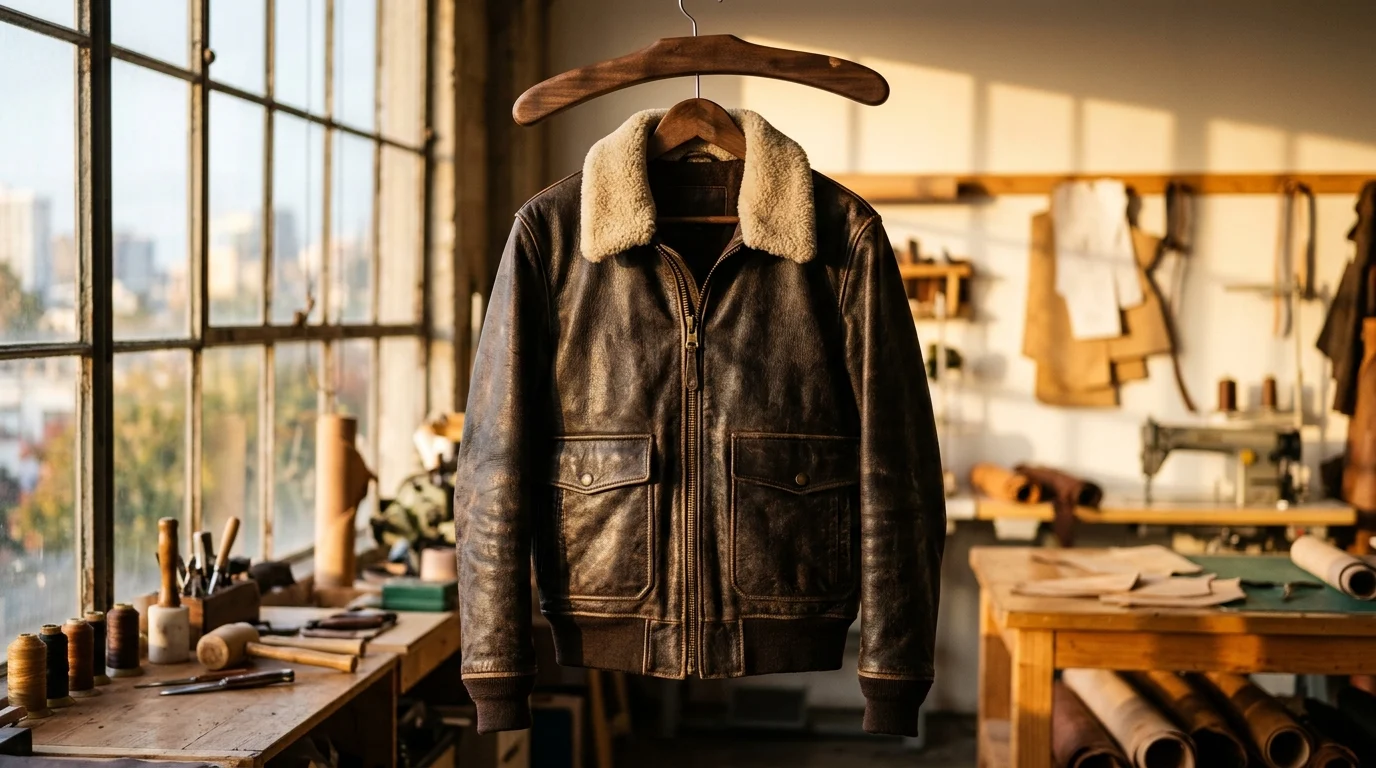
Is a Vintage Avirex Leather Jacket Still Worth Buying in 2026? Modern Value and Alternative Guide
Analyze the real 2026 collector value of vintage Avirex leather jackets. Discover dry-rot inspection checks, restoration costs, and bespoke leather alternatives.
Key Takeaways
- Vintage Avirex flight jackets and varsity bombers from the 1980s and 1990s command between $450 and $1,800 on secondary markets, but over 60 percent exhibit hidden structural flaws including leather dry rot, oxidized brass teeth, and rotted cotton seams.
- Pre-purchase verification requires a rigorous tactile flex test along the lower kidney panel, inspection of inner lining perspiration acid decay, and an elasticity audit of acrylic-wool ribbed waistbands.
- Professional restoration costs frequently range from $320 to $650 for relining, panel re-dyeing, and zipper replacement, often exceeding the initial purchase price of an untreated secondhand garment.
- Handcrafted made-to-measure alternatives from independent ateliers like Lux Wearz deliver virgin full-grain cowhide, rot-proof bonded nylon stitching, and exact anatomical chest-to-waist tapering without pre-owned degradation.
- Archival silhouettes such as the A-2 Flight Jacket and Icon Varsity remain timeless menswear cornerstones when sourced with intact hide temper or commissioned as freshly tailored bespoke outerwear.
Artisan Independence & Trademark Notice: Lux Wearz is an independent bespoke leathercraft atelier. All brand names, logos, and trademarks mentioned in this article (including Avirex® and related trademarks) belong exclusively to their respective trademark holders. Lux Wearz is not an authorized distributor, licensee, or affiliated partner of these brands. All brand references and historical retrospectives are made strictly for educational, comparative, and sizing review purposes under Fair Use. Lux Wearz specializes in custom-tailored, heirloom-grade genuine leather outerwear handcrafted individually in our private workshop.
Is a Vintage Avirex Leather Jacket Worth Buying in 2026?
A vintage Avirex leather jacket is worth buying in 2026 only if the hide maintains supple grain flexibility without micro-cracking, the original brass zipper tracks retain all teeth, and the acquisition price accounts for potential $300-plus professional restoration costs. For discerning enthusiasts prioritizing daily wearability and lifetime durability over distressed collector provenance, investing in a newly handcrafted bespoke leather alternative constructed from virgin full-grain cowhide offers superior structural integrity, modern ergonomic comfort, and tailored precision.
The vintage leather market has experienced dramatic valuation shifts over the past five years. Driven by archival streetwear revivalism and the enduring romance of mid-century military aviation silhouettes, pre-owned flight outerwear has transitioned from thrift bin relics to high-dollar collector assets. However, leather is an organic protein structure that naturally oxidizes, loses essential lipid moisture, and degrades when exposed to decades of ambient humidity, ultraviolet radiation, and improper closet storage. Before committing four figures to a secondary market listing, every buyer must evaluate whether an authentic 1990s relic justifies the hidden metallurgical and structural risks.
The Cultural Trajectory and Heritage of Avirex Outerwear
To comprehend the contemporary fascination with vintage Avirex, one must trace the brand's pioneering trajectory across military historical reproduction and urban luxury culture. Founded in 1975 by Jeff Clyman, Avirex initially focused on recreating authentic military flight garments issued to United States Army Air Forces (USAAF) and Navy aviators during World War II. Clyman scoured military archives, original government contract specifications, and vintage aviation depots to reverse-engineer iconic garments including the Type A-2 summer flying jacket, the G-1 naval aviator jacket with mouton shearling collar, and the heavyweight Type B-3 sheepskin bomber engineered for sub-zero open-cockpit bomber crews.
During the late 1970s and early 1980s, Avirex operated as the premier outfitter for vintage aviation purists. The brand achieved global mainstream prominence following the 1986 cinematic phenomenon Top Gun, which catapulted naval flight jackets into civilian fashion dominance. Clyman's workshop supplied flight outerwear featured prominently in Hollywood productions, establishing Avirex as the definitive civilian benchmark for military-grade leatherwear.
However, the defining metamorphosis of Avirex occurred during the early 1990s on the streets of New York City. Hip-hop icons, neighborhood trendsetters, and urban fashion pioneers adopted oversized Avirex leather bombers, particularly the heavily appliqued "Icon" jackets and athletic varsity silhouettes. Outerwear that had originated in cockpits over the English Channel was recontextualized as the pinnacle of metropolitan street luxury. The substantial drape of heavy cowhide, bold leather lettering, chenille chest crests, and vibrant multi-paneled graphics transformed these jackets into wearable armor. By the late 1990s and early 2000s, an Avirex bomber jacket was a mandatory uniform in hip-hop music videos, worn by luminaries including The Notorious B.I.G., Nas, and Raekwon.
Today, that dual lineage—uncompromising military utility coupled with iconic 1990s streetwear authority—fuels explosive collector demand. Enthusiasts seeking these garments today fall into two distinct camps: archival purists hunting pristine collector specimens to preserve in climate-controlled wardrobes, and active dressers seeking rugged, visually commanding statement jackets for regular rotation. Understanding which camp you belong to is the first critical step in assessing modern value.
Archival Silhouette and Fit Architecture
Vintage outerwear silhouettes differ radically from contemporary slim-cut tailoring. Avirex jackets engineered throughout the 1980s and 1990s were intentionally patterned with generous drop-shoulder seams, expansive chest circumferences, deep armhole armscyes, and abbreviated torso lengths designed to sit squarely at the natural waistline.
For the contemporary buyer accustomed to modern off-the-rack sizing, slipping into an un-altered vintage piece often reveals surprising fit anomalies. A tagged vintage size "Large" from 1994 typically measures between 48 and 52 inches across the chest—comparable to a contemporary XXL in standard retail outerwear. The dramatic chest-to-waist taper was engineered to pair seamlessly with high-rise denim and heavy fleece hoodies, but it can create an excessively billowing or boxy balloon profile when worn over modern slim-cut knitwear or lightweight shirting.
Review the dimensional fit architecture across the most prominent archival silhouettes in the table below to evaluate how vintage proportion balances against modern bespoke tailoring.
| Silhouette Model | Cut & Fit Type | Shoulder / Chest Offset | Ideal Body Profile | Leather Weight & Temper |
|---|---|---|---|---|
| Type A-2 Flight Bomber | Boxy Military Heritage | +4 to +6 Inches Chest Ease | Broad Shoulders, Athletic Frame | Heavy Steerhide, Firm Temper |
| Type G-1 Naval Aviator | Bi-Swing Action Back | +3 to +5 Inches Chest Ease | Average to Broad Torso | Goat / Cowhide, Pliable Temper |
| Type B-3 Cold Weather Bomber | Heavyweight Oversized | +6 to +8 Inches Chest Ease | Robust Stature, Cold Climates | Shearling Sheepskin, Dense Loft |
| Signature Icon Varsity | Extreme 90s Drop-Shoulder | +6 to +9 Inches Chest Ease | Tall, Broad, Layered Urban Stature | Heavy Naked Cowhide, Soft-Medium |
| Modern Bespoke Tailored Cut | Ergonomic Anatomical Fit | +2.5 to +4 Inches Chest Ease | All Proportions (Custom Patterned) | Full-Grain Cowhide, Supple Temper |
Notice how vintage military and streetwear garments deliberately incorporate between 4 and 9 inches of positive chest ease. When browsing pre-owned garments online, never rely on tagged sizes. Always request pit-to-pit flat measurements, shoulder seam width, back collar-to-hem length, and sleeve length from shoulder seam to knit cuff edge. Cross-reference these dimensions against your personal physique using the comprehensive guidance published in our leather jacket size guide.
Leather Hide Durability and Hardware Metallurgy Matrix
The enduring survival of vintage outerwear depends almost entirely on the chemical composition of the leather hide, the tanning method employed, and the metallurgical resilience of the mechanical closures. Avirex utilized various hides across distinct manufacturing decades, transitioning from vegetable-retanned domestic steerhide in the 1970s and 1980s to heavy chrome-tanned naked cowhide and supple lamb nappa during the peak 1990s streetwear explosion.
Understanding hide anatomy allows prospective buyers to distinguish superficial surface distress from terminal structural failure. The hide grain consists of tightly interlaced collagen protein fibers. When properly hydrated with natural tallow and conditioning oils, these fibers glide smoothly over one another during movement. When dried out through decades of environmental exposure, the fibers turn brittle and snap under mechanical load, creating permanent fissures and surface tears that no topical conditioner can repair.
| Component / Hide | Leather Grade & Tannage | Thickness (mm) | Weather Resistance | Expected Longevity | Maintenance Needs |
|---|---|---|---|---|---|
| Vintage Full Steerhide | Full-Grain Chrome/Veg Retan | 1.3 – 1.5 mm | High (Dense Water Shedding) | 40+ Years (If Conditioned) | Semi-Annual Oil Replenishment |
| Vintage Naked Cowhide | Full-Grain Drum-Dyed Chrome | 1.2 – 1.4 mm | Moderate (Absorbent Surface) | 30–35 Years (High Porosity) | Quarterly Hydration Balms |
| Vintage Nappa Lambskin | Top-Grain Aniline / Pigmented | 0.8 – 1.0 mm | Low (Prone to Water Spotting) | 15–20 Years (Fragile Grain) | Frequent Wax Protective Creams |
| Heavy Sheepskin Shearling | Natural Un-split Wool Sheep | 15–20 mm Loft | Very High (Thermal Snow Barrier) | 25–35 Years (Pelt Vulnerable) | Suede Brush & Dry Air Storage |
| Heavy-Gauge Brass Hardware | Solid Extruded Brass Alloy | Gauge #8 / #10 | High (Corrosion Resistant) | 50+ Years (Teeth Subject to Wear) | Paraffin Wax Lubrication |
| Bespoke Virgin Full-Grain | Premium Drum-Dyed Bovine | 1.2 – 1.4 mm | Superior (Hydrophobic Sealed) | Lifetime Heirloom (50+ Years) | Annual Routine Leather Milk |
Vintage brass hardware is another critical longevity factor. High-grade Avirex flight bombers featured heavy-gauge YKK, Talon, or Ideal brass zippers. While solid brass does not rust like mild steel, it is susceptible to copper carbonate oxidation—the familiar greenish verdigris patina that forms when copper alloys react with airborne moisture and acidic sweat. Verdigris corrodes zipper tape cotton fabric, causing teeth to loosen and misalign.
Pre-Owned Inspection Checklist: Detecting Hidden Structural Flaws
When inspecting a vintage Avirex jacket in person or evaluating high-resolution seller photographs, you must look past the romantic patina and interrogate five specific failure zones that frequently afflict garments aged between 25 and 45 years.
1. The Underarm and Kidney Panel Flex Test (Dry-Rot Detection)
Dry rot is the single most catastrophic defect in pre-owned leatherwear. It occurs when collagen fibers completely oxidize and lose moisture, leaving the leather chemically fragile. To test for dry rot, take a small section of leather—ideally in high-flex areas such as the underarm gusset or lower kidney panel—and pinch it into a sharp 180-degree bend between your thumb and forefinger.
- Healthy Hide Response: The leather yields smoothly, displaying supple micro-wrinkling across the grain, and immediately snaps back flat when released.
- Dry-Rot Warning: The surface produces an audible microscopic crackle, reveals a network of fine white spiderweb fissures, or tears open under moderate thumb pressure. If dry rot has taken hold, the jacket is structurally compromised and unwearable.
2. Seam Tensile Integrity and Cotton Thread Breakdown
Garments produced prior to the mid-1990s were predominantly assembled using multi-ply cotton or cotton-wrapped polyester core threads. Unlike modern synthetic threads, natural cotton fibers decompose over time through bacterial exposure, moisture absorption, and mechanical abrasion. Inspect the stress seams across the shoulder yoke, rear armhole joins, and main zipper tape. If you observe popped stitches, loose thread loops, or seam gaping when you gently pull the leather panels apart, the entire garment will require systematic restitching with industrial bonded nylon thread.
3. Zipper Tape Shredding and Tooth Misalignment
Examine the zipper insertion pin and retainer box at the jacket's lower hem. On heavily worn vintage outerwear, the woven fabric tape directly adjacent to the metal insertion pin frequently frays and splits. Once the tape shreds, the slider cannot seat correctly, resulting in tooth jams and zipper track bursts. Replacing a heavy-gauge #10 front zipper on a thick leather jacket requires unpicking structural topstitching, cutting through the lining, and re-setting the zipper assembly—a complex operation that few dry cleaners or shoe cobblers can execute without marring the leather.
4. Lining Acid Degradation and Perspiration Decay
Vintage aviation and streetwear jackets typically feature acetate satin, rayon, or lightweight quilted polyester linings. Over decades of wear, human perspiration—which contains lactic acid, urea, and mineral salts—permeates the lining fabric and settles into the backside of the leather. This acidic buildup rots synthetic textiles, causing large tears along the upper back, armpits, and neck collar. Furthermore, trapped perspiration creates stubborn mold spores and rancid tallow odors that chemical dry cleaning cannot completely eradicate.
5. Elasticity Loss in Ribbed Knit Cuffs and Waistbands
Military A-2 bombers and varsity bombers rely on tubular knit cuffs and waistbands to seal out drafts. Vintage knits were woven from wool-acrylic blends. Over time, the internal elastane rubber threads dry out and lose tension, leaving the cuffs stretched, flaccid, and riddled with moth holes. Replacing authentic circular knit cuffs requires specialized tubular ribbing and precise blind-stitching.
The True Economics of Vintage Leather Restoration
Secondary market listings often advertise vintage jackets as "needs a little TLC" or "great fixer-upper project." However, prospective buyers rarely calculate the genuine financial burden of professional leather restoration before submitting an offer.
Consider a realistic restoration scenario for a 1992 Avirex Icon varsity bomber acquired online for an enticing secondary market price of $450:
- Complete Interior Lining Tear-Out and Replacement: $220 – $350
A master leather tailor must unpick the jacket, draft a custom paper pattern from the damaged lining, cut new premium silk-rayon or breathable satin lining, and sew it into place while preserving internal welt pockets. - Full Front #10 Brass Zipper Replacement: $85 – $140
Sourcing an authentic heavy-gauge antiqued brass zipper, matching original stitch hole alignments, and reinstalling without needle deflection marks requires specialized equipment. - Ribbed Knit Cuff and Waistband Replacement: $95 – $160
Procuring military-spec double-ply tubular wool knits and attaching them to heavy cowhide cuffs. - Deep Hide Decontamination, Ozone Odor Removal, and Deep Hydration Balm: $120 – $180
Removing decades of mildew spores, cigarette smoke, and atmospheric grime followed by multi-stage lipid replenishment. - Total Estimated Restoration Investment: $520 – $830
When added to the initial $450 purchase price, your total expenditure quickly escalates to $970 – $1,280. For that financial commitment, you are still left with an aged garment containing historical leather stress points, potential dimensional mismatches, and uncertain future longevity.
Curated Collection: Featured Silhouettes Available at Lux Wearz
For enthusiasts who appreciate iconic flight aesthetics and urban leather heritage without the hidden perils of secondhand decay, Lux Wearz offers a meticulously curated selection of statement outerwear. Every piece is thoroughly verified for structural excellence, genuine leather grain authenticity, and flawless hardware operation.
Explore five standout designs currently featured in the Lux Wearz collection:
1. Avirex Vintage Flight A2 Jacket – Black
This silhouette pays direct homage to the heroic Type A-2 summer flying jackets commissioned for USAAF fighter pilots. Cut from rich, heavy-gauge black cowhide with a natural pebbled grain, the Avirex Vintage Flight A2 Jacket – Black features snap-down collar points, dual snap-flap utility cargo pockets with hidden side-entry hand warmers, solid brass hardware, and heavy-duty ribbed cuffs. The hide is drum-dyed to preserve leather breathability while delivering an authentic broken-in drape straight from the box. Priced at $1,698, it represents the gold standard of timeless aviation outerwear.
2. Avirex X Starter Super Bowl LX Leather Jacket – Black
Bridging collegiate athletics and heavy-hitting streetwear, the Avirex X Starter Super Bowl LX Leather Jacket – Black celebrates iconic sports iconography through master-level leather applique. Constructed from supple full-grain bovine leather with contrast leather sleeve paneling, intricate embroidered commemorative badging, and a substantial snap-button storm placket over a heavy brass zipper, this limited-edition collector outerwear commands immediate attention. Its substantial weight provides formidable wind resistance and unmatched presence on city streets.
3. Avirex Script Nappa Leather Hoodie – Black
For those who prefer contemporary athleisure luxury over rigid military flight cuts, the Avirex Script Nappa Leather Hoodie – Black offers an ultra-supple alternative. Tailored from silky lamb nappa leather that drapes with the effortless fluidity of a luxury cashmere sweatshirt, this piece integrates a full leather-lined hood, premium metal drawstrings, a spacious kangaroo split pocket, and tonal script leather embroidery across the chest. At $898, it combines everyday comfort with high-end leather sophistication.
4. Avirex Icon Jacket – Jet Black
No discussion of urban leather outerwear is complete without the legendary Icon bomber. The Avirex Icon Jacket – Jet Black embodies 1990s hip-hop royalty. Featuring generous drop shoulders, multi-layered cut-and-sewn leather crests, bold athletic typography, and an oversized waistband profile, this jacket is crafted from virgin full-grain leather engineered to withstand harsh winter weather. Available for $1,498, it delivers the definitive archival aesthetic with zero pre-owned wear or rot concerns.
5. Avirex X Wrangler Suede Trucker Jacket – Black
Infusing Western heritage into urban leather styling, the Avirex X Wrangler Suede Trucker Jacket – Black is fashioned from heavyweight split cowhide suede with a velvety napped nap. Featuring point collar detailing, buttoned flap chest pockets, adjustable waist tabs, and rugged metal tack buttons, this piece bridges transitional fall outerwear and winter layering. At $769, it delivers textural depth and rugged understated elegance.
To browse the complete lineup of verified brand outerwear, visit the Avirex brand catalog filter or explore the broader catalog at all outerwear products.
The Bespoke Handcrafted Custom Alternative: Why Atelier Made-to-Measure Wins
While vintage garments carry nostalgic historical allure, modern bespoke leathercraft provides an entirely different echelon of sartorial ownership: outerwear built exclusively for your anatomical body measurements, tailored from hand-selected virgin hides, and engineered without compromise.
At Lux Wearz, our private bespoke atelier operates on time-honored artisanal leathercraft standards that mass-market commercial factories and aged vintage production lines cannot match:
Virgin Full-Grain Bovine and Ovine Hides
Commercial mass production frequently utilizes corrected-grain or split leather sanded down and coated in synthetic polyurethane lacquers to disguise surface imperfections. In our workshop, we select only virgin full-grain cowhide, steerhide, and lambskin originating from certified tanneries. The full natural grain layer remains completely intact, ensuring supreme tensile strength, natural moisture vapor transmission, and the capacity to develop an organic, breathtaking patina over decades of wear.
Rot-Proof Bonded Synthetic Stitching
The structural Achilles' heel of vintage jackets is cotton seam degradation. Every bespoke garment tailored at Lux Wearz is assembled using high-tensile bonded nylon thread (size v69 and v92). Bonded nylon possesses extraordinary resistance to friction, moisture, body acids, and ultraviolet exposure, ensuring that every load-bearing seam remains impervious to tearing for the lifetime of the wearer.
Anatomical Pattern Drafting and Proportional Tailoring
Vintage jackets force you to accept fixed historical proportions—often resulting in sleeves that swallow your wrists or an excessively voluminous torso that bunches awkwardly when seated. Through our bespoke service, every pattern is drafted from scratch according to your specific shoulder slope, chest circumference, torso drop, and arm reach. Whether you desire an authentic military boxy silhouette or a modern tailored cut that flatters an athletic physique, our master patternmakers draft an exact fit.
Explore the possibilities of commissioning your own custom flight bomber, varsity, or moto silhouette through our dedicated custom order consultation.
Preserving Fine Leather Outerwear: Long-Term Maintenance Rules
Whether you acquire an authentic archival piece or commission a freshly tailored bespoke jacket, extending the working lifespan of leather outerwear demands consistent, knowledgeable stewardship.
- Avoid Wire Hangers: Never hang a heavy leather jacket on thin wire or narrow plastic hangers. The concentrated downward weight stretches the delicate shoulder leather, causing permanent dimpling and structural deformation. Always store your jacket on a broad, contoured wooden wishbone hanger that supports the full breadth of the shoulder cap.
- Never Enclose in Plastic Dry-Cleaning Bags: Leather is a porous biological membrane that requires continuous air circulation. Enclosing a jacket in synthetic polyethylene bags traps ambient moisture, fostering accelerated mold growth and fiber rot. Always store garments in breathable 100% cotton garment bags.
- Control Humidity and Temperature: Store fine outerwear in a cool, dark wardrobe with ambient relative humidity maintained between 45% and 55%. Keep garments well away from baseboard heaters, hot air ducts, and direct window sunlight, which rapidly dehydrate vital leather oils.
- Practice Strategic Annual Hydration: Apply a light coat of pH-balanced, silicone-free leather cream or lanolin-based milk once every twelve months. Avoid heavy grease or petroleum distillates that clog hide pores. For comprehensive conditioning techniques, consult our definitive leather care guide.
- Wipe Down Salt and Road Grime: If exposed to winter road salt slush or acid rain, gently blot the hide dry with a soft microfiber cloth and allow it to dry naturally at room temperature. Never apply hair dryers or direct heating elements to wet leather.
Final Decision Matrix: Vintage Provenance vs Modern Bespoke
Making an informed decision between hunting a vintage Avirex bomber and commissioning a modern bespoke jacket comes down to your personal priorities:
- Choose Vintage If: You are an archival fashion collector who values historical cultural provenance, seeks specific out-of-production 1990s sports collaboration graphics, possess the specialized patience to hunt verified pristine hides, and have budgeted an additional $300 to $600 for professional leather restoration.
- Choose Modern Bespoke If: You demand impeccable anatomical fit, crave virgin full-grain leather that molds exclusively to your body from day one, prioritize rot-free synthetic stitching and flawless modern brass metallurgy, and desire a luxury heirloom jacket backed by craftsmanship integrity.
Discover our full spectrum of handcrafted men's outerwear in the men's leather jacket collection, or start your personalized design journey today by submitting your measurements via Lux Wearz custom order.
Explore The Full 2026 Leather Outerwear Collection
Vegetable-tanned full-grain cowhide, buttery New Zealand lambskin, and heritage Melton wool. Free express delivery across the USA with 30-day hassle-free returns.