
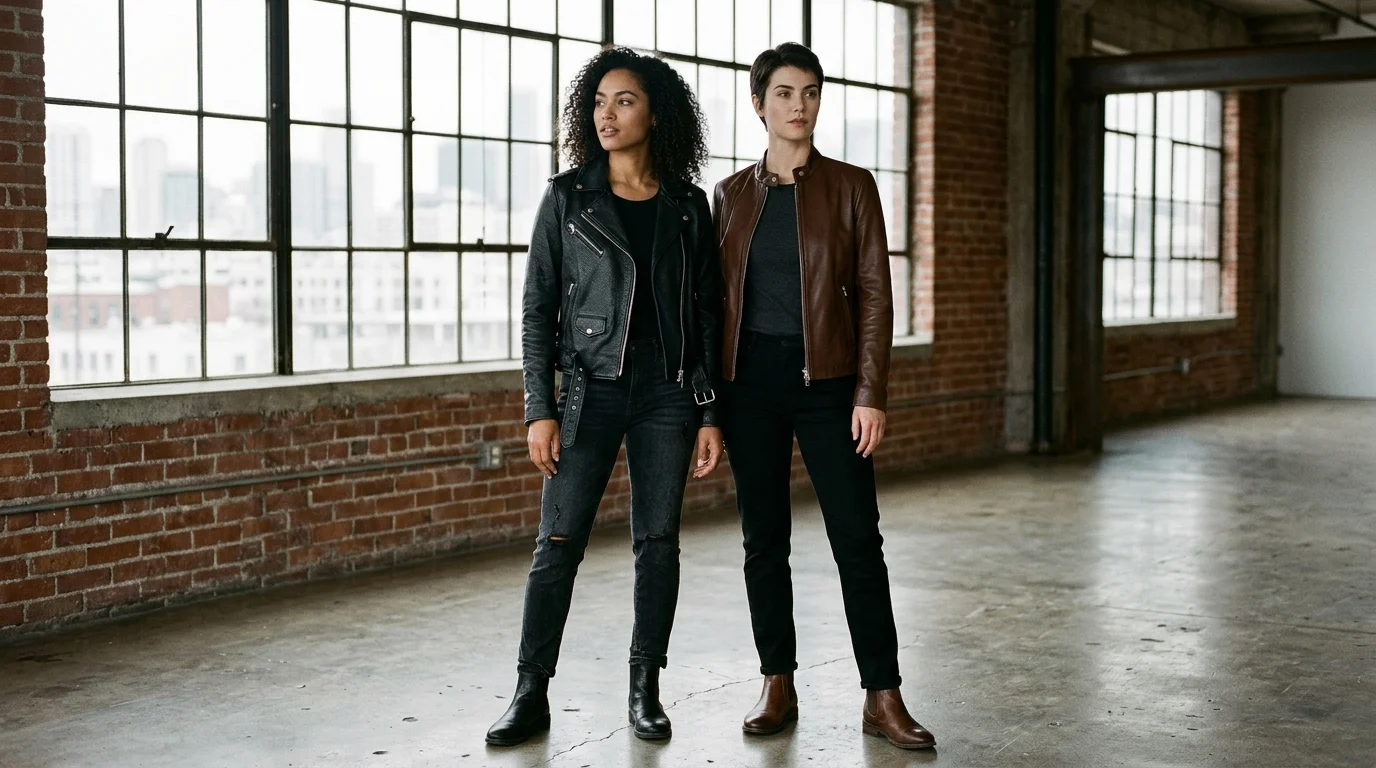
Double Rider vs Single Rider Leather Jacket Which One to Buy
Compare double rider vs single rider leather jackets. Explore motorcycle heritage, zipper mechanics, fit differences, styling advice, and durability specs.
Choosing between a double rider and a single rider leather jacket represents the ultimate decision point in motorcycle outerwear, separating bold subcultural rebellion from refined minimalist versatility. Both archetypes originated in mid-twentieth-century two-wheeled motorsport, yet each silhouette developed radically distinct closures, collar architectures, and hardware distributions. Selecting your ideal leather investment requires analyzing zipper geometry, shoulder drape, torso ease, and wardrobe compatibility.
Key Takeaways
- Closure Architecture: Double rider jackets utilize asymmetrical diagonal front zippers with overlapping wind flaps, whereas single rider jackets feature centered vertical zippers with clean mandarin collars.
- Visual Impact: Double rider designs project assertive rock-and-roll attitude with prominent lapels, belts, and hardware, while single rider cafe racers offer streamlined, understated elegance.
- Anatomical Fit: Single rider jackets fit trim and close to the torso for low aerodynamic drag, while double riders provide broader chest ease to accommodate wind-blocking overlaps.
- Versatility Across Settings: Single rider jackets transition seamlessly into smart-casual corporate offices, while double riders serve as high-impact statement pieces for street style and nightlife.
- Artisan Construction: Handcrafted iterations utilize 1.1–1.4mm full-grain cowhide or 0.9–1.2mm lambskin paired with heavy-duty YKK brass hardware for generational durability.
- Bespoke Fit Precision: Custom made-to-order tailoring eliminates sleeve bunching and collar gaping, guaranteeing a personalized anatomical drape across all builds.
What Is the Historical Origin of the Double Rider Leather Jacket?
The double rider leather jacket originated in 1928 when Irving Schott designed the legendary Perfecto for Harley-Davidson motorcycle distributors in Long Island, New York, introducing the world's first asymmetrical zipper closure engineered specifically for highway wind protection. The design gained international cultural prominence after Marlon Brando wore it in the 1953 film The Wild One.
Before the invention of the double rider, motorcyclists wore button-up wool aviation coats or straight-zippered work jackets that allowed cold highway gusts to penetrate between buttons and zipper teeth. Irving Schott revolutionized rider protection by offsetting the zipper track diagonally across the chest. This engineering breakthrough created a double-layered leather barrier over the rider's sternum, effectively shielding vulnerable internal organs from biting headwinds.
The jacket's distinctive notched lapels served an ingenious functional purpose. When riding at high speeds, riders snapped the wide lapels down firmly against the chest to prevent the leather collar from buffeting violently against their neck. When parked at a roadside diner or mechanic shop, the rider unsnapped the collar, allowing the lapels to fold back casually like a tailored blazer.
Throughout the 1970s and 1980s, the double rider crossed from motorcycle racing into youth rebellion and music history. Punk rock icons like The Ramones and The Sex Pistols adopted the asymmetrical silhouette as their uniform, embedding heavy brass hardware, zippered sleeves, and waist buckle belts permanently into the lexicon of global rock fashion.
What Is the Historical Heritage of the Single Rider Cafe Racer Jacket?
The single rider cafe racer jacket originated in post-war Britain during the late 1950s and 1960s, designed for young motorcycle enthusiasts who modified British roadsters to sprint between transport cafes across London arterial highways. These cafe racers stripped away decorative epaulettes, wide lapels, and waist belts to achieve maximum aerodynamic efficiency.
British rock-and-roll youth, known as the Ton-Up Boys or Rockers, congregated at iconic venues like London's Ace Cafe. Their primary objective was exceeding 100 miles per hour—known colloquially as 'doing the ton'—on modified Triumph, Norton, and BSA motorcycles. In this high-speed pursuit, the flapping lapels and bulky buckles of traditional American biker jackets created unwanted wind drag and scratched polished gas tanks.
Outerwear makers responded by engineering the single rider silhouette, characterized by a clean symmetrical center zipper, a low snap-tab mandarin collar, and minimal pocket welts. The mandarin collar hugged the throat closely without interfering with helmet chinstraps, while zippered sleeve cuffs prevented air currents from rushing up the rider's forearms.
By the 1970s, the single rider had gained favor among European road racers and Hollywood icons like Steve McQueen, who prized its Spartan functionality and athletic cut. Today, the single rider remains the quintessential minimalist leather jacket, celebrated worldwide for its clean architectural lines and effortless transition into modern contemporary fashion.
How Does the Front Closure Geometry Differ Between Double and Single Riders?
Front closure geometry differs fundamentally between double and single rider jackets through the placement and trajectory of the main zipper, with double riders featuring diagonal asymmetrical tracks that establish overlapping windproof barriers, while single riders utilize symmetrical center zippers for streamlined closure. This engineering distinction dictates chest insulation, lapel drape, and visual balance.
On a double rider jacket, the zipper starts near the lower left or right hip and angles across the ribcage to the opposite collarbone. When zipped, two thick panels of full-grain leather overlap across your chest, doubling the effective hide thickness to 2.2–2.8mm across your vital core. When left unzipped, the heavy overlapping flap creates dramatic angular lapels that fall naturally outward, adding broad masculine volume across your upper torso.
Conversely, a single rider jacket features a straight, vertical zipper running directly up the sternum from waist hem to throat tab. Because the zipper aligns with the garment's central axis, the jacket maintains exact bilateral symmetry whether zipped or unzipped. When open, the front panels fall in clean vertical columns, elongating the wearer's torso and creating a slimming visual frame.
This geometric difference directly influences how each garment feels while seated or operating a vehicle. The asymmetrical zipper of a double rider prevents metal teeth from bunching into your belly when leaning forward over handlebars. The single rider's vertical zipper requires an athletic, trim fit with proper torso length to avoid buckling when sitting.
How Do Collar Designs and Hardware Layouts Contrast Between Silhouettes?
Collar designs and hardware layouts contrast sharply between the two styles, with double riders incorporating wide snap-down notched lapels, belted waistbands, epaulettes, and multiple exterior zipper pockets, whereas single riders utilize minimalist snap-tab band collars and discreet welt pockets. This hardware density establishes opposite aesthetic expressions ranging from aggressive embellishment to Spartan elegance.
A traditional double rider functions as a masterclass in functional hardware:
- Notched Lapels: Four heavy-duty brass snaps anchor the collar flaps flat against the chest.
- Waist Belt: A full-grain leather half-belt with a heavy nickel or brass roller buckle cinches the hem tight against the hips to prevent draft entry.
- Coin Flap Pocket: A small snapped flap pocket on the left waist historically held tollway coins or ignition keys.
- Sleeve Gussets: Zippered cuffs open to reveal internal leather expansion gussets that accommodate thick gauntlet gloves.
- Shoulder Epaulettes: Snapped shoulder straps originally secured military gloves or utility lanyards.
In direct contrast, the single rider eliminates nearly all exterior decorative components:
- Mandarin Band Collar: A simple 1.0-inch standing leather band fastened by a single or double snap closure.
- Clean Torso: Straight vertical or slightly angled zippered chest pockets and discreet side entry hand pockets.
- Beltless Waist: Clean leather hemline without buckles, loops, or belts that could snag or scratch surfaces.
- Streamlined Cuffs: Simple zipper openings without bulky pleated expansion gussets.
This difference in hardware density directly dictates styling versatility. A double rider demands attention, making it the undeniable protagonist of your ensemble. A single rider acts as a sophisticated collaborator, enhancing your wardrobe without competing with other garments.
How Do Double and Single Rider Silhouettes Compare Across Key Benchmarks?
Double and single rider leather jackets deliver contrasting performance across torso ease, shoulder width, formal adaptability, and cold-weather thermal retention. Evaluating these practical dimensions ensures you select the outerwear silhouette that harmonizes with your personal build, daily lifestyle, and regional climate conditions.
The detailed matrix below contrasts both iconic motorcycle cuts across seven essential garment benchmarks.
Silhouette & Craftsmanship Comparison Matrix
| Garment Characteristic | Classic Double Rider (Biker) | Single Rider (Cafe Racer / Moto) | Practical Everyday Impact |
|---|---|---|---|
| Main Front Zipper | Asymmetrical diagonal track | Symmetrical straight center track | Double rider provides dual-layer windbreak |
| Collar Architecture | Wide notched lapels with 4 snaps | 1.0-inch snap-tab mandarin band collar | Single rider hugs throat; double rider folds open |
| Torso Clearance (Ease) | 4.0 to 6.0 inches (Athletic volume) | 2.0 to 3.5 inches (Trim aerodynamic cut) | Double rider accommodates bulky hoodies and knits |
| Exterior Hardware Density | Heavy (Zips, snaps, belt, epaulettes) | Minimal (Discreet zips and snap collar) | Double rider is bold statement; single rider is subtle |
| Visual Torso Effect | Broadens shoulders and upper chest | Elongates torso with vertical lines | Double rider flatters slim builds; single rider slims |
| Optimal Aesthetic Vibe | Rock-and-roll rebellion, edge, streetwear | Modern minimalism, smart-casual, commuter | Single rider transitions into corporate offices |
| Wind & Cold Protection | Superior core warmth via overlapping hides | Moderate core warmth with single zip flap | Double rider excels in cold highway conditions |
Selecting between these silhouettes often comes down to your personal physique. Wearers with slender or narrow shoulders often benefit from the double rider, as the wide lapels and epaulettes visually broaden the upper frame. Conversely, individuals with broad athletic chests or shorter torsos frequently prefer the single rider, as its vertical zipper and collarless neck establish clean, uninterrupted height. Explore classic cuts across our men's biker moto jackets and women's biker jackets collections, or contrast with clean lines in our leather blazers lineup.
What Are the Best Styling Formulas for a Double Rider Leather Jacket?
Styling a double rider leather jacket requires embracing its bold rebellious heritage while balancing hardware density against clean minimalist basics, pairing heavyweight white tees, raw selvedge denim, and rugged Goodyear-welted service boots. Allowing the jacket's asymmetrical geometry to anchor the outfit creates timeless, effortless masculinity or high-attitude feminine edge.
Outfit Breakdown:
- Outerwear: Handcrafted black full-grain cowhide double rider jacket with antique brass zippers.
- Base Layer: Heavyweight 300 GSM optic white combed cotton crewneck t-shirt.
- Bottoms: 14 oz raw indigo selvedge denim with a slight taper and clean cuff roll.
- Footwear: Black or deep burgundy oiled leather combat boots or heritage work boots.
- Finishing Touch: Solid full-grain utility belt from our leather accessories line.
To master this classic look, leave the front zipper completely open or fastened only up to the mid-chest point. This positioning allows the wide lapels to frame the stark white t-shirt, establishing high-contrast graphic appeal. Avoid wearing graphic tees with complex illustrations beneath a double rider, as competing visuals clash with the jacket's angled metal hardware.
For cold autumn and winter evenings, layer the double rider over a heavy black or charcoal cashmere hoodie. Pull the hoodie's hood out over the leather collar and let the drawstrings hang naturally. This high-low streetwear pairing merges vintage biker toughness with modern casual ease.
What Are the Best Styling Formulas for a Single Rider Cafe Racer Jacket?
Styling a single rider cafe racer jacket requires highlighting its clean aerodynamic lines by pairing it with refined smart-casual separates, including fine-gauge knit turtlenecks, tailored wool trousers, and polished Chelsea boots. The jacket's low-profile mandarin collar complements tailored shirts and fine sweaters without creating collar bunching.
Outfit Breakdown:
- Outerwear: Tailored rich espresso brown or cognac lambskin single rider cafe racer jacket.
- Base Layer: Charcoal grey or black fine-gauge merino wool turtleneck sweater.
- Bottoms: Slim-fit pleated wool flannel trousers in heather grey, navy, or olive green.
- Footwear: Polished calfskin Chelsea boots or minimalist suede dress loafers.
- Carry Accent: Handstitched full-grain commuter briefcase from our leather bags collection.
The beauty of the single rider lies in its remarkable chameleon quality. In creative office spaces, gallery exhibitions, and fine dining establishments, a single rider in rich brown or matte black functions seamlessly as an elevated sport coat. Because it lacks aggressive belts and epaulettes, it communicates understated sophistication rather than countercultural grit.
For relaxed weekend outings, style the cafe racer with a grey heather loopback sweatshirt, olive utility chinos, and clean white leather court sneakers. Zip the jacket up three-quarters of the way and leave the throat tab unsnapped for an effortless European continental aesthetic. Compare silhouette options in our men's casual jackets and men's classic leather jackets ateliers, or examine our vintage cuts in vintage leather jackets.
How Does Artisan Full-Grain Craftsmanship Outperform Split Commercial Replicas?
Artisan full-grain craftsmanship outperforms split commercial replicas through superior tensile hide strength, natural pore breathability, heavy-duty solid brass metallurgy, and generational patina development that deepens with regular wear. Mass-market commercial brands routinely substitute genuine full-grain leather with sanded split hides coated in synthetic polyurethane that degrades within seasons.
The technical evaluation below contrasts authentic Lux Wearz workshop standards against generic commercial manufacturing benchmarks.
Material & Durability Matrix
| Workshop Specification | Lux Wearz Full-Grain Artisan Build | Standard Department Store Brand | Budget Fast-Fashion Replica | Long-Term Durability Consequence |
|---|---|---|---|---|
| Hide Grade & Integrity | 100% genuine full-grain cowhide or lambskin | Sanded top-grain with synthetic pigment coat | Corrected split leather coated with polyurethane | Retains unbroken outer dermal epidermis |
| Hide Thickness Range | 1.1–1.4mm cowhide, 0.9–1.2mm lambskin | 0.8–1.0mm thinned hide | 0.6–0.7mm split leather | Heavy hide provides authentic wind armor |
| Zipper Hardware Specs | Genuine heavy-duty YKK brass #8 / #10 zips | Generic alloy zipper tracks | Hollow zinc die-cast or nylon plastic zippers | Solid brass glides smoothly without jams |
| Interior Lining Fabric | Breathable silky polyester satin | Synthetic nylon taffeta lining | Low-grade static-prone polyester | Breathable lining prevents sweat buildup |
| Thread & Seam Strength | Hand-stitched with bonded nylon thread | Automated single chain stitch | Lightweight monofilament cotton-poly | Bonded nylon resists seam blowout under stress |
| Craftsmanship Pedigree | Handcrafted by master artisans with 20+ years experience | Factory automated mass assembly line | High-speed contract sweatshop | 12-point quality inspection on every jacket |
| Price Range (USD) | 249-399 Premium, 299-499 Custom Made | 450-700 Branded retail markup | 90-180 Fast-fashion synthetic | Exceptional heirloom value at direct pricing |
| Fulfillment Lead Time | 3-5 business days (Free USA shipping) | 5-10 business days plus shipping fees | 4-8 business days | Rapid domestic dispatch with zero shipping cost |
| Warranty & Returns | 30-day hassle-free returns, 1-year warranty | 14-day store exchange only | Final sale, no warranty | Complete consumer protection and full refund |
The structural difference between full-grain hide and sanded split leather is monumental. In full-grain leather, the tightly interwoven natural collagen bundles remain intact, offering unmatched resistance against punctures, road abrasions, and tensile tears. Over years of wear, friction and body heat burnish the high-contact areas, creating an organic patina unique to your lifestyle. To master hide authentication techniques, review our guide on testing real vs fake leather with 7 tests that never fail.
How Should You Choose Your Correct Size for Double and Single Rider Jackets?
Choosing your correct size requires measuring your chest circumference, shoulder width, sleeve length, and torso length, keeping in mind that double riders require slightly more chest ease for layering, while single riders should fit closely to your shoulders. Accurate anatomical measurements eliminate sizing frustration and prevent ill-fitting collar gaps.
Because a double rider features overlapping leather panels and an asymmetrical zipper, it requires 4.0 to 5.0 inches of ease over your actual body chest measurement if you intend to layer hoodies or heavy knits. A single rider, however, looks best when cut closer to the body with 2.5 to 3.5 inches of torso ease, preserving its streamlined racing silhouette.
To take your measurements accurately at home:
- Chest Measurement: Measure horizontally around the fullest part of your chest, keeping the tape snug beneath your armpits and across your shoulder blades.
- Shoulder Span: Measure straight across the back from the tip of the left acromion bone to the tip of the right acromion bone.
- Sleeve Length: With your arm slightly bent at a 45-degree angle, measure from the outer shoulder point down to your wrist bone.
- Back Length: Measure vertically from the prominent cervical vertebrae at your neck base down to your beltline.
If your physique features an athletic drop from broad shoulders to a narrow waist, or if your arm length differs from standard templates, custom tailoring ensures a flawless fit. Consult our size & fit guide to verify your dimensions before purchasing.
How Do You Care for, Condition, and Maintain Rider Leather Jackets?
Caring for rider leather jackets requires biannual conditioning with lanolin-based balms, routine surface dusting with a soft horsehair brush, and storage on wide contoured wooden hangers away from direct sunlight. Proper ongoing care prevents hide desiccation, keeps zipper tracks gliding smoothly, and protects natural oils from drying out.
Essential Maintenance Protocols:
- Biannual Conditioning: Apply a dime-sized amount of wax-free leather conditioner to high-flex zones like elbows, collar folds, and cuffs twice a year to preserve suppleness.
- Hardware Maintenance: Rub a tiny dab of beeswax or paraffin along the zipper teeth once a year to prevent track sticking and ensure smooth slider travel.
- Wet-Weather Drying: If caught in heavy rain, gently blot standing water with a dry cotton towel and allow the jacket to air-dry naturally on a wide hanger at room temperature. Never place wet leather near radiators or heaters.
- Off-Season Storage: Store your jacket inside a breathable cotton garment bag in a temperature-controlled closet. Avoid plastic garment bags that trap ambient humidity and induce mold growth.
For an extensive manual on cleaning, conditioning, and long-term storage protocols, review our leather care guide or read our expert advice on proper leather jacket care. For dedicated track and road performance insights, explore our comparison between racing jackets vs biker jackets and our guide on motorcycle riding jackets vs fashion bikers.
Why Is Bespoke Made-to-Order Handcrafting the Ultimate Rider Investment?
Bespoke made-to-order handcrafting is the ultimate rider investment because motorcycle-inspired outerwear demands exacting anatomical alignment across shoulders, chest taper, and sleeve lengths to ensure total comfort and unimpeded arm articulation. At Lux Wearz, master artisans hand-tailor each piece individually to your exact anatomical specifications.
Off-the-rack jackets are cut to generic average proportions that rarely accommodate athletic broad shoulders, tall arm reaches, or unique torso heights. An ill-fitting motorcycle jacket can cause the collar to dig painfully into your throat or the sleeves to ride up past your wrists whenever you stretch your arms.
Through our bespoke made-to-order service:
- Leather Customization: Choose between rugged 1.1–1.4mm full-grain cowhide for heavy road protection, or buttery 0.9–1.2mm lambskin for lightweight everyday luxury.
- Hardware Selection: Pick between solid YKK antique brass, polished nickel chrome, or matte gunmetal zippers to harmonize with your personal hardware aesthetic.
- Anatomical Precision: Specify custom sleeve lengths, shoulder spans, chest clearances, and torso lengths tailored exactly to your body.
- Master Artistry: Every jacket is assembled with reinforced bonded nylon seams by artisans with over 20 years of bespoke leathercraft experience.
To start your bespoke ordering journey, connect directly with our workshop team through our artisan customer service chat to discuss hide selections and sizing details.
Where Can You Invest in Authentic Handcrafted Rider Leather Jackets?
You can invest in authentic handcrafted double rider and single rider leather jackets through Lux Wearz, where master craftsmen produce full-grain leather outerwear backed by comprehensive warranty protection. Priced accessibly between $149 and $499, Lux Wearz eliminates traditional fashion markups to offer genuine artisan luxury.
Every garment produced in our workshop passes a rigorous 12-point artisan inspection that verifies zipper travel, hide grain uniformity, and seam tension before dispatch. We stand firmly behind our workmanship with a 1-year craftsmanship warranty, 30-day hassle-free returns, and complimentary priority shipping across the United States.
Whether you choose the rebellious edge of a classic double rider or the refined minimalism of a single rider cafe racer, explore our complete catalog of men's leather jackets and women's leather jackets, or browse specialized motorcycle riding gear and bomber flight jackets. For questions regarding shipping timelines or leather sourcing, consult our frequently asked questions or read verified client reviews on our customer testimonials page.
Explore The Full 2026 Leather Outerwear Collection
Vegetable-tanned full-grain cowhide, buttery New Zealand lambskin, and heritage Melton wool. Free express delivery across the USA with 30-day hassle-free returns.