Blog
How to Spot Real vs Fake Leather: 7 Tests That Never Fail
Learn how to tell real leather from fake with 7 workshop-tested methods. Pore patterns, water absorption, edge grain, tactile warmth, and flame resistance.
A high-end leather jacket or handcrafted briefcase is one of the most rewarding wardrobe investments you will ever make. Yet as synthetic manufacturing techniques evolve, telling authentic animal hide from polyurethane (PU), polyvinyl chloride (PVC), and reconstituted bonded scrap has become a genuine challenge for buyers. Commercial marketing labels like "Genuine Leather" frequently confuse consumers, disguising ultra-thin split trimmings coated in plastic paint as premium artisan goods.
This guide provides seven definitive workshop tests developed by master leathercrafters to separate authentic full-grain and top-grain leather from synthetic imitators. Whether inspecting a vintage cafe racer or purchasing your next heirloom coat, these practical diagnostics ensure you invest in authentic durability.
Key Takeaways
- The Capillary Absorption Rule: Authentic full-grain leather absorbs a water droplet within 15 to 45 seconds due to open dermal pores; synthetic polymers repel moisture indefinitely.
- The Tactile Warmth Metric: Real hide conducts and retains body heat within 3 seconds of skin contact, whereas synthetic petroleum surfaces feel cool, rigid, and rubbery.
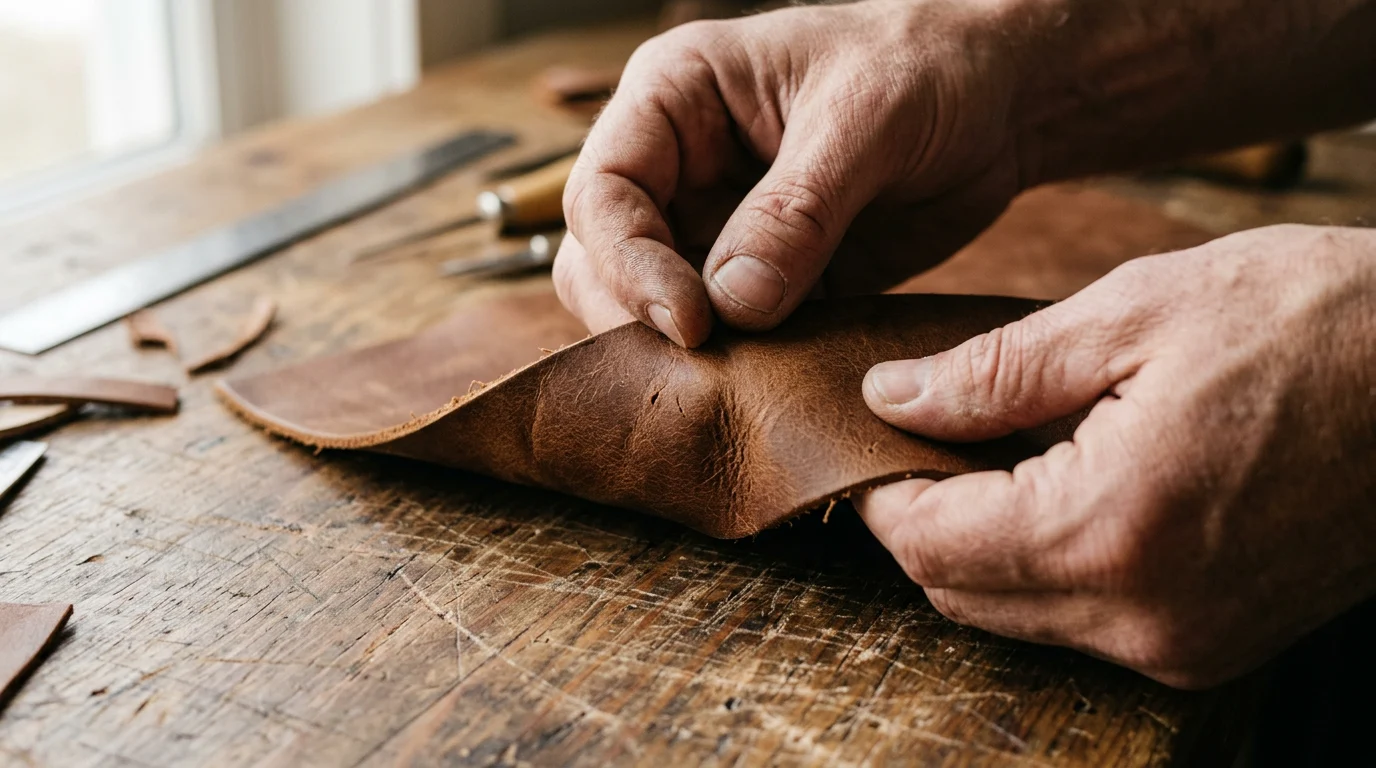
- The Radiating Wrinkle Signature: Pressing an authentic leather panel creates organic radiating micro-wrinkles identical to human skin; synthetic PVC compresses flatly like plastic sheet.
- Monolithic Edge Integrity: Cross-sectional cut edges of authentic leather reveal dense collagen fibers; faux alternatives display laminated fabric mesh backings.
- Long-Term Evolution: Real leather softens and develops a rich patina over decades of friction and oxidation; synthetic imitators delaminate, crack, and peel within 24 to 36 months.
What Is Real Leather Versus Synthetic Leather?
Real leather is a natural, biological protein hide harvested as a food industry byproduct and stabilized through vegetable, chrome, or combination tanning processes to preserve intact collagen fibers. Synthetic leather—commonly designated as faux leather, vegan leather, PU leather, or pleather—is an engineered textile composed of a woven polyester, nylon, or cotton base coated with liquid polyurethane or polyvinyl chloride polymers embossed with an artificial grain roller.
While authentic animal hide breathes, molds to body contours, and endures for 20 to 30 years with routine conditioning, synthetic substitutes have an average functional lifespan of only 2 to 4 years before polymer fatigue causes irreversible surface peeling. Understanding hide anatomy is the foundation of quality assessment.
The Comprehensive Leather Grade & Material Matrix
To evaluate any garment or accessory, compare the structural characteristics of authentic hide grades against synthetic formulations:
| Leather Grade / Material | Hide Layer Sourced | Surface Treatment | Average Tensile Strength | Expected Lifespan | Patina Potential | Breathability Rating |
|---|---|---|---|---|---|---|
| Full-Grain Leather | Outermost epidermis layer | Uncorrected natural grain | High (3,200+ PSI) | 25 to 30+ Years | Exceptional deep patina | Excellent (natural pores) |
| Top-Grain Leather | Upper dermis layer | Lightly buffed & finished | Moderate-High (2,400 PSI) | 12 to 20 Years | Subtle gradual luster | Good (semi-porous) |
| Genuine Leather | Lower corium split layer | Heavy pigment & PU coating | Low-Moderate (1,100 PSI) | 2 to 5 Years | None (pigment fades) | Poor (sealed polymer) |
| Bonded Leather | Shredded scraps & pulp | Glued with polyurethane binder | Extremely Low (450 PSI) | 1 to 2 Years | None (cracks and flakes) | Zero (dense resin) |
| PU / Vegan Leather | 100% synthetic fabric | Liquid polyurethane layer | Low (600 PSI) | 2 to 4 Years | None (delaminates) | Minimal (synthetic mesh) |
| PVC Vinyl Leather | 100% synthetic fabric | Polyvinyl chloride plasticizers | Low (550 PSI) | 2 to 3 Years | None (brittle failure) | Zero (solid plastic) |
When shopping for durable outerwear across our men's leather jackets and women's leather jackets collections, choosing full-grain or premium top-grain hide ensures your garment outlasts seasonal fashion cycles.
7 Workshop Tests to Spot Real vs Fake Leather
Master craftsmen do not rely solely on store tags or price stickers. Apply these seven diagnostic techniques in sequence:
1. The Tactile Warmth and Texture Test
Real leather conducts ambient temperature and responds dynamically to human body warmth within seconds. When you rest your palm against authentic full-grain cowhide or supple lambskin, the natural protein fibers absorb your thermal energy, warming rapidly while feeling soft and supple.
In contrast, synthetic PU and vinyl feel cold, slick, and unnaturally clammy. Synthetic finishes feel uniform across every square inch because mechanical embossing rollers imprint repetitive patterns. Authentic animal hides exhibit organic grain variation: looser pebble formations along flank zones, tighter pore densities across back sections, and subtle natural grain variations that confirm natural provenance.
2. The Thumb Press Wrinkle Test
The thumb press test evaluates hide elasticity and fiber cohesion. Place your thumb firmly in the center of an open leather panel and exert downward pressure while pushing slightly forward.
- On Authentic Leather: The surrounding hide contracts and creases into organic, radiating micro-wrinkles mimicking human skin. When pressure is released, the resilient collagen network rebounds smoothly without retaining permanent creases.
- On Faux Leather: The synthetic plastic film resists micro-wrinkling, depressing as a rigid, concave depression like rubber sheeting or vinyl upholstery.
3. The Water Absorption Droplet Test
Authentic leather retains microscopic dermal pores that allow moisture vapor exchange. Deposit a single drop of clean water onto an inconspicuous test area of the leather surface.
- Authentic Unfinished Leather: The droplet rests momentarily before slowly penetrating the porous grain within 15 to 45 seconds, leaving a slightly darkened moist ring that evaporates cleanly without harming the hide.
- Synthetic Polymers: Water droplets bead up into tight spherical domes and sit indefinitely without entering the textile, demonstrating the impermeable barrier of synthetic polyurethane coatings.
Artisan Note: Heavy waterproof finishes applied to some motorcycle gear can slow absorption rates. For styling pieces like men's biker moto jackets or sleek bomber and flight jackets, combining this with the smell test provides foolproof confirmation.
4. The Aroma Olfactory Test
The human olfactory system easily distinguishes biological tannins from synthetic petrochemicals. Authentic leather possesses a rich, earthy, and warm aroma derived from natural tree barks (mimosa, chestnut, quebracho) and conditioning oils used during tanning. This organic scent remains embedded in genuine hides for decades.
Synthetic faux leathers emit an unmistakable synthetic fragrance of volatile organic compounds (VOCs)—resembling new plastic shower curtains, vinyl upholstery, rubber cement, or nail polish solvent. Even synthetic manufacturers attempting to spray artificial "leather cologne" onto PU jackets cannot mask the underlying acrid chemical base once warmed.
5. The Edge Grain Cross-Section Audit
Examine the unstitched or cut edges of seams, collar lapels, and interior pocket linings. Authentic hides possess a monolithic cross-section featuring densely intertwined protein strands at the top that transition into slightly looser fibrous suede nap along the underside.
Synthetic materials feature clean, sharp, laser-cut edges with zero natural fiber strands. Under 10x magnification or close inspection, faux leather edges reveal layered sandwich construction: a thin polymer film heat-fused onto a woven textile mesh backing. This structural difference is especially critical when shopping for everyday accessories like leather belts and leather wallets and cardholders, where bonded materials quickly delaminate along belt holes.
6. The Flame Resistance & Char Test
While impractical inside retail boutiques, the flame test is the ultimate chemical discriminator in workshop environments. Animal hide is a natural protein that naturally resists brief flame contact.
When exposed to a flame for 2 to 3 seconds:
- Authentic Leather: Resists ignition, chars slightly at the immediate contact point, leaves a dry gray ash residue, and emits an organic scent similar to singed hair.
- Synthetic Faux Leather: Catches fire immediately, curls and shrinks inward, drips flaming liquid plastic, and produces acrid, toxic black chemical smoke.
7. The Flex Memory and Flexibility Test
Bend a leather panel sharply 180 degrees between your fingers and examine the crease line. Full-grain aniline leather exhibits a subtle color shift along the apex of the fold—known in craftsmanship as the "pull-up effect"—caused by natural oils migrating through the porous fiber structure.
Synthetic pleather maintains identical uniform color along the bend, showing white stress lines or micro-tears where brittle plastic coatings stretch beyond their elastic threshold.
Common Misleading Leather Terms Explained
Marketing terminology in fashion often conceals inferior construction. Understand these industry classifications before committing your budget:
| Commercial Label | True Material Content | Industry Reality & Durability Warning |
|---|---|---|
| "100% Genuine Leather" | Lowest grade split hide | Made from discarded bottom hide layers heavily sprayed with polyurethane paint to mimic surface grain. Typically cracks within 3 years. |
| "Vegan Leather" | 100% Petroleum Plastic | Marketing euphemism for polyurethane (PU) or polyvinyl chloride (PVC). Non-biodegradable synthetic textile with zero natural leather fibers. |
| "Bonded Leather" | 10%–20% Scrap Fibers + 80% Glue | Shredded leather floor sweepings mixed with adhesive resin and rolled into sheets. Prone to catastrophic peeling within 18 months. |
| "Faux Suede / Microsuede" | 100% Polyester Microfiber | Synthetic polyester woven into a velvety nap. Lacks the wind resistance and tensile strength of real goat or calf suede. |
| "Full-Grain Nappa" | Premium Uncorrected Cow/Lambskin | The gold standard of luxury leathercrafting: intact outer grain, ultra-soft hand, breathable pores, and lifelong durability. |
Real Leather Care vs. Synthetic Maintenance
Because authentic hide and synthetic textiles possess opposite chemical structures, their maintenance protocols are entirely distinct:
AUTHENTIC LEATHER CARE PROTOCOL:
├── Frequency: Every 6 months
├── Cleaning: Damp microfiber cloth + pH-neutral saddle soap
├── Nourishing: Natural beeswax, jojoba oil, or lanolin balm
└── Storage: Breathable cotton garment bag on wide cedar hangers

SYNTHETIC FAUX LEATHER CARE PROTOCOL:
├── Frequency: As needed
├── Cleaning: Mild soapy water or alcohol-free baby wipe
├── Conditioning: DO NOT APPLY OIL (dissolves PU resin coating)
└── Storage: Cool environment (heat accelerates polymer hydrolysis)
Applying traditional petroleum waxes or heavy mineral oils to authentic lambskin can clog delicate pores, while applying leather conditioners to faux leather dissolves polyurethane binders. For tailored maintenance guidelines across distinct materials, review our detailed leather care guide.
How to Choose the Right Authentic Leather Piece
When investing in wardrobe essentials, balance leather thickness, weight, and cut against your functional lifestyle needs:
- For Everyday Cold Weather Outerwear: Quilted insulation and supple lambskin shells deliver cloud-like comfort without excessive weight; browse our leather puffer jackets for metropolitan warmth.
- For Heritage Weekend Styling: Heavyweight cowhide and goatskin trucker styles provide rugged wind resistance that shapes to your torso; explore our men's biker moto jackets.
- For Commuter & Travel Accessories: Heavy-gauge vegetable-tanned duffels and messengers withstand luggage handling; browse our curated leather bags collection.
Before finalizing sizing, remember that authentic leather relaxes approximately half an inch across high-friction pressure zones (chest, shoulders, elbows) during the initial 30 days of wear. Cross-reference your exact body measurements with our size guide and consult our tutorial on how a leather jacket should fit to select the perfect silhouette.
For deeper technical comparisons of animal hides, read our breakdown of lambskin vs cowhide vs goatskin, or explore our complete routine on how to care for a leather jacket.
Invest in Authentic Craftsmanship
At Lux Wearz, every jacket, briefcase, and accessory is handcrafted exclusively from ethically sourced, certified full-grain and top-grain hides. We reject synthetic fillers, bonded paper pulp, and faux polyurethane substitutes in favor of heirloom materials that tell your story with every passing season.
Discover authentic craftsmanship today: explore our handcrafted leather collection with free delivery across the United States, or request bespoke tailoring through our custom orders department. Have questions about a specific hide? Contact our leather artisans for tailored buying advice.