
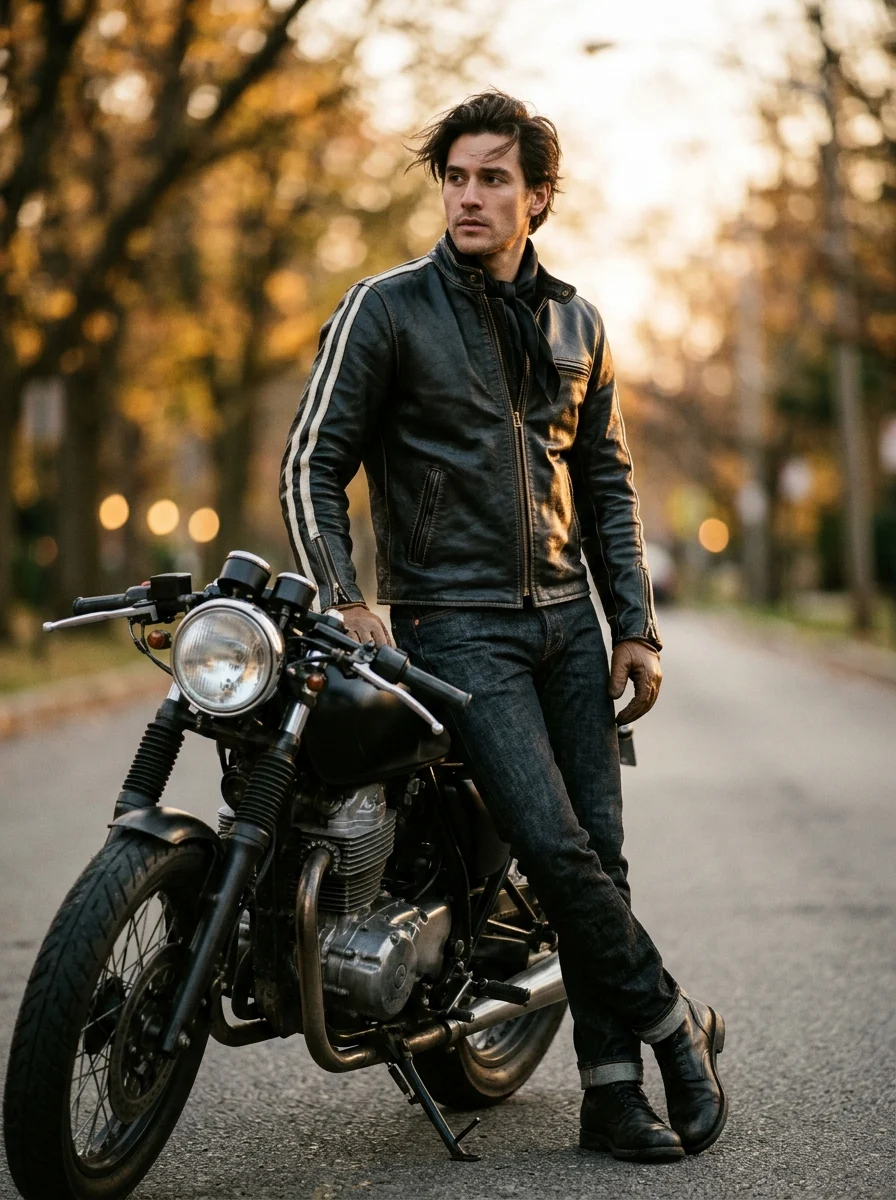
VANSON LEATHER Jackets vs Bespoke Custom Leather: Durability, Grain, and Craftsmanship Comparison
Key Takeaways
- Leather Weight & Temper: Traditional competition-weight steerhide averages a dense 3.5 to 3.8 ounces (1.4–1.6 mm) with an exceptionally rigid temper requiring hundreds of riding hours to break in, whereas bespoke custom leathercraft from Lux Wearz utilizes hand-selected 1.2–1.4 mm full-grain cowhide that delivers optimal tensile abrasion defense alongside immediate ergonomic flexibility.
- Tannage Chemistry & Patina: Industrial chrome-tanned motorcycle leathers prioritize extreme tear resistance and water repellency through synthetic polymer surface finishes, while artisanal vegetable-tanned and semi-aniline bespoke hides develop an authentic, deep amber patina as natural oils migrate through open pores over decades of wear.
- Structural Stitching Metallurgy: Factory race garments rely on high-tensile bonded nylon threads (v69 to v92) stitched at 6 to 8 stitches per inch to prevent seam blowout under sliding friction; bespoke leathercraft matches or exceeds these burst thresholds using heavy bonded nylon locked with reinforced hidden safety seams across all impact zones.
- Hardware Longevity: Heavy-duty #10 brass and nickel-plated zippers endure decades of high-speed wind buffeting, but factory off-the-rack sizing often exerts excessive lateral tension on zipper teeth; bespoke anatomical tailoring eliminates cross-chest strain, dramatically extending the mechanical lifespan of brass sliders and pin boxes.
- The Tailoring Advantage: While mass-manufactured riding jackets are engineered around standardized torso blocks that frequently pinch at the armholes or bunch across the lower back in riding position, made-to-measure bespoke leather outerwear is patterned directly from 20+ distinct bodily measurements, guaranteeing zero riding fatigue and perfect sleeve pitch.
Artisan Independence & Trademark Notice: Lux Wearz is an independent bespoke leathercraft atelier. All brand names, logos, and trademarks mentioned in this article (including VANSON LEATHER® and related trademarks) belong exclusively to their respective trademark holders. Lux Wearz is not an authorized distributor, licensee, or affiliated partner of these brands. All brand references and historical retrospectives are made strictly for educational, comparative, and sizing review purposes under Fair Use. Lux Wearz specializes in custom-tailored, heirloom-grade genuine leather outerwear handcrafted individually in our private workshop.
How Does Vanson Leather Compare to Bespoke Custom Leathercraft in 2026?
Vanson Leather jackets utilize heavy 3.5-ounce competition-weight steerhide engineered primarily for high-speed track abrasion, whereas bespoke custom leathercraft from Lux Wearz combines hand-selected full-grain cowhides and supple vegetable-tanned hides with individual anatomical patterning, anatomical armhole placement, and tailored mobility without the punishing multi-year break-in period of factory production.
Archival Origins and Engineering Pedigree: The Massachusetts Heritage of Competition Steerhide
The American motorcycle leather landscape underwent a seismic transformation during the mid-1970s. Founded in Boston in 1974 by Michael van der Sleesen and later establishing its permanent manufacturing workshop in the historic textile mill city of Fall River, Massachusetts, Vanson Leather carved an uncompromising reputation among road racers, flat-track competitors, and urban motorcycle subcultures. At a time when European racing suits were pivoting toward lighter, thinner hides for Grand Prix agility, the Massachusetts workshop doubled down on raw, industrial-strength American steerhide. The design philosophy was stark and pragmatic: prioritize rider survival, seam integrity, and maximum slide resistance over lightweight fashion or immediate out-of-the-box comfort.
Throughout the 1980s and 1990s, this relentless focus on ballistic-grade leather construction made Fall River steerhide garments legendary across AMA Superbike grids and East Coast drag strips. Garments were patterned with distinctively heavy panels, double-layer leather envelopes across the shoulders and elbows, and an imposing, armor-like heft that earned them the moniker of wearable iron. Racers understood that buying one of these jackets meant entering a contractual commitment: the garment would not yield to the rider on day one, nor on day thirty. It required hundreds of saddle hours, sweat absorption, natural body heat, and mechanical flexing before the stubborn collagen fibers within the dense steerhide began to mold to the human torso.
In the contemporary landscape of 2026, outerwear enthusiasts and serious motorcyclists view these archival designs through a multifaceted lens. On one hand, the historical significance and rugged Americana aesthetic remain indisputable benchmarks of twentieth-century industrial garment design. On the other hand, modern riders who navigate daily commutes, long-distance touring, and metropolitan lifestyles increasingly question whether enduring years of restrictive stiffness is truly necessary when advanced bespoke leathercraft can deliver equivalent or superior tensile protection alongside instantaneous ergonomic comfort. To understand this evolving dynamic, one must examine the molecular differences between industrial competition hides and artisanally curated bespoke full-grain leathers.
Anatomy of the Hide: Chrome Tannage, Steerhide Density, and Full-Grain Tannery Chemistry
The foundational integrity of any leather garment resides within the corium—the dense, fibrous lower stratum of the animal hide where intertwined bundles of collagen proteins dictate tensile strength, puncture resistance, and elongation under load. When evaluating competition-weight steerhide against bespoke artisan cowhide, the selection of raw livestock skins and the subsequent chemical tannage create stark functional contrasts in how the finished jacket behaves on the road and ages over decades.
Chrome III Mineral Tannage and Surface Polymer Sealing
Industrial competition outerwear almost exclusively relies on chromium salt tannage (Chrome III). In large rotating wooden drums, raw steerhides undergo mineral tanning that cross-links chromium ions with carboxyl groups on the collagen chains. This process occurs relatively rapidly, producing a pale blueish hide—known in the leather trade as wet blue—that exhibits remarkable thermal resistance, extreme tensile elasticity, and complete resistance to biological decomposition. Steerhide, sourced from mature castrated male cattle, possesses a noticeably tighter grain and thicker corium structure than cowhide or calfskin, routinely measuring 3.5 to 4.0 ounces per square foot (approximately 1.4 to 1.6 millimeters in physical thickness).
To render this dense steerhide impervious to torrential rain, road grit, chain lubricant, and high-speed wind shear, industrial production lines finish the leather with pigmented polymer topcoats and heavy acrylic resins. While this pigmentation creates a uniform, weather-resistant barrier that shields the hide from immediate environmental staining, it fundamentally alters the natural breathability of the skin. The microscopic pores are sealed beneath the synthetic emulsion. Consequently, natural moisture vapor generated by the rider cannot easily escape through the leather membrane, while external conditioning oils cannot penetrate deeply without extensive mechanical work and high ambient temperatures. The finish resists scuffs, but it does not develop the translucent, three-dimensional patina cherished by luxury leather connoisseurs; instead, heavy wear eventually reveals the lighter base coat beneath the pigment layer.
Artisanal Aniline Drum-Dyeing and Vegetable-Tannin Infusion
In contrast, bespoke leather crafting at an independent atelier like Lux Wearz approaches hide selection through the disciplined lens of luxury tactile performance. Rather than masking the grain beneath heavy pigmented acrylic coats, bespoke garments prioritize virgin full-grain cowhides and full-grain vegetable-tanned hides sourced from premier boutique tanneries. The full grain represents the uppermost layer of the epidermis where natural hair follicles, subtle epidermal variations, and micro-pore networks remain completely intact without buffing, sanding, or artificial embossing.
In the drum-dyeing phase, soluble aniline dyes permeate through the entire cross-section of the leather fibers, coloring the hide from front to back rather than merely painting the surface. For jackets that will be worn across changing seasons, bespoke ateliers utilize combination tannages or dedicated vegetable tannages employing chestnut, mimosa, and quebracho tree barks. These natural plant tannins introduce organic polyphenols into the collagen matrix, creating a pliable yet incredibly dense fibrous structure. The open pores are nourished with natural hot-stuffed tallow, neat's-foot oils, and beeswax emulsions during fatliquoring.
When you handle a bespoke full-grain cowhide jacket tailored at 1.2 to 1.4 millimeters, you experience an unmistakable sensory difference: the leather feels rich, waxy, and responsive to bodily warmth. The tensile strength matches that of competition steerhide due to the uncompromised density of the virgin grain, yet the hide possesses natural suppleness right off the cutting table. As you wear the jacket through urban rain, autumnal chill, and coastal air, the open-pore aniline grain absorbs ambient moisture, skin oils, and ambient sunlight, developing a breathtaking depth of color and marbled highlights that synthetic pigmented coatings can never replicate.
Silhouette Architecture and Fit Engineering
The visual impact and riding comfort of an iconic leather jacket depend entirely on its pattern block. Industrial motorcycle jackets developed for track competition employ aggressive pre-curved sleeves and abbreviated front panels that function brilliantly when tucked over a sportbike fuel tank, but cause uncomfortable bunching, choking necklines, and restricted arm mobility when standing upright or walking through city streets. Bespoke tailoring resolves this tension through precise ergonomic patterning.
| Silhouette Model | Cut & Fit Type | Shoulder / Chest Offset | Ideal Body Profile | Leather Weight & Temper |
|---|---|---|---|---|
| Cobra MK2 SportRider | Aggressive Pre-Curved Track Cut | +1.5" Shoulder Broadening / Severe Waist Taper | Athletic / Muscular V-Taper Riders | 3.5 - 3.8 oz Extra-Firm Hard Temper |
| Satellite MK2 SportRider | Sport Touring Hybrid Cut | +1.0" Shoulder / Standard Torso Drop | Athletic to Average Builds | 3.2 - 3.5 oz Firm Temper with Action Back |
| Flying Fortress B-3 | Heavy Cold-Weather Aviator Cut | +2.0" Drop-Shoulder Relaxed Box | Broad Chest / Winter Layering Profiles | 4.0 - 4.5 oz Heavyweight Shearling / Firm Sheepskin |
| Villainess Motorcycle Cut | Contoured Asymmetric Moto Fit | Hourglass Taper with Adjustable Waist Gussets | Tailored Feminine Athletic Frame | 2.8 - 3.2 oz Medium-Firm Drum-Dyed Cowhide |
| Drifter Retro Sport | Classic 1970s Cafe Racer Silhouette | Neutral Drop / Straight Torso Line | Lean to Medium Athletic Builds | 3.0 - 3.4 oz Semi-Aniline Cowhide |
| Bespoke Made-to-Measure Outerwear | Individual Laser Anatomical Pattern | 0.0" Offset (100% Custom Tailored Proportion) | Any Body Anatomy (Custom Ergonomics) | 2.8 - 3.6 oz Client-Selected Full-Grain Hide |
When analyzing the table above, the primary distinction between factory patterns and custom bespoke outerwear becomes glaringly apparent. Factory sizing grades proportional dimensions uniformly: if you order a larger chest size to accommodate broad deltoids, the manufacturer automatically lengthens the sleeves, expands the waist circumference, and drops the armhole lower down the side torso. This standard grading method results in excess billowing around the lower torso and severe armhole drag when you raise your arms. Conversely, bespoke pattern drafting allows you to maintain a high, clean armhole for full range of motion while tailoring the exact chest-to-waist drop required for your personal physical proportions.
Thread Metallurgy and Structural Seam Integrity: Bonded Nylon v69 vs v92
When a motorcycle rider slides across rough asphalt at highway speeds, friction generates intense localized thermal energy within fractions of a second. If an outerwear manufacturer cuts corners on structural threading, the heat generated by the sliding abrasion will instantly melt ordinary polyester threads, allowing garment seams to burst open before the leather hide has even exhausted its abrasion threshold. Seam integrity is the true life-saving barrier of protective riding apparel.
The Physics of Continuous Filament Bonded Nylon
Professional leather garment construction demands continuous filament nylon thread treated with a specialized resin bonding agent. This liquid bonding formula coats the multiple strands of nylon fibers, cementing them together so that needle friction does not fray, unravel, or twist the thread as the sewing needle punches through dense 3.5-ounce leather hides.
The industry benchmark for commercial leather jacket manufacturing is v69 thread (Tex 70), which boasts an average tensile breaking strength of approximately 11 pounds per single strand. While v69 thread is sufficient for light casual jackets and general non-impact seams, high-speed motorcycle protection demands heavier v92 thread (Tex 90), offering a robust 14.5 to 15-pound tensile breaking strength, or even industrial v138 thread across critical sliding zones.
In factory assembly lines, high-speed automated sewing machines operate at thousands of revolutions per minute. At these extreme velocities, sewing needles reach temperatures exceeding 300 degrees Fahrenheit simply from friction against the dense chrome-tanned steerhide. If needle cooling systems are inadequate or machine tension is poorly calibrated, the thread bonding resin can degrade during the manufacturing process itself, creating microscopic weak points hidden within the stitch line.
Stitch Density and Seam Burst Pressure Dynamics
A critical technical factor frequently overlooked by buyers is stitch density, measured in stitches per inch (SPI). In standard textile tailoring, higher stitch counts generally correlate with finer seam craftsmanship. In heavyweight leather tailoring, however, the exact inverse rule applies. Leather does not possess a woven textile grid; it is a solid fibrous skin. Every time a heavy round-point or diamond-point leather needle penetrates the hide, it punches a permanent perforation through the structural collagen matrix.
- Under-Stitching (3 to 4 SPI): Seams lack sufficient tensile load distribution. Under severe impact, localized tension pulls excessively on individual thread loops, causing seam separation and gaping.
- Over-Stitching (10 to 12 SPI): High stitch counts transform the needle punctures into a continuous perforation line, functionally creating a postage-stamp tear strip. When subjected to violent shear forces during a road slide, the leather hide tears cleanly along the dotted needle line, completely negating the thickness of the steerhide.
- The Master Craftsman Standard (6 to 8 SPI): The optimal balance for competition-grade and heirloom bespoke leather garments is strictly 6 to 8 stitches per inch. This spacing preserves maximum fibrous structural bridge between needle holes while distributing tensile load evenly across heavy v92 bonded nylon threads.
At Lux Wearz, every bespoke jacket constructed for road use incorporates safety flat-felled or hidden interior topstitched seams. The outer stitch holds the leather fold, while an internal secondary seam runs parallel along the interior seam allowance, shielded completely from direct asphalt contact. Even if the primary exterior thread is abraded away during a prolonged slide, the interior safety lockstitch holds the garment structural panels firmly together, preventing catastrophic panel blowout.
Hardware Dissection: Heavy Gauge Zippers, Brass Buckles, and Snap Metallurgy
A leather jacket is only as dependable as the mechanical hardware holding its panels together. While an unblemished sheet of 3.5-ounce steerhide can survive thirty years of wear, cheap zinc-alloy sliders, stamped tin buckles, and lightweight nylon coil zippers will fail within three to five seasons of active use. In the domain of heritage and bespoke outerwear, hardware selection is treated with rigorous metallurgic scrutiny.
The Superiority of Solid Antiqued Brass over Cast Zinc Alloys
Mass-market apparel manufacturers frequently employ die-cast zinc alloy (often referred to as pot metal) electroplated with a thin, microscopic film of brass or chrome finish. While these components look acceptable on a showroom mannequin, die-cast zinc is inherently brittle and prone to structural fatigue. Under the dynamic vibrating stress of high-speed motorcycle handlebars or repeated forceful tugs with heavy winter leather gauntlets, cast zinc zipper pull tabs snap at the crown, and cast waist buckles shear along hidden micro-fissures.
Authentic heritage garments and Lux Wearz bespoke creations reject cast pot metal in favor of solid extruded brass and machined nickel-plated bronze. Solid brass possesses a remarkably high tensile yield strength and superior ductility. It does not shatter under sudden lateral shock; instead, it flexes microscopically and retains its geometric form. Furthermore, solid brass develops an exquisite natural oxidation layer—a warm, muted patina that complements the deepening character of full-grain leather rather than flaking off into cheap silver pits like electroplated alloys.
Zipper Tooth Engineering: #8 vs #10 Heavy Gauge Chains
The main front closure of a heavy leather riding jacket must withstand tremendous atmospheric pressure. At 75 miles per hour, oncoming wind exerts continuous outward pneumatic force against the rider's chest panels, transferring hundreds of pounds of lateral tension across the interlocking zipper chain.
- #5 Gauge Zippers: Common on casual fashion jackets and lightweight bombers. The tooth width measures approximately 5 millimeters. While adequate for lightweight lambskin blousons, a #5 zipper installed on a heavy 3.5-ounce steerhide jacket will inevitably derail or suffer tooth blowout when zipped over thick wool knitwear.
- #8 Heavy Gauge Zippers: The versatile standard for heavy-duty heritage jackets. Measuring 7.5 to 8 millimeters across the closed teeth, an extruded brass #8 zipper provides an exceptional balance of flexible glide and mechanical locking strength.
- #10 Industrial Track Zippers: The absolute gold standard for extreme competition jackets and rugged bespoke outerwear. Spanning a massive 10 millimeters across the teeth, the #10 brass zipper features deep, interlocking mechanical lugs and a heavy, weighted slider with an internal cam-lock mechanism. When the pull tab is folded flat against the teeth, the internal brass pin locks firmly between the chain elements, preventing the front zipper from migrating downward even under intense wind buffeting.
Equally crucial is the lower insertion pin and retainer box. In low-tier outerwear, the insertion pin is stamped from thin aluminum sheet metal and crimped onto the textile tape. Over repeated daily engagements, the pin splits along its vertical seam, rendering the jacket impossible to zip. In heirloom-grade bespoke construction, the insertion pin and box are reinforced with solid cast brass anchors hot-pressed directly through multiple layers of heavy ballistic nylon reinforcement tape, ensuring thousands of smooth, flawless closure cycles.
Leather Hide and Hardware Durability Matrix
To assist discerning riders and collectors in evaluating material longevity, the following comparative engineering matrix illustrates the technical specifications, chemical tannages, weather resistances, and maintenance requirements across primary outerwear components:
| Component / Hide | Leather Grade & Tannage | Thickness (mm) | Weather Resistance | Expected Longevity | Maintenance Needs |
|---|---|---|---|---|---|
| Competition Steerhide (Industrial Track Grade) | Full-Grain Chrome-Tanned Steerhide | 1.4 - 1.6 mm | High (Heavy Wax & Polymer Sealer) | 25 - 40 Years | Heavy Lanolin / Neatsfoot Oil Conditioning Every 12 Months |
| Premium Bespoke Full-Grain Cowhide (Lux Wearz) | Aniline Drum-Dyed Virgin Cowhide | 1.2 - 1.4 mm | Moderate-High (Natural Wax Dressing) | 30 - 50 Years | Light Mink Oil or Beeswax Balm Bi-Annually |
| Bespoke Vegetable-Tanned Lambskin Outerwear | Full Vegetable Tannage (Chestnut / Quebracho) | 0.9 - 1.1 mm | Moderate (Patina Sensitive) | 20 - 30 Years | Breathable Leather Milk & Gentle Moisture Buffing |
| Heavy Sheepskin Shearling Fur | Double-Faced Pelts with Natural Wool | 15 - 20 mm Pile (1.8 mm Suede Hide) | Extreme Cold & Windproof | 30 - 45 Years | Suede Brush, Cold Dry Storage, Specialized Shearling Care |
| Industrial Zippers & Solid Hardware | Solid Antiqued Brass / Heavy Alloy (#10 Gauge) | 1.8 mm Tooth Depth | Total Salt & Corrosion Resistance | 40+ Years (Lifetime) | Occasional Paraffin Wax or Micro-Lubricant on Teeth |
| Structural Bonded Nylon Stitching | Continuous Filament Bonded Nylon (v92) | 0.32 mm Diameter | Impervious to Mildew & Rot | 30+ Years | Keep Clean of Dirt Grit and Salt Particles |
As demonstrated in the durability matrix, the lifespan of genuine heirloom leather outerwear is measured not in seasons, but in decades. A high-density full-grain cowhide or competition steerhide jacket routinely outlives its original owner when maintained with appropriate pH-balanced conditioners and stored on contoured wooden supports. However, realizing this multi-decade potential requires navigating the infamous physical reality of heavy leather: the break-in cycle.
The Grueling Break-In Phenomenon: Cardboard Stiff Steerhide vs Ergonomic Bespoke Suppleness
One cannot have an honest discussion regarding archival competition-weight leather without addressing the notorious break-in period. When a rider purchases a brand-new, off-the-rack jacket crafted from 3.8-ounce chrome-tanned competition steerhide, the immediate sensation is startlingly akin to strapping on a suit of medieval plate armor.
The garment literally stands upright on a table unsupported. The sleeves project outward at fixed angles, resisting natural arm flexion. Zipping the heavy #10 brass closure requires substantial two-handed effort, and tilting the head downward causes the stiff stand-up collar to dig uncomfortably into the throat and jawline. During the initial fifty to one hundred hours of wear, riders frequently experience chafing at the inner elbow crease (the cubital fossa) where the thick, unyielding steerhide folds into rigid ridges that pinch the skin. The armholes feel restrictive when reaching for handlebars, and sitting in a standard automobile seat causes the back panel to thrust upward into the helmet.
This grueling break-in phenomenon is the direct consequence of two factors: hide thickness and standardized factory pattern geometry. Because factory production lines cut flat patterns designed to fit a theoretical average mannequin, the garment cannot conform to the subtle anatomical curves of your individual spine, scapula blades, and shoulder slope until mechanical friction, body heat, and moisture force the stiff collagen bundles to soften and crease along your personal movement lines. Enthusiasts often resort to unorthodox methods—sleeping in the jacket, wearing it in hot showers, or beating it with wooden mallets—to expedite this arduous process.
In sharp contrast, the bespoke leathercraft methodology employed at Lux Wearz renders this agonizing break-in ordeal completely obsolete without sacrificing a single millimeter of protective hide integrity. How is this achieved?
- Precision Grain Selection: Rather than utilizing board-stiff, heavily resin-coated industrial steerhides, Lux Wearz selects premium full-grain cowhides that have undergone extensive drum-milling and natural fatliquoring. The structural fibers retain maximum tensile density, but the internal fibers have been softened through controlled tumbling, resulting in a rich, buttery hand-feel from the first moment of wear.
- Anatomical Pattern Drafting: When a jacket pattern is drafted specifically to your posture—accounting for forward shoulder roll, individual armhole circumference, and torso arch—the leather does not need to fight your body for months to create artificial comfort creases. The excess tension points are eliminated during the paper pattern stage.
- Ergonomic Articulation Panels: Strategically integrated action-back bi-swing shoulder gussets, underarm football-shaped venting gussets, and pre-curved sleeve pitching allow the jacket to flex effortlessly the very first time you throw your leg over a motorcycle, walk through airport terminals, or sit down for dinner.
Pre-Owned Inspection Checklist & Common Vintage Flaws
Because vintage and archival American leather riding jackets command passionate interest on the secondary collector market, thousands of buyers scour online auctions, estate sales, and vintage boutiques each week searching for classic Fall River steerhide pieces. However, purchasing a pre-owned jacket that is twenty, thirty, or forty years old entails serious technical hazards that can turn a seemingly thrifty acquisition into a costly financial regret.
Before committing your funds to a pre-owned vintage motorcycle jacket, systematically evaluate the garment against this professional leather artisan inspection checklist:
1. Sweat Acid Hydrolysis and Armpit Dry-Rot
The single most destructive threat to vintage leather outerwear is human perspiration. Over years of aggressive riding in hot summer weather, sweat saturated with acidic salts, lactic acid, and sebum oil penetrates through the interior satin or nylon lining and impregnates the underlying leather corium. In the confined space of the underarm seams, these acidic salts slowly break down the tanning chemistry, crystallizing within the collagen fibers.
Over decades of dark closet storage, the leather undergoes dry-rot: the hide fibers become irreversibly brittle, turning into a powdery, crumbly texture. If you firmly pinch and flex the underarm leather of a vintage jacket and hear a dry, crackling sound—or worse, if tiny flecks of black leather dust flake off onto your fingers—the hide is dead. No amount of oil, conditioner, or restoration balm can reverse chemical dry-rot. The entire panel must be replaced, which is often economically unfeasible.
2. Seam Thread Embrittlement and UV Degradation
Vintage jackets manufactured in the 1970s and 1980s may have utilized earlier iterations of nylon or cotton-wrapped polyester threads. Decades of exposure to solar ultraviolet (UV) radiation and atmospheric ozone degrade synthetic polymers. Examine the structural seams along the upper shoulders, outer sleeves, and waist band. If the thread appears discolored, fuzzy, or pulls apart when gently stressed with a fingernail, the garment will require a comprehensive and labor-intensive re-stitching overhaul before it can be safely worn.
3. Zipper Pin Box Fatigue and Tooth Oxidation
Inspect the base of the main front zipper with a magnifying lens or bright smartphone light. Look closely at the fabric tape where the insertion pin meets the jacket hem. On heavily worn vintage jackets, the cotton-blend zipper tape repeatedly flexes against the metal pin, causing the woven fabric to fray and tear away from the leather face. Once the zipper tape splits at the base, the slider will derail continuously, necessitating a complete zipper replacement. In a heavy steerhide jacket, unstitching a #10 zipper and sewing in a replacement requires industrial walking-foot machinery capable of punching through four layers of dense leather; professional leather tailors routinely charge between $120 and $200 for this repair alone.
4. Storage Mold, Mildew Colonization, and Leather Hardening
Garments stored in damp basements, unventilated attics, or humid coastal closets frequently fall victim to fungal mold infestation. While surface white mold can be wiped away, fungal hyphae penetrate deeply into the open pore structure of the hide, releasing persistent, foul musty odors that linger indefinitely. Furthermore, jackets dried improperly near home heating radiators or directly beneath attic eaves lose their internal fatliquors, causing the leather to shrink and petrify into an unyielding, cardboard-hard state that crackles when bent.
The True Economics of Vintage Restoration
When you tally the realistic expenses of resurrecting a distressed vintage leather jacket—purchasing the jacket for $350, paying $150 for deep ozone sanitation and professional leather rehydration, spending $160 for main zipper and pocket slider replacements, and investing $120 for lining repairs—your total outlay easily surpasses $780. For that same financial investment, discerning clients discover that commissioning a brand-new, flawlessly constructed bespoke jacket from Lux Wearz provides far greater value, impeccable fit, modern structural safety, and lifetime durability.
Featured Silhouette Retrospective & Curated Collection
To illustrate how iconic riding silhouettes and heavy-duty American craftsmanship translate into real-world outerwear, we examine five standout models available within the Lux Wearz catalog. Each design represents a specific historical engineering milestone, offering riders and style connoisseurs exceptional construction, verified material authenticity, and distinctive silhouette architecture:
1. Vanson Leather Cobra MK2 SportRider Men's Leather Sport Motorcycle Jacket
Engineered as the quintessential closed-circuit racing jacket for aggressive sport riders, the Vanson Leather Cobra MK2 SportRider Men's Leather Sport Motorcycle Jacket showcases competition-grade steerhide at its absolute pinnacle. Featuring pre-curved sleeves mapped to standard clip-on handlebar reach, this iconic model incorporates patented zippered front ventilation panels that double as airflow ducts while maintaining structural front impact integrity. The waistband is secured with heavy-duty side leather adjustment straps and solid brass buckles, allowing riders to lock the lower hem firmly against wind updrafts. For those seeking unmatched road presence and uncompromising abrasion resistance, this jacket remains an undisputed track legend.
2. Vanson Leather Satellite MK2 SportRider Men's Leather Sport Motorcycle Jacket
For riders who demand aerodynamic racing aesthetics combined with all-day sport touring comfort, the Vanson Leather Satellite MK2 SportRider Men's Leather Sport Motorcycle Jacket offers a masterfully balanced silhouette. Constructed from heavyweight drum-dyed cowhide, the Satellite MK2 features subtle reflective piping seamlessly integrated along the shoulder and back seams, maximizing nighttime visibility without disrupting the jacket's aggressive aesthetic. The back torso is engineered with an extended kidney protector flap and an internal bi-swing accordion gusset system, providing exceptional flexibility when moving from an upright touring stance into a tucked highway crouch.
3. Vanson Leather Villainess Women's Leather Motorcycle Jacket
Specially patterned to overcome the boxy, unflattering proportions of conventional unisex motorcycle apparel, the Vanson Leather Villainess Women's Leather Motorcycle Jacket establishes an elite benchmark in technical moto styling. Built from supple yet durable 3.0-ounce drum-dyed cowhide, this jacket features an asymmetric front zipper closure, a contoured hourglass waist taper, and expandable zippered hip gussets that accommodate natural hip curves in both seated and standing postures. Solid brass snap closures secure the lapels against high-speed wind flap, proving that authentic protective gear can achieve breathtaking, flattering lines without sacrificing protective thickness.
4. Vanson Leather Drifter Women's Leather Motorcycle Jacket
Embodying the rebellious spirit of 1970s flat-track racing and retro cafe racer heritage, the Vanson Leather Drifter Women's Leather Motorcycle Jacket captivates with contrasting bone-white leather racing stripes inlaid directly along the outer sleeve lengths. The leather panels are precision-skived along the stripe borders to prevent bulky internal seam ridges, ensuring that the interior lining sits smoothly against the arms. Equipped with a classic mandarin snap collar, heavy brass cuff zippers, and dual zippered handwarmer pockets, the Drifter delivers an authentic vintage motorsport aesthetic backed by rugged modern construction.
5. Vanson Leather Flying Fortress Crew Men's Sheepskin Flight Jacket
When winter temperatures plummet and highway winds become freezing shears, the Vanson Leather Flying Fortress Crew Men's Sheepskin Flight Jacket provides an impenetrable sanctuary of natural thermal luxury. Inspired by WWII B-3 high-altitude bomber coats, this heirloom piece is constructed from thick, double-faced natural shearling sheepskin featuring a dense 15-millimeter wool fleece interior and a rugged, weather-treated outer leather suede face. Twin leather throat latch buckle straps allow the immense shearling collar to be flipped upright and secured against blizzard winds, while heavy-duty brass side buckles allow precise waist adjustments over heavy winter knits.
The Bespoke Alternative: Handcrafted Custom Leather Outerwear from the Ground Up
While owning an iconic archival jacket represents a thrilling milestone for collectors, off-the-rack manufacturing will always suffer from an insurmountable structural limitation: human bodies do not conform to universal factory standard sizes.
If you are an athletic lifter with a 46-inch chest and a 32-inch waist, off-the-rack riding jackets will fit you like a parachute around your midsection, billowing uncontrollably at speed. If you are tall and lean, sizing up to gain proper sleeve length guarantees a loose, drafty neck and oversized shoulders that sag downward past your deltoid bones.
This is precisely where the bespoke leather atelier at Lux Wearz redefines luxury outerwear. When you commission a custom-tailored made-to-measure leather jacket, the manufacturing process begins not with a pre-cut stack of factory hides, but with your exact personal measurements, riding ergonomics, and aesthetic vision.
The Seven Steps of the Lux Wearz Bespoke Journey
- Comprehensive Anatomical Measurement: Utilizing our comprehensive Lux Wearz Size Guide, you or your personal tailor record over twenty distinct anatomical metrics—including neck circumference, natural shoulder breadth, bicep diameter, forearm girth, sleeve pitch angle, torso length, and natural chest-to-waist drop.
- Individual Pattern Drafting: Our master patternmakers generate an exclusive paper pattern drafted exclusively for your frame. There are no shared sizing shortcuts; every curve, dart, and gusset is calculated to drape flawlessly over your unique physique.
- Hide Selection and Grading: You choose your desired leather hide from our curated stock of virgin, ethically sourced full-grain cowhides, lightweight Italian lambskins, or rugged vegetable-tanned horsehides. We inspect every hide under high-intensity color-calibrated lighting to ensure uniform grain density and zero structural scarring across prime garment panels.
- Mechanical Hardware Customization: Select your hardware alloy from solid antiqued brass, polished chrome, gunmetal PVD, or blackened oxidized steel. We install heavy #8 or #10 authentic YKK and Riri zipper chains built to withstand decades of daily pulling.
- Interior Lining Personalization: Choose between breathable luxury Bemberg cupro silk linings for city elegance, heavy quilted thermal linings for sub-zero winter comfort, or abrasion-resistant Kevlar aramid reinforcement layers across critical shoulder and elbow impact zones.
- Master Hand-Stitching: Every seam is executed by veteran leather artisans utilizing computerized walking-foot machinery calibrated with heavy v92 continuous filament bonded nylon threads, maintaining a strict 7 SPI standard with double-felled structural safety stitching throughout.
- Final Quality Audit and White-Glove Dispatch: The finished bespoke garment undergoes a fifty-point structural inspection, receives an initial hand-buffing with natural beeswax leather cream, and is dispatched in a breathable garment carrier engineered to preserve hide breathability for a lifetime.
To explore the unlimited possibilities of tailored outerwear crafted specifically for your physique, visit our Custom Order Atelier to initiate your bespoke consultation with our senior leather artisans.
Strategic Care, Hydration, and Conditioning Protocol
To ensure that high-grade full-grain leather outerwear delivers its promised thirty to fifty years of dependable performance, owners must establish a disciplined maintenance routine. Leather is not a synthetic plastic; it is an organic, cellular hide that requires balanced hydration, regular cleaning, and proper atmospheric storage.
The 4 Rules of Leather Longevity
- Preventing Desiccation with pH-Neutral Conditioners: Never apply household silicones, saddle soaps with harsh alkaline caustic sodas, or mineral oil spirits to luxury leather garments. Saturated mineral oils break down internal tanning salts. Instead, apply a premium conditioning cream formulated with natural lanolin, beeswax, and pure neat's-foot oil every six to twelve months. Warm a modest dab between your palms and gently massage it into the leather in circular motions, allowing the open pores to drink in the moisture before buffing away excess with a soft horsehair brush. Consult our comprehensive Leather Care Guide for brand-specific conditioning schedules.
- Managing Water Saturation: If you are caught in a torrential rainstorm, resist the temptation to hang your soaked leather jacket near an electric heater, fireplace, or radiator. Rapid heat application forces water molecules out too quickly, causing the collagen proteins to denature and shrink into permanent brittleness. Instead, wipe away standing surface water with a clean microfiber towel, place the jacket on a broad contoured wooden hanger, and allow it to dry slowly at room temperature away from direct sunlight. Once dry, immediately replenish the surface with a light coat of leather balm.
- Hanger Ergonomics: Never hang a heavy leather jacket on a thin wire or plastic coat hanger. The concentrated downward weight of a 4-pound steerhide jacket will create permanent dimples and stretch the leather across the deltoid seams, ruining the silhouette. Always use a contoured wooden hanger with broad, flared shoulder supports measuring at least 2 inches in width.
- Breathable Off-Season Storage: When storing your jacket during warmer summer months, never seal it inside an airtight plastic dry-cleaning bag. Deprived of circulating ambient humidity, trapped moisture fosters fungal mold colonies while the lack of fresh airflow causes the leather to dry out. Always store outerwear inside a breathable 100% cotton garment bag inside a cool, dark, climate-controlled wardrobe.
Explore the Curated Outerwear Collection at Lux Wearz
Whether your aesthetic gravitas leans toward the archival heavyweight ruggedness of American competition riding gear or the refined, contoured silhouette of modern bespoke tailoring, Lux Wearz provides an exceptional gateway to world-class leather outerwear:
- Discover our complete collection of Vanson Leather Jackets, featuring verified product galleries, authentic model specifications, and guaranteed US shipping.
- Explore our master catalog of handcrafted Men's Leather Jackets, spanning classic cafe racers, tactical riders, and modern aviator bombers.
- For track enthusiasts, discover our specialized Racing Jackets Collection engineered with pre-curved sleeves and race-ready protection.
- Browse the full Lux Wearz Outerwear Hub to compare hundreds of styles across our entire luxury leather portfolio.
- Ready to eliminate sizing compromises forever? Submit your personal measurements to our master leathercrafters through our dedicated Custom Order Portal and experience the unmatched perfection of custom-tailored genuine leather outerwear.
Explore The Full 2026 Leather Outerwear Collection
Vegetable-tanned full-grain cowhide, buttery New Zealand lambskin, and heritage Melton wool. Free express delivery across the USA with 30-day hassle-free returns.