
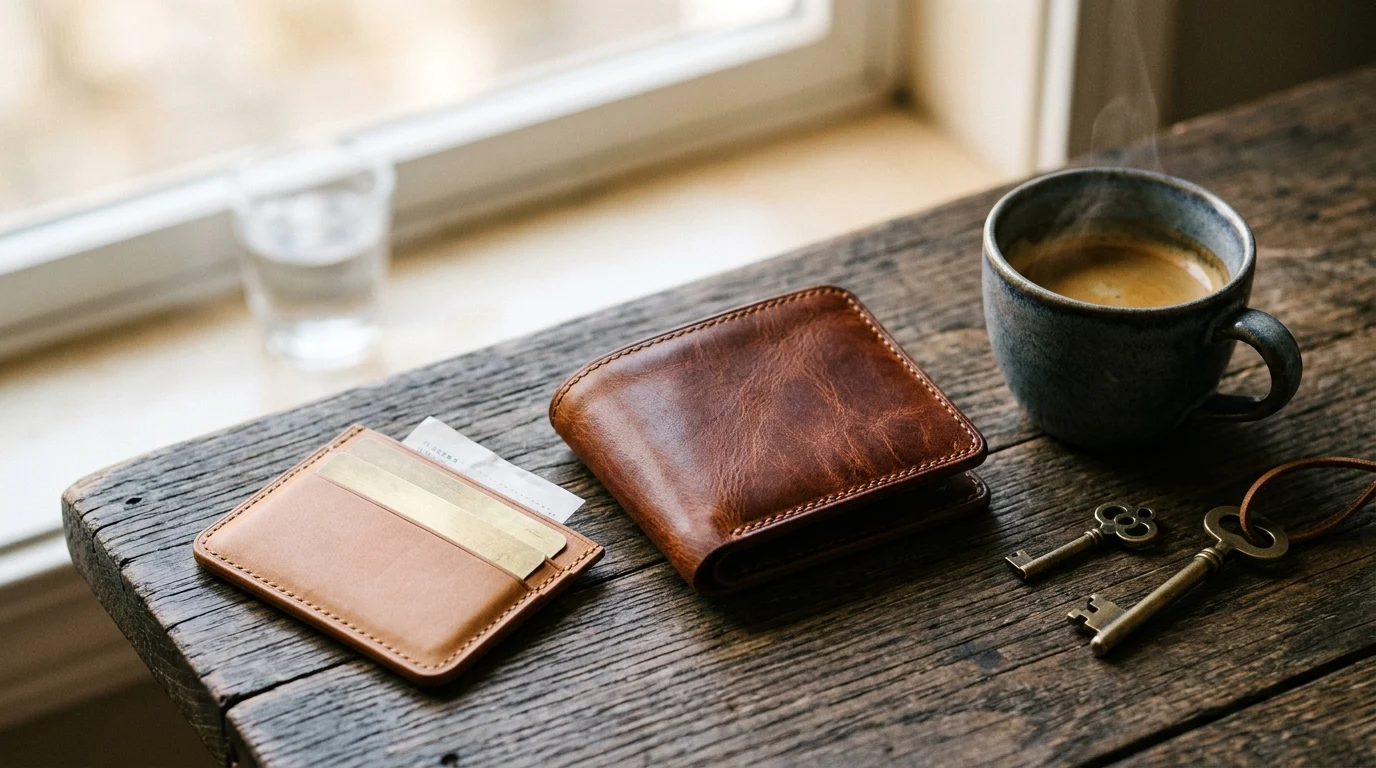
Leather Bifold Wallet vs Cardholder: Which One Should You Buy? [2026 Comparison]
Compare full-grain leather bifold wallets and slim cardholders in card capacity, cash folding, RFID security, and pocket ergonomics for everyday carry in 2026.
Leather Bifold Wallet vs Cardholder: Which One Should You Buy? [2026 Comparison]
Selecting the ideal everyday carry leather accessory requires balancing physical pocket ergonomics against daily storage capacity, transaction frequency, and artisanal longevity. The ongoing debate between a full-grain leather bifold wallet and a minimalist leather cardholder reflects how modern individuals navigate the transition from physical paper currency to digital contactless transactions. While traditionalists celebrate the comprehensive organizational utility of a classic folding billfold, modern urban commuters increasingly favor the featherlight, front-pocket footprint of a slim card sleeve. Both everyday carry silhouettes possess distinctive aesthetic merits, textural appeal, and structural advantages when crafted from authentic full-grain bovine hides. Exploring hide thickness, pocket distortion, card extraction mechanics, and artisan construction reveals which everyday carry companion best elevates your lifestyle.
Key Takeaways & Everyday Carry Principles
- Core Silhouette Distinction: A leather bifold wallet folds horizontally to store flat banknotes and 8 to 12 cards, whereas a slim cardholder remains rigid, holding 4 to 6 essential cards and folded bills.
- Pocket Ergonomics: Minimalist cardholders eliminate back-pocket spinal misalignment by slipping seamlessly into front trouser pockets or breast pockets without causing unsightly fabric bulges.
- Optimal Hide Caliber: Master leather crafters utilize 1.1 to 1.4 millimeter full-grain cowhide for exterior shells to resist corner abrasion, paired with skived interior card pockets.
- RFID Shielding Integration: Premium everyday carry accessories incorporate flexible electromagnetic blocking foils between leather layers, safeguarding contactless chips against unauthorized digital skimming.
- Patina Maturation: Regular contact with skin lipids and ambient friction transforms raw vegetable-tanned bovine hides into deeply burnished, golden-hued heirloom artifacts over years of daily handling.
What Is the Core Difference Between a Leather Bifold Wallet and a Cardholder?
A leather bifold wallet is a traditional folding accessory featuring a central spine, multiple card slots, and a full-length compartment for unfolded banknotes, whereas a leather cardholder is a slim, non-folding pocket sleeve engineered specifically for digital cards and folded currency. Choosing between them depends on whether you prioritize maximum storage capacity or featherlight, front-pocket minimalism.
The structural geometry of each accessory dictates its physical interaction with your clothing. A classic bifold wallet utilizes two symmetrical exterior wings that fold together like a book. This design allows you to open the accessory flat, surveying your credit cards, identification documents, and cash denominations in a single glance. However, folding leather over itself inherently doubles the accessory's base thickness, even before cards and cash are inserted. When fully loaded, a traditional bifold often measures between three-quarters of an inch and one full inch thick, creating noticeable heft in a pocket.
In sharp contrast, a leather cardholder strips away all redundant volume. Constructed from two exterior facing panels and an optional central cash sleeve, a cardholder remains completely flat. It features diagonal or vertical card slots that allow you to slide debit cards, transit passes, and driver licenses in and out with single-finger thumb motions. Because it eliminates the folding spine and full-length cash divider, a loaded cardholder rarely exceeds three-eighths of an inch in thickness. This razor-thin profile allows it to vanish inside tailored trouser pockets without ruining the clean silhouette of your garments.
Discerning connoisseurs exploring our dedicated leather accessories collection quickly realize that modern everyday carry is not about compromise. Both designs fulfill vital roles depending on whether you are commuting through a digital-first metropolis or traveling internationally where physical currency remains indispensable.
How Do Card Capacity and Cash Storage Compare Across Both Everyday Carry Designs?
Card capacity and cash storage represent the primary functional divergence between bifold wallets and cardholders, dictating how comfortably each accessory accommodates daily transactions. While a bifold wallet effortlessly holds eight to twelve cards alongside ten to twenty flat banknotes, a cardholder comfortably accommodates four to six essential cards and three to four trifolded currency notes.
For individuals who regularly handle physical paper money, the bifold wallet offers undeniable advantages. Banknotes slide directly into the full-length top billfold compartment without requiring preliminary folding or creasing. When making cash purchases at artisanal farmers markets, cash-only dining establishments, or international terminals, you can count and extract specific bills instantly. Furthermore, a bifold provides dedicated interior slots for transit passes, medical insurance cards, business cards, and emergency receipts, keeping your financial life meticulously categorized under a single leather roof.
Conversely, carrying cash in a minimalist cardholder demands deliberate intentionality. Because cardholders lack a full-width billfold channel, you must fold each banknote in half or thirds before tucking it into the central compartment. Extracting a specific bill often requires sliding out the entire folded cash bundle, selecting your denomination, and refolding the remaining notes. For individuals who make 95% of their daily purchases via smartphone tap-to-pay, credit card chips, or smartwatches, this minor friction is negligible compared to the liberation of shedding unnecessary wallet bulk.
The physical card slots also behave differently over years of daily usage. In a multi-slot bifold, individual staggered pockets prevent cards from rubbing against one another. In a compact cardholder, stacking two cards inside a single pocket is common, which requires high-tensile full-grain leather that stretches gracefully without tearing. Style enthusiasts balancing bags and accessories can study our comparative analysis on leather duffle bag vs weekend backpack which luggage wins for holistic travel coordination.
How Does Pocket Placement Influence Posture, Ergonomics, and Silhouette Lines?
Pocket placement profoundly impacts spinal posture, seating ergonomics, and the visual drape of tailored clothing, establishing front-pocket cardholders as the healthier choice for seated workers. Carrying a thick bifold wallet in your rear trouser pocket creates an asymmetrical pelvis tilt when sitting, leading to chronic piriformis muscle irritation and lower back sciatica over prolonged periods.
Physical therapists and ergonomic specialists routinely caution against sitting on loaded bifold wallets. When you sit on an inch-thick leather object resting beneath one buttock, your pelvis rotates out of horizontal alignment. To compensate, your lumbar spine curves unnaturally, compressing nerve roots and straining pelvic ligaments. Over years of daily commuting and sedentary desk work, this chronic postural imbalance causes recurring lower back stiffness, hip aches, and radiating leg discomfort known colloquially as wallet sciatica.
Beyond spinal health, carrying a bulky bifold in your rear pocket damages both the wallet and your garments. The intense pressure of body weight pressing against chair surfaces crushes the leather grain, bends plastic credit cards, and wears shiny abrasion rings into the seat of your trousers. Furthermore, a bulging back pocket disrupts the clean, elegant lines of tailored trousers and raw denim, creating an unsightly visual distraction that draws the eye away from sharp tailoring.
Cardholders completely eliminate these ergonomic and aesthetic dilemmas. Designed explicitly for front trouser pockets, suit jacket breast pockets, or coat interior pockets, a cardholder rests safely against your flat upper thigh or ribcage. It creates zero postural interference when driving or sitting at a desk, while providing superior defense against opportunistic pickpockets in crowded subway cars and international airports. Women seeking streamlined everyday options will find beautiful coordination across our women collection and tailored outerwear lines.
How Do Bifold Wallets and Cardholders Compare Across Everyday Carry Metrics?
Comparing full-grain leather bifold wallets and slim cardholders across everyday carry metrics highlights essential differences in capacity, pocket thickness, transaction speed, and aesthetic formality. While traditional bifolds deliver complete financial autonomy for frequent cash handlers, minimalist cardholders provide unmatched agility for modern digital lifestyles.
Choosing between these accessories requires assessing your daily routines and sartorial wardrobe. If you frequently wear relaxed denim, utility jackets, or heritage outerwear with generous pocket depth, a structured bifold feels substantial and reassuring in the hand. Its unfolding ritual communicates traditional dignity during business lunches and upscale retail encounters. In contrast, if your daily wardrobe centers on slim-fitting suits, tapered chinos, or athletic joggers, a cardholder preserves your garment's architectural lines without creating dragging pockets.
The following comprehensive comparison table details how bifold wallets and slim cardholders perform across key everyday carry dimensions:
| Everyday Carry Model | Ideal Carry Location | Card Capacity | Cash Storage Method | Loaded Pocket Thickness | Price Range USD |
|---|---|---|---|---|---|
| Handstitched Leather Bifold | Jacket Interior or Rear Pocket | 8 to 12 Cards | Full-Length Flat Bill Compartment | 0.75 to 1.00 Inch | 29 to 79 |
| Slim Minimalist Cardholder | Front Trouser or Breast Pocket | 4 to 6 Cards | Central Folded Bill Slot | 0.25 to 0.40 Inch | 29 to 79 |
| Executive Coat Pocket Wallet | Long Overcoat Breast Pocket | 12 to 16 Cards | Dual Full-Length Cash Dividers | 0.50 to 0.70 Inch | 39 to 89 |
| Gusseted Accordion Card Case | Front Pocket or Crossbody Bag | 10 to 15 Cards | Compartmentalized Accordion Fold | 0.60 to 0.85 Inch | 29 to 79 |
| Minimalist Money Clip Bifold | Front Trouser Pocket | 6 to 8 Cards | Interior Spring-Loaded Brass Clip | 0.45 to 0.60 Inch | 29 to 79 |
| Zip-Around Leather Card Wallet | Coat Pocket or Handbag | 6 to 8 Cards + Coins | Zippered Enclosure with Pouch | 0.70 to 0.90 Inch | 39 to 89 |
Reviewing these specifications clarifies why many discerning professionals maintain both accessories in their personal rotation. Men seeking comprehensive leather coordination can study our practical guide on how to style bags wallets belts for work today to synchronize small leather goods with luxury outerwear.
What Leather Grades and Construction Standards Define an Heirloom Wallet?
Evaluating leather grades and construction standards separates handcrafted heirloom small leather goods from mass-produced commercial wallets that delaminate, split, and tear within twelve months. True heirloom accessories demand 100% full-grain cowhide, hand-skived card pockets, saddle-stitched bonded nylon thread, and hand-burnished edges sealed with natural beeswax.
Many commercial wallet manufacturers utilize genuine leather or bonded leather scraps coated with polyurethane finishes to mimic authentic grain. These inferior materials lack natural collagen tensile strength; within months of inserting cards, the pocket edges stretch out permanently, causing cards to slip out unexpectedly. Full-grain bovine leather preserves the intact epidermal grain layer, offering dense cross-linked fibers that flex hundreds of thousands of times without tearing or losing tensile memory.
At Lux Wearz, every handcrafted wallet and cardholder adheres strictly to verifiable workshop standards. The following durability and materials matrix outlines our authentic workshop specifications:
| Leather Accessory Tier | Hide Origin & Grade | Leather Thickness | Hardware Architecture | Interior Lining Build | Production Lead Time | Craftsmanship Guarantee |
|---|---|---|---|---|---|---|
| Full-Grain Leather Wallet | 100% Full-Grain Cowhide | 1.1 to 1.4 mm Cowhide Shell | Solid YKK Brass Hardware | Polyester Satin Lining | 3 to 5 Business Days | 1-Year Craftsmanship Warranty |
| Slim Leather Cardholder | 100% Full-Grain Cowhide | 1.1 to 1.4 mm Cowhide Shell | Brass Rivets or Clean Stitch | Polyester Satin Lining | 3 to 5 Business Days | 1-Year Craftsmanship Warranty |
| Custom Made-to-Order Accessory | Full-Grain Cowhide, Lambskin, Goatskin | 0.8 to 1.4 mm Bespoke Caliber | YKK Brass Zippers | Polyester Satin Lining | 7 to 14 Business Days | 1-Year Craftsmanship Warranty |
| Full-Grain Leather Belt | 100% Full-Grain Cowhide | 1.1 to 1.4 mm Heavyweight Cowhide | Solid Antiqued Brass Buckle | Unlined Natural Suede Backing | 3 to 5 Business Days | 1-Year Craftsmanship Warranty |
Every seam in our leather atelier is assembled using heavy-duty bonded nylon thread that resists friction, skin oils, and environmental moisture. Edge finishing represents another hallmark of master craftsmanship: our artisans bevel and hand-burnish every raw leather edge using wooden slickers and organic beeswax, creating a smooth, glassy seal that prevents fiber fraying. To explore professional luggage companions that mirror these artisanal standards, review our executive review on is a leather briefcase worth buying work guide 2026.
How Does RFID Shielding Technology Protect Modern Contactless Cards?
Radio Frequency Identification (RFID) shielding technology protects contactless payment cards and electronic passports from unauthorized wireless interrogation by intercepting radio wave frequencies between 13.56 MHz and 860 MHz. By embedding a flexible metallic composite foil between exterior leather hides and interior satin linings, an RFID-blocking wallet creates a protective Faraday cage around your financial credentials.
Modern contactless payment cards utilize embedded microchips and radio frequency antennas to transmit encrypted card numbers and expiration dates to payment terminals across short distances. While this technology enables effortless tap-to-pay convenience, it exposes cardholders to opportunistic digital skimming. Sophisticated handheld RFID scanners can capture unencrypted data through clothing pockets in crowded train stations, hotel lobbies, and airport security queues without physical contact.
At Lux Wearz, our RFID-shielded wallets and cardholders integrate ultra-thin, flexible electromagnetic shielding fabrics that block high-frequency transmissions without adding unnecessary weight or rigidity. Unlike cheap metal inserts that crack and pierce leather panels, our shielding textiles flex naturally with the hide, preserving the supple hand-feel and organic drape of full-grain cowhide. You enjoy complete peace of mind knowing that your credit cards, debit cards, and electronic transit passes remain impenetrable to electronic theft while enclosed inside your pocket.
Gentlemen curating cohesive everyday carry kits can pair an RFID-protected cardholder with pieces from our mens leather jackets collection, while women can discover versatile options across our womens leather jackets line.
How Do Full-Grain Leather Small Goods Develop an Irreplaceable Patina?
Developing a rich, personalized patina represents the ultimate aesthetic reward of carrying a full-grain leather bifold wallet or cardholder over years of daily handling. Unlike synthetic pleather that cracks and peels, vegetable-tanned and drum-dyed bovine hides behave like living organic records, absorbing body warmth, natural skin oils, and ambient friction to reveal glowing golden-brown undertones across high-contact surfaces.
The biological mechanics of small leather goods patina formation involve three distinct daily interactions:
- Sebum and Oil Absorption: Every time you reach into your pocket and touch your wallet, microscopic lipids from your fingertips penetrate the open pore structure of full-grain leather. These natural oils condition the collagen fibers from within, darkening the hide and imparting a luxurious satin sheen.
- Surface Friction Polishing: Sliding your wallet into and out of denim or cotton trouser pockets creates gentle, continuous abrasion. This friction buffs the outer grain layer, smoothing microscopic fibers and creating glossy burnished highlights along pocket edges and folding seams.
- Ambient Light and Flex Creasing: Exposure to natural sunlight gently oxidizes tanning oils, deepening pale tan and cognac hides into rich whiskey and mahogany hues. Meanwhile, natural pocket flexing introduces soft anatomical contours that mirror your exact grip.
Within three to six months of daily carry, a full-grain leather wallet transforms from a pristine workshop product into a completely unique personal artifact that tells the intimate story of your daily journeys. Discerning collectors interested in matching small leather goods with heritage outerwear can explore our curated selections in casual jackets and timeless men collection.
How Do You Clean, Condition, and Maintain Everyday Small Leather Goods?
Maintaining full-grain leather everyday carry accessories requires regular, gentle conditioning to replenish natural biological lipids depleted by pocket friction, body heat, and environmental air conditioning. Establishing a quarterly care routine prevents leather drying, strengthens pocket seams, and ensures that card slots retain their natural elasticity across decades of service.
Begin your maintenance routine by emptying all cards, cash, and receipts from the accessory every three months. Inspect the interior pockets for accumulated pocket lint, grit, or sand particles that collect inside corners. Use a soft, dry horsehair brush or a burst of compressed air to dislodge trapped debris. If surface grime or dark denim dye transfer appears along the exterior panels, dampen a clean lint-free microfiber cloth with distilled water and wipe the leather gently using light circular motions. Never saturate the leather or immerse it in water.
Conditioning restores essential moisture and prevents corner cracking. Apply a small, pea-sized portion of pH-balanced, natural wax leather cream to a soft foam applicator. Work the conditioner sparingly across the exterior hide panels, paying careful attention to the folding spine and perimeter stitching. Allow the hide to absorb the lipids for twenty minutes, then buff the surface vigorously with a clean horsehair brush to restore a rich, glowing luster. Avoid heavy neatsfoot oil or dark grease pastes that oversaturate thin wallet panels and cause cards to stick. For an exhaustive, step-by-step preservation handbook, study our complete Lux Wearz Leather Care Guide.
To expand your accessory wardrobe with travel-ready carry options, explore our rugged leather backpacks, executive leather briefcases, and protective leather gloves.
Why Is Handcrafted Made-to-Order Leather Superior for Daily Wallets?
Choosing handcrafted made-to-order leathercraft for everyday carry wallets eliminates the loose stitching, synthetic paper linings, and synthetic card slots that fail prematurely in mass-market commercial accessories. Because a wallet is manipulated dozens of times each day, individualized artisan construction guarantees structural resilience backed by master leatherworking techniques.
Commercial department store accessories are assembled on automated assembly lines using pre-glued split hides and flimsy synthetic paper linings that tear within months of card insertion. Once a plastic pocket tears or glued seams delaminate, the accessory becomes completely unusable. In contrast, our artisan workshop builds each piece individually using continuous-filament bonded nylon thread and hand-matched full-grain cowhide panels, ensuring that every seam holds steadfast under years of intense pocket friction.
At Lux Wearz, our bespoke atelier provides complete personalization for your everyday carry needs. Master tailors calibrate every detail:
- Card Pocket Tolerance: Precision-cut slot widths that grip single cards securely while permitting dual-card expansion without tearing.
- Custom Leather Selection: Choice of full-grain cowhide, buttery lambskin, or durable goatskin drum-dyed in rich heritage colorways.
- Hardware Integration: Solid antiqued brass YKK zippers or snaps tailored to your aesthetic preferences.
- Hand-Burnished Finishing: Hand-beveled edges sealed with organic beeswax for lifelong resistance to moisture and fraying.
Every handcrafted piece leaving our atelier is backed by our 1-year craftsmanship warranty, ensuring uncompromising quality that endures across decades. Patrons worldwide share their genuine impressions in our Customer Testimonials archive. For personal sizing advice on wearable leather goods, review our comprehensive Lux Wearz Size Guide.
Elevate your daily ritual with heirloom small leather goods by exploring the artisan workshop archives, or speak directly with our leather craftsmen today.
Explore The Full 2026 Leather Outerwear Collection
Vegetable-tanned full-grain cowhide, buttery New Zealand lambskin, and heritage Melton wool. Free express delivery across the USA with 30-day hassle-free returns.