
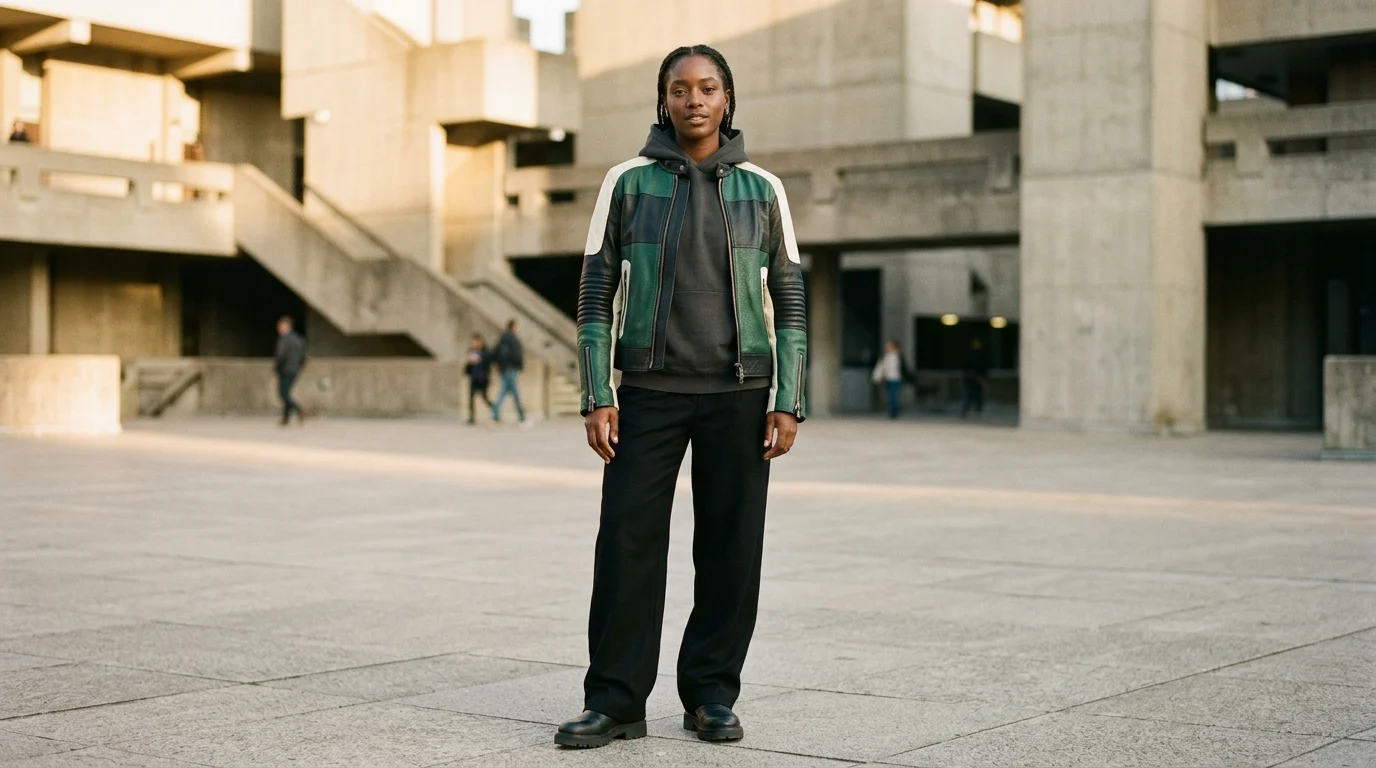
How to Style Kawasaki Leather Jackets: Streetwear Proportions, Layering, and Silhouette Guide [2026]
Master Kawasaki leather jacket streetwear proportions, moto-panel color blocking, forward-pitched sleeve layering, and bespoke custom fits in this 2026 styling guide.
Key Takeaways
- Balance High-Contrast Color Blocking with Tonal Foundations: Because iconic lime-green, obsidian-black, and optic-white sportbike panels command immediate visual attention, anchor the lower half with matte charcoal denim, wide-leg black wool trousers, or washed slate cargos.
- Master the Cropped Moto Waistline Ratio: Traditional sport-riding cuts end sharply at the hip bone (24 to 25.5 inches center back), creating a high-impact 1/3 upper-to-2/3 lower silhouette when paired with mid- or high-rise bottoms.
- Account for Pre-Curved Sleeves When Layering: Forward-rotated raglan and set-in moto sleeves accommodate riding posture rather than straight vertical arms; limit mid-layers to 280–340 GSM French terry or fine merino unless your chest ease exceeds +3 inches.
- Respect Vintage Foam and Liner Degradation: Pre-owned 1990s and early-2000s racing jackets often hide pulverized open-cell shoulder foam and brittle taffeta linings that create boxy, uneven drape on the street.
- Bespoke Streetwear Calibration: Through Lux Wearz's Custom Order Studio, you can preserve classic sport-moto paneling while tailoring softer 1.15 mm–1.25 mm drum-dyed cowhide, neutral street pitch, and exact waist taper.
Artisan Independence & Trademark Notice: Lux Wearz is an independent bespoke leathercraft atelier. All brand names, logos, and trademarks mentioned in this article (including Kawasaki® and related trademarks) belong exclusively to their respective trademark holders. Lux Wearz is not an authorized distributor, licensee, or affiliated partner of these brands. All brand references and historical retrospectives are made strictly for educational, comparative, and sizing review purposes under Fair Use. Lux Wearz specializes in custom-tailored, heirloom-grade genuine leather outerwear handcrafted individually in our private workshop.
How Do You Style Kawasaki Leather Jackets for Modern Streetwear Proportions?
Styling Kawasaki leather jackets for modern streetwear requires balancing high-contrast motorsport color blocking and cropped waist geometry against relaxed, matte-textured trousers and grounded footwear. Keep base layers streamlined beneath the forward-pitched moto armholes, let the structured collar frame a clean neckline, and neutralize bright green or white leather accents with monochromatic charcoal, raw indigo, or washed black bottoms.
Over the past decade, genuine motorsport outerwear has crossed decisively from pit lanes and canyon roads into global streetwear editorials from Tokyo's Shibuya district to Milan, London, and New York. Unlike minimalist café racers or slouchy 1980s flight bombers, Kawasaki-inspired sportbike jackets carry unmistakable visual geometry: articulated accordion stretch zones, bold diagonal chest seams, reinforced shoulder caps, and kinetic emerald, obsidian, and ivory paneling. That sculptural boldness is precisely why contemporary stylists reach for them—and also why careless pairing can accidentally look like you walked off a track without a helmet.
Getting streetwear proportions right with a racing-derived leather silhouette is not about hiding its motorsport DNA. It is about architectural counterweight. When a jacket has high structural stiffness (1.2 mm to 1.4 mm cowhide), cropped back length, and graphic chest blocking, the rest of the outfit must introduce vertical drape, matte fabric contrast, and deliberate volume around the ankle. Whether you are building outfits around an archive-inspired piece from our Kawasaki brand catalog, exploring wider options in our racing jackets category, or specifying a custom street-pitched pattern in our Custom Order Studio, understanding cut geometry transforms a track-born jacket into an effortless daily signature.
The Style Heritage of Sport-Moto Leather in Urban Streetwear
To understand why Kawasaki-era sportbike leather wears so differently from classic cruiser outerwear, you have to trace how pattern engineering evolved from the late 1970s through the early 2000s superbike boom. Early cruiser and café jackets—rooted in 1950s double-rider templates—relied on relatively flat chest blocks, wide notched lapels, and straight cylindrical sleeves designed for upright or mildly leaned postures. By contrast, late-1980s and 1990s Japanese superbike culture introduced aerodynamic, tucked-in ergonomics directly into commercial street jackets.
Patternmakers rotated the sleeve head forward by 12 to 18 degrees, narrowed the upper bicep, inserted elasticated leather accordion pleats behind the deltoid and above the elbow, and shortened the front zipper rise by 1.5 to 2.5 inches so the hem would not buckle against a fuel tank. Simultaneously, track visibility rules and factory team aesthetics popularized sharp diagonal color blocking—pairing deep jet black cowhide with signature lime green, stark racing white, and subtle metallic silver piping.
By the mid-2000s, archival moto jackets began appearing in hip-hop videos, Japanese archive fashion magazines, and underground skate lookbooks. Stylists realized that those exact technical features—a sharp stand-up mandarin collar, articulated shoulders, and a cropped hip termination—created an aggressive V-taper silhouette that made wide-leg cargo pants, carpenter denim, and heavy boots look twice as intentional. In 2026, this neo-moto aesthetic has matured beyond costume nostalgia. Rather than pairing a bright graphic racing jacket with skin-tight distressed jeans and clunky trainers, modern streetwear favors quiet, disciplined contrast: architectural moto leather up top, tailored wide-leg volume below, and zero competing logos.
If you want deeper background on how these archival patterns compare across eras and stitch architectures, see our dedicated Kawasaki archival silhouettes and sizing guide as well as our technical breakdown comparing Kawasaki leather jackets vs bespoke custom leather.
Mastering Proportions: The Rule of Thirds and Silhouette Balance
Proportion is the single biggest difference between a racing jacket that looks styled and one that looks borrowed. Sport-moto leather is inherently top-heavy in visual mass. Even without bulky external armor, thick cowhide panels, layered elbow gussets, and a high-contrast chest stripe add perceptual width across the upper torso.
1. Managing the Cropped Hemline and Waist Rise
Most Kawasaki-style moto jackets measure between 24.0 and 25.75 inches down the center back for a men's Medium/Large, with the front hem sitting slightly higher to clear the belt buckle. When worn over low-rise trousers, that short front drop exposes awkward slivers of T-shirt hem and bisects the torso poorly.
The solution is pairing the jacket with mid-rise or high-rise trousers (11.5 to 13 inches front rise) so the jacket hem kisses or hovers just half an inch above the waistband. If you prefer an untucked tee underneath, keep the tee hem strictly within 1.5 to 2.0 inches below the jacket zipper—ideally in heavyweight matte cotton (240–280 GSM) in optic white, heather ash, or washed bone so it acts as an intentional architectural spacer rather than sloppy excess fabric.
2. Trouser Volume: Wide-Leg, Relaxed Straight, and Utility Cuts
Skinny jeans paired with an armored or structured moto jacket produce an inverted-triangle silhouette that looks dated and emphasizes every seam stiffly. Instead, counterbalance the upper-body structure with trouser leg openings between 8.5 and 10.5 inches across:
- Relaxed Straight Raw or Washed Indigo Denim (13–15 oz): The dry, slubby texture of selvedge denim softens the sheen of drum-dyed cowhide. Choose dark rinsed indigo, charcoal black, or vintage faded slate rather than heavily whiskered light wash.
- Wide-Leg Pleated Wool or Cavalry Twill Trousers: One of the sharpest 2026 editorial moves is contrasting a technical sport-moto leather jacket with charcoal or espresso wide-leg tailored trousers. The fluid leg drape absorbs the jacket's rigid shoulder line effortlessly.
- Articulated Ripstop or Double-Knee Canvas Cargos: For utility streetwear, matte olive drab, slate grey, or pitch-black double-knee work pants echo the reinforced paneling of a racing jacket without introducing competing graphic prints.
3. Footwear Weight and Grounding
A heavyweight leather upper demands visual mass at the floor. Sleek low-profile canvas sneakers can make a structured racing jacket appear overly bulky on top. Ground the silhouette with square-toe or round-toe leather combat boots, Vibram-soled Chelsea boots, chunky heritage leather trainers, or lug-soled derbies. Keeping footwear matte black or dark espresso ensures the eye travels cleanly from the jacket's chest paneling down to a grounded base.
Table 1: Silhouette & Fit Architecture
Before choosing layers or trouser widths, match your jacket's underlying pattern geometry to your natural build and intended streetwear drape.
| Silhouette Model | Cut & Fit Type | Shoulder / Chest Offset | Ideal Body Profile | Leather Weight & Temper |
|---|---|---|---|---|
| Sport-Moto Colorblock Jacket | Cropped tapered athletic fit with forward-pitched sleeves | +2.0 to +2.5 in chest ease; snug 0.5 in shoulder drop | Athletic, V-taper, or lean builds seeking sharp upper definition | 1.2–1.3 mm full-grain cowhide; medium-firm temper |
| Heritage Cafe-Moto Mandarin Cut | Straight boxy torso with subtle kidney-panel taper | +2.5 to +3.5 in chest ease; natural square shoulder | Broad shoulders or straight torsos wanting clean daily layering | 1.1–1.25 mm drum-dyed cowhide; supple broken-in temper |
| Track-Inspired Padded Shoulder Cut | Contoured anatomical race block with accordion back gussets | +1.5 to +2.25 in chest ease; structured molded shoulder | Lean to medium frames favoring tight neo-moto editorial fits | 1.3–1.4 mm competition cowhide; structured crisp temper |
| Quilted Street-Biker Hybrid | Relaxed mid-hip cut with diamond-stitched yokes | +3.0 to +4.0 in chest ease; slightly dropped shoulder | Muscular, taller, or layer-heavy streetwear silhouettes | 1.1–1.2 mm milled cowhide or lambskin; pliable drape |
| Track-to-Street One-Piece & Two-Piece Archive | Full articulated aerodynamic chassis with waist-zip connector | +1.0 to +1.75 in precision ease; aggressive riding pitch | Collector display, track days, or avant-garde runway styling | 1.3–1.5 mm heavy top-grain cowhide; dense protective temper |
Layering Strategy Without Armhole Pinch or Bulk
Layering under a sport-moto leather jacket fails most often at the bicep and front deltoid, not the waist. Because racing-derived patterns cut high into the armpit (to prevent fabric bunching when reaching for handlebars), shoving a thick, stiff fleece sleeve into a tight moto armscye restricts circulation and forces the jacket's shoulders to ride up toward your ears.
Lightweight and Trans-Seasonal Layering (55°F–72°F)
In mild spring and autumn weather, keep internal layers flat and breathable:
- 240–280 GSM Heavyweight Crewneck Tees: A dense combed cotton tee holds a crisp ribbed collar against the jacket's snap-tab throat latch without sagging. Bone white or heather grey creates clean contrast inside an open black-and-green moto front zipper.
- Fine-Gauge Merino Rollnecks or Mock-Necks: A black or charcoal 19.5-micron merino turtleneck slips smoothly through quilted polyester or satin linings with zero friction, elongating the neck above a mandarin collar.
- Open-Collar Chambray or Brushed Poplin Workshirts: Wearing an unbuttoned charcoal or indigo workshirt beneath an unzipped moto jacket adds horizontal texture without crowding the forearm.
Cold-Weather Streetwear Layering (35°F–54°F)
If you want the classic moto-over-hoodie streetwear look, you must manage hood bulk and sleeve GSM carefully:
- Choose Unbrushed Loopback French Terry (320–380 GSM Max): Avoid plush, lofty fleece hoodies unless your jacket was deliberately sized up or custom-drafted with +3.5 inches of chest ease. Smooth-faced French terry slides inside the jacket sleeves without bunching at the elbow accordion.
- Check Collar-to-Hood Geometry: Most Kawasaki-style jackets feature a short mandarin snap collar rather than wide notched lapels. When pulling a hoodie hood over a stand collar, flatten the stand collar's snap tab open so the hood drapes cleanly over the back yoke rather than choking the throat.
- Consider Sleeveless Thermal Quilted Vests: To retain core warmth under a snugger 1.3 mm cowhide jacket without sacrificing arm mobility, layer a thin packable down or wool-pile gilet under the torso while keeping sleeves covered only by a fitted long-sleeve henley.
Always verify your actual chest circumference over your heaviest intended mid-layer against the garment's pit-to-pit specification using our Lux Wearz Size Guide before finalizing any fit.
Color Palette Architecture: Taming Racing Green, Obsidian, and Ivory
Color discipline separates timeless moto-streetwear from noisy costume styling. Kawasaki's classic motorsport palette pairs saturated lime or emerald green with deep jet black and stark white panels. Green leather is visually electric—if you pair it with competing primary colors, neon sneakers, or loud graphic tees, the outfit fractures immediately.
The Three Foolproof Color Formulas
- Obsidian Anchor (90% Black/Charcoal, 10% Moto Green): Pair a black-and-green colorblock jacket over a washed charcoal crewneck tee, wide black wool-blend trousers, and matte black combat boots. Every dark surface quiets the eye so the green leather stripes read like intentional architectural pinstriping.
- Earth & Bone Neutrality: Match black-green-white paneled leather with an ecru or bone heavyweight tee, faded vintage slate denim, and dark olive or espresso suede boots. Warm off-whites soften the starkness of optical white leather piping.
- Tonal Stealth (All-Black Embossed & Perforated): If you love sport-moto seam geometry—chest vents, elbow gussets, stand collar—but work in conservative creative environments, choose all-black quilted or tonal-stitched cowhide over slate grey trousers and gunmetal hardware. You keep 100% of the aerodynamic silhouette with zero high-contrast loudness.
For broader wardrobe inspiration across dark leathers and minimalist outerwear, browse our wider men's leather jackets collection to compare collar heights and monochrome finishes.
Table 2: Leather Hide & Hardware Durability Matrix
Streetwear styling puts unexpected daily stress on moto leather—from heavy backpack straps rubbing shoulder seams to repeated zipper pulls at the subway turnstile. Understanding hide metallurgy, thickness, and seam specs ensures your jacket drapes better in year five than on day one.
| Component / Hide | Leather Grade & Tannage | Thickness (mm) | Weather Resistance | Expected Longevity | Maintenance Needs |
|---|---|---|---|---|---|
| Virgin Full-Grain Cowhide | Chrome- or semi-veg retanned, drum-dyed aniline finish | 1.25–1.40 mm | High; resists wind chill, light mist, and urban abrasion | 20–30+ years with periodic conditioning | Wipe dust quarterly; light pH-balanced balm every 9–12 months |
| Milled Pebble-Grain Cowhide | Drum-milled full-grain hide for softer drape | 1.10–1.25 mm | Moderate-High; water beads cleanly off sealed topcoat | 15–25 years of daily urban wear | Brush creases with horsehair; avoid silicone sprays |
| Perforated Moto Paneling | Full-grain cowhide die-punched for airflow | 1.20–1.30 mm | Low-Moderate; breathable in warm weather, porous in rain | 12–20 years (avoid excess tension on holes) | Use dry microfiber only; never saturate perforations with wax |
| Bonded Nylon Thread (V69 / V92) | UV-stabilized continuous-filament twisted nylon | 0.30–0.45 mm gauge | High; impervious to sweat rot and mild moisture | 20+ years without dry-rotting | Inspect high-flex elbow gussets annually |
| Heavy-Gauge Zippers (#8 / #10) | Solid brass, gunmetal-plated brass, or nickel alloy teeth | 8.0–10.0 mm tooth width | Corrosion-resistant when kept free of road salt | 15–25+ years (slider replaceable if worn) | Dry paraffin or silicone-free zipper wax twice yearly |
| Breathable Bemberg / Cotton Twill Lining | High-twist cupro rayon or 100% combed cotton twill | 160–220 GSM | Breathable; prevents clammy moisture buildup indoors | 10–18 years (re-lineable by bespoke tailor) | Spot clean collar neckband; air on wide cedar hanger |
Pre-Owned Inspection Checklist & Common Vintage Flaws
Many shoppers hunt secondary marketplaces for 1990s and early-2000s Kawasaki-branded or vintage superbike jackets thinking older automatically means better leather. In practice, pre-owned sport-moto jackets carry specific structural failure modes that ruin streetwear drape and cost more to restore than commissioning a fresh bespoke piece.
1. Pulverized Shoulder & Elbow Foam (Dry-Rot Dust)
Unlike minimalist cruiser jackets, 1990s racing jackets commonly stitched open-cell polyurethane foam pads directly inside quilted shoulder and bicep compartments. After 15 to 25 years of oxidation, that foam disintegrates into sticky orange or grey powder. Visually, the shoulder caps collapse unevenly, creating lumpy, deflated ridges that ruin clean streetwear proportions—and the dust sifts permanently out through needle holes onto your shirts.
2. Colorblock Dye Migration & Cracking White Panels
Classic moto jackets rely on bright green and optic-white pigment coatings over chrome-tanned hides. Because heavy opaque pigment coats sit on top of the grain rather than soaking deeply like aniline black dye, flexing at the inner elbow and collar fold eventually causes spiderweb cracking and peeling. Worse, improper wet storage causes black panel dye to bleed permanently into adjacent white or green leather strips—a defect no cobbler can bleach out without repainting the entire panel.
3. Dry-Rotted Thread & Stress-Torn Accordion Gussets
Vintage jackets stored in hot attics or damp basements suffer thread embrittlement. Give gentle lateral tension to the rear shoulder gusset seams and underarm panels: if you hear faint popping sounds or see needle holes elongating, the original cotton-core or aged thread has lost tensile strength. Rebuilding shredded gusset seams on a lined moto jacket requires opening the entire body lining—often $180 to $350 in tailor labor alone.
4. Worn Zipper Retaining Boxes & Sticky Sliders
Test the bottom pin and retaining box of the center-front zipper five times cleanly. Vintage brass or die-cast zinc teeth near the belt line absorb years of bending stress; once the fabric tape frays beside the retaining pin, the entire #8 or #10 front zipper must be unpicked and stitched through double-thick cowhide placket layers.
5. Sweat-Hardened Collars & Locked Odor
Mandarin moto collars sit directly against bare neck skin. Decades of perspiration salt crystallize inside the leather fibers, leaving the collar rim stiff like cardboard and permanently darkened. While proper cleaning outlined in our Lux Wearz Leather Care Guide helps preserve healthy modern hides, salt-crystallized vintage collars rarely recover supple comfort.
Featured Silhouette Retrospective & Curated Collection
If you want the visual authority and aerodynamic geometry of iconic motorsport leather without vintage dry-rot risk, inspect these five curated pieces currently available in the Lux Wearz collection. Each model highlights a distinct streetwear styling lane—from subtle tonal textures to bold paddock color blocking.
1. Men's Kawasaki Ninja H2-Style Leather Jacket – Black Green
Built around an obsidian-black body punctuated by razor-sharp emerald-green racing accents and structured chest paneling, the Men's Kawasaki Ninja H2-Style Leather Jacket – Black Green offers one of the cleanest contemporary takes on hyperbike outerwear. Because black dominates over 80 percent of the garment's surface area, the green piping acts as precision tailoring lines rather than overwhelming visual noise. Style it unzipped over a 260 GSM washed-black tee, wide pleated slate wool trousers, and chunky black leather derbies for an effortless dark-moto city look.
2. Kawasaki Ninja Graphic Leather Jacket – Black Green White
For purists drawn to unmistakable tri-color heritage blocking, the Kawasaki Ninja Graphic Leather Jacket – Black Green White pairs bold ivory chest and sleeve segments against deep black and vibrant Kawasaki-inspired green. To keep tri-color graphics grounded in 2026 streetwear rather than 2004 track-day nostalgia, eliminate all other white or green elements below the waist: wear raw charcoal selvedge jeans, a heather-grey crewneck, and matte black boots so the jacket remains the sole focal point.
3. New Custom Kawasaki Racing Leather Jacket Motorcycle Biker Jacket
When your priority is a tailored, custom-fitted chest block that bridges street utility with classic racing shoulder architecture, the New Custom Kawasaki Racing Leather Jacket Motorcycle Biker Jacket delivers crisp stand-collar framing and reinforced sleeve tapering. Its balanced waist cut pairs seamlessly with mid-rise double-knee carpenter trousers or relaxed black cargos, allowing you to layer a slim 320 GSM French terry hoodie beneath without bulging at the front zipper.
4. Kawasaki Racing Team Motorcycle Leather Jacket – Men's Biker Riding Gear Cowhide
Constructed for enthusiasts who appreciate authentic competition-style cowhide presence, the Kawasaki Racing Team Motorcycle Leather Jacket – Men's Biker Riding Gear Cowhide features structured paneling, zippered sleeve cuffs, and substantial leather weight that holds its shoulder silhouette off the body. Leave the cuff zippers closed for a sleek tapered wrist over a heavy mechanical watch, and pair with relaxed straight-leg vintage black denim to let the jacket's cropped profile elongate your leg line.
5. Kawasaki Ninja Graphic One-Piece Leather Racing Suit – Black
While a full suit belongs primarily on canyon tarmac and circuit track days, collectors and avant-garde stylists frequently study the Kawasaki Ninja Graphic One-Piece Leather Racing Suit – Black as the anatomical blueprint behind modern moto streetwear. Notice how its forward-angled shoulder gussets, knee-to-hip articulation, and color-blocked torso lines directly inspire today's cropped leather street jackets—and why full-suit buyers rely on exact chest, torso-length, and inseam calibration for true ergonomic comfort.
Browse the complete range of riding and street-ready silhouettes inside our Kawasaki collection or compare across all artisanal outerwear in our full Lux Wearz catalog.
The Bespoke Handcrafted Custom Tailoring Alternative
Even when you love the geometry of sport-moto leather, off-the-rack sizing forces awkward compromises. Standard racing patterns assume a narrow, hunched torso with disproportionately tight forearms; if you have broad athletic shoulders, a longer torso, or simply want to wear a heavy hoodie on cool evenings, buying two sizes up turns the waist into a sloppy parachute and sends sleeves past your knuckles.
This is where commissioning an individual, made-to-measure jacket through the Lux Wearz Custom Order Studio transforms how motorsport leather fits your daily wardrobe:
- Calibrated Street Pitch vs. Track Hunch: Our master patternmakers adjust the shoulder forward-rotation from aggressive 18-degree race crouch to a natural 6-to-8-degree street posture, eliminating unsightly back collar gapping when you stand upright.
- Custom Torso Length & Hem Drop: Add 1.0 to 1.5 inches to the center-back length if you are over 6'1", or request a crisp 24.5-inch cropped cut if you exclusively style high-waisted tailored trousers.
- Virgin Full-Grain Cowhide & Temper Selection: Choose between dense 1.35 mm structured cowhide for architectural shelf-presence or supple 1.15 mm milled full-grain cowhide that drapes effortlessly from the first wear without weeks of stiff break-in.
- Personalized Hardware & Lining: Swap loud plastic pullers for solid antiqued brass or matte gunmetal YKK #8/#10 zippers, and upgrade stiff synthetic mesh to breathable Bemberg cupro or quilted cotton twill.
- Zero Counterfeit Logos, Pure Craftsmanship: Rather than slapping unauthorized corporate patches onto low-grade split leather, every bespoke piece is cut and stitched individually in our private workshop to celebrate authentic motorsport proportion through virgin hide quality and precision tailoring.
Final Fit Calibration & Styling Summary
Before finalizing your outfit or custom measurement sheet, keep three non-negotiable styling rules in mind: match the cropped moto waist to a mid- or high-rise trouser, limit sleeve layers to smooth 240–340 GSM fabrics unless your armhole ease was custom-expanded, and treat bright green or white panels as the sole graphic anchor of your look. For detailed chest, shoulder, and sleeve measurement instructions, visit our Lux Wearz Size Guide or start your tailored build at the Custom Order Studio.
Explore The Full 2026 Leather Outerwear Collection
Vegetable-tanned full-grain cowhide, buttery New Zealand lambskin, and heritage Melton wool. Free express delivery across the USA with 30-day hassle-free returns.