
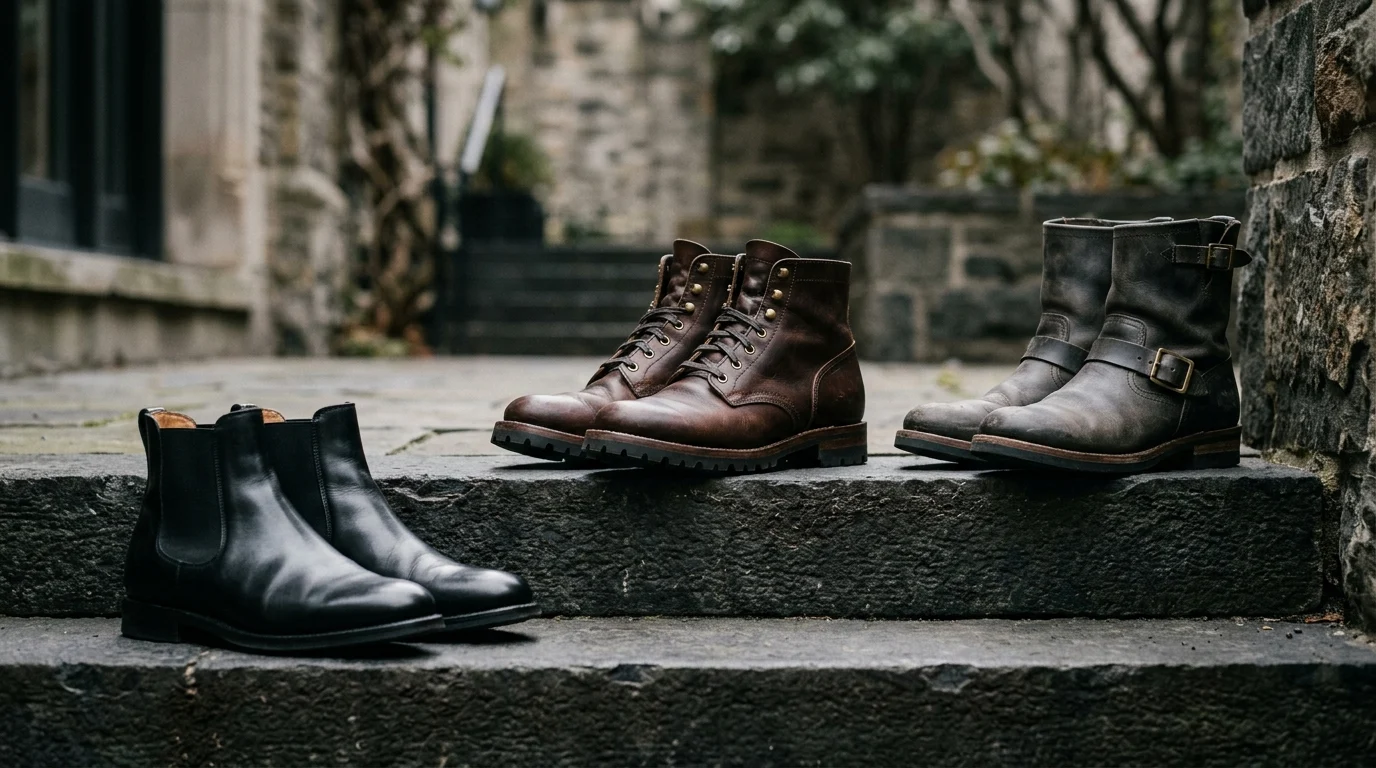
Chelsea vs Combat vs Biker Leather Boots Which Wins
Chelsea vs combat vs biker leather boots compared by construction, sole welt, ankle support, break-in time, and matching outerwear silhouettes.
Choosing between Chelsea, combat, and biker leather boots determines how your entire cold-weather wardrobe hangs from the ankle up. Each boot silhouette brings radically different closure mechanics, sole traction, dress-code range, and visual weight beneath leather outerwear. Comparing construction anatomy, welt longevity, break-in curves, and outerwear pairing rules reveals exactly which boot deserves your first investment.
Key Takeaways
- Chelsea boots win for daily versatility: Sleek elastic side gussets transition smoothly from tailored wool trousers and office blazers to weekend selvedge denim.
- Combat boots win for winter traction and ankle support: Speed-hook lacing and deep commando lug soles lock down ankles across wet pavement, snow, and rugged terrain.
- Biker boots win for heavy-duty protection and Americana edge: Pull-on shafts, brass harness straps, and oil-resistant soles anchor heavy cowhide riding jackets effortlessly.
- Sole construction controls lifespan: Goodyear-welted boots support three to five full resoles over a decade, whereas glued cemented soles split permanently once worn down.
- Pair boot weight with jacket weight: Slim Chelsea lasts complement clean cafe racers, while chunky biker and combat soles balance heavy men's biker and moto jackets.
Chelsea vs Combat vs Biker Leather Boots Which Silhouette Fits Your Lifestyle?
Chelsea boots deliver peak dress-to-casual versatility, combat boots provide superior inclement-weather grip and ankle stability, and biker boots command rugged motorcycle and streetwear wardrobes. Selecting the right silhouette starts with evaluating where you walk daily, how often you dress up for work or evening dinners, and which outerwear weight anchors your closet.
Many buyers pick boots purely from product photos without considering how closure hardware and sole thickness dictate comfort after six hours on pavement. A slim Chelsea profile disappears neatly beneath tailored trouser hems, whereas an engineer or harness biker boot forces wide trouser cuffs and visually dominates minimalist outfits.
Before exploring our men's leather boots catalog, match your weekly routine against each boot's core engineering strengths. One silhouette handles boardrooms and date nights seamlessly, another conquers slushy commutes, and the third outlasts highway wind and asphalt wear.
Understanding Last Shapes and Visual Proportions
Every leather boot sits on a wooden or composite foot mold called a last, which dictates toe taper, arch support, and instep height. Chelsea boots typically rely on sleek almond or soft chiseled lasts that extend the visual line of tailored trousers without adding bulk at the ankle. Combat boots shift onto wider round-toe anatomical lasts engineered to leave space for thick wool socks and natural toe splay during ten-mile city treks.
Biker and engineer boots sit on high-volume work lasts with reinforced toe boxes and elevated heel stacks built to lock securely against motorcycle footpegs. Understanding these three distinct last geometries keeps you from buying an aggressive chunky silhouette when your closet relies on slim tailored suiting.
Shoemaker's Proportion Rule: Match the visual thickness of your boot sole to the weight of your jacket; delicate flat dress soles look spindly under heavyweight cowhide, while chunky lugged soles anchor bold outerwear.
What Makes Chelsea Leather Boots the Most Versatile Men's Style?
Chelsea boots earn their reputation as the ultimate all-rounder through a laceless ankle-height profile defined by twin elastic side gussets and a rear pull tab. Originally crafted in Victorian London as quick slip-on walking and riding footwear, modern Chelsea boots bridge tailored business-casual dressing and relaxed weekend denim better than any other boot design.
Anatomy, Shaft Height, and Instep Fit
Traditional Chelsea boots rise 5.5 to 6.5 inches from heel welt to ankle collar. Because two panels of elastic gore replace laces and eyelets, you cannot tighten or loosen the vamp across your instep after purchase. Getting instep clearance right on day one makes the difference between effortless slip-on comfort and pinched circulation across the top of your foot.
Men with high insteps should inspect the waist curve and use a long brass or horn shoehorn every morning so the rear heel counter never collapses. Over time, elastic side panels stretch slightly, so a brand-new Chelsea boot should feel comfortably snug across the midfoot without pinching your toes.
Smooth Leather vs. Suede Chelsea Finishes
Smooth calfskin or full-grain cowhide in jet black and dark espresso turns a Chelsea boot into a legitimate dress-shoe substitute. Pair sleek black Chelsea boots with dark charcoal flannel trousers and a tailored blazer for client meetings or evening events.
Soft suede Chelsea boots in warm tobacco, sand, or chocolate brown soften the silhouette for smart-casual weekends. Wear suede Chelseas with slim indigo jeans, an oxford shirt, and classic men's leather jackets for clean European proportions. Remember to apply water-repellent spray before stepping out in suede during rainy autumn commutes.
Why Do Combat Boots Dominate Streetwear and Harsh Weather?
Combat boots dominate utilitarian streetwear and winter weather through full lace-up ankle lockdown, bellows tongues, and deep lugged rubber outsoles. Descended directly from mid-century military paratrooper jump boots, modern civilian combat boots combine protective calf height with aggressive commando treads that grip slick cobblestones, gravel, and winter slush.
Lace-Up Support and Speed-Hook Mechanics
Standing roughly 7 to 8 inches tall, combat boots wrap higher around the lower shin than Chelsea silhouettes. Quality pairs combine lower brass eyelets across the vamp with three to four upper speed hooks so you can unlace and step out in ten seconds flat.
Unlike fixed elastic gussets, full lacing lets you dial in customized tension across narrow heels, wide forefeet, or thick wool boot socks. That adjustability makes combat boots ideal for twelve-hour city walking days and winter travel when foot volume swells slightly between morning and night.
Commando Lug Soles and Streetwear Layering
Combat boots anchor casual layered outfits where sleek dress boots look overly precious. Thick commando or Vibram-style lugged soles lift the leather upper half an inch above standing street puddles while absorbing concrete shock through every stride.
Style black pebbled or distressed combat boots with straight-leg selvedge denim, heavyweight hoodies, and men's bomber and flight jackets for balanced athletic volume. Avoid tucking skinny stretch jeans awkwardly into wide combat shafts; instead, let straight-leg cuffs stack lightly or take a single clean turn-up just above the third speed hook.
When Should You Choose Biker or Harness Leather Boots Over Combat Boots?
Choose biker or harness boots when you prioritize motorcycle riding protection, thick pull-on leather shafts, oil-resistant traction, and unmistakable Americana presence. Built originally to shield riders' ankles from scorching exhaust pipes, flying road gravel, and bike weight, authentic biker boots feature zero laces that could catch on footpegs or shift levers.
Engineer vs. Harness Boot Hardware
Two classic silhouettes dominate our biker boots lineup:
- Engineer boots: Born for steam-locomotive firemen before riders adopted them, engineer boots feature a tall 9-to-11-inch pull-on shaft, a curved instep strap with a heavy roller buckle, and a protective toe box.
- Harness boots: Defined by four metal-ring ankle straps encircling the heel and instep, harness boots pair squared or rounded toes with chunky stacked heels and heavy oil-tanned cowhide uppers.
Because pull-on biker shafts lack laces, proper heel-slip tolerance matters enormously during break-in. Expect roughly a quarter to half an inch of initial heel lift on brand-new thick leather soles until the stacked midsole bends naturally with your forefoot stride.
Styling Heavyweight Biker Boots With Outerwear
Biker boots refuse to play a quiet supporting role. Their wide shafts, prominent brass or nickel buckles, and thick rubber soles overwhelm tailored dress slacks or lightweight linen shirts immediately.
Instead, pair distressed black or dark brown biker boots with heavyweight raw denim (hem opening at least 8 to 8.5 inches so denim drapes cleanly over the boot collar), a crisp heavyweight tee, and men's leather jackets in structured cowhide. For complete visual harmony across heavy outerwear and footwear, explore our dedicated guide on how to style biker boots with leather outerwear.
Table 1: Chelsea vs Combat vs Biker Boots Silhouette & Style Matrix
| Boot Feature | Chelsea Boots | Combat Boots | Biker / Harness Boots |
|---|---|---|---|
| Closure System | Slip-on elastic side gussets | Lace-up eyelets & speed hooks | Pull-on shaft with buckle straps |
| Typical Shaft Height | 5.5–6.5 inches (low ankle) | 7–8 inches (mid-high ankle) | 9–11 inches (mid-calf riding guard) |
| Standard Outsole | Slim leather or low-profile rubber | Deep commando / lugged rubber | Thick oil-resistant stacked lug sole |
| Recommended Trouser Leg Opening | 7–7.5 inches (slim to tailored) | 7.5–8 inches (straight leg or cuffed) | 8–8.5 inches (straight or bootcut) |
| Formality Spectrum | Smart-casual to business-casual | Casual streetwear & utility | Strictly casual, rugged & riding |
| Ideal Jacket Pairing | Blazers, cafe racers & men's leather coats | Flight bombers & distressed field cuts | Double riders & vintage leather jackets |
| Average Break-In Window | 5–10 hours of wear | 10–20 hours of wear | 20–30+ hours of wear |
How Does Boot Sole Construction Affect Longevity and Comfort?
Boot sole construction determines whether your leather boots last two seasons in a landfill or fifteen years through repeated resoles. Goodyear welt, Blake stitch, and cemented gluing look almost identical from ten feet away, yet their internal engineering dictates waterproofing, underfoot breathability, cobbler repairability, and lifetime cost per wear.
Goodyear Welt (360° vs. 270°)
A Goodyear welt stitches a thick strip of leather (the welt) simultaneously to the upper leather and a canvas rib underneath the insole, then locks that welt directly to the outer sole via a separate heavy lockstitch. Because no nails or direct punctures shoot straight through the footbed into your socks, Goodyear-welted boots keep water out and accept three to five complete outsole replacements over their lifespan.
Beneath your foot, Goodyear welted boots trap a layer of granulated natural cork between the insole and outsole. Over your first month of walking, body heat and weight compress that cork bed into an exact anatomical footprint unique to your arches. Storm-welted 360-degree variants turn the welt edge upward against the upper to form a tight weather barrier ideal for combat and biker boots.
Blake Stitch Construction
A Blake stitch runs a single vertical seam straight through the outsole, leather upper, and insole inside the shoe cavity. Removing the outer welt strip lets shoemakers trim the sole edges razor-close to the upper, giving sleek dress Chelsea boots a streamlined, lightweight profile that feels flexible straight out of the box.
The tradeoff arrives during rainstorms and cobbler visits. Because vertical stitch channels pierce straight into the footbed, moisture can wick upward during wet commutes, and cobblers need specialized Blake-arm sewing machines to resole the boot cleanly.
Cemented (Glued) Soles
Fast-fashion department store boots simply wrap uppers around cheap fiberboard insoles and glue synthetic soles underneath with industrial adhesive. Cemented boots cost less upfront and feel soft immediately, yet once the tread wears flat or adhesive dries out, cobblers cannot restitch them reliably. Investing once in stitched footwear across our men's leather shoes and boots collection saves years of replacement spending.
Outsole Compounds: Leather vs. Studded Dainite vs. Commando Lug
Outsole material matters just as much as the welt stitching underneath your arches. Smooth leather outsoles look sharpest under formal charcoal suits and dry-weather Chelsea boots, offering effortless glide on hardwood floors while wearing down faster on wet asphalt. Adding thin rubber half-soles (often called Topy protectors) shields leather bottoms without altering the sleek side profile.
Studded rubber Dainite-style soles bridge the gap between dress refinement and rainy street grip. Their recessed rubber studs grip wet marble and subway stairs cleanly while maintaining a flat, razor-thin edge profile suitable for business casual offices. Deep commando lug outsoles deliver maximum snow traction, mud clearance, and underfoot cushioning on rugged combat boots and heavy harness styles.
What Leather Grades Should You Look for When Buying Men's Boots and Matching Jackets?
Full-grain leather ranks at the top for both boots and matching outerwear because it retains the hide's dense outer fiber layer, resisting cracking, scuffs, and moisture penetration. Avoid "genuine leather" stamps on bargain boots—that grade often denotes sanded split hides coated in thin plastic polyurethane that peels cleanly off at the toe flex crease within six months.
Inspecting hide thickness across your boots and leather outerwear ensures cohesive aging and patina. Heavyweight full-grain cowhide measuring 1.1–1.4mm handles harsh abrasion on road-ready biker boots and structured rider jackets. Supple full-grain goatskin (0.8–1.0mm) delivers natural pebble texture and impressive tear strength, while ultra-soft lambskin (0.9–1.2mm) elevates tailored jackets worn over sleek Chelsea silhouettes.
When coordinating tones between boots and outerwear, follow our practical men's leather jacket color combinations guide so espresso, cognac, and black leathers harmonize without matching stiffly like a uniform. Pairing textured dark brown combat boots with a deep olive or matte black jacket creates effortless depth.
Table 2: Leather Material, Craftsmanship & Outerwear Pairing Matrix (Lux Wearz Standards)
| Leather / Outerwear Tier | Hide Thickness | Hardware & Stitching | Interior Lining | Price Range (USD) | Production Lead Time | Warranty & Returns |
|---|---|---|---|---|---|---|
| Entry Genuine Leather Jacket | 1.1–1.4mm (Cowhide) | Hand-stitched seams | Polyester satin lining | USD 149–249 | 3–5 business days | 1-year craftsmanship warranty; 30-day returns |
| Premium Full-Grain Cowhide | 1.1–1.4mm | YKK brass zippers; hand-stitched seams | Polyester satin lining | USD 249–399 | 3–5 business days | 1-year craftsmanship warranty; 30-day returns |
| Premium Full-Grain Lambskin | 0.9–1.2mm | YKK brass zippers; hand-stitched seams | Polyester satin lining | USD 249–399 | 3–5 business days | 1-year craftsmanship warranty; 30-day returns |
| Premium Full-Grain Goatskin | 0.8–1.0mm | YKK brass zippers; hand-stitched seams | Polyester satin lining | USD 249–399 | 3–5 business days | 1-year craftsmanship warranty; 30-day returns |
| Custom Made-to-Order Jacket | Choice of 0.8–1.4mm hides | YKK brass zippers; hand-stitched seams | Polyester satin lining | USD 299–499 | 7–14 business days | 1-year craftsmanship warranty; free video fit consult |
| Shearling & Aviator Jacket | Heavyweight hide (fleece-backed) | YKK brass zippers; hand-stitched seams | Genuine shearling lining | USD 349–599 | 3–5 business days | 1-year craftsmanship warranty; 30-day returns |
How Should Men's Leather Boots Fit and Break In Without Blisters?
Men's leather boots should lock your heel snugly against the back counter while leaving roughly half an inch of wiggle room ahead of your longest toe. Buying boots tight across the toe box expecting length stretch always ends in bruised toenails—leather expands slightly side-to-side across the ball of your foot, never lengthwise against rigid steel shanks and toe puffs.
Follow these three fitting rules regardless of boot silhouette:
- Test late in the afternoon: Human feet swell up to half a size after walking all day, so evening fittings prevent cramped midday toes.
- Wear your real boot socks: Try on combat and biker boots wearing medium-weight merino wool socks rather than thin athletic dress socks.
- Verify the flex point: Bend onto the balls of your feet and confirm the boot creases squarely across the widest part of the vamp, never digging backward into your toe knuckles.
Smart Break-In Protocol for Heavy Cowhide Shafts
Rush through breaking in thick cowhide biker or combat boots and your ankles pay the price. Instead of wearing stiff new boots on a five-mile weekend hike, wear them indoors over thick wool socks for 90-minute evening sessions across four days. Body warmth softens natural waxes inside full-grain leather so flex creases form gently along your ankle anatomy.
Apply a light coat of natural conditioning balm exclusively to stiff ankle bend points if cowhide resists flexing after week one. Always insert unvarnished aromatic cedar shoe trees immediately after pulling boots off—cedar pulls acidic foot moisture out of leather linings overnight and prevents deep vamp cracks from collapsing inward. For complete seasonal conditioning advice across boots and jackets, review our leather care guide and check exact measurement tables in our size and fit guide.
How to Pair Leather Boots With Men's Jackets for Cohesive Outfits
Pairing leather boots with outerwear successfully relies on matching formality levels, coordinating trouser cuffs, and balancing cold-weather textures. Combining rugged wool flannel, crisp heavyweight cotton, and full-grain leather creates visual richness that prevents all-black or all-brown ensembles from falling flat. Take cues from our leather and wool wardrobe combinations whenever winter temperatures drop.
Use these three fail-safe outfit formulas right out of the box:
- The Smart-Casual Chelsea Formula: Black polished calfskin Chelsea boots, slim charcoal wool-blend trousers, a cream merino turtleneck, and a fitted espresso lambskin cafe racer.
- The Urban Utility Combat Formula: Dark chocolate lace-up combat boots, straight-leg indigo selvedge denim cuffed once, a heather grey mid-weight hoodie, and a black cowhide flight bomber.
- The Heritage Biker Formula: Distressed black harness biker boots, heavyweight black straight-cut jeans resting cleanly over the shaft, a white heavyweight crewneck tee, and an asymmetric double-rider jacket.
Building a complete head-to-toe leather wardrobe? Explore our handcrafted leather goods with complimentary shipping across the USA and a 30-day hassle-free return policy.
Want bespoke outerwear proportioned to your exact height and layering style? Design yours with our custom order service, backed by a free video sizing consultation.
Which Leather Boot Should You Buy First?
Buy Chelsea boots first if you prioritize effortless work-to-weekend versatility, combat boots first for rugged four-season traction, or biker boots first for motorcycle riding and bold heritage style. Most well-rounded men's wardrobes eventually house two distinct pairs—one sleek Chelsea for smart dinners and one heavy lugged combat or biker boot for inclement weather and heavy leather jackets.
Evaluate your three most frequent weekly outfits before clicking checkout:
- Pick Chelsea Boots if: You wear chinos, wool trousers, or slim jeans five days a week and value slip-on convenience over heavy treads.
- Pick Combat Boots if: You walk miles on wet city sidewalks, wear straight-leg denim and layered flannels, and want custom lace-up ankle support.
- Pick Biker Boots if: You ride a motorcycle, love rugged heritage workwear, and want heavy buckle hardware that outlasts decades of hard wear.
Every Lux Wearz order ships worldwide with free delivery across the USA and a 1-year craftsmanship warranty so you can step into authentic full-grain leather with zero guesswork.
How to Rotate, Store, and Maintain Men's Leather Boots Year-Round
Rotating leather boots every other day and storing them with raw cedar shoe trees doubles upper lifespan by letting absorbed perspiration evaporate completely. Wearing the exact same pair seven days straight saturates vegetable-tanned insoles and weakens internal stitching over time. Giving full-grain hides twenty-four hours to rest between outings preserves both ankle structure and lining freshness.
Follow a simple three-step seasonal routine for lasting patina:
- Weekly horsehair brushing: Thirty seconds with a soft horsehair brush sweeps abrasive sidewalk grit out of welt creases before dust grinds into the leather flex points.
- Quarterly cream conditioning: Massage a dime-sized amount of natural beeswax cream across smooth cowhide or calfskin uppers every ninety days so creases stay supple rather than cracking.
- Salt stain neutralization: Wipe winter road salt rings off immediately with a cloth lightly dampened in equal parts cool water and white vinegar, then let boots dry away from radiators or heat vents.
Explore The Full 2026 Leather Outerwear Collection
Vegetable-tanned full-grain cowhide, buttery New Zealand lambskin, and heritage Melton wool. Free express delivery across the USA with 30-day hassle-free returns.