
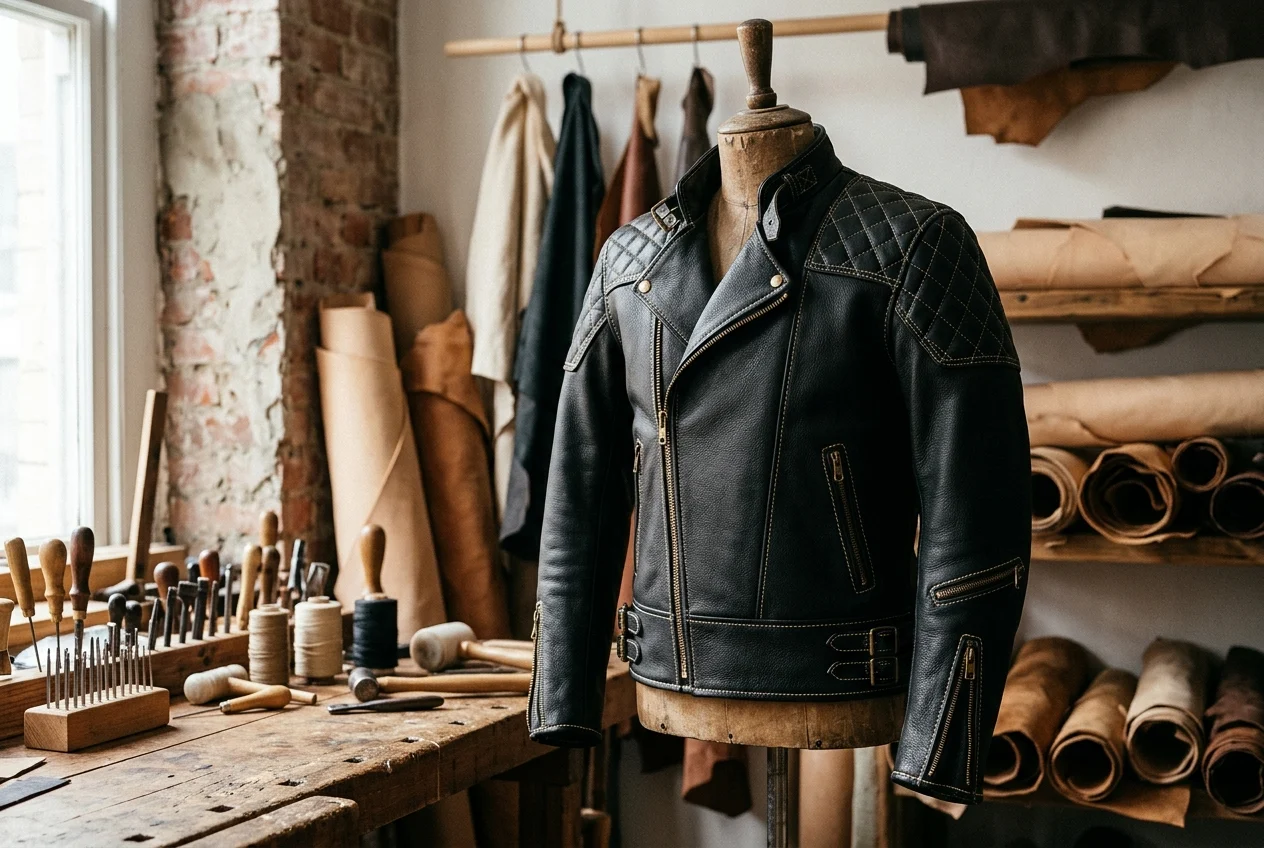
Alpinestars Leather Jackets: Archival Silhouettes, Quilted Craftsmanship, and Sizing Architecture Guide
Explore Alpinestars leather jackets: archival silhouettes, quilted shoulder craft, hide metallurgy, and sizing architecture. Compare vintage vs bespoke cuts.
Alpinestars Leather Jackets: Archival Silhouettes, Quilted Craftsmanship, and Sizing Architecture Guide
Key Takeaways & Archival Leathercraft Principles
- Anatomical Pre-Curve Architecture: Italian motorcycle riding jackets are engineered around the aggressive forward tuck of a rider, featuring rotated shoulder joints, forward-canted sleeves, and high armscyes that can feel restrictive when standing upright.
- Tight Chest Ease Tolerance: Unlike American casual outerwear which incorporates generous positive ease, European road and track cuts permit only +1 to +2 inches over true body measurements, requiring precise chest and shoulder calibration.
- Quilted Padded Reinforcement: Archival quilted leather shoulders integrate dual-density impact dampening behind 1.2mm drum-dyed bovine hides, serving both high-abrasion safety needs and timeless cafe racer aesthetics.
- Grain Metallurgy & Tannage: Race-spec 1.3mm bovine hide prioritizes tensile resistance and abrasion defense over immediate softness, requiring structured break-in cycles or bespoke hand-milled hide alternatives.
- Bespoke Tailoring Precision: Discerning riders and collectors frequently commission made-to-measure bespoke jackets to achieve archival European race styling with customized chest ease and personalized sleeve lengths.
Artisan Independence & Trademark Notice: Lux Wearz is an independent bespoke leathercraft atelier. All brand names, logos, and trademarks mentioned in this article (including Alpinestars® and related trademarks) belong exclusively to their respective trademark holders. Lux Wearz is not an authorized distributor, licensee, or affiliated partner of these brands. All brand references and historical retrospectives are made strictly for educational, comparative, and sizing review purposes under Fair Use. Lux Wearz specializes in custom-tailored, heirloom-grade genuine leather outerwear handcrafted individually in our private workshop.
How Does Alpinestars Leather Jacket Sizing and Architecture Function?
Alpinestars leather jackets feature an aggressive European anatomical taper engineered with a pre-curved sleeve architecture and high armscyes designed primarily for riding posture. Because track and street silhouettes provide minimal chest ease (+1 to +2 inches) compared to casual outerwear, sizing up by one standard size is recommended for street comfort, while bespoke tailoring delivers perfect proportions without mobility restrictions.
Understanding the engineering principles behind Italian motorsport outerwear transforms how you evaluate, wear, and maintain high-performance leather jackets. While mainstream casual fashion treats a leather jacket merely as a stylistic layer, the heritage of Italian racing apparel is rooted in absolute biomechanical protection, high-velocity abrasion resistance, and ergonomic precision. Every curve of the sleeve, every diamond-quilted seam on the shoulder, and every choice of bovine hide thickness is calculated to withstand extreme physical forces while maintaining complete structural integrity.
Whether you are evaluating iconic racing suits from World Championship circuits, hunting for archival cafe racer silhouettes like the legendary Revern or Maver-X, or deciding whether to commission an artisanal bespoke alternative tailored specifically to your physique, this comprehensive guide deconstructs every dimension of sizing architecture, quilted construction, hide metallurgy, and collector economics.
The Alpine Heritage: From Asolo Craftsmen to Grand Prix Podiums
The lineage of modern technical motorcycle outerwear was largely forged in the foothills of the Italian Alps. Founded in 1963 by master craftsman Sante Mazzarolo in the town of Asolo, Veneto, Alpinestars took its name from the resilient mountain flower Stella Alpina (Edelweiss). Mazzarolo began by revolutionizing motocross footwear, creating the world’s first protective steel-shinned riding boot that quickly became the global benchmark for off-road champions.
By the 1970s and 1980s, the company translated its mastery of protective leathercraft into road racing suits and high-speed leather jackets. As Grand Prix racing evolved into the 500cc two-stroke golden era—commanded by legends like Kenny Roberts, Mick Doohan, and Randy Mamola—the physical demands placed on leather jackets increased exponentially. At velocities exceeding 180 miles per hour, standard commercial cowhide tore instantly upon contact with coarse asphalt. Mazzarolo’s atelier pioneered advanced chrome-tanned bovine leathers, engineered rotational sleeve joints, and developed internal kinetic impact zones that laid the technical groundwork for every modern motorcycle jacket produced today.
Over subsequent decades, this competition heritage expanded beyond the racetrack into elite street culture. Archival designs began incorporating heritage styling elements: hand-quilted diamond shoulder insets, clean cafe racer mandarin collars, antiqued metal hardware, and distressed drum-dyed leather finishes. These garments bridged the divide between uncompromising track safety and sophisticated, rugged urban style.
However, because these garments trace their DNA directly to Grand Prix circuits, their internal architecture follows strict biomechanical parameters that can perplex casual outerwear enthusiasts who are accustomed to relaxed-fit street jackets.
Deconstructing the Ergonomic Cut: Sizing Physics and Biomechanical Drape
When a rider climbs onto a modern sportbike, the body assumes an aggressive crouch: the spine arches forward, the pelvis rotates, the elbows bend outward at a forty-five-degree angle, and the wrists extend toward low clip-on handlebars. If a leather jacket were cut like a traditional business suit or casual bomber, this riding posture would cause the lower back of the jacket to ride up several inches, the front zipper to bunch into a bulky bulge, and the shoulders to pull painfully across the upper back.
To solve this biomechanical challenge, Italian racing outerwear is cut with what master patternmakers call pre-curved anatomical architecture:
- The Rotated Armscye: The armhole (armscye) is rotated forward by fifteen to twenty-five degrees. When you let your arms hang relaxed at your sides in a neutral standing posture, the leather around the front chest and armpit will naturally fold and bunch slightly. Conversely, the moment you reach forward into a riding position or driving stance, the leather pulls taut, creating a flawless, wrinkle-free aerodynamic surface.
- The Aggressive European Drop: Standard American garments feature a modest chest-to-waist drop of four to six inches. European sport jackets, by contrast, feature an aggressive drop of seven to ten inches. A jacket with a 42-inch chest will taper down to a trim 32-to-34-inch waist circumference.
- High-Set Armpits: To prevent the jacket from shifting upward when the arms are elevated, the armhole is positioned extremely close to the axilla (armpit). While this enhances mobility on a motorcycle, wearers with muscular or broad upper arms often perceive this as uncomfortably tight when trying on off-the-rack garments.
| Silhouette Model | Cut & Fit Type | Shoulder / Chest Offset | Ideal Body Profile | Leather Weight & Temper |
|---|---|---|---|---|
| Professional 1-Piece Race Suit (e.g. GP Tech / GP Force) | Aggressive Pre-Curved Race Fit | +0 to +1 inch over true chest (Skin-Tight) | Athletic / Lean Racing Ergonomics | 1.3–1.4mm Full-Grain Race-Grade Bovine Hide, Firm Armor Temper |
| Urban Heritage Cafe Racer (e.g. Revern / Maver-X) | Semi-Sport European Slim Fit | +1.5 to +2.5 inches over true chest | Medium / Athletic Torso | 1.1–1.3mm Drum-Dyed Bovine Leather, Supple-to-Medium Temper |
| Perforated Airflow Sport Jacket (e.g. Dusk Airflow) | Articulated Road Riding Fit | +2 inches over true chest | Standard Athletic Build | 1.2–1.3mm Perforated Full-Grain Cowhide, Firm Protective Temper |
| Stella Ergonomic Women's Silhouette | Tailored Hourglass Curved Fit | +1 to +2 inches over true chest | Feminine Curved Ergonomics | 1.0–1.2mm Supple Nappa Cowhide, Soft-to-Medium Temper |
| Bespoke Atelier Custom Riding Outerwear | Handcrafted Made-to-Measure Cut | Custom-Calibrated to Stance | Universal Personalized Fit | 1.2–1.4mm Premium Full-Grain Cowhide, Hand-Conditioned Temper |
This architectural divergence explains why standard sizing charts frequently mislead buyers. A gentleman who comfortably wears a Size 40 regular in a casual jacket often requires an Italian Euro 52 (US 42) or even Euro 54 in a race-cut leather jacket to accommodate his chest and shoulder breadth.
For comprehensive sizing conversions and body measuring instructions, refer to our Lux Wearz Sizing Guide.
Leather Hide Metallurgy and Hardware Durability Matrix
The durability of track-grade leather outerwear depends on a precise balance of hide grain density, tannage chemistry, and high-tensile hardware engineering. Motorcycle outerwear is subjected to friction, wind blast, UV radiation, and severe tensile loads that would shred standard consumer fashion garments in seconds.
| Component / Hide | Leather Grade & Tannage | Thickness (mm) | Weather Resistance | Expected Longevity | Maintenance Needs |
|---|---|---|---|---|---|
| Race-Spec Full-Grain Bovine Hide | Chrome-Tanned Drum-Dyed Cowhide | 1.3 – 1.4 mm | High (Surface Sealed for High Abrasion) | 25+ Years with Proper Conditioning | Bi-Annual Specialized Hide Feeder & Degreaser |
| Diamond-Quilted Ergonomic Shoulder Panels | High-Density Padded Leather Insets | 1.2 mm Leather + 6mm Memory Foam | High Impact & Weather Resistance | 20+ Years | Regular Cleaning of Quilt Seams with Soft Horsehair Brush |
| Semi-Auto Lock Heavy Metal Zippers | Cast YKK Heavy-Duty Metal Hardware (#8/#10) | Solid Metallurgical Alloy | High (Vibration & Slip Resistant) | 30+ Years | Semi-Annual Graphite or Silicone Lubrication |
| High-Tenacity Aramidic Seam Thread | Kevlar-Reinforced Bonded Polyamide | 0.38 mm Structural Gauge | Extreme (High Melting Point & Tensile Strength) | 30+ Years | Inspect High-Wear Stress Points After Heavy Use |
| 3D Spacer Mesh Thermal & Breathable Liner | Engineered Technical Moisture-Wicking Poly | 3.0 mm Multi-Layer Spacer | High Quick-Dry Performance | 10–12 Years Active Riding | Removable Hand Wash in Cold Mild Detergent |
The standard hide thickness for high-abrasion zones is 1.3mm to 1.4mm. While fashion garments frequently use split cowhide or wafer-thin 0.7mm lambskin to maximize immediate softness, genuine track-grade outerwear relies exclusively on full-grain bovine hide. Full-grain leather retains the outermost layer of the animal's epidermis, where the collagen fibers are most densely interwoven. This dense fiber matrix provides the exceptional puncture resistance and thermal friction barrier required to survive high-speed asphalt slides.
To keep these dense collagen fibers from stiffening over time, regular maintenance with pH-neutral leather conditioners is mandatory. Consult our master Leather Care Guide for professional cleaning schedules.
The Art of Quilted Shoulder Craftsmanship
One of the most celebrated design hallmarks in archival leather outerwear is the integration of diamond-quilted or channel-quilted shoulder and elbow yokes. While frequently admired today for its vintage cafe racer aesthetic, quilting originally served a critical protective and structural function.
Anatomical Padding and Impact Dissipation
In traditional leathercraft, quilting is not merely decorative surface stitching. It involves sandwiching a shock-absorbing substrate—typically high-density 5mm to 8mm open-cell memory foam or compressed wool felt—between the heavy outer cowhide and an internal tear-resistant scrim.
- Micro-Deflection: When subjected to direct blunt impact or gravel abrasion, the quilted diamond segments allow the leather to compress independently, dissipating kinetic energy across hundreds of individual stitched geometric cells rather than transferring the shock directly into the clavicle or acromion bone.
- Structural Reinforcement: The repetitive criss-cross pattern of bonded nylon stitching locks the hide fibers into a rigid grid. Even if an asphalt slide tears through one section of the quilt, the surrounding lockstitch seams prevent the tear from propagating across the shoulder panel.
The Tailoring Challenge of Leather Quilting
Executing flawless quilted leather requires extraordinary artisan precision. Unlike woven fabrics that stretch uniformly, genuine cowhide exhibits directional stretch depending on the orientation of the hide grain. A master leather craftsman must hand-tension each panel before feeding it into a heavy-gauge walking-foot sewing machine. If the tension is off by a fraction of a millimeter, the leather will pucker along the stitch line, ruining the garment's symmetrical shoulder drape.
In our bespoke atelier, every quilted panel is hand-marked, hand-cut, and meticulously saddle-stitched to ensure perfectly uniform diamond geometry that aligns seamlessly with the sleeve cap and back yoke.
Curated Collection Spotlight: Analyzing 5 High-Performance Silhouettes
To observe how these technical design principles manifest in real garments, let us examine five distinct outerwear and riding models featured in the curated Lux Wearz Catalog.
1. High-Velocity Climate Control: Alpinestars Dusk Airflow Leather Jacket
The Alpinestars Dusk Airflow Leather Jacket tackles the perennial dilemma of the warm-weather rider: how to achieve genuine leather abrasion protection without succumbing to heat exhaustion.
Engineered with localized high-density pinhole perforations across the main chest panels and inner bicep zones, the Alpinestars Dusk Airflow Leather Jacket directs massive airflow through the garment while leaving the high-impact shoulder caps and outer forearm zones in solid, unperforated 1.3mm bovine hide:
- Structural Integrity: The laser perforations are calibrated to preserve 85% of the hide’s continuous tensile strength, preventing seam tear-out under slide loads.
- Airflow Channeling: Paired with an internal 3D spacer mesh lining, the jacket maintains a circulating micro-climate between the rider’s skin and the heated leather outer shell.
- Styling Versatility: Its clean monochrome dark aesthetic transitions effortlessly from highway touring to urban evening settings when paired with dark raw denim and rugged boots.
2. The Apex of MotoGP Technology: Alpinestars GP Tech V4 Leather Suit
Representing the absolute pinnacle of competition racing gear, the Alpinestars GP Tech V4 Leather Suit is engineered for elite track performance. This is the direct commercial descendent of suits worn by World Championship riders.
The Alpinestars GP Tech V4 Leather Suit incorporates space-age materials alongside full-grain leather:
- Kangaroo & Bovine Hybrid Construction: Utilizing ultra-dense kangaroo hide across high-flex zones to reduce weight while reinforcing primary impact zones with 1.4mm bovine leather.
- Airbag System Integration: Engineered with dedicated expansion zones that accommodate the rapid millisecond deployment of internal autonomous electronic airbag vests without compressing the rider's ribcage.
- External Dual-Density Sliders: Dynamic Friction Shield (DFS) TPU shoulder and knee sliders reduce friction during ground contact, allowing the rider to slide smoothly rather than tumbling.
3. Track-Ready Road Protection: Alpinestars GP Force V2 Leather Suit
For dedicated track-day enthusiasts and spirited canyon carvers, the Alpinestars GP Force V2 Leather Suit offers exceptional track-grade engineering in a robust one-piece configuration.
Constructed from multi-panel premium 1.3mm bovine leather, the Alpinestars GP Force V2 Leather Suit features:
- Extensive Accordion Stretch Zones: Strategically located behind the shoulders, lower lumbar spine, and above the knees, heavy-duty leather accordion gussets allow up to four inches of elastic elongation during deep knee-down cornering.
- Reinforced Knee Construction: Multi-layer leather knee reinforcements paired with removable sport knee sliders ensure repeatable track reliability.
- Ergonomic Hump: An aerodynamic back hump smoothes airflow over the rider's helmet while providing spinal deflection protection in a high-speed fall.
4. Feminine Ergonomic Precision: Alpinestars Stella Maver-X Leather Jacket
Motorcycle outerwear has historically suffered from poorly adapted unisex patterning that ignored female physiology. The Alpinestars Stella Maver-X Leather Jacket represents a ground-up architectural reimagining tailored exclusively for female riders.
The Alpinestars Stella Maver-X Leather Jacket excels through sophisticated pattern geometry:
- Sculpted Hourglass Torso: The torso panels are drafted with parabolic side darts and an elevated hip flare that accommodates the female pelvis without bunching when seated.
- Contoured Chest Architecture: Specially articulated chest paneling provides dedicated contouring while seamlessly integrating low-profile CE-certified impact armor.
- Refined Leather Selection: Hand-selected 1.1mm supple nappa cowhide balances track-inspired abrasion resistance with immediate, supple out-of-the-box comfort.
5. Timeless Cafe Racer Heritage: Alpinestars Revern Leather Jacket
The Alpinestars Revern Leather Jacket is the definitive masterclass in heritage moto styling. Stripping away aggressive race graphics, the Revern celebrates pure leathercraft, understated detailing, and timeless road aesthetics.
Featuring exquisite quilted shoulder paneling and drum-dyed vintage bovine leather, the Alpinestars Revern Leather Jacket bridges two worlds:
- Stealth Protection: Ultra-thin, flexible Nucleon Flex Plus armor is concealed invisibly beneath the shoulders and elbows, preserving a clean, unarmored silhouette when you dismount the motorcycle.
- Vintage Finish: The leather hide undergoes a proprietary artisan tumbling and oil-wax finishing process that produces subtle tonal depth and accelerated patina along the seams.
- Everyday Urban Integration: Perfectly suited for daily streetwear when worn over a classic henley or fine knit sweater paired with tailored denim.
Explore the complete collection of riding gear and jackets in our Alpinestars Brand Catalog.
Pre-Owned Inspection Checklist: Evaluating Vintage Riding Gear
When considering pre-owned racing leathers or vintage motorcycle jackets on secondary marketplaces, the evaluation criteria must be far more rigorous than for standard fashion outerwear. A structural failure in a motorcycle jacket can lead to severe injury. Use this five-point forensic inspection protocol before finalizing any vintage purchase.
1. Slide Rash and Micro-Fissuring
The most critical defect on any pre-owned riding jacket is evidence of an undisclosed accident slide.
- Grain Melting: Asphalt friction generates intense localized heat (often exceeding 400 degrees Fahrenheit). If a section of leather appears glassy, hardened, or melted, the natural oils have been incinerated and the tensile strength of the hide has plummeted by over 70%.
- Structural Thinning: Run your fingers over any scuffed or abraded zones. If the leather feels paper-thin compared to adjacent panels, the protective grain layer has been ground away. A compromised slide panel cannot be restored and will burst upon secondary impact.
2. Thread Decomposition and Seam Burst Risk
Inspect every high-stress seam around the shoulders, elbows, and back yoke:
- Traditional nylon or polyester thread degrades when exposed to years of ultraviolet sunlight and road grime. Gently tug the leather panels sideways across a major seam. If you see white thread loops pulling free or if the stitch perforations gap open, the thread is rotting.
- Professional track gear relies on multi-row safety stitching where at least one row of thread is concealed inside the folded leather seam. If the external exposed stitches are shredded, inspect whether the internal safety seam remains intact.
3. Leather Hardening from Weather Cycling
Motorcycle jackets endure extreme weather exposure: soaking downpours followed by baking engine heat and wind blast.
- This continuous wet-and-dry cycle leaches natural tanning fats out of the hide, causing the leather fibers to cross-link and harden like rawhide. If the jacket stands stiffly on its own and crackles audibly when flexed, the leather requires intensive multi-stage re-hydration or is permanently compromised.
4. Armor Pocket Integrity and Delamination
Turn the jacket completely inside-out and inspect the armor pockets:
- The lightweight mesh or fabric envelopes that secure the elbow and shoulder protectors are subjected to constant friction. Check for ripped seams or torn velcro closures that would allow the protective armor cups to migrate out of position during a slide.
- Inspect any internal foam back protectors. Vintage polyurethane foam frequently degrades into a crumbly, yellow powdery dust that provides zero kinetic absorption.
5. Metal Zipper Pull and Track Wear
Motorcycle zippers endure intense wind vibration:
- Check the teeth of the main front zipper (typically a heavy-gauge YKK metal or molded plastic track). If individual teeth are bent, chipped, or loose on the fabric tape, the zipper can burst open at highway speeds.
- Verify that the zipper slider features a functioning semi-automatic lock that prevents the zipper from migrating downward when exposed to wind buffeting.
The Bespoke Advantage: Handcrafted Custom Leather Riding Outerwear
Navigating the off-the-rack market for high-performance leather jackets often forces enthusiasts into unacceptable compromises: a jacket that fits perfectly across the chest may have sleeves that are two inches too short, or an off-the-rack riding cut may feel constrictive and unwearable in casual daily life.
At Lux Wearz, we offer the definitive alternative: handcrafted bespoke made-to-measure leather jackets that combine the timeless aesthetic heritage of vintage Italian racing with personalized anatomical tailoring.
When you create a custom piece through the Lux Wearz Custom Order Portal, you experience true bespoke outerwear creation:
1. Ergonomic Patterning Tailored to Your Stance
Unlike mass-produced garments that utilize standardized sizing algorithms, our master cutters draft a unique paper pattern for your specific body architecture:
- Calibrated Stance Orientation: Tell us whether your jacket is intended for active sportbike riding (aggressive forward pre-curve), relaxed cruiser touring (upright neutral posture), or daily urban street style. We adjust the armscye rotation angle accordingly.
- Customized Sleeve and Torso Lengths: Never endure bunched leather around your forearms or an exposed lower back again. We build the exact sleeve length to align with your riding gloves and adjust the torso hem to sit precisely at your preferred belt line.
- Chest and Shoulder Precision: Enjoy unrestricted freedom of movement across your upper back and latissimus dorsi while preserving an elegant, fitted European taper down through the waist.
2. Hand-Selected Virgin Bovine and Lambskin Hides
We source exclusively from world-renowned tanneries adhering to strict environmental and artisanal tanning standards:
- Heavyweight 1.2mm to 1.4mm full-grain drum-dyed cowhide providing legendary abrasion resistance, deep natural pebble texture, and rich scent.
- Hand-milled full-grain lambskin options for clients seeking the archival cafe racer look with buttery softness and zero break-in period.
- Flawless virgin hides free from the chemical degradation, micro-tearing, and perspiration crystallization found in pre-owned gear.
3. Artisanal Hardware and Tailored Interiors
Personalize every functional component of your heirloom jacket:
- Forged antiqued brass, blackened matte steel, or high-polish chrome zippers engineered for lifetime durability.
- Hand-stitched diamond-quilted shoulder and elbow reinforcements with customizable padding density.
- Luxurious thermal satin, breathable technical mesh, or lightweight silk linings customized with internal leather-trimmed utility pockets.
Bring your vision of the ultimate bespoke leather jacket to life by visiting our Custom Tailoring Atelier.
Conclusion: Honoring the Heritage of High-Performance Leathercraft
From the historic workshops of northern Italy to the premier racing circuits of the world, high-performance leather outerwear represents the ultimate fusion of protective engineering, material metallurgy, and bold styling. Understanding how pre-curved sleeve architecture, quilted impact reinforcement, and full-grain hide density function allows you to appreciate these garments not merely as vintage collectibles, but as enduring masterworks of functional craftsmanship.
Whether you are investing in an archival road classic like the Alpinestars Dusk Airflow Leather Jacket or the heritage-inspired Alpinestars Revern Leather Jacket, or commissioning a personalized bespoke piece crafted from virgin cowhide at our Custom Order Atelier, you are choosing outerwear built to provide decades of style, protection, and unforgettable character.
Browse our complete catalog of handcrafted leather outerwear at the Lux Wearz Outerwear Collection.
For an in-depth breakdown of European chest-to-waist drop, pre-curved sleeve mechanics, and size conversion charts, read our comprehensive Alpinestars Leather Jackets Sizing, Fit Architecture, and Style Heritage Guide.
Explore The Full 2026 Leather Outerwear Collection
Vegetable-tanned full-grain cowhide, buttery New Zealand lambskin, and heritage Melton wool. Free express delivery across the USA with 30-day hassle-free returns.