
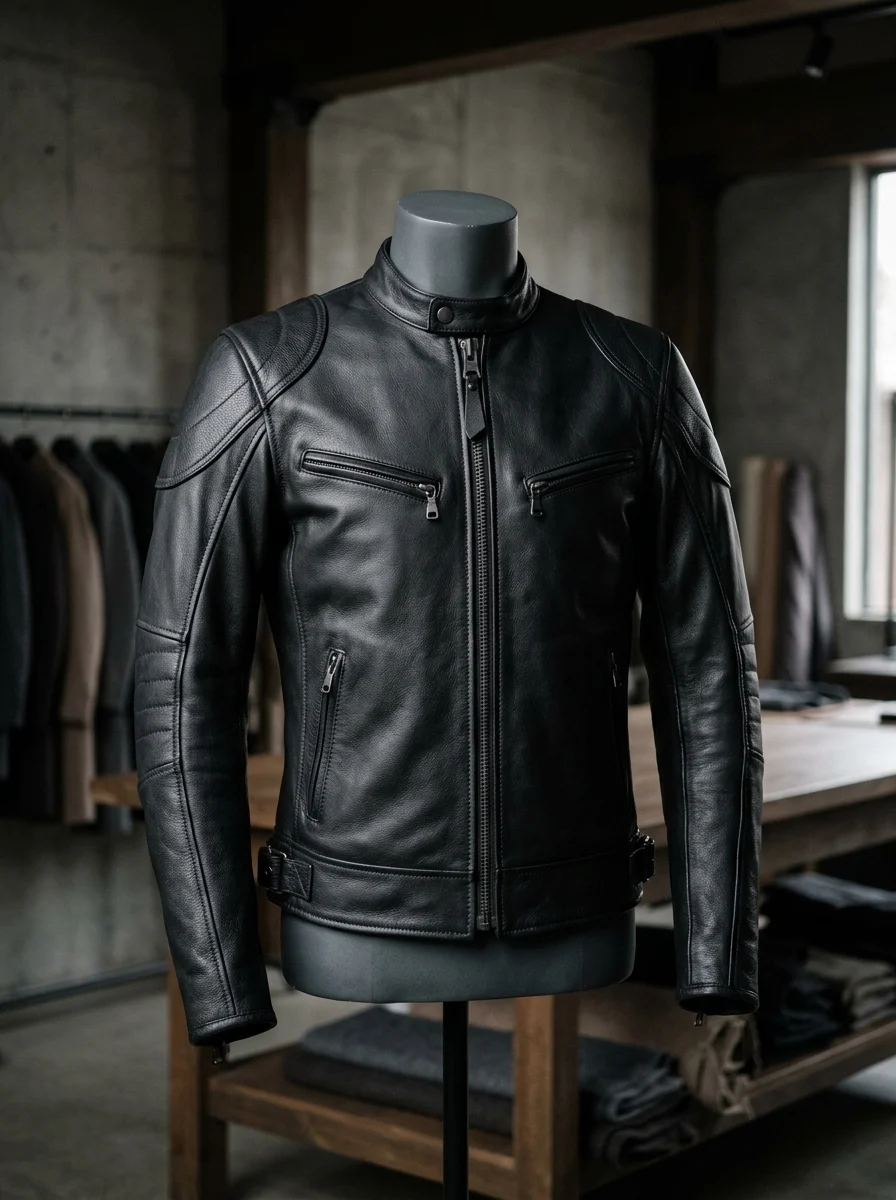
Alpinestars Leather Jackets Sizing, Fit Architecture, and Style Heritage Guide
Master Alpinestars leather jacket sizing and fit architecture. Learn European drop geometry, track vs street ease, race pre-curves, and bespoke alternatives.
Alpinestars Leather Jackets Sizing, Fit Architecture, and Style Heritage Guide
Key Takeaways
- Aggressive European Drop: Alpinestars performance leather jackets feature an aggressive athletic taper, typically providing a 4-to-6-inch waist drop relative to chest circumference that demands precise torso sizing.
- Ergonomic Pre-Curved Articulation: Race-fit sleeves are structurally rotated 25 to 35 degrees forward to alleviate forearm fatigue in a sportbike riding tuck, making the jacket feel snug and forward-biased when standing upright.
- 1.3mm Race-Grade Bovine Hide: Primary chassis construction utilizes 1.3mm premium full-grain bovine cowhide, offering superior tensile shear strength and abrasion resistance over lightweight fashion leather.
- Stella Women's Anatomical Patterning: The dedicated Stella line features independently sculpted bust-to-waist curves, narrowed shoulder yoke widths, and shortened torso profiles engineered specifically for female ergonomics.
- Bespoke Tailoring Alternatives: Riders with broad shoulders, athletic builds, or non-standard torso proportions often encounter off-the-rack sizing friction, making custom made-to-measure leathercraft the definitive solution for lifetime comfort.
Artisan Independence & Trademark Notice: Lux Wearz is an independent bespoke leathercraft atelier. All brand names, logos, and trademarks mentioned in this article (including Alpinestars® and related trademarks) belong exclusively to their respective trademark holders. Lux Wearz is not an authorized distributor, licensee, or affiliated partner of these brands. All brand references and historical retrospectives are made strictly for educational, comparative, and sizing review purposes under Fair Use. Lux Wearz specializes in custom-tailored, heirloom-grade genuine leather outerwear handcrafted individually in our private workshop.
How Do Alpinestars Leather Jackets Fit Across Chest, Shoulders, and Waist?
Alpinestars leather jackets fit with a distinct European athletic cut characterized by a narrow shoulder yoke, a snug contoured chest profile, and a dramatic taper through the midsection. Riders accustomed to relaxed American cuts generally need to size up by one full European increment (for example, transitioning from EU 50 to EU 52) when prioritizing comfortable daily street riding over track-level skin-tight compression.
When you step into a high-performance Italian-engineered leather riding jacket, the physical sensation diverges immediately from traditional fashion outerwear. High-grade motorcycling leather is not patterned to hang loosely like an everyday streetwear coat. Instead, every leather panel, stretch insert, and internal seam is plotted around dynamic human anatomy in a seated, forward-leaning motorcycling posture. Understanding this underlying geometry is essential for selecting the correct size, avoiding costly return cycles, and ensuring your riding jacket delivers both peerless safety and effortless road presence.
The Evolution of Italian Racecraft: From Alpine Motocross to MotoGP Dominance
To comprehend why an Alpinestars leather jacket fits the way it does, one must examine its heritage rooted in high-speed competition. Founded in 1963 by Sante Mazzarolo in Asolo, Italy—nestled in the foothills of the Alps where the iconic Alpine star flower blooms—the brand began by redefining motocross footwear before expanding into full-chassis road racing leathers in the 1990s.
On premier world circuits like MotoGP and World Superbike, aerodynamic drag and high-speed pavement friction dictate garment engineering. A loose leather flap fluttering at 180 mph introduces turbulence, fatigues the rider, and risks rolling or bunching during an asphalt slide. Consequently, Italian race tailoring prioritized the "second skin" philosophy. Every pattern piece was drafted to hug the torso closely, anchoring composite elbow, shoulder, and back armor directly against the rider's skeletal framework.
Over the ensuing decades, this track-bred racing architecture trickled down into urban sport, retro heritage, and touring collections. While urban jackets introduce subtle comfort concessions—such as slightly more relaxed waistbands and softer grain finishes—the foundational architecture retains its competitive European DNA: broad across the upper back, snug around the latissimus dorsi, and sharply tapered through the abdominal core.
Anatomical Fit Categories: Race Fit vs. Touring Cut vs. Urban Commuter
Navigating the sizing matrix requires distinguishing between the brand's primary chassis geometries:
1. Race / Sport Fit (Track Performance)
Engineered for supersport and track riding. The chest is cut flat, the back protector pocket is tightly calibrated, and the sleeves feature an aggressive forward rotation. Stand upright in front of a mirror, and a race-fit jacket will pull across your upper chest while slightly hunching your shoulders forward. This tension vanishes the moment you reach forward onto clip-on handlebars.
2. Touring and Sport-Touring Fit
Designed for upright adventure and long-distance touring ergonomics. These jackets incorporate a less pronounced waist taper, longer kidney tails to prevent lower-back wind chill, and generous accordion expansion zones across the scapula. They accommodate thermal mid-layers and waterproof membrane liners without constricting blood flow.
3. Urban and Retro Cafe Racer Fit
Tailored for cafe racers, cruisers, and city commuters. These designs soften the aggressive taper in favor of a cleaner vertical drape. While maintaining internal impact armor pockets, they prioritize softer hide tempers, minimalist exterior stitching, and classic brass or gunmetal hardware for seamless transitions between bike and street.
4. Stella Anatomical Women's Fit
Far more than a simple "shrink and pink" adaptation, the Stella collection represents a ground-up anatomical re-engineering. Stella patterns incorporate hourglass waist shaping, higher armscye placement to accommodate narrower shoulder spans, and sculpted chest darts that eliminate uncomfortable pressure points across the bust line.
Deciphering the European Sizing Matrix: US vs. EU Dimensions
One of the most persistent hurdles for international riders is the conversion between European (EU) and American (US) numeric standards. A standard European size 52 does not correlate to a 52-inch chest. Instead, European sizing is calculated as the chest circumference in centimeters divided by two, or approximately 10 sizes higher than the corresponding US numeric chest measurement:
- EU 48 / US 38: Suited for a 37.5 to 38.5 inch (95-98 cm) chest. Typical waist circumference: 31 to 32.5 inches (79-83 cm).
- EU 50 / US 40: Suited for a 39 to 40.5 inch (99-103 cm) chest. Typical waist circumference: 33 to 34.5 inches (84-88 cm).
- EU 52 / US 42: Suited for a 41 to 42.5 inch (104-108 cm) chest. Typical waist circumference: 35 to 36.5 inches (89-93 cm).
- EU 54 / US 44: Suited for a 43 to 44.5 inch (109-113 cm) chest. Typical waist circumference: 37 to 38.5 inches (94-98 cm).
- EU 56 / US 46: Suited for a 45 to 46.5 inch (114-118 cm) chest. Typical waist circumference: 39 to 40.5 inches (99-103 cm).
- EU 58 / US 48: Suited for a 47 to 48.5 inch (119-123 cm) chest. Typical waist circumference: 41 to 42.5 inches (104-108 cm).
The Critical Chest-to-Waist Drop
The hidden variable that causes sizing disappointment is the waist drop. An off-the-rack EU 52 jacket is designed for a rider with a 42-inch chest and a 35-inch waist. If an athletic rider with a 44-inch chest and a 32-inch waist orders an EU 54 to fit their chest, the waist circumference will measure 37 inches, resulting in excessive billowing and upward bunching at the tank. Conversely, a rider with a 42-inch chest and a 38-inch waist will find the zipper impossible to close at the hip line without sizing up to an EU 56, which subsequently leaves the sleeves excessively long and shoulder armor displaced.
Table 1: Silhouette & Fit Architecture
| Silhouette Model | Cut & Fit Type | Shoulder / Chest Offset | Ideal Body Profile | Leather Weight & Temper |
|---|---|---|---|---|
| Track Spec Super-Sport | Ultra-Aggressive Race Fit | 5.5 to 6.5 inch drop from chest to waist | Lean, athletic, track-focused riders | 1.3mm Full-Grain Bovine; Stiff initial temper |
| Urban Commuter Sport | Moderate Athletic Cut | 3.5 to 4.5 inch drop from chest to waist | Standard athletic to athletic builds | 1.2mm Semi-Aniline Calfskin; Medium-soft temper |
| Stella Women's Series | Contoured Anatomical Curve | Hourglass bust-to-waist taper with high armscye | Female riders seeking contoured mobility | 1.1mm to 1.2mm Drum-Dyed Bovine; Supple temper |
| Classic Cafe Racer | Straight-Drop Heritage Cut | 2.0 to 3.0 inch drop with vertical waistline | Broad torso, muscular, or classic builds | 1.3mm Waxed Antique Cowhide; Structured temper |
| Long-Distance Touring | Relaxed Ergonomic Touring Cut | 2.5 to 3.5 inch drop with dropped kidney tail | Commuters, long-distance touring riders | 1.2mm Treated Waterproof Bovine; Flexible temper |
Pre-Curved Sleeve Mechanics and Shoulder Mobility
A defining characteristic of technical leather outerwear is the articulated sleeve construction. Traditional civilian jackets feature straight-hanging sleeves that fall perpendicular to the floor when at rest. In contrast, technical riding jackets rotate the arm tubes forward by 25 to 35 degrees and introduce subtle anatomical elbow darts.
This specialized pattern geometry serves two critical functions:
- Zero Riding Fatigue: When reaching forward to grip handlebars or low clip-ons, the leather across the triceps does not stretch or pull tight, preserving blood circulation to the fingers and preventing forearm pump.
- Armor Retention: In the event of an impact, pre-curved sleeves keep the elbow and forearm armor cup seated firmly over the olecranon process rather than twisting outward.
However, when standing upright with hands at your sides, this forward bias creates distinct puckering along the bicep and a mild pulling sensation across the upper back. This is not a manufacturing defect or sizing flaw; it is intentional ergonomic tailoring engineered specifically for two-wheeled mobility.
Leather Hide Engineering: 1.3mm Bovine Cowhide, Grain Integrity, and Tannage
The protective capability and tactile feel of any leather jacket ultimately trace back to the raw hide selection and tannage methodology. High-performance motorcycling jackets rely almost exclusively on premium bovine hide ranging between 1.2mm and 1.4mm in thickness:
1. Full-Grain vs. Corrected-Grain Bovine Leather
Virgin full-grain cowhide preserves the outermost dermal layer of the animal hide, where the collagen fibers are most densely interwoven. This structural density provides unmatched tensile shear strength—essential when sliding across abrasive chip-seal asphalt at road speeds. Corrected or sanded leathers, while uniform in appearance, sacrifice significant tensile strength and tear resistance.
2. Chrome Tannage vs. Vegetable Tannage
Technical motorcycling leather almost universally undergoes mineral chrome tanning. Chrome-tanned hides exhibit exceptional heat resistance, tear strength, and water repellency compared to traditional vegetable-tanned leathers. Modern premium formulations combine chrome tanning with specialized silicone and wax fat-liquoring, yielding a hide that repels road grime while remaining supple across a wide temperature spectrum.
3. High-Tenacity Stretch Accordion Inserts
To bridge the gap between heavy 1.3mm leather and agile rider movement, engineers integrate high-tenacity accordion stretch panels across the shoulder blades, lumbar, and above the elbows. Constructed from micro-folded leather backed by high-gauge elastane or polyamide bands, these concertina sections expand dynamically during aggressive cornering transitions and contract smoothly once the rider relaxes into a cruising position.
Table 2: Leather Hide & Hardware Durability Matrix
| Component / Hide | Leather Grade & Tannage | Thickness (mm) | Weather Resistance | Expected Longevity | Maintenance Needs |
|---|---|---|---|---|---|
| Primary Chassis Hide | 1.3mm Premium Bovine Cowhide (Chrome Tanned) | 1.30 mm ± 0.05 | High water & road grime resistance | 15 to 25+ Years of hard riding | Bi-annual conditioning with pH-balanced cream |
| Ergonomic Accordion Zones | Micro-Folded Full-Grain Leather with Elastic Core | 1.00 mm to 1.10 mm | Moderate; requires clean lubrication | 10 to 15 Years (elastomer dependent) | Clean dust from folds; silicone-free conditioner |
| Abrasion Strike Zones | Double-Layer High-Density Steerhide | 2.40 mm combined | Exceptional structural shear resistance | 20+ Years | Regular surface inspection for micro-cracks |
| Fastening Hardware | Semi-Auto Lock Coil & Brass Tooth Zippers | YKK #8 to #10 Gauge | High corrosion resistance (Salt-spray tested) | 12 to 18 Years | Periodic paraffin wax lubrication on zipper teeth |
| Internal Structural Seams | Bonded Nylon & Polyester Thread (Multi-Row) | Tex 70 / Tex 90 Tensile | Resistant to rot, road chemicals, and friction | 15+ Years without unraveling | Inspect safety seams annually for friction fraying |
| Interior Liner Matrix | Breathable Mesh with 3D Spacer Fabric | N/A (Technical Textile) | High moisture wicking; antimicrobial treated | 8 to 12 Years | Hand sponge wash with gentle castile soap |
Pre-Owned Inspection Checklist: Hidden Flaws in Vintage & Used Riding Jackets
Because premium leather jackets represent a substantial initial investment, a thriving secondary market exists for pre-owned riding gear. However, evaluating a second-hand technical jacket requires rigorous technical scrutiny far beyond inspecting an ordinary vintage garment:
- Hidden Asphalt Friction Damage: Examine the lower sleeves, shoulder caps, and hip seams for "black shoe polish camouflage." Previous owners often conceal light low-side pavement rash by rubbing pigmented wax over shredded grain. Run your fingertips across impact zones; authentic virgin grain feels smooth and pliable, whereas road-rashed leather feels paper-thin, brittle, or abrasive.
- Accordion Elastic Fatigue: Grab the shoulder accordion panels and pull them outward. When released, they should snap back crisply against the body. If the leather folds remain saggy or loose, the internal elastic core has suffered heat degradation from prolonged sunlight exposure or radiator drying.
- Sweat Acid Degradation at the Collar and Cuffs: Motorcycle riding generates intense perspiration. The acidic salts present in human sweat penetrate unconditioned leather linings around the nape and wrist openings, hydrolyzing the collagen fibers. Sniff the interior collar: an acrid, sour odor combined with stiff, cardboard-like leather indicates advanced collagen breakdown that cannot be reversed by topical oils.
- Zipper Box and Pin Separation: The insertion pin at the base of the primary front zipper takes immense lateral load when the rider sits down. Check the reinforcement tape around the insertion box. If the nylon fabric backing is frayed or splitting, the zipper head will derail within months, requiring an expensive full-zipper replacement through the internal lining.
- Internal Armor Pocket Delamination: Inspect the hook-and-loop closures inside the mesh lining that cradle the elbow and shoulder armor cups. Worn hook-and-loop strips allow heavy armor inserts to sag down toward the forearm, leaving the shoulder joints completely exposed during an impact.
Curated Silhouette Retrospective: Modern Collections at Lux Wearz
For enthusiasts seeking the pinnacle of performance leather styling, modern collections blend heritage track aesthetics with refined urban wearability. Discover these standout models from our curated inventory, each engineered with meticulous attention to leather grain, ventilation, and athletic posture:
- Explore the aerodynamic ventilation of the Alpinestars Dusk Airflow Leather Jacket, crafted with strategic perforation matrices that channel high-velocity air through the chest while maintaining dense 1.3mm bovine abrasion protection across the shoulders and arms.
- For riders demanding a cleaner urban cafe racer silhouette without sacrificing Italian technical pedigree, the Alpinestars Revern Leather Jacket delivers timeless minimalist lines paired with heavy-duty gunmetal zipper tracks and supple drum-dyed leather temper.
- Female riders seeking tailored track-tested ergonomics will appreciate the Alpinestars Women's Stella Maver-X Leather Jacket, specifically sculpted with anatomical bust-to-waist curves, flexible accordion ribbing, and lightweight internal impact protection.
- For refined everyday street commuting and cafe culture, the Alpinestars Women Tory Leather Jacket merges understated casual elegance with concealed protective engineering and ultra-soft handfeel.
- Track purists aiming for maximum competitive performance can inspect the pinnacle of closed-circuit design in the Alpinestars GP Tech V4 Leather Suit, featuring seamless ergonomic panel integration, external dual-density sliders, and race-proven structural resilience.
You can browse our complete offering of performance outerwear in the Alpinestars Brand Catalog or explore our broader selection of handcrafted outerwear in the Men's Leather Jackets Collection.
The Bespoke Custom Alternative: Why Handcrafted Made-to-Measure Outperforms Off-the-Rack Sizing
While mass-production racing gear sets the benchmark for standardized circuit use, millions of riders fall outside the narrow statistical bell curve of commercial sizing charts. If you have a muscular chest, broader shoulders from weight training, longer arms, or a non-standard waistline, buying commercial off-the-rack riding jackets forces an unacceptable compromise: either the shoulders fit while the waist billows uncontrollably, or the waist fits while your chest is suffocated.
At Lux Wearz, our bespoke atelier eliminates this compromise through individual made-to-measure craftsmanship:
1. 24-Point Individual Anatomical Patterning
Rather than grading sizes by simple 2-inch steps, our master patternmakers draft every pattern from scratch based on your exact body geometry. We calibrate shoulder slope, bicep circumference, armscye depth, torso length, and wrist aperture to millimeter precision.
2. Virgin Full-Grain Hides Tailored to Your Preference
You select the exact tannage and weight of your garment—from robust 1.3mm naked Italian bovine cowhide engineered for maximum road abrasion to buttery soft 1.1mm full-grain lambskin for luxurious weekend touring. Every hide is inspected individually for tight grain structure, zero tick scars, and optimal tensile density.
3. Solid Brass & Antiqued Steel Hardware
Where mass-market commercial brands often utilize lightweight stamped alloy sliders and plastic teeth to trim manufacturing costs, Lux Wearz outfits custom jackets with heavy-duty solid brass and antiqued steel YKK hardware. Our zippers, snap buttons, and belt buckles are built to endure decades of hard use without bending, jamming, or stripping.
4. Personalized Interior Linings & Armor Cavities
Customize your jacket with breathable diamond-quilted satin linings, heavy flannel cold-weather inserts, or hidden concealed-carry and smartphone pockets. We can integrate bespoke armor pockets tailored precisely to your preferred D3O or SAS-TEC protective inserts, ensuring impact protection remains locked securely in place without external bulk.
Ready to create a one-of-a-kind leather jacket tailored exclusively to your physique? Visit our Custom Orders Atelier to collaborate directly with our master leathercraft artisans.
Atelier Conditioning & Longevity Care: Preserving Suppleness and Seam Tensile Strength
A premium leather jacket is an organic investment capable of lasting multiple decades if properly nourished. Follow these essential atelier maintenance protocols:
- Purge Road Grime Immediately: After hard rides, wipe down the exterior leather with a damp microfiber cloth dipped in distilled water and a few drops of pH-neutral glycerin soap. Never allow dead insects or highway salt spray to dry out on the hide; insect acids chemically burn full-grain finishes over time.
- Nourish with Lanolin and Beeswax Creams: Twice per year, apply a thin coat of natural leather conditioning cream containing lanolin, neatsfoot oil, and natural beeswax. Avoid liquid silicone sprays, which create an artificial plastic barrier that clogs leather pores and causes internal leather fibers to desiccate. Detailed step-by-step methods are available in our comprehensive Leather Care & Conditioning Guide.
- Hang on Wide Wooden Contoured Hangers: Never hang a heavy technical leather jacket on a thin wire or plastic coat hanger. The concentrated weight of 1.3mm leather will stretch the shoulder caps and create permanent leather deformities. Use a contoured wooden suit hanger with at least 2 inches of shoulder depth.
- Air Dry at Ambient Temperatures: If caught in a torrential rainstorm, gently blot excess water with dry cotton towels and hang the jacket in a well-ventilated room away from direct heaters, fireplaces, or radiant radiators. Rapid artificial heating evaporates natural moisture along with the water, leaving the hide permanently stiff and brittle.
To confirm your exact body dimensions before selecting your next jacket, consult the Lux Wearz Size Guide.
Strategic Sizing Verdict: Making the Right Investment
Selecting the ideal technical leather jacket hinges on honest self-assessment regarding how and where you intend to ride. If your riding consists primarily of aggressive track days, canyon carving, and sport riding, prioritizing a snug, European race fit ensures your protective armor remains seated firmly in impact zones while optimizing high-speed aerodynamics. However, if your journey includes daily city commuting, casual weekend touring, and stepping off the motorcycle into casual social venues, sizing up by one European numerical increment—or commissioning a bespoke made-to-measure piece from Lux Wearz—ensures you experience supreme all-day comfort without sacrificing an ounce of iconic road styling.
Explore our full spectrum of handcrafted outerwear, archival cuts, and luxury leather goods across our complete catalog at View All Products.
Explore The Full 2026 Leather Outerwear Collection
Vegetable-tanned full-grain cowhide, buttery New Zealand lambskin, and heritage Melton wool. Free express delivery across the USA with 30-day hassle-free returns.