
Wholesale Leather Goods: How to Source Artisan Jackets, Wallets & Belts (Factory-Direct Guide)
Master wholesale leather goods sourcing. Discover factory-direct production economics, hide grade testing, MOQs, profit margins, and B2B vendor vetting frameworks.
Wholesale Leather Goods: How to Source Artisan Jackets, Wallets & Belts (Factory-Direct Guide)
Sourcing wholesale leather goods successfully requires partnering directly with artisan manufacturers who maintain complete vertical integration from hide selection to final edge finishing. In an era dominated by synthetic pleathers and fragile bonded scraps, retailers and boutique owners achieve sustainable 60% to 75% gross margins by procuring authentic full-grain leather jackets, wallets, belts, and bags directly from master craftspeople. At Lux Wearz, our heritage workshops manufacture bespoke outerwear and small leather goods priced from $29 to $499, combining 100% genuine full-grain hides with industrial YKK brass hardware, rigorous 12-point quality inspections, and factory-direct wholesale pricing to empower independent retailers worldwide.
Key Takeaways
- Factory-Direct Margin Expansion: Cutting out international middlemen and trading companies allows retail boutiques to secure wholesale unit economics 40% to 60% below standard trade distributor rates.
- Hide Integrity Over Artificial Coatings: Discerning retailers stock full-grain cowhide (1.1–1.4mm) and supple lambskin (0.9–1.2mm) rather than polyurethane-coated split leathers that peel and generate costly customer returns.
- Category Profit Density: Small leather goods like wallets ($29–$79 retail) and solid cowhide belts ($39–$89 retail) generate extraordinary revenue per square foot, serving as high-velocity companion purchases for outerwear ($149–$499 retail).
- Vetting Seam & Hardware Architecture: Reliable B2B production requires bonded nylon V-69 stitching (7–8 stitches per inch), solid antique brass YKK zippers, and solid cast zinc alloy belt buckles that endure decade-long friction.
- Low MOQ Flexibility: Modern boutique brands require nimble minimum order quantities (10 to 50 units per style) to test regional market demand without tying up excessive working capital in slow-moving inventory.
- Artisan Contract Manufacturing: Retailers seeking private-label embossing or custom size scaling can leverage our Custom Orders Atelier for rapid prototyping and factory-direct fulfillment.
Trend Overview & Why It Matters: The Resurgence of Factory-Direct Artisan Leather Sourcing
The wholesale leather goods industry is experiencing a profound paradigm shift driven by consumer demand for heirloom durability and transparent material origins. For decades, commercial wholesale catalogs were dominated by overseas trading intermediaries who pushed heavily corrected split leathers coated with chemical lacquers to mimic luxury hides.
The Downfall of Intermediary Wholesale Agents
Traditional wholesale supply chains involve three to four intermediaries: raw hide brokers, contract tanning houses, assembly subcontractors, and domestic import distributors. Each layer adds a 15% to 30% markup while obscuring the true origin, tanning methodology, and tensile integrity of the leather.
When retail customers discovered that their 'genuine leather' jackets and wallets cracked and flaked after twelve months of wear, boutique reputations suffered irreparable damage. Contemporary retailers now bypass conventional wholesale middlemen entirely, connecting directly with specialized artisan workshops capable of delivering consistent hide grading, custom hardware stamping, and transparent lead times.
Economic Advantages of Small Leather Goods (SLGs)
While leather jackets command high average order values ($149 to $499 retail), small leather goods provide essential cash flow velocity and retail margin stability. High-grade full-grain leather wallets and cardholders require minimal shelf space, enjoy zero seasonal obsolescence, and carry shipping costs under two dollars per unit.
Boutiques that bundle leather outerwear with color-matched accessories experience a 34% increase in basket size. To understand how contemporary consumers assemble minimalist everyday collections, explore our curated analysis on capsule wardrobe leather essentials.
Local vs Global Sourcing: The Search for 'Leather Wholesale Near Me'
Retail entrepreneurs searching for local wholesale leather vendors often encounter domestic stockrooms with limited styling variety and steep 100% markups on imported stock. Partnering with a vertically integrated manufacturer offering rapid air express shipping bridges the gap between local convenience and factory-direct pricing.
Lux Wearz operates dedicated fulfillment hubs delivering free domestic shipping across the USA alongside global express delivery to the UK, Canada, and Australia. This hybrid model provides independent retailers with local fulfillment speed while preserving direct artisan factory margins.
Style Guide & Outfit Ideas: Merchandising Curated Leather Bundles for Maximum Retail Velocity
Merchandising wholesale leather goods effectively requires presenting complete lifestyle vignettes rather than displaying isolated garments on generic clothing racks. Curating cohesive color families, hardware finishes, and complementary hide textures enables retailers to sell high-value head-to-toe leather ensembles.
Bundle Concept 1: The Executive Heritage Commuter
- Anchor Garment: Handcrafted cognac brown or deep espresso leather blazer from our men's classic leather jackets lineup.
- Small Leather Accessory: Solid 1.4mm full-grain vegetable-tanned dress belt with a brushed antique brass buckle from our leather belts collection.
- Pocket Essential: Ultra-slim RFID-blocking leather cardholder or bifold wallet from our wallets and cardholders series.
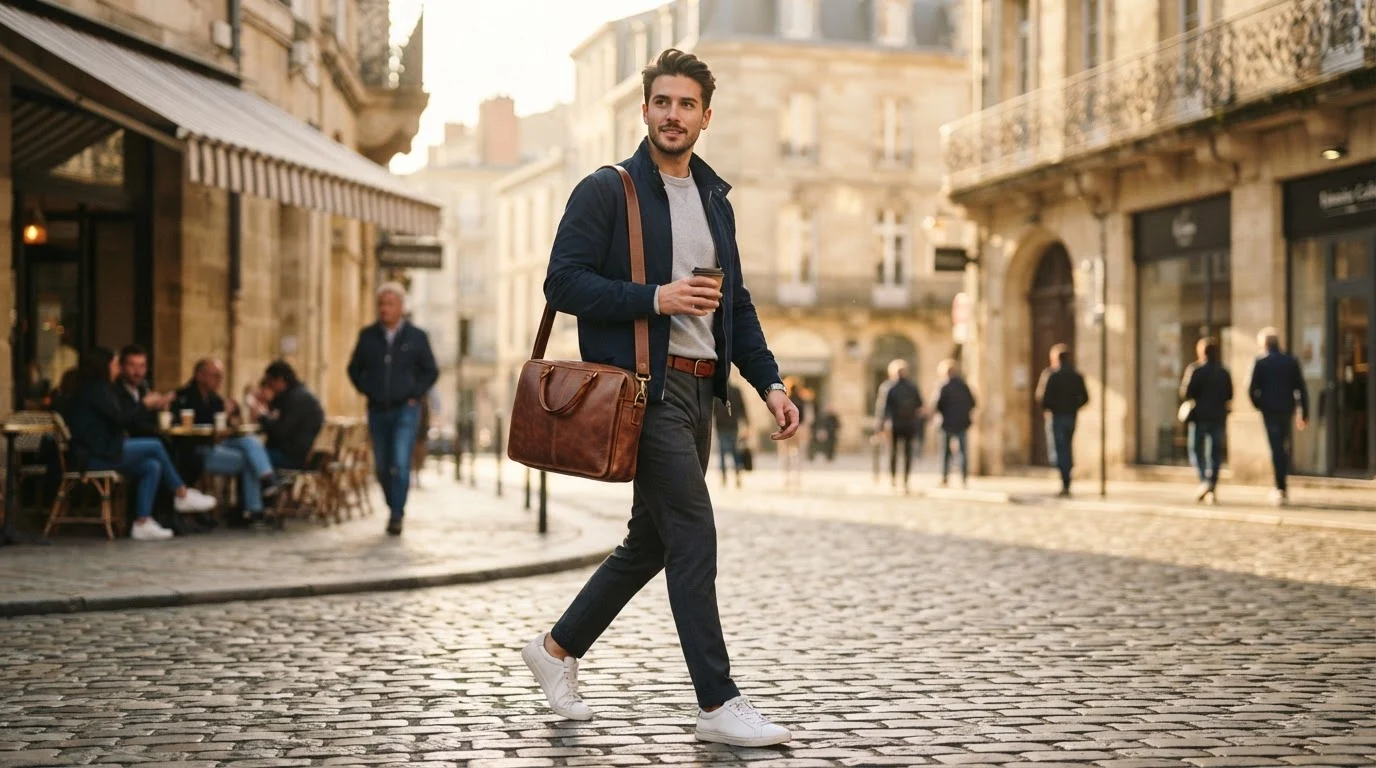
- Luggage Statement: Full-grain leather messenger brief or structured laptop tote from our leather bags collection.
- Merchandising Tip: Display the wallet protruding subtly from the jacket's interior breast pocket, with the belt coiled artfully around the bag handle to encourage multi-item purchases.
Bundle Concept 2: The Modern Urban Moto Capsule
- Anchor Garment: Heavyweight 1.2mm drum-dyed black cowhide asymmetric biker jacket from our men's biker and moto jackets collection.
- Waist Accessory: Heavy-duty 1.5-inch black bridle leather casual belt featuring an industrial matte nickel roller buckle.
- Daily Carry: Minimalist zip-around leather coin pouch and matching braided leather key lanyard.
- Supporting Apparel: Crisp heavyweight 300 GSM white crewneck tee and raw indigo selvedge denim.
- Merchandising Tip: Position the moto jacket on an elevated mannequin with the front zipper half-open, placing the belt and wallet directly beneath on a natural reclaimed timber display plinth.
Bundle Concept 3: The Contemporary Women's Minimalist Capsule
- Anchor Garment: Butter-soft 0.9mm black or chocolate brown lambskin cropped bomber from our women's leather jackets collection.
- Waist Accessory: Slim 1.0-inch waist-cinching full-grain leather belt featuring a sculpted gold-tone buckle.
- Daily Carry: Compact crossbody leather camera bag and matching accordion leather card case.
- Merchandising Tip: Hang the jacket alongside neutral knit dresses and wide-leg trousers, positioning the crossbody bag at hip level to illustrate versatile proportions.
Material & Durability Comparison Table: Evaluating Commercial B2B Leather Grades
Selecting the appropriate leather grade determines customer satisfaction, warranty claim frequencies, and brand reputation. The technical matrix below contrasts commercial leather classifications commonly encountered in wholesale trade channels.
| Leather Classification | Raw Hide Layer Utilized | Surface Treatment & Finishing | Average Tensile Strength | Expected Product Lifespan | Recommended Retail Application |
|---|---|---|---|---|---|
| Full-Grain Cowhide | Intact upper epidermis with natural grain | Aniline or semi-aniline dye; zero artificial sanding | 20.0 – 28.0 MPa (ASTM D2209) | 15 – 30+ Years (Develops Patina) | Premium outerwear ($249–$499), luxury bags ($89–$249), lifetime belts ($39–$89) |
| Top-Grain Leather | Upper dermis with sanded/buffed natural grain | Light pigment coating; embossed synthetic grain pattern | 14.0 – 18.5 MPa | 7 – 12 Years (Minimal Patina) | Mid-tier commercial jackets, structured corporate portfolios |
| Split / Suede Leather | Lower corium split layer beneath epidermis | Suede nap buffing or heavy polyurethane foil laminates | 9.0 – 12.5 MPa | 3 – 5 Years (Fibers Loosen) | Casual suede overshirts, decorative interior linings |
| Bonded / Reconstituted Leather | Shredded leather fibers bound with polyurethane resin | Heavy synthetic emboss pattern; polyvinyl chloride backing | 3.5 – 6.0 MPa (Prone to Delamination) | 6 – 18 Months (Peels & Flakes) | Budget promotional giveaways; NOT recommended for quality retail |
| Full-Grain Lambskin | Complete uncorrected lamb pelt | Drum-dyed with natural softening oils; 0.9–1.2mm | 12.0 – 16.0 MPa (Supple Elasticity) | 10 – 20 Years (Unrivaled Softness) | High-fashion women's outerwear, luxury dress gloves, lightweight bombers |
Why Full-Grain Hide Structure Prevents Retail Returns
Retailers sourcing wholesale inventory must recognize that customer returns destroy profitability. When jackets peel or belt holes stretch into oblong tears, customers lose faith in the retailer's curatorial expertise.
Full-grain leather retains the dense, cross-hatched collagen fiber network found exclusively in the outermost dermal layer. Because the surface remains un-sanded, the hide repels surface moisture, breathes naturally, and increases in flexibility over time. To educate your retail sales team on material authentication, share our guide on how to spot real vs fake leather with 7 tests that never fail.
Hardware Quality: The Hidden Risk in Wholesale Outerwear
A leather jacket is only as durable as its closure hardware. Low-tier wholesale suppliers reduce manufacturing costs by utilizing lightweight cast zinc alloy zippers that snap under lateral stress or jam along pocket welts.
Lux Wearz builds all wholesale outerwear and accessories using genuine YKK antique brass and nickel hardware. YKK teeth undergo precision milling to ensure butter-smooth track movement across 10,000+ continuous zip cycles. Solid brass hardware resists atmospheric oxidation and complements heritage leather with rich metallic depth.
Silhouette & Fit Comparison Table: Wholesale Minimums, Margins & Sizing Curves
Managing wholesale inventory requires balancing minimum order quantities (MOQs), production lead times, and retail size curve distributions. The table below outlines optimal purchasing parameters across core leather categories.
| Wholesale Product Category | Target Wholesale Cost | Recommended Retail MSRP | Realistic Gross Profit Margin | Standard Minimum Order Quantity (MOQ) | Recommended Size Curve Distribution |
|---|---|---|---|---|---|
| Full-Grain Leather Jackets | $85 – $145 / unit | $249 – $399 / unit | 63% – 66% Gross Margin | 10 – 25 Units (Mix sizes/colors) | S: 15% / M: 30% / L: 30% / XL: 20% / 2XL: 5% |
| Artisan Leather Wallets | $12 – $24 / unit | $39 – $79 / unit | 69% – 72% Gross Margin | 25 – 50 Units (Assorted finishes) | One Size (40% Black, 35% Brown, 25% Tan) |
| Solid Cowhide Belts | $14 – $28 / unit | $49 – $89 / unit | 68% – 71% Gross Margin | 20 – 40 Units (Assorted lengths) | 32": 15% / 34": 30% / 36": 30% / 38": 15% / 40": 10% |
| Full-Grain Leather Bags | $38 – $75 / unit | $119 – $249 / unit | 68% – 70% Gross Margin | 10 – 20 Units (Mix styles) | Assorted (50% Cognac Brown, 50% Classic Black) |
| Bespoke Made-to-Order | $120 – $180 / unit | $299 – $499 / unit | 60% – 64% Gross Margin | 1 Unit (Drop-ship prototype) | Individual customer measurements via custom portal |
Optimizing Sizing Allocations for Regional Markets
Outerwear retailers frequently make the mistake of ordering equal quantities across all sizes (e.g., 20% each of S, M, L, XL, XXL). This leads to rapid stockouts of medium and large garments, while XS and 2XL inventory remains stranded on clearance racks.
Historical sales data indicates that sizes Medium and Large account for 60% of total commercial leather jacket volume in North American markets. When testing a new silhouette, allocate 30% to Medium, 30% to Large, 20% to Extra Large, 15% to Small, and 5% to Double Extra Large. For detailed anatomical sizing conversions and chest measurement ratios, consult our Official Sizing & Fit Guide.
How to Choose the Right One: The Definitive B2B Leather Vendor Vetting Framework
Selecting a wholesale leather manufacturing partner requires disciplined due diligence beyond browsing polished digital catalogs. Follow this four-step evaluation protocol before committing working capital to production purchase orders.
Step 1: Request Physical Production Swatches and Burn Samples
Never issue a commercial purchase order without inspecting tactile physical material samples:
- Request 4x4 inch leather cuttings of both cowhide and lambskin from the vendor's active production drum runs.
- Perform a microscopic edge inspection: full-grain hides display distinct epidermal pores and natural collagen fiber density, whereas synthetic coated leathers exhibit uniform, foam-like backing layers.
- Conduct a flame test on an inconspicuous scrap corner: genuine leather chars slowly, emits a distinct burnt hair aroma, and extinguishes without melting. Synthetic materials melt rapidly into sticky chemical droplets accompanied by acrid plastic smoke.
Step 2: Audit Hardware Provenance and Stitch Tension
Examine garment construction integrity on pre-production samples:
- Inspect the main zipper slider and box pin for authentic manufacturer engravings (such as YKK, Riri, or Talon).
- Verify stitch tension across high-stress junctions, including armpit seams, pocket welts, and belt buckle folds. Stitches must be locked with bonded nylon thread (minimum V-69 grade) at 7 to 8 stitches per inch without loose loops or skipped holes.
- Check pocket linings. High-grade jackets incorporate 210T breathable polyester satin or heavy cotton drill lining, avoiding fragile non-woven synthetics that tear within months.
Step 3: Evaluate Minimum Order Quantities and Lead Times
Assess the vendor's operational agility and shipping reliability:
- Inquire about tiered MOQ thresholds. Vendors requiring 200+ units per colorway often subcontract work to uncontrolled third-party factories.
- Confirm standard turnaround windows. Typical artisan manufacturing requires 7 to 14 business days for custom batches, with air express freight taking 3 to 5 business days for door-to-door delivery.
- Ensure the vendor provides real-time tracking numbers and transparent customs documentation to prevent unexpected import tariffs or border holding delays.
Step 4: Verify Guarantees, Warranties and Drop-Shipping Capability
Protect your commercial investment with contractual assurances:
- Partner exclusively with manufacturers offering a comprehensive craftsmanship warranty against seam splits, zipper failures, and tanning defects.
- Inquire whether the manufacturer offers private-label drop-shipping services for oversized or bespoke made-to-order requests. Lux Wearz provides white-label custom manufacturing through our Custom Orders Atelier, allowing boutique retailers to offer bespoke leathercraft without holding expensive custom inventory.
Care & Maintenance Tips: Bulk Warehouse Storage and Inventory Preservation
Properly storing leather goods in warehouse and retail environments prevents inventory spoilage, leather desiccation, and fungal growth. For comprehensive garment care guidelines, refer to our Official Leather Care & Maintenance Guide.
Climate Control and Humidity Management
Natural leather hides are hygroscopic, meaning they absorb and release ambient moisture based on surrounding atmospheric conditions:
- Maintain warehouse storage rooms at 50% to 60% relative humidity and temperatures between 65°F and 72°F (18°C to 22°C).
- If relative humidity exceeds 70%, stagnant air promotes mildew growth on organic hides. Install industrial dehumidifiers and maintain continuous air circulation using oscillating warehouse fans.
- Avoid storing leather goods in unconditioned attics or humid basements where temperature fluctuations cause tanning oils to evaporate, resulting in brittle grain surfaces.
Structural Hanger Allocation and Box Storage Protocols
Preserving garment drape during extended inventory storage prevents permanent creasing:
- Always hang leather jackets on wide, contoured wooden hangers with minimum 2.0-inch shoulder flares. Thin metal or plastic hangers cause the heavy hide to sag, creating irreversible 'shoulder nipple' distortions.
- Never store leather jackets compressed tightly against one another on crowded inventory racks. Allow 2 inches of breathing space between garments to prevent color migration between adjacent leather hides.
- For small leather goods like wallets and belts, store inventory flat in breathable cotton dust bags or rigid cardboard presentation boxes. Never seal leather goods inside airtight plastic bags, as trapped condensation promotes mold formation.
Annual Pre-Season Conditioning for Display Stock
Display models subjected to hot retail spotlighting require regular hydration to maintain showroom luster:
- Wipe display jackets and accessories every 90 days with a clean, dry microfiber cloth to remove airborne dust that pulls moisture from the hide.
- Apply a thin layer of wax-free, lanolin-based leather lotion to high-exposure display garments once per season, buffing lightly to restore a supple satin sheen.
- Avoid petroleum-based oils, neat's-foot oil, or silicone sprays, which clog leather pores and cause permanent discoloration on lighter cognac and tan hides.
How Can Retailers Partner with Lux Wearz for Factory-Direct Wholesale & Custom Manufacturing?
Retailers, boutique owners, and commercial brands can partner directly with Lux Wearz to secure factory-direct wholesale pricing across our complete handcrafted leather goods catalog. By cutting out third-party trading intermediaries, our B2B partners enjoy unmatched quality control, low MOQs, and healthy 60% to 75% retail markups that build enduring enterprise value.
Explore our extensive collection of artisan leather outerwear and accessories, including Men's Classic Leather Jackets, Bomber & Flight Jackets, Men's Biker & Moto Jackets, Handcrafted Leather Bags, Full-Grain Leather Belts, and Artisan Wallets & Cardholders. Every wholesale partner benefits from our dedicated account management, 1-year craftsmanship warranty, 30-day return policy, and complimentary priority shipping across the USA. Visit Lux Wearz to submit a wholesale inquiry or launch your custom private-label collection today.
Explore The Full 2026 Leather Outerwear Collection
Vegetable-tanned full-grain cowhide, buttery New Zealand lambskin, and heritage Melton wool. Free express delivery across the USA with 30-day hassle-free returns.