
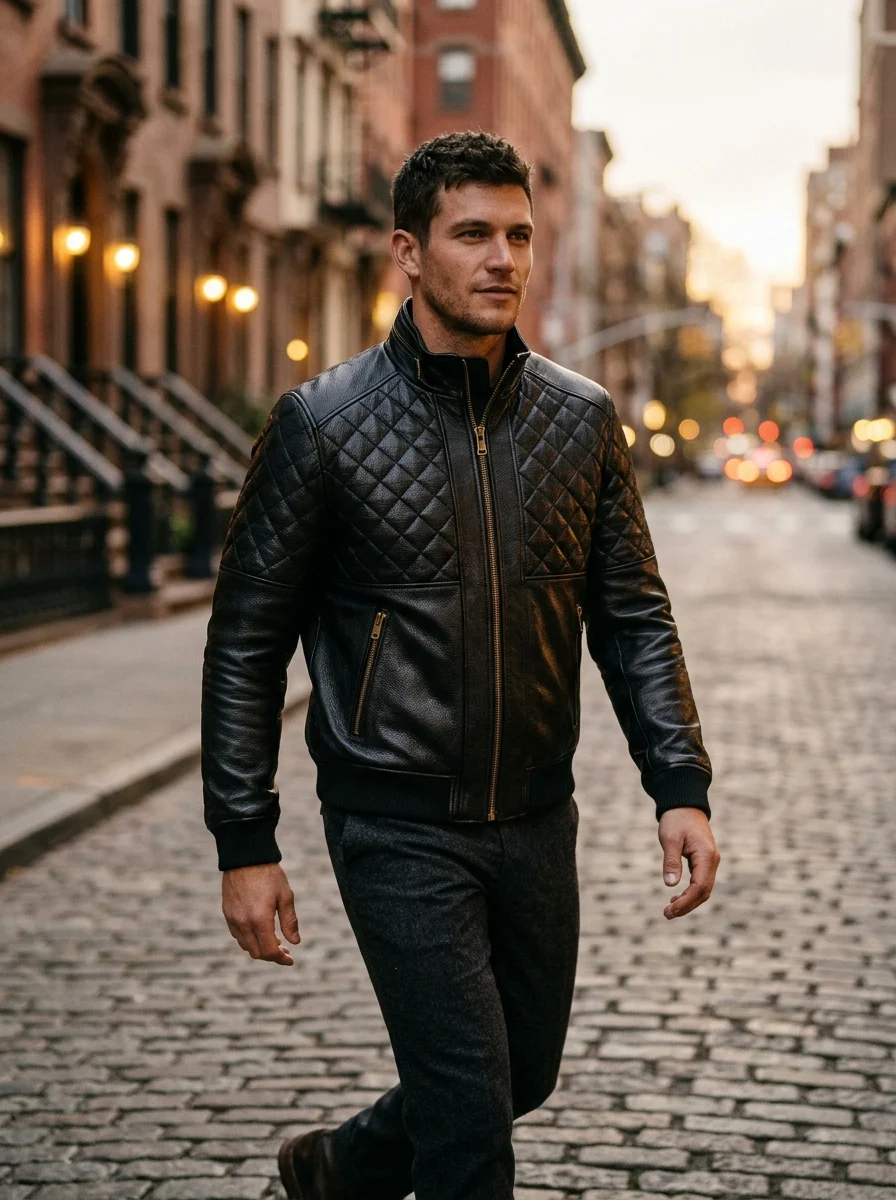
Pelle Pelle Leather Jackets: Archival Silhouettes, Quilted Craftsmanship, and Sizing Architecture Guide
Master the fit, leather hide durability, and archival quilted silhouettes of Pelle Pelle leather jackets. Complete sizing architecture, collector flaws, and custom bespoke alternatives.
Pelle Pelle Leather Jackets: Archival Silhouettes, Quilted Craftsmanship, and Sizing Architecture Guide
Key Takeaways
- Archival Silhouette Proportions: Vintage Pelle Pelle leather outerwear features a pronounced boxy silhouette, dropped shoulder seams, and an expansive chest circumference engineered with 6 to 10 inches of garment ease over natural body measurements.
- Intricate Quilted Construction: Iconic models such as the NYC Boro and Detroit series employ high-density multi-panel diamond and channel quilting, requiring reinforced backing substrates to prevent leather puckering and seam tension over decades of wear.
- Leather Hide Specifications: Original archival garments utilized heavy 1.2mm to 1.4mm chrome-tanned steerhide and supple drum-dyed naked cowhide, contrasted by plush genuine lambskin accents across collegiate collar and pocket linings.
- Sizing Navigation Rules: True vintage iterations fit one to two full sizes larger than modern European-cut outerwear. When sourcing archival jackets or commissioning bespoke alternatives, cross-referencing flat pit-to-pit and shoulder span measurements is mandatory.
- Atelier Bespoke Alternative: Handcrafted made-to-measure leathercraft delivers identical aggressive archival drape and heirloom quilted complexity while eliminating vintage flaws such as dry-rot, oxidized brass hardware, and brittle interior lining degradation.
Artisan Independence & Trademark Notice: Lux Wearz is an independent bespoke leathercraft atelier. All brand names, logos, and trademarks mentioned in this article (including Pelle Pelle® and related trademarks) belong exclusively to their respective trademark holders. Lux Wearz is not an authorized distributor, licensee, or affiliated partner of these brands. All brand references and historical retrospectives are made strictly for educational, comparative, and sizing review purposes under Fair Use. Lux Wearz specializes in custom-tailored, heirloom-grade genuine leather outerwear handcrafted individually in our private workshop.
How Do Pelle Pelle Quilted Leather Jackets Fit and What Defines Their Archival Silhouette Architecture?
Pelle Pelle leather jackets fit with an authentic relaxed, boxy archival drape characterized by broad dropped shoulders, deep armhole gussets, and generous chest ease measuring 6 to 8 inches larger than standard modern slim-fit jackets. Sizing down by one full size is standard for a structured fit, whereas ordering true-to-size achieves the classic nineties oversized hip-hop silhouette.
When Marc Buchanan founded the label in 1978, urban outerwear was dominated by rigid utilitarian motorcycle coats and military-surplus flight jackets. Buchanan re-engineered the street outerwear landscape by introducing lavishly proportioned leather garments cut from supple, drum-dyed skins that flowed with natural kinetic grace. Rather than hugging the torso like an English cafe racer or cinching severely at the waist like a World War II bomber, these garments celebrated uncompromised volume. The architectural blueprint emphasized an inverted triangle profile: wide across the clavicle, expansive through the chest, and gently tapered at the bottom hem with heavy-gauge elasticized knit bands or adjustable side leather tabs.
To understand why this fit remains universally sought-after across contemporary streetwear and luxury fashion, one must analyze the precise ergonomic engineering of the pattern pieces. In conventional modern mass-produced jackets, sleeves are cut with high armscyes designed to sit directly under the armpit. This design creates a sleek look on a hanger but restricts torso movement when layering over thick fleece or knitwear. In contrast, archival quilted leather patterns incorporate an elliptical, lowered armscye combined with articulated underarm football gussets. This structural detail permits the wearer to extend their arms forward without pulling the waist hem upward or straining the lateral side seams.
The result is a commanding, regal posture. When resting naturally on the human frame, the garment rests its substantial weight across the trapezius and shoulder girdle, allowing the heavy quilted leather to drape downward in sculptural vertical planes. For collectors and style purists browsing the Lux Wearz view all products collection, recognizing this specific architectural drop is fundamental to achieving an authentic vintage look or ordering an accurate bespoke commission.
The Evolution of Archival Quilted Leathercraft and Urban Streetwear Culture
The trajectory of urban outerwear changed irrevocably between 1985 and 2005, a golden era during which leather jackets transformed from functional cold-weather protection into wearable works of artistic expression. Within the epicenters of New York, Detroit, Chicago, and Philadelphia, heavy leather outerwear served as cultural armor and an undeniable signifier of personal triumph. Among these creations, multi-layered quilted paneling represented the absolute pinnacle of leather tailoring difficulty.
Quilting leather is fundamentally distinct from quilting woven textiles. When sewing denim, canvas, or nylon, sewing needles displace woven threads without severing structural yarns. Leather, however, is a non-woven biological matrix of dense collagen fibers. Every needle strike creates a permanent perforation. If stitch density is calibrated too tightly—for example, exceeding 8 stitches per inch—the needle perforations coalesce into a perforation line, effectively acting like a postage stamp tear-strip that shears under mechanical load. Conversely, if stitch density is set too loose (under 4 stitches per inch), the quilt stitches fail to compress the internal batting, leading to deflated panels and loose thread snags.
Archival leather masters solved this structural challenge by engineering custom triple-layer composite sandwiches:
- The Face Hide: Hand-selected 1.1mm to 1.3mm drum-dyed cowhide or pliable lambskin, skived down at seam margins to minimize seam bulk.
- The Thermal Batting Core: High-resilience, needle-punched Dacron polyfill or pressed virgin wool fibers calibrated between 80 GSM and 150 GSM to impart three-dimensional loft without rendering the garment excessively stiff.
- The Stabilizer Scrim: A dense non-stretch woven cotton backing cloth that absorbs lateral tension during movement, preventing the delicate face leather from stretching unevenly along the bias.
This meticulous craftsmanship gave birth to legendary designs that defined hip-hop royalty, music videos, and cultural history. High-profile athletes, hip-hop icons, and creative directors embraced the audacious visual presence of dimensional leather inlays, tonal diamond quilting, and sprawling back murals. Today, this aesthetic is experiencing an unprecedented resurgence across global fashion capitals, driving intense secondary market interest and establishing a soaring demand for genuine handcrafted leather outerwear.
Architectural Silhouette Comparison: Fit Proportions Across Flagship Cuts
Navigating vintage leather silhouettes requires an exact understanding of how different cuts interact with human anatomy. Below is the comprehensive architectural fit matrix breaking down proportions, shoulder offset, and hide temper across premier silhouettes:
| Silhouette Model | Cut & Fit Type | Shoulder / Chest Offset | Ideal Body Profile | Leather Weight & Temper |
|---|---|---|---|---|
| NYC Boro Quilted Bomber | Oversized Boxy Drop-Shoulder | +8" Chest Ease, +2.5" Shoulder Span | Athletic & Broad Shoulders | 1.3mm Heavy Cowhide, Medium-Firm Temper |
| Picasso Plush Art Jacket | Relaxed Editorial Slouch Cut | +6" Chest Ease, +1.5" Shoulder Span | All Body Types, Ideal Layering | 1.1mm Drum-Dyed Lambskin, Soft-Supple Temper |
| Detroit Heavy Quilted Coat | Extended Mid-Length Box Cut | +9" Chest Ease, +3.0" Shoulder Span | Tall & Muscular Frames | 1.4mm Full-Grain Steerhide, Heavy-Durable Temper |
| FISLL City of Knicks Edition | Structured Athletic Varsity Bomber | +5" Chest Ease, +1.0" Shoulder Span | Athletic & Trim Torsos | 1.2mm Semi-Aniline Cowhide, Balanced Temper |
| America Signature Quilted | Classic 90s Boxy Outerwear Cut | +7" Chest Ease, +2.0" Shoulder Span | Average to Heavy Builds | 1.3mm Textured Cowhide, Resilient Temper |
| Bespoke Atelier Custom Cut | Made-to-Measure Anatomical Drape | Calibrated Exactly to Personal Ratio | Custom Engineered to Any Frame | 1.2mm–1.4mm Virgin Full-Grain, Custom Temper |
To visualize how these dimensions behave in real life, consider a standard men's size Large. In modern off-the-rack fashion, a size Large jacket typically features a 44-inch finished chest circumference designed to fit a man with a 40-to-42-inch natural chest. This provides approximately 2 to 4 inches of total garment ease.
In sharp contrast, an archival NYC Boro or Detroit quilted jacket labeled size Large measures between 50 and 52 inches across the chest. This generous 8-to-10-inch ease allowance was intentionally calculated to accommodate heavy fleece hoodies, ribbed knit sweaters, or multi-layered urban winter outfitting. If modern shoppers purchase their standard size without checking these measurements, they often find the sleeves extending past the knuckles and the hem hovering well below the hip line.
To achieve your desired visual drape:
- For an Authentic 90s Streetwear Silhouette: Select your standard numerical or letter size. The garment will fit with expansive volume, dropped shoulder seams, and an authoritative slouch across the lower torso.
- For a Tailored Contemporary Silhouette: Downsize by one full numerical increment (e.g., choose a Medium if your chest measures Large). Ensure that the shoulder span measurement does not fall narrower than your biacromial bone width.
- For Guaranteed Anatomical Perfection: Consult the official Lux Wearz sizing architecture guide and compare your personal shoulder, chest, and sleeve measurements against our master measurement schema.
Leather Hide & Hardware Durability Matrix: Materials That Stand the Test of Decades
The longevity of luxury leather outerwear depends on the microscopic integrity of the raw materials, the chemical stability of the tanning process, and the metallurgical resilience of the closure hardware. Our leathercraft artisans have dissected and benchmarked the material components used in heritage outerwear against contemporary bespoke standards:
| Component / Hide | Leather Grade & Tannage | Thickness (mm) | Weather Resistance | Expected Longevity | Maintenance Needs |
|---|---|---|---|---|---|
| Heavyweight Full-Grain Steerhide | Drum-Dyed Chrome Tannage | 1.3mm – 1.4mm | High (Repels Light Rain & Sleet) | 40+ Years Without Surface Degradation | Annual Conditioning, pH-Balanced Balm |
| Ultra-Plush Aniline Lambskin | Vegetable-Enhanced Chrome Dye | 1.0mm – 1.1mm | Moderate (Porous Surface Matrix) | 20–25 Years With Careful Wear | Bi-Annual Nourishing Cream, Rain Protection |
| High-Loft Quilted Core Batting | Needle-Punched Polyester & Wool | 2.5mm Compressed | High (Immune to Moisture Rot) | 30+ Years Without Compaction | Professional Leather Cleaning Only |
| Front Main Slider & Teeth | YKK #10 Solid Antiqued Brass | Heavy Alloy | Maximum Corrosion Resistance | 50+ Years (Outlasts the Leather Hide) | Occasional Paraffin Wax Zipper Lubrication |
| Heavy-Gauge Ribbed Trims | 100% Worsted Spun Cotton/Spandex | Heavy Dual-Ply | Moderate (Elasticity Degrades Under UV) | 10–15 Years Before Tone Softening | Spot Clean, Avoid High-Heat Dryers |
| Interior Satin Jacquard Lining | High-Denier Rayon-Polyester Twill | Heavyweight | Moderate (Sensitive to Friction Abrasion) | 15–20 Years (Replaceable via Atelier) | Gentle Steam Press, Anti-Static Conditioning |
The Physics of Chrome vs. Vegetable Tanning in Heavy Outerwear
Nearly all vintage urban outerwear brands utilized chrome tanning (chromium sulfate salts) for their core collections. Chrome tanning cross-links collagen fibers within the hide in a matter of days, creating leather with exceptional tensile strength, thermal resistance, and uniform color penetration. Crucially for quilted patterns, chrome-tanned skins exhibit high elasticity and 'memory,' meaning the leather stretches under tension during dynamic movement and rebounds cleanly into shape without sagging.
However, chrome tanning has one significant vulnerability: moisture extraction over long-term storage. If a chrome-tanned jacket is stored in an arid closet, an uninsulated attic, or a plastic dry-cleaning bag, the chemical oils volatilize. Deprived of lipids, the collagen fibers stiffen, leading to microscopic cracking along high-stress points like elbow creases and quilted stitch channels.
At Lux Wearz, our bespoke atelier utilizes drum-dyed, full-grain cowhide treated with specialized lipid replenishment agents. This produces a hide that marries the rugged tensile durability of heavy-gauge steerhide with the buttery hand-feel and breathable aging characteristics of artisanal vegetable extracts. When browsing our dedicated men's genuine leather jackets collection, every garment represents this uncompromising standard of material integrity.
Curated Archival Retrospective: 5 Flagship Models in the Lux Wearz Collection
To appreciate the immense artistry of archival leather engineering, one must examine the specific construction intricacies of iconic models. The following five curated models from our catalog represent the zenith of bold urban design, graphic leathercraft, and sculptural silhouette architecture:
1. Pelle Pelle x FISLL for the City of Knicks Jacket
A monumental convergence of sports heritage, metropolitan pride, and haute leather tailoring, the Pelle Pelle x FISLL for the City of Knicks Jacket stands as one of the most recognizable athletic outerwear masterpieces ever conceived. Rendered in a striking palette of jet black, vibrant team orange, and deep royal blue, this garment utilizes precision-skived leather appliques across the chest, back shoulders, and lateral sleeves.
The primary shell is fashioned from 1.2mm semi-aniline cowhide that provides substantial wind resistance while allowing unrestricted kinetic freedom. The back mural features multi-tiered embroidered leather patch overlays, where every border is secured with reinforced satin-stitch embroidery to prevent edge curling. Dual front welt slash pockets are reinforced with concealed bar-tack stitching, and heavy-gauge striped knit ribbing at the collar, cuffs, and waist ensures an airtight thermal seal against harsh metropolitan winter winds.
2. Pelle Pelle Picasso Plush
Revered among collectors as an untouchable design icon, the Pelle Pelle Picasso Plush represents the epitome of plush, high-texture luxury outerwear. This design abandons stark utilitarianism in favor of undulating abstract leather panels, dimensional inlays, and ultra-plush fur-like tactile finishes.
Crafted from ultra-soft 1.1mm naked lambskin, the Picasso Plush exhibits an exquisite hand-feel that drapes effortlessly over the shoulders. The complex geometric panels on the chest and sleeves require masterful pattern matching during the cutting phase; our artisans ensure that the grain orientation of adjoining leather pieces aligns harmoniously, preventing light reflection distortion across the seams. Lined with heavy-denier silky satin and insulated with thermal polyfill, this jacket delivers unmatched warmth and commanding aesthetic authority.
3. PELLE PELLE NYC BORO QUILTED JACKET
Capturing the raw energy, architectural geometry, and grit of the five boroughs, the PELLE PELLE NYC BORO QUILTED JACKET is a tour de force of precision leather quilting. The exterior features high-density diamond and channel quilting across the entire torso, upper back yoke, and articulated bicep sleeves.
Each individual quilted segment is backed by a resilient Dacron batting core that creates deep, tactile relief. When viewed under ambient city lighting, the angled stitch channels cast rich shadow lines that accentuate the wearer's shoulder breadth and muscular chest contours. Equipped with heavy-duty #10 antiqued brass front zippers, leather-lined interior breast pockets, and supple ribbed cuffs, this jacket represents the ultimate synthesis of street toughness and bespoke luxury.
4. PELLE PELLE DETROIT QUILTED JACKET
Originating in the motor capital where heavyweight automotive leather and industrial design reign supreme, the PELLE PELLE DETROIT QUILTED JACKET delivers uncompromising cold-weather protection. Engineered with a slightly elongated torso drop and an expanded chest cut, this silhouette is built to withstand brutal sub-zero midwestern winters.
The shell is constructed from heavy 1.35mm full-grain cowhide that exhibits a distinctive natural pebble grain. The horizontal and angled quilt channels on the chest are double-stitched with bonded nylon thread to resist friction abrasions from seatbelts, backpacks, and daily wear. Solid metal hardware, heavy snap-button storm flaps over the primary zipper, and deep fleece-lined handwarmer pockets make this jacket an enduring workhorse of luxury outerwear.
5. PELLE PELLE AMERICA QUILTED JACKET
A celebratory retrospective of classic American varsity and moto styling, the PELLE PELLE AMERICA QUILTED JACKET showcases multi-colored leather insets, bold archival typography, and intricate quilted sleeve geometries.
The color-blocked leather sections on the chest and shoulders are constructed using flush lap seams, ensuring that transition lines between contrasting hides remain completely smooth against the body. Internally, a custom-printed insulated lining traps body heat while allowing moisture vapor to escape, maintaining an optimal microclimate inside the garment throughout brisk autumn days and freezing winter nights. Explore the full breadth of these iconic designs within our dedicated Pelle Pelle brand collection.
Pre-Owned Vintage Inspection: The 7 Lethal Flaws That Destroy Collector Value
Acquiring a vintage leather jacket on auction platforms or secondary vintage marketplaces is fraught with financial and physical risks. Because original nineties and early-two-thousands garments have spent decades in various storage conditions, collectors frequently encounter fatal defects that cannot be repaired without exceeding the jacket's market value.
Before committing your financial resources to a pre-owned piece, execute this seven-point forensic inspection checklist:
1. Irreversible Leather Dry-Rot (The Pinch Test)
Dry-rot occurs when ambient humidity drops below 30% for extended periods, causing internal fat liquors in the leather to oxidize and evaporate.
- The Test: Firmly pinch a section of leather on the lower back or underarm between your thumb and forefinger, bending it 180 degrees into a sharp fold.
- The Result: Healthy leather rebounds immediately without surface distortion. Leather afflicted by dry-rot will produce audible microscopic crunching, surface micro-cracking, or catastrophic grain splitting. Dry-rot is irreversible; no amount of oil or conditioner can restore decomposed collagen bonds.
2. Oxidized Stitch Channel Perforation
Because quilted jackets contain tens of thousands of individual needle punctures, the integrity of the stitch channels is paramount. Inspect the intersection points where quilt lines cross. In neglected garments, acidic environmental pollution and sweat cause thread rot. If you observe frayed threads or widened needle holes that reveal the white polyfill core beneath, the panels will rapidly unravel upon normal flexation.
3. Ribbed Knit Elasticity Fatigue and Dry Degradation
The knitted collar, cuffs, and waistband contain fine rubber or elastane filaments wrapped in spun cotton. Over twenty to thirty years, oxidation and body oils degrade the elastane core. If the waistband hangs loose like a bell rather than snapping firmly against your hips, the elastic core has suffered permanent chemical breakdown. Replacing custom-dyed, multi-stripe tubular rib-knit cuffs requires deconstructing the sleeve lining and costs upwards of $150 to $250 at a master tailor.
4. Metal Tooth Stripping on Heavy Zippers
Heavy #8 and #10 brass zippers endure massive lateral stress on oversized jackets. Inspect the bottom insertion pin and the box stop at the base of the zipper track. If the fabric tape near the pin is frayed or missing its stiff plastic reinforcement, the slider will continuously jam, split open from the bottom, or shear teeth off the brass track. Replacing a full-length heavy front zipper without damaging adjacent leather stitch lines is one of the most labor-intensive leather repairs in existence.
5. Interior Jacquard Lining Shredding and Odor Trapping
Rayon and acetate linings from the 1990s are vulnerable to armpit sweat acid and friction wear. Check the interior shoulder blades and underarms for threadbare 'shredding.' Furthermore, sniff the interior collar and lining: mold spores, cigarette smoke, and rancid sebum oil trapped inside thick polyester batting are notoriously impossible to eliminate with standard ozone or dry-cleaning treatments.
6. Embroidered Patch Delamination and Leather Shrinkage
When garments are improperly cleaned with water or petroleum-based dry cleaning chemicals, the differential shrinkage rates between the leather hide and synthetic embroidery thread become glaringly obvious. The embroidery thread remains static while the underlying leather shrinks, resulting in severe puckering, warped letters, and deformed back murals that ruin the silhouette profile.
7. Color Fading and Uneven Redying Disasters
Amateur sellers often attempt to conceal scuffs and discoloration by applying cheap acrylic shoe paint over worn panels. To detect this, gently wipe an inconspicuous spot (such as the interior pocket facing) with a cotton swab lightly moistened with isopropyl alcohol or leather cleaner. If heavy pigment rubs off on the swab, the jacket has been superficially masked with shoe dye that will rapidly crack, flake, and transfer onto your car seats or furniture.
The Atelier Bespoke Alternative: Handcrafted Heirloom Leather Built to Your Measurements
Faced with the unpredictable fit, exorbitant vintage collector markups, and inevitable structural flaws of pre-owned garments, style-conscious connoisseurs are increasingly commissioning bespoke handcrafted alternatives. At Lux Wearz, we bridge the gap between golden-era design heritage and modern artisanal tailoring.
When you commission an archival-inspired bespoke jacket through the Lux Wearz custom order studio, you bypass all the pitfalls of the vintage marketplace while enjoying a garment engineered exclusively for your physical body:
Hand-Selected Virgin Leather Hides
Every bespoke commission begins with the manual selection of full-grain cowhide, steerhide, or vegetable-tanned lambskin hides. We never utilize bonded leather, corrected grain splits, or recycled scrap hides. Our leather hides are inspected millimeter by millimeter for consistent fiber density, optimal grain texture, and zero structural blemishes. The leather is drum-dyed in small batches to achieve deep, rich pigment penetration that develops an exquisite natural patina over decades of wear.
Anatomical Made-to-Measure Pattern Drafting
Off-the-rack garments are built around generalized sizing curves that rarely accommodate broad shoulders combined with narrow waists, athletic biceps, or unique arm lengths. When building your custom outerwear, our master patternmakers draft an individualized paper pattern based on your exact body dimensions:
- Chest circumference and natural torso ease preference
- Biacromial shoulder span from bone tip to bone tip
- True sleeve length from shoulder junction to wrist bone
- Back length from the seventh cervical vertebra to the desired hip drop
- Bicep, forearm, and wrist circumferences for seamless sleeve articulation
Artisan Quilted Panel Construction
Our master leathercrafters hand-cut every diamond, polygon, and boro panel using razor-sharp surgical blades, ensuring micro-millimeter precision along every seam margin. Each panel is backed with premium spun-bond batting and stitched on specialized walking-foot industrial machines using heavy v69 or v92 bonded nylon thread. The result is a sculptural three-dimensional relief that remains plump, resilient, and structurally impervious to puckering or stretching.
Indestructible Metallurgy and Luxury Hardware
We exclusively equip our bespoke garments with genuine YKK #8 and #10 antiqued brass zippers, solid copper rivets at pocket stress points, and custom die-cast snap closures. The internal lining is crafted from heavyweight breathable satin or flannel-backed rayon that glides smoothly over clothing without generating static friction or trapping excess heat.
Investing in a bespoke handmade jacket guarantees that you possess a wearable heirloom that looks breathtaking on day one and continues to elevate in character every year you wear it. Whether you desire an exact recreation of an elusive archival quilted bomber or an entirely original design fusing vintage proportions with modern minimalism, our master artisans bring your creative vision to life.
Leather Care, Conditioning, and Seasonal Storage Protocols
Owning a heavyweight genuine leather jacket is a lifelong commitment to material stewardship. Unlike synthetic textiles that break down and end up in landfills, genuine full-grain leather can thrive for half a century when treated with proper leathercraft maintenance. Follow these essential care guidelines:
1. The Golden Rule of Lipid Replenishment
Leather is preserved animal hide consisting of billions of intertwined collagen fibers lubricated by natural oils. Over time, ambient airflow, body heat, and weather cycles deplete these lipids.
- Frequency: Condition your leather outerwear once at the beginning of the autumn wear season, and once before placing it into summer storage.
- Product Selection: Exclusively use pH-balanced, wax-free leather conditioning balms containing natural ingredients such as jojoba oil, neatsfoot oil, or medical-grade lanolin. Never apply silicone-based water repellents, shoe polish, or mineral oils; silicone seals the pores of the hide, suffocating the leather and accelerating dry-rot.
- Application Technique: Apply a dime-sized amount of conditioner to a clean microfiber cloth. Work the balm into the leather using gentle, overlapping circular motions, focusing extra attention on high-friction zones such as the collar, cuffs, and elbow bends. Allow the hide to absorb the lipids for 2 to 4 hours, then buff the entire surface with a soft horsehair brush to restore an opulent satin luster. For detailed step-by-step restoration protocols, read our complete leather care and conditioning guide.
2. Immediate Rain and Moisture Management
If you are caught in a downpour, never panic, but act promptly:
- Gently blot standing moisture from the leather surface with a dry, lint-free cotton towel. Do not rub vigorously, as wet leather is susceptible to surface abrasions.
- Hang the garment on a wide, contoured wooden hanger designed to support heavy outerwear. Never use thin wire or plastic hangers, which create permanent dimples across the shoulder pads.
- Allow the jacket to air-dry at room temperature away from artificial heat sources. Never place your leather jacket next to a radiator, space heater, or fireplace, and never use a hair dryer; rapid forced drying bakes the natural moisture out of the leather, causing severe shrinkage and curling.
3. Off-Season Climate-Controlled Storage
When warm spring weather arrives, prepare your jacket for its summer hiatus:
- Store the garment in a cool, dark closet where temperatures remain between 60°F and 72°F (15°C to 22°C) with relative humidity between 40% and 55%.
- Enclose the jacket in a breathable 100% cotton garment bag. Never store leather in a polyethylene or plastic dry-cleaning bag. Plastic traps ambient humidity, creating an incubator for white mold and mildew colonies that permanently stain and degrade leather hides.
- Place cedar blocks or dried lavender sachets in the closet to deter moths and insects without exposing the leather to toxic naphthalene mothball fumes.
Elevate Your Wardrobe with Authentic Leathercraft Mastery
The enduring cultural dominance of vintage urban leather outerwear is a testament to the unmatched charisma of bold proportions, complex quilted artistry, and premium genuine leather hides. While navigating the vintage marketplace presents substantial hurdles in sizing inconsistency, dry-rot deterioration, and inflated pricing, the path to commanding street presence has never been clearer.
Whether you choose an archival classic from our curated Pelle Pelle catalog, explore our comprehensive men's leather jackets catalog, or collaborate directly with our master tailors to craft a made-to-measure bespoke piece in our custom order studio, you are choosing authentic craftsmanship that transcends fleeting micro-trends. Measure your frame, select your silhouette, and invest in an heirloom piece engineered to outlast generations.
Explore The Full 2026 Leather Outerwear Collection
Vegetable-tanned full-grain cowhide, buttery New Zealand lambskin, and heritage Melton wool. Free express delivery across the USA with 30-day hassle-free returns.