
Pelle Pelle Leather Care, Conditioning, and Patina Maintenance: Atelier Guide [2026]
Master Pelle Pelle leather care, conditioning, and patina maintenance in 2026. Expert atelier guide on cleaning heavy steerhide, embroidery, and lipid hydration.
Pelle Pelle Leather Care, Conditioning, and Patina Maintenance: Atelier Guide [2026]
Key Takeaways
- Collagen Fiber Preservation: Pelle Pelle leather jackets utilize dense, heavyweight full-grain bovine hides and supple lambskins that demand specialized lipid replenishment rather than generic wax coatings.
- Embroidery Thread Protection: High-relief chenille, direct embroidery, and leather appliqué elements require localized cleaning protocols to prevent thread dry rot and dye transfer.
- Atmospheric Storage Defense: Avoiding airtight plastic bags and maintaining 45% to 55% ambient relative humidity prevents irreversible leather fiber embrittlement and fungal mildew infestation.
- Hardware Metallurgy Upkeep: Heavy-gauge antiqued brass zippers and snap closures require solid paraffin or beeswax lubrication to prevent tooth grinding and track warping.
- Heirloom Bespoke Alternatives: For vintage jackets suffering from systemic grain cracking, commissioning a custom bespoke made-to-measure leather jacket from Lux Wearz provides authentic heritage styling with virgin hide longevity.
Artisan Independence & Trademark Notice: Lux Wearz is an independent bespoke leathercraft atelier. All brand names, logos, and trademarks mentioned in this article (including Pelle Pelle® and related trademarks) belong exclusively to their respective trademark holders. Lux Wearz is not an authorized distributor, licensee, or affiliated partner of these brands. All brand references and historical retrospectives are made strictly for educational, comparative, and sizing review purposes under Fair Use. Lux Wearz specializes in custom-tailored, heirloom-grade genuine leather outerwear handcrafted individually in our private workshop.
How Should You Properly Clean, Condition, and Maintain a Pelle Pelle Leather Jacket?
Pelle Pelle leather jacket maintenance requires a structured three-step protocol combining dry horsehair dust extraction, pH-neutral foaming leather cleanser, and natural lanolin-beeswax lipid conditioning applied every six months. Preserving multi-panel urban outerwear demands careful isolation of embroidered chenille patches, gentle grain massage, and breathable cotton garment storage at 50% relative humidity.
The Architectural Anatomy of Pelle Pelle Outerwear
Founded in 1978 by visionary designer Marc Buchanan, the Pelle Pelle design language revolutionized urban streetwear by transforming utilitarian leather jackets into wearable monumental canvases. Unlike lightweight commercial fashion jackets, archival Pelle Pelle outerwear is characterized by extreme structural density, generous spatial proportions, and intricate multi-layered appliqué construction. Understanding how to clean and condition these legendary garments begins with an appreciation of their complex anatomical composition.
A flagship Pelle Pelle jacket is rarely an unbroken expanse of uniform hide. Instead, an authentic silhouette represents an intricate composite of heavy-gauge naked bovine hide, supple aniline lambskin overlays, heavy polyester lining quilts, ribbed acrylic-wool storm cuffs, and dense multi-colored rayon embroidery threads. Each distinct component responds differently to moisture, humidity, temperature fluctuations, and chemical conditioning agents.
When an untrained enthusiast applies commercial saddle soap indiscriminately across an archival Pelle Pelle bomber, disaster frequently ensues. Alkaline surfactants penetrate porous embroidery threads, drawing out embedded aniline dyes and bleeding pigments onto neighboring pale leather panels. Concurrently, heavy petroleum residues coat the leather pores without penetrating the deeper reticular collagen layer, creating a tacky surface film that attracts microscopic airborne dust and accelerates abrasive fiber friction.
To preserve these archival masterpieces in pristine wearable condition—or to properly evaluate pre-owned marketplace acquisitions—collectors must adopt master atelier preservation methods. Leather is essentially an organic matrix of interwoven collagen bundles. As long as these bundles maintain an optimal balance of hydration and natural animal lipids, the hide remains supple, flexible, and virtually indestructible. When those lipids evaporate through decades of neglect, the collagen bundles cross-link, harden, and inevitably snap under mechanical flexion, causing permanent grain cracking.
Archival Silhouettes & Fit Architecture
Before diving into hands-on chemical conditioning formulas, one must examine how the physical silhouette and wear patterns of Pelle Pelle outerwear influence hide wear and stress points. The dramatic cut of 1990s and 2000s urban jackets places specific biomechanical pressures upon specific zones of the garment.
Archival Pelle Pelle designs are renowned for their voluminous drop shoulders, generously contoured batwing armholes, and elongated torso profiles. While this cut created the commanding, oversized hip-hop aesthetic favored by music icons, athletes, and street culture tastemakers, it also generates concentrated stress points along the lower armhole gussets, elbow flexion lines, and lower lumbar ribbed bands. The oversized chest ease causes the leather across the upper back and chest to drape in broad undulating folds, meaning dust and airborne pollutants naturally settle into the creases during daily wear.
| Silhouette Model | Cut & Fit Type | Shoulder / Chest Offset | Ideal Body Profile | Leather Weight & Temper |
|---|---|---|---|---|
| Soda Club Heritage Bomber | Oversized Boxy Cut | +6.0 to +8.0 Inches Ease | Athletic / Broad Builds | 1.4 mm Heavy Cowhide, Semi-Firm Temper |
| Picasso Plush Collar Jacket | Relaxed Heavyweight Draped | +5.0 to +7.0 Inches Ease | All Silhouette Types | 1.2 mm Milled Cowhide with Shearling Trim |
| Encrusted Varsity Statement | Structured Drop-Shoulder | +4.5 to +6.5 Inches Ease | Muscular / Broad Frames | 1.5 mm Top-Grain Steerhide with Wool Body |
| Modern Reissue Commemorative | Modified Regular Urban Cut | +3.0 to +4.5 Inches Ease | Contemporary Slim / Regular | 1.2 mm Drum-Dyed Lambskin, Soft Temper |
| Bespoke Custom Atelier Tribute | Personalized Anatomical Fit | Tailored to Exact Specs | Any Custom Proportions | 1.3 mm Virgin Full-Grain Cowhide, Supple Temper |
As outlined in the silhouette architecture comparison above, vintage garments incorporate substantial chest ease. When an owner wears an oversized 1.4 mm cowhide jacket in colder weather, natural body heat and perspiration rise upward through the interior lining, escaping through the neck and arm openings. Over decades, this internal humidity vaporizes the tanning oils within the interior grain layer, making regular conditioning of high-friction zones—specifically underarm panels, inner cuffs, and collar folds—vital to long-term survival.
Leather Hide & Hardware Durability Matrix
A fundamental mistake among vintage outerwear enthusiasts is treating all leather hides as identical materials. Pelle Pelle incorporated an evolving array of hide grades throughout its four-decade history, ranging from ultra-heavy naked steerhides in the early 1990s to buttery Italian-finished lambskins and specialized polyurethane-coated metallic accent leathers in the late 2000s. Understanding the durability, tannage method, and chemical requirements of each material ensures flawless maintenance outcomes.
| Component / Hide | Leather Grade & Tannage | Thickness (mm) | Weather Resistance | Expected Longevity | Maintenance Needs |
|---|---|---|---|---|---|
| Full-Grain Bovine Main Shell | Chrome-Tanned Drum-Dyed Cowhide | 1.3 mm – 1.5 mm | Moderate (Requires Repellent) | 40+ Years with Maintenance | Bi-annual deep lipid conditioning and horsehair brushing |
| Aniline Lambskin Accent Panels | Full-Aniline Plonge Lambskin | 0.9 mm – 1.1 mm | Low (Sensitive to Water Stains) | 20–30 Years | Light lanolin cream, zero aggressive chemical solvents |
| Chenille & Rayon Embroidery | Multi-Filament Spun Thread | Non-Leather Component | Low (Prone to Snags & Dry Rot) | 15–25 Years | Dry soft-bristle dusting, zero liquid conditioner contact |
| Antique Cast Brass Zippers | Heavy-Gauge Solid Brass (#8/10) | Rigid Metal Alloy | High (Corrosion-Resistant) | 50+ Years | Dry paraffin or microcrystalline beeswax tooth lubrication |
| Interior Quilted Satin Lining | High-Density Polyester Taffeta | 150 GSM with Polyfill | High Tear Resistance | 25+ Years | Spot-cleaning with distilled water and mild textile surfactant |
Recognizing the exact hide tannage of your outerwear dictates which chemical products you may safely introduce. Chrome-tanned bovine hide, which accounts for the vast majority of classic Pelle Pelle main shells, exhibits outstanding tensile strength and thermal resistance. However, chrome tanning imparts an acidic baseline within the leather matrix (typically pH 3.5 to 4.5). Utilizing strongly alkaline soaps (such as traditional saddle soap formulated at pH 9.0 to 10.0) causes rapid chemical degradation of the chrome tanning bonds, resulting in stiff, chalky leather and premature surface micro-cracking.
Pre-Owned Inspection Checklist & Common Vintage Flaws
The global resurgence of vintage 1990s streetwear has ignited an intense collector market for archival Pelle Pelle outerwear. However, purchasing secondary-market leather jackets across online marketplaces entails substantial technical risks. Many vintage pieces have endured decades of improper storage in humid basements, unheated storage lockers, or dry attics. Before attempting any restorative conditioning, perform this comprehensive six-point structural health audit:
1. The Red Rot and Dry Rot Flexural Test
Dry rot in vintage leather occurs when acidic environmental pollutants or chronic lipid starvation permanently destroy the collagen protein bonds. Gently bend an inconspicuous edge of the lower hem into a tight ninety-degree curvature. If the surface grain produces fine, hairline micro-fractures, powdery residue, or audible snapping sounds, the internal fibers have disintegrated. True dry rot cannot be cured by liquid conditioners; deep cellular rot is irreversible.
2. The Olfactory Mold and Mildew Audit
Take a deep breath near the interior armhole lining and collar seams. A sharp, sour, musty odor indicates active fungal mildew spores deep within the padding layers. Placing a moldy jacket inside an enclosed closet will contaminate adjacent luxury outerwear. Eradicating deep fungal colonies requires specialized ozone chamber aeration or anti-microbial alcohol-free leather sanitizers.
3. Embroidery Thread Integrity and Appliqué Delamination
Pelle Pelle's iconic back panels often feature upwards of 100,000 dense embroidery stitches and layered leather lettering. Inspect the outer perimeter of each appliqué patch. Look closely for loose filament loops, fraying chenille borders, or curling leather edges. If the original water-based adhesives have decomposed, aggressive brush scrubbing during conditioning will peel the edges away from the underlying shell.
4. Hardware Stress and Track Alignment
Examine the bottom pin and box mechanism of the front zipper. Because vintage Pelle Pelle jackets feature heavy front leather panels, the zipper insertion pin frequently suffers metal fatigue, bending outward or tearing the canvas zipper tape. Ensure all teeth are intact and free from green verdigris oxidation, which indicates prolonged exposure to moisture.
5. Grease and Sebum Saturation on Collar and Cuffs
Direct skin contact around the neckline transfers human sebum, sweat acids, and cosmetic residues into the leather pores. Over time, oxidized oils turn the leather dark, tacky, and rock-hard. This hardened sebum must be drawn out using specialized micro-absorbent degreasing powders before any nourishing conditioners are introduced.
6. Chemical Color Overspray and Aftermarket Coverups
Unscrupulous pre-owned resellers frequently spray acrylic shoe spray or shoe polish over scuffed corners to mask severe leather wear before photographing garments for sale. Rub a white cotton swab lightly dampened with distilled water over high-wear areas (cuffs and elbow seams). If artificial black or colored pigments immediately transfer onto the swab, an amateur paint coverup has compromised the breathability of the pores.
Master Step-by-Step Atelier Leather Care Protocol
When your vintage or contemporary leather jacket has passed its physical safety audit, execute the following master protocol once every six months to guarantee generational preservation.
Step 1: Deep Dry Dust Extraction and Debris Evacuation
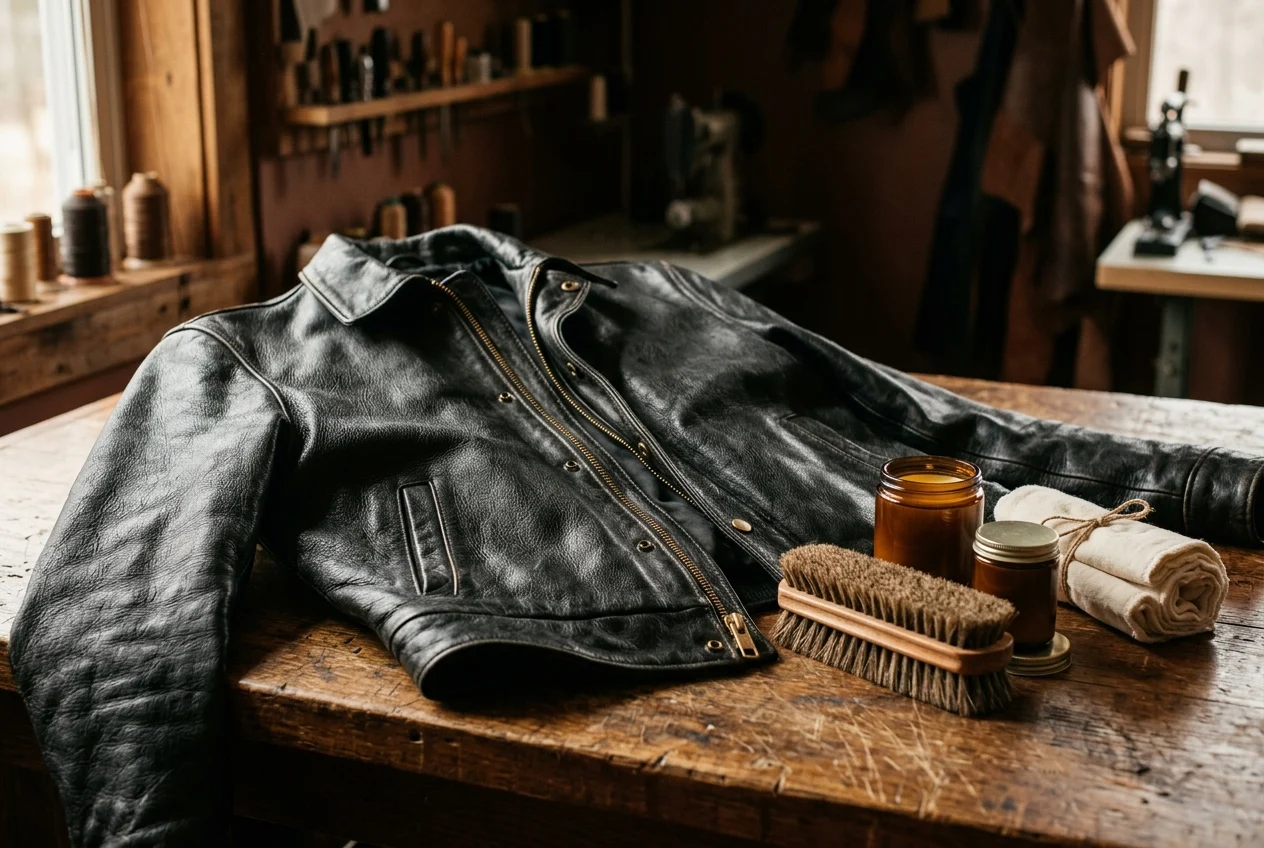
Begin by laying the jacket completely flat on a wide, clean wooden atelier table. Utilizing a 100% natural horsehair brush with dense, flagged bristles, sweep across every panel in long, deliberate strokes. Pay particular attention to the recessed valleys along quilted stitching, under the arm gussets, and beneath pocket flaps. This dry step is non-negotiable: if you apply liquid cleanser over settled atmospheric dust, the abrasive mineral particles will grind into the delicate pores, creating microscopic lacerations across the grain.
Step 2: Formulated pH-Balanced Surface Cleansing
Prepare a solution of pH-neutral (pH 5.0 to 5.5) leather cleanser. Dispense a small volume of foaming cleanser onto a dense, damp microfiber towel or a soft camel-hair cleaning brush. Never apply liquid cleaner directly to the garment surface. Work the foam across one leather panel at a time using gentle circular motions, lifting surface oils, grime, and street pollution. Immediately wipe away dirty lather with a second, dry microfiber cloth. Avoid touching any embroidery threads with the cleaning foam.
Step 3: Lipid Replenishment and Deep Fiber Nourishment
Once the leather has air-dried for thirty minutes, it is ready for deep lipid replenishment. Select a premium leather balm formulated with natural lanolin, refined cosmetic-grade neatsfoot oil, and unbleached beeswax. Avoid silicone-based conditioners or heavy mineral petroleum distillates, which seal the pores and prevent atmospheric breathability.
Apply a nickel-sized amount of balm onto your bare palms or an unbleached cotton buffing pad. Rub your hands together to warm the natural waxes until they liquify into a sheer oil. Massage the balm deeply into the leather grain, following the natural grain striations. Allow the jacket to rest undisturbed in a room at 68°F to 72°F (20°C to 22°C) for a minimum of twelve hours. During this resting phase, the warm collagen fibers absorb the natural triglycerides deep into the reticular layer, restoring tensile resilience and elastic rebound.
Step 4: High-Gloss Horsehair Buffing and Patina Awakening
After twelve hours of resting, inspect the leather surface. Any unabsorbed wax remnants will appear as a delicate matte haze. Take your dry horsehair buffing brush and vigorously buff the leather panels in rapid back-and-forth strokes. The subtle frictional heat generated by natural horsehair melts the surface microcrystalline waxes, creating an exquisite, deep, lustrous patina that accentuates the natural grain pebbles while providing a water-resistant protective barrier.
Step 5: Hardware Lubrication and Fastener Servicing
Do not overlook the mechanical hardware. Take a block of pure unbleached beeswax or a dry paraffin wax stick and rub it firmly along the outer and inner teeth of the primary front zipper track and pocket closures. Run the zipper slider up and down three to four times to distribute the wax evenly across the brass teeth. The zipper will glide effortlessly without metal friction, preventing slider tooth breakage.
Step 6: Atmospheric Shielding and Archival Seasonal Storage
Store your jacket properly between outings. Never hang a heavyweight leather jacket on a thin wire or plastic coat hanger. The concentrated weight will stretch the shoulder leather, creating unsightly "hanger bumps" and breaking interior shoulder pad stitching. Suspend the jacket on a broad, contoured hardwood coat hanger (minimum 2.0 inches wide across the shoulder horns). Encase the garment inside a breathable 100% unbleached cotton garment bag. Store in a climate-controlled wardrobe maintained between 45% and 55% relative humidity, safely insulated from damp perimeter walls, floor heaters, and direct sunlight.
Featured Silhouette Retrospective & Curated Collection
For collectors and leatherwear connoisseurs seeking iconic urban heritage, exploring authentic archival silhouettes demonstrates the enduring power of premium leather craftsmanship. Discover these legendary statement pieces within the curated collection at Lux Wearz:
- Pelle Pelle x FISLL for the City of Knicks Jacket: An extraordinary tribute to New York basketball culture and streetwear royalty. Handcrafted with high-contrast color blocking in deep black, vivid orange, and royal blue, this statement bomber combines thick, buttery cowhide panels with high-density embroidered crests that require meticulous pH-balanced maintenance to keep the contrasting leather and thread dyes pristine.
- Pelle Pelle Picasso Plush: One of the most sought-after silhouettes in urban outerwear history. Featuring an opulent plush shearling collar and heavy-gauge pebbled bovine shell, the Picasso Plush demands delicate dual-surface care—protecting the plush pile from moisture while nourishing the heavy hide to maintain its dramatic supple drape.
- Pelle Pelle NYC Boro Quilted Jacket: Celebrating the five boroughs with intricate multi-layer quilted leather paneling. The complex quilted grid creates hundreds of individual leather pillows, requiring patient horsehair brush work to clean recessed seam channels and prevent debris buildup along the top-stitched grid lines.
- Pelle Pelle Detroit Quilted Jacket: Paying homage to the birthplace of Marc Buchanan's brand, the Detroit Quilted edition showcases heavyweight full-grain leather construction engineered for harsh Midwestern winters. Regular application of lanolin conditioning balms preserves its cold-weather flexibility and prevents grain hardening.
- Pelle Pelle America Quilted Jacket: A patriotic urban masterwork featuring bold stars, stripes, and dimensional leather appliqués across the back and sleeves. Caring for this multi-colored masterpiece requires targeted spot cleaning to maintain the striking white leather panels without color migration from adjacent crimson and navy sections.
To explore all available models, archival sizes, and curated outerwear, visit the comprehensive Pelle Pelle Catalog Hub and browse our wide array of luxury Men's Leather Jackets.
The Bespoke Handcrafted Alternative: Why Discerning Enthusiasts Choose Custom Atelier Outerwear
While restoring and preserving vintage outerwear is a rewarding endeavor for passionate collectors, the harsh economic and structural realities of thirty-year-old pre-owned jackets cannot be overlooked. Many secondary-market jackets offered at exorbitant collector prices suffer from irreversible internal degradation: dried-out collagen fibers on the verge of splitting, degraded foam shoulder padding, brittle nylon stitching, and stale tobacco or mildew odors permanently trapped within the insulating layers.
For discerning clients who admire the bold, commanding silhouettes of legendary urban outerwear but refuse to compromise on hygienic freshness, structural longevity, or tailored fit, Lux Wearz provides a superior bespoke alternative. Through our dedicated Custom Bespoke Tailoring Atelier, you can commission a brand-new, heirloom-grade leather jacket built from the ground up to your precise anatomical measurements.
The Advantages of Bespoke Made-to-Measure Leathercraft:
- Virgin Full-Grain Bovine & Lambskin Hides: We select only top-tier, hand-sorted full-grain hides free from pre-existing dry rot, synthetic polyurethane plastic topcoats, or fiber fatigue.
- Custom Anatomical Tailoring: Say goodbye to unflattering, excessively baggy vintage sleeve lengths and oversized armholes. We calibrate shoulder width, chest circumference, sleeve taper, and back length to flatter your individual physique while maintaining commanding heritage proportions.
- Indestructible Thread & Hardware Metallurgy: Every custom jacket is assembled using heavy-gauge bonded nylon threads (V69 and V92 tensile specs) and genuine solid brass YKK #8 and #10 zipper hardware built to deliver decades of flawless daily wear.
- Personalized Bespoke Styling: Choose your dream leather weight, custom interior silk-satin lining colors, hidden interior media pockets, and personalized collar configurations.
Before placing an order, consult our comprehensive Online Sizing and Fit Guide to capture your body dimensions accurately. You can also explore our master Leather Care and Restoration Manual for in-depth insights into hide preservation, or review our entire luxury outerwear portfolio in the Lux Wearz Full Product Catalog.
Long-Term Value & Collector Stewardship
A genuine luxury leather jacket is not a seasonal disposable garment; it is an enduring personal asset that deepens in character and beauty with every passing year. When treated with respect, nourished with high-grade organic lipids, and stored in an optimal breathable atmosphere, heavy-gauge leather outerwear will effortlessly outlive its original owner, developing a rich, nuanced patina that tells the story of a lifetime of journeys.
Whether you are stewarding an authentic archival collector piece through meticulous biannual conditioning or commissioning a virgin made-to-measure masterpiece at Lux Wearz Custom Orders, uncompromising attention to leathercraft fundamentals guarantees that your investment remains an enduring symbol of style, authority, and artisanal mastery.
Explore The Full 2026 Leather Outerwear Collection
Vegetable-tanned full-grain cowhide, buttery New Zealand lambskin, and heritage Melton wool. Free express delivery across the USA with 30-day hassle-free returns.