
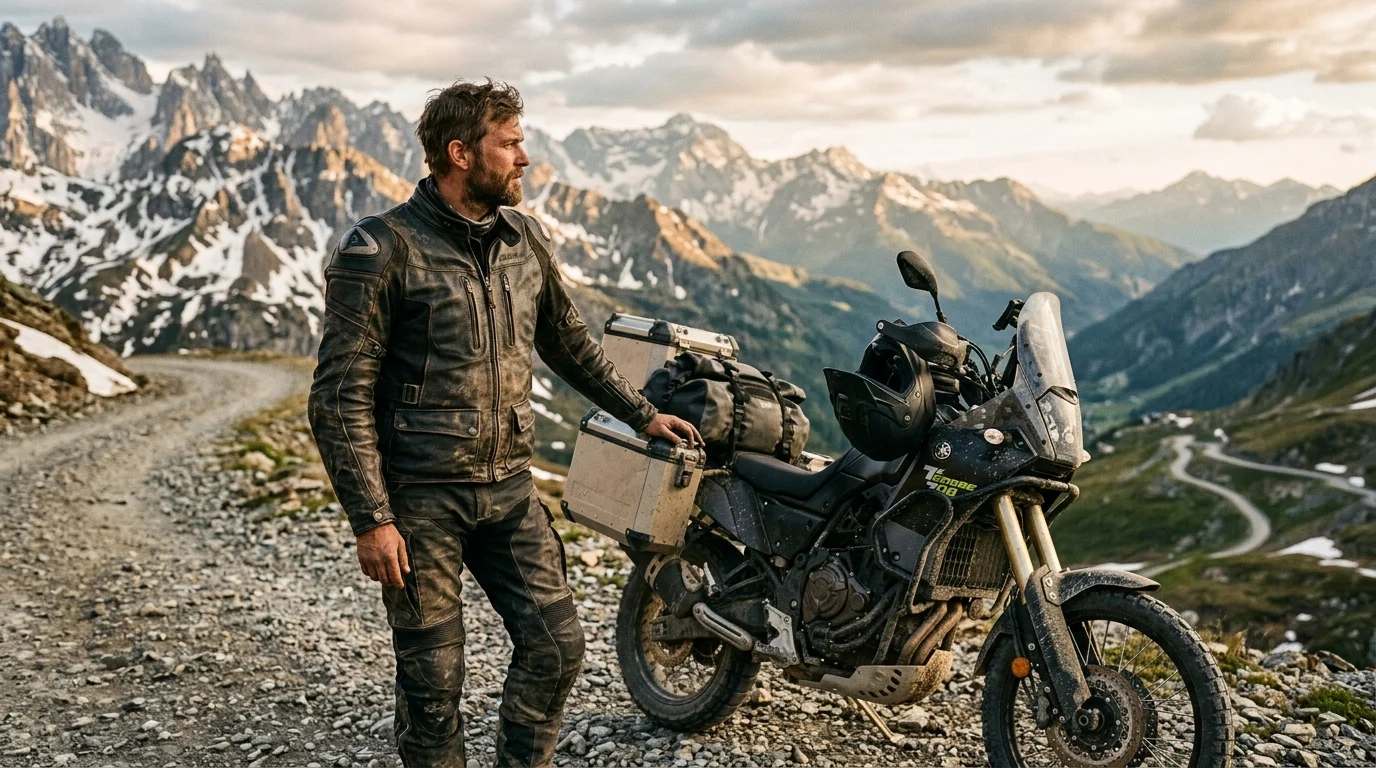
Is an Adventure Touring Leather Jacket Worth Buying in 2026?
Evaluate whether an adventure touring leather jacket is worth buying in 2026 by comparing asphalt slide safety, thermal regulation, weatherproofing, and fit.
Key Takeaways
- Definitive Protective Advantage: An adventure touring leather jacket provides unmatched asphalt slide defense and tear resistance, outperforming synthetic textile weaves during high-speed highway transit.
- Ergonomic Mobility Engineering: Modern adventure leather jackets incorporate generous accordion stretch panels across the shoulder blades, elbows, and lower back to accommodate upright standing and seated dual-sport riding positions.
- Hide Specifications: Adventure touring outer shells utilize heavy-duty 1.1 to 1.4 mm full-grain cowhide reinforced with safety drop-in pockets accommodating CE Level 2 shoulder, elbow, and spine impact protectors.
- Inclement Weather Management: Dual-sport riders manage rain and temperature swings using a modular strategy, combining windproof leather shells with packable lightweight waterproof overshells and breathable base layers.
- Long-Term Investment Value: Full-grain leather touring jackets develop an individualized road patina across decades of cross-country expeditions, making them heirloom investments compared to synthetic gear that degrades under intense UV exposure.
Is an Adventure Touring Leather Jacket Worth Buying for Riders in 2026?
An adventure touring leather jacket is worth buying for riders who prioritize supreme asphalt slide protection, heirloom durability, and timeless road aesthetics over lightweight all-weather synthetics. Motorcyclists who log extensive highway miles, ride trans-continental touring routes, or pilot modern retro scramblers gain exceptional value from full-grain leather construction that withstands decades of rigorous open-road use.
Motorcycle gear technology in 2026 offers riders a dazzling array of synthetic textiles, laminated membranes, and multi-layer cordura suits. Yet a dedicated cohort of long-distance riders continually returns to the organic protection of genuine animal hide. When you browse our specialized adventure adv jackets archive or inspect our dedicated mens motorbike jackets, you encounter garments engineered to conquer punishing elements while molding intimately to your physique over thousands of cross-country miles.
The decision to invest in an adventure leather jacket hinges on your primary riding terrain. Synthetic textile gear excels in muddy off-road single tracks, tropical downpours, and humid desert heat. However, textile threads can melt, fray, or abrade rapidly when sliding across coarse asphalt at seventy miles per hour. Heavy-duty cowhide leather possesses natural dense collagen fiber matrixes that resist friction heat, preventing painful road rash and structural garment failure during unexpected tarmac slides.
Furthermore, leather outerwear provides an acoustic tranquility that synthetic garments cannot match. Textile jackets often flap, whistle, and vibrate in high-velocity headwinds, contributing to rider fatigue over an eight-hour riding day. A properly fitted leather adventure jacket acts as a quiet, aerodynamic second skin, deflecting turbulent wind shear and keeping your core muscles relaxed throughout demanding trans-continental journeys.
Historical Evolution: From Dakar Rallies to Modern Trans-Continental Touring
Adventure touring outerwear evolved from early desert endurance rally gear and traditional road-racing leather suits of the twentieth century into articulated, multi-pocket touring armor. Early Paris-Dakar competitors and cross-country explorers wore heavy leather motoring coats to block desert sandstorms, chill morning winds, and abrasive terrain before synthetic textiles entered mainstream production.
During the 1970s and 1980s, pioneering desert racers navigated unforgiving Sahara landscapes wearing heavy leather jackets retrofitted with external map pockets and reinforced elbow patches. These early adventurers understood that natural leather deflected flying gravel, resisted cactus thorns, and insulated against dramatic day-to-night temperature swings. As motorcycle technology advanced, producing capable twin-cylinder travel machines, the demand for dedicated long-distance touring apparel expanded rapidly across Europe and North America.
Throughout the 1990s and 2000s, commercial textile manufacturers shifted the market toward multi-layer nylon shells. While synthetics offered waterproof liners and lightweight convenience, riders quickly noticed that technical textiles suffered severe UV degradation and fabric brittleness after three or four seasons of sun exposure. In response, master leather craftsmen re-engineered leather riding gear with modern ergonomics, incorporating concealed armor pockets, reflective piping, and advanced ventilation systems.
Today, contemporary adventure riders pilot powerful adventure motorcycles across mixed surfaces, demanding garments that honor heritage motorcycling roots without compromising modern impact safety. By reviewing our curated motorcycle riding gear and vintage-inspired racing jackets, you discover how twentieth-century rally ruggedness merges with modern impact ergonomics to protect ambitious overland travelers.
Ergonomic Architecture: Upright Adventure Posture Versus Hunched Sportbike Cuts
Ergonomic patterning distinguishes adventure touring leather jackets from aggressive track suits through torso length, armhole positioning, and multi-axis stretch zones. An adventure touring jacket features a taller, upright torso profile with generous bi-swing back gussets and neutral sleeve pitch, whereas a sportbike racing jacket forces the arms forward into an aggressive, hunched crouch over clip-on handlebars.
Track-focused motorcycle jackets utilize pre-curved sleeves rotated forward by thirty to forty degrees. This aggressive cut relieves wrist strain when tucked behind a aerodynamic fairing on a supersport machine, but it feels painfully stiff and restrictive when sitting upright on a tall adventure tourer with wide, elevated handlebars. Adventure touring jackets utilize a neutral sleeve rotation, allowing riders to transition effortlessly between seated highway cruising and standing upright on footpegs when tackling gravel fire roads.
Torso proportions also address the ergonomic needs of long-distance expedition riding. Sportbike jackets feature cropped front hems that prevent bunching against the fuel tank, leaving the rider's lower back exposed if they sit upright. Adventure leather outerwear incorporates a dropped kidney tail panel that extends two to three inches lower in the rear, ensuring complete draft exclusion over the lower spine. To evaluate how different riding styles dictate jacket cuts, explore our comparative analysis on motorcycle riding jacket vs fashion biker real differences for essential perspective.
Additionally, adventure patterns integrate large accordion leather expansion gussets behind each shoulder blade and above the elbow joints. These mechanical flex zones expand up to thirty percent under tension, permitting wide-arm maneuvering across rough washboard tracks without pulling the lower hem upward. Soft neoprene collar bindings prevent chafing around the neck during constant head checks in dense urban traffic, ensuring total rider focus and endurance.
Impact Protection and Abrasion Resistance: Full-Grain Cowhide Benchmarks
Abrasion resistance represents the foundational justification for selecting genuine leather outerwear for long-distance motorcycle touring. An adventure touring leather jacket utilizes 1.1 to 1.4 millimeter full-grain cowhide possessing high tensile strength, providing crucial slide protection that far surpasses standard nylon textiles during high-speed roadway impacts.
When a motorcycle rider parts company with their machine at highway speeds, the primary hazard on tarmac is friction heat and abrasive erosion. In laboratory testing under CE EN 17092 standards, high-density full-grain cowhide consistently achieves Class AA and Class AAA abrasion ratings, enduring several seconds of high-speed mechanical friction before breaching. Standard single-layer cordura and nylon textiles can fail in under one second of friction against coarse highway aggregate.
Impact armor integration completes the safety envelope of a genuine touring garment. Modern adventure leather jackets feature internal mesh pockets that secure CE Level 2 viscoelastic armor protectors at the shoulders, elbows, and back. Under resting conditions, these advanced polymer protectors feel soft and pliable, contouring naturally to your joints. Upon sudden impact, the molecular structure locks instantaneously into a rigid shield, absorbing and distributing kinetic force away from vulnerable bones and joint capsules.
Seam construction serves as the unsung hero of road safety. An adventure jacket relies on safety seams utilizing heavy-gauge bonded nylon threads sewn in a three-stage configuration: one hidden structural stitch, one internal lockstitch, and one external topstitch. This redundant engineering ensures that even if external stitch threads abrade against the pavement during a slide, the internal structural seam remains intact, preventing the leather panels from bursting open.
Comparative Silhouette Analysis: Adventure Touring Leather Versus Alternative Riding Gear
Comparative silhouette analysis clarifies how adventure touring leather jackets balance crash protection, thermal versatility, and ergonomic mobility across diverse riding profiles. The following data matrix outlines key architectural parameters between adventure leather and alternative protective silhouettes.
| Silhouette Style | Best Riding Profile | Climate Suitability | Armor Level | Ergonomic Stretch Ease | Price Range USD |
|---|---|---|---|---|---|
| Heavy-Duty ADV Leather Jacket | Long-Distance Tarmac, Dual-Sport Highways | Cool to Warm (45°F to 85°F) | CE Level 2 Shoulder, Elbow, Back | +2.5 Inches Accordion Gussets | USD 249-399 |
| Asymmetric Biker Moto Jacket | Urban Cruiser, Cafe Racer Commuting | Mild to Cool (50°F to 75°F) | Optional Internal Armor Pockets | +1.5 Inches Forward Cut | USD 249-399 |
| Ventilated Mesh Riding Jacket | Extreme Summer Heat, Desert Touring | High Heat (75°F to 100°F) | CE Level 1 or 2 Composite | +1.0 Inch Fitted Profile | USD 149-249 |
| Full Track Racing Suit | Closed-Circuit Supersport, Track Days | Mild (60°F to 80°F) | CE Level 2 Track Sliders & Foam | +3.0 Inches Kinetic Flex | USD 299-499 |
| Custom Touring Leather Garment | Bespoke Cross-Country Expeditions | Multi-Season Adaptive Layering | Custom Armor Pockets | Tailored to Exact Proportions | USD 299-499 |
Selecting the proper outerwear silhouette requires matching your typical route geography against your personal risk tolerance. Riders who spend eighty percent of their touring time on paved highways, winding mountain passes, and sweeping coastal roads find that the heavy-duty adventure leather jacket delivers superior peace of mind. To explore alternative urban moto silhouettes, inspect our broad collection of men's biker moto jackets.
Conversely, riders who tackle technical single-track trails through mud, boulders, and river crossings often find heavy leather cumbersome. If your travel involves slow-speed technical maneuvering where falling into mud and perspiring heavily are guaranteed, synthetic textiles or lightweight mesh alternatives provide faster drying times. However, for the majority of adventure motorcyclists who balance scenic highway transit with gravel touring, leather represents the ultimate synthesis of protection, comfort, and enduring style.
Weather Management: Rain Strategies, Wind Defense, and Perforated Airflow
Weather management in an adventure leather jacket relies on intelligent modular layering and targeted airflow engineering rather than complex internal membranes. Full-grain cowhide naturally forms an impermeable barrier against wind chill, while zippered intake and exhaust vents combined with external packable rain shells create a versatile multi-season riding system.
Wind chill at highway speeds rapidly saps rider stamina, turning a mild sixty-degree morning into a biting thermal challenge. The dense epidermal layer of full-grain cowhide blocks one hundred percent of wind penetration, preserving your body's microclimate during chilly morning departures. In hot midday sun, riders open heavy-duty YKK chest and bicep ventilation zippers, forcing cooling air across the torso and exhausting thermal buildup through large rear back vents. For extreme summer heat, explore our analysis in the mesh vs leather motorcycle jacket guide to understand warm-weather ventilation dynamics.
When torrential rain strikes, experienced touring riders reject built-in waterproof membranes that trap perspiration on warm days. Instead, they deploy the proven modular rain shell strategy. A high-visibility, packable waterproof rain overshell slips smoothly over your leather jacket in under thirty seconds when storm clouds gather. The outer shell deflects driving downpours, keeping the leather dry and preventing waterlogging, while the heavy leather beneath preserves impact protection and body warmth.
Riders can also complement their touring setup with weather-resistant lower-body protection. You can review specialized protective options like our handcrafted leather riding chaps and specialized mesh riding jackets to tailor your gear configuration to specific regional climates. Routine conditioning using wax-free waterproofing leather balms further enhances the leather's natural water-shedding capabilities during unexpected mountain showers.
Hardware Specs: Heavy-Duty Zippers, Cargo Pockets, and Glove Compatibility
Hardware specifications differentiate adventure touring leather outerwear from urban fashion jackets through zipper gauge, puller ergonomics, and secure pocket placement. Touring jackets utilize heavy-gauge YKK brass zippers, extended glove-friendly leather pull tabs, and high-capacity storm-flap cargo pockets designed for fast roadside operation.
Operating motorcycle gear while wearing heavy leather gloves presents serious mechanical challenges. Small fashion zipper pulls are impossible to manipulate with gloved fingers at a toll booth or fuel stop. Master ateliers fit adventure jackets with heavy-duty number eight and number ten YKK brass zippers equipped with elongated leather puller lanyards. These tactile pullers allow riders to open chest vents, access toll tickets, or adjust cuffs without removing their gloves. Complement your setup with our abrasion-resistant leather racing gloves for unified tactile grip.
Pocket engineering directly addresses the storage demands of long-distance motorcycle travel. An adventure touring jacket features two expansive lower cargo pockets equipped with dual storm flaps and secure brass snap closures. These pockets keep essential multi-tools, tire pressure gauges, and spare face shields completely protected from vibration and road grit. Interior waterproof zippered pockets protect delicate electronic key fobs, passports, and smartphones from accidental moisture exposure.
Collar and cuff closures employ multi-position brass snap adjusters lined with soft micro-fleece. Riders can cinch the collar tightly during cold morning ascents to prevent wind blasts from swirling around the neck, or loosen the snap tab during warm afternoon rides to promote internal air circulation. Heavy brass waist adjustment buckles allow you to cinch the jacket's lower perimeter over base layers, preventing the hem from flapping at highway speeds.
Craftsmanship Baselines and Material Quality Standards Matrix
Artisan production benchmarks establish verifiable durability baselines across leather grades, hide thickness, seam strength, production lead times, and warranties. The following craftsmanship matrix details verified technical parameters sourced directly from our master leather workshop.
| Garment Category | Leather Hide Type | Hide Thickness | Hardware Specs | Interior Lining | Production Lead Time | Craftsmanship Guarantee | Price Range USD |
|---|---|---|---|---|---|---|---|
| Entry Genuine Leather Jacket | Cowhide, standard sizing | 1.1-1.4mm | YKK brass zippers | Polyester satin lining | Standard 3-5 business days | 1-year warranty and 30-day returns | USD 149-249 |
| Premium Full-Grain Jacket | Full-grain lambskin or cowhide | 0.9-1.2mm lambskin, 1.1-1.4mm cowhide | YKK brass zippers | Polyester satin lining | Standard 3-5 business days | 1-year warranty and 30-day returns | USD 249-399 |
| Custom Made-to-Order Jacket | Bespoke sizing, choice of leather | Tailored to hide selection | YKK brass zippers | Polyester satin lining | Custom 7-14 business days | 1-year warranty and 30-day returns | USD 299-499 |
| Shearling & Aviator Jacket | Genuine shearling lining | Soft and heavy insulating hide | YKK brass zippers | Genuine shearling lining | Standard 3-5 business days | 1-year warranty and 30-day returns | USD 349-599 |
Every motorcycle jacket constructed in our atelier undergoes a stringent twelve-point quality inspection before leaving the bench. Experienced artisans boasting more than twenty years of bench experience hand-stitch every critical load-bearing seam with heavy-duty bonded nylon thread, ensuring panels will not burst under road friction. To verify your exact chest, waist, and arm measurements before ordering, consult our comprehensive size and fit guide.
Our workshop exclusively selects top-tier full-grain leathers, strictly rejecting split leathers and artificial synthetic coatings. Full-grain cowhide preserves the natural epidermis of the hide, ensuring superior tensile strength, breathability, and natural abrasion resistance. Whether you choose a standard sizing model for highway cruising or design a bespoke touring layer tailored to your exact armor dimensions, authentic hand-stitched construction guarantees an heirloom companion for decades of travel.
Layering Strategies for Multi-Season Climate Adaptability
Mastering seasonal layering allows adventure riders to wear a full-grain leather touring jacket comfortably from early spring mountain passes to late autumn coastal runs. Touring experts combine technical merino wool base layers, wind-blocking mid-layers, and modular leather outer shells to maintain a steady core body temperature without feeling encumbered.
During early spring mornings when temperatures hover near forty degrees Fahrenheit, start with a 200 gsm merino wool thermal base layer worn directly against the skin. Merino wool wicks perspiration away from your body while trapping insulating air within its natural crimped fibers. Over this base layer, add a slim fleece or technical softshell jacket to trap core warmth. When you zip your heavy-duty cowhide jacket over these layers, the dense leather shell seals out exterior wind chill, keeping you comfortably warm for hours.
As the afternoon sun warms the roadway into the seventies, remove the fleece mid-layer and open the jacket's chest and arm ventilation zippers. The incoming airflow circulates through the interior polyester satin lining, pulling excess heat away from your torso and exhausting it out the rear vents. Riders who frequently ride in variable autumn climates can explore our versatile men's leather vests as modular mid-layers that keep the core insulated without adding bulk to the sleeves.
In sudden rain squalls, pull your packable waterproof shell directly over the leather jacket. This three-stage configuration—moisture-wicking base layer, windproof protective leather shell, and waterproof external barrier—delivers greater climate versatility and crash security than any single synthetic garment on the market. For riders interested in full two-piece ensembles, examine our specialized motorcycle leather suit sets for unified upper and lower body protection.
Long-Term Maintenance: Keeping Touring Leather Supple and Road-Ready
Routine maintenance preserves the structural integrity, water resistance, and suppleness of an adventure touring leather jacket across tens of thousands of highway miles. Riders should clean surface road grime with mild damp cloths, deep-condition the hide bi-annually, and store the jacket on wide contoured wooden hangers away from direct sunlight.
After returning from a long-distance road trip, your jacket will carry bug splatter, road dust, and highway film. Never allow acidic bug remains to dry out and bake onto the leather surface under direct sunlight. Wipe down the outer shell promptly using a lukewarm damp microfiber cloth. If road grease is present, apply a specialized pH-balanced leather cleaner using gentle circular motions. For comprehensive conditioning protocols, follow our official leather care guide.
Bi-annual conditioning replenishes natural lubricating oils that evaporate from leather hides due to wind exposure and engine heat. Apply a high-grade natural conditioner containing beeswax and lanolin across all leather panels, paying particular attention to the shoulders, collar, and elbows. Allow the conditioner to penetrate overnight before buffing off excess residue with a clean cloth. This treatment maintains tensile strength and restores water repellency.
Storage habits also dictate garment longevity. Never hang a heavy, armor-equipped leather touring jacket on a thin wire hanger, which can stretch and deform shoulder seams under garment weight. Use a broad, heavy-duty contoured wooden hanger that supports the entire shoulder yoke. Store the jacket in a well-ventilated, humidity-controlled closet inside a breathable fabric garment bag to prevent mildew growth between riding seasons.
Buying Decision: Is an Adventure Leather Jacket Right for Your Riding Style?
Deciding whether to invest in an adventure touring leather jacket requires balancing your typical riding routes, aesthetic preferences, and budget against your practical gear requirements. If your travel centers on paved highways, scenic canyon runs, and vintage scrambler touring where high-speed abrasion resistance is paramount, an adventure leather jacket represents the finest investment you can make.
If you spend eighty percent of your saddle time riding paved highways and gravel backroads, appreciate timeless heritage styling, and desire a garment that looks distinguished when walking into roadside cafes, leather delivers unmatched satisfaction. It provides superior pavement slide defense, molds organically to your riding posture over time, and develops a rich road patina that chronicles your personal travel history. Review verified rider testimonials and cross-country experiences on our testimonials page to see how our gear performs across real-world expeditions.
Conversely, if your adventure travel consists primarily of wet off-road single tracks, deep mud crossings, or extreme tropical jungle humidity, technical synthetics remain more practical for rapid wash-and-wear care. However, for the majority of dual-sport and overland riders who value life-saving slide protection and heirloom craftsmanship, genuine leather remains the undisputed king of motorcycle gear. You can review detailed warranty and shipping answers on our frequently asked questions page before selecting your heirloom touring companion.
Explore The Full 2026 Leather Outerwear Collection
Vegetable-tanned full-grain cowhide, buttery New Zealand lambskin, and heritage Melton wool. Free express delivery across the USA with 30-day hassle-free returns.