
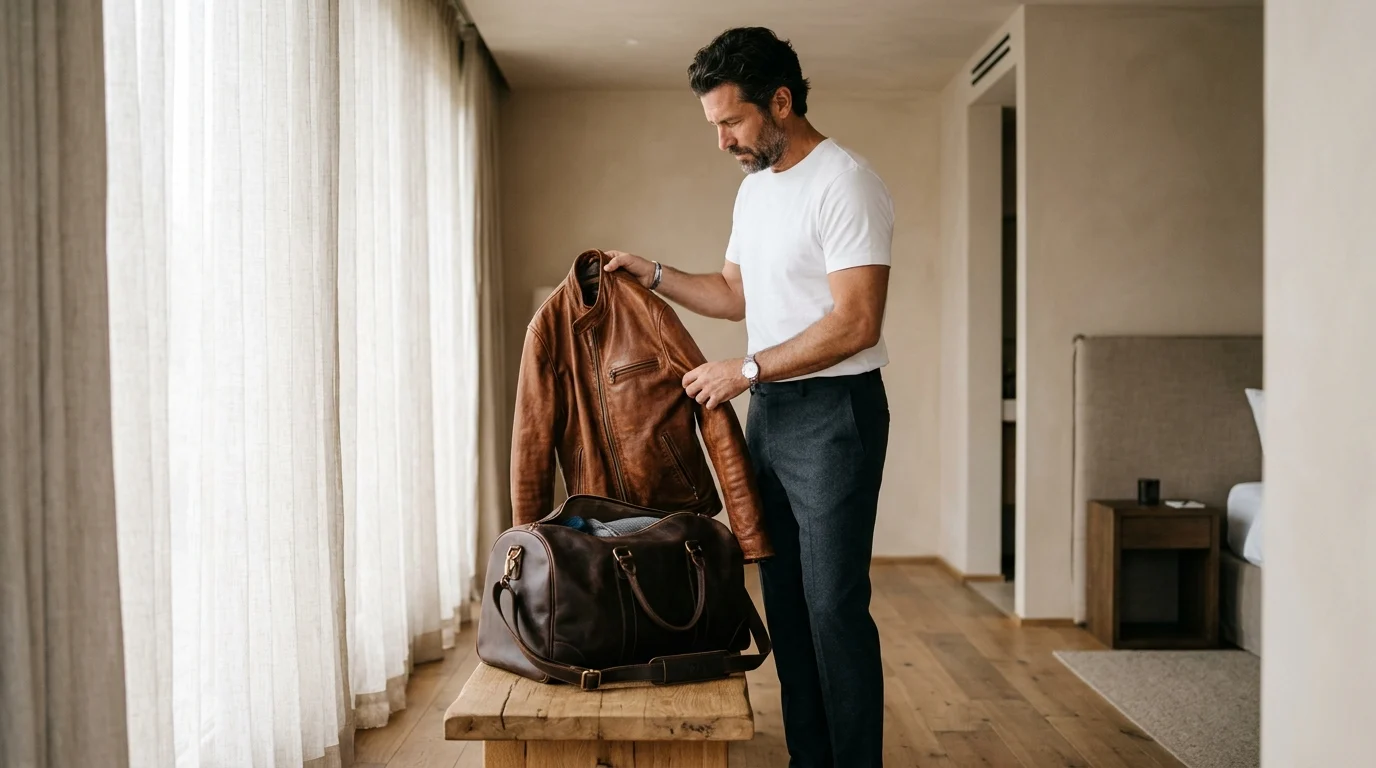
How to Pack a Leather Jacket for Travel Without Creases [2026 Guide]
Learn how to pack a leather jacket for travel without permanent creases. Master hide-specific folding, suitcase cushioning, and safe hotel de-wrinkling.
Packing a handcrafted leather jacket wrong turns a lifelong wardrobe staple into a creased mess before your hotel check-in. Travelers often stuff full-grain outerwear under heavy boots or fold structured lapels in half like cotton shirts. In our workshop with over twenty years of artisan leathercraft, we inspect hundreds of hides through a 12-point quality inspection and see firsthand how compression affects collagen fibers.
Key Takeaways
- Match the method to your hide: Supple full-grain lambskin (0.9-1.2mm) and goatskin (0.8-1.0mm) handle loose cushioned rolls, while cowhide (1.1-1.4mm) demands an inside-out flat fold.
- Condition 48 hours early: Hydrated collagen fibers flex around soft bends instead of cracking under dry airplane cabin air.
- Never seal leather in tight plastic: Breathable cotton garment sleeves stop friction scuffs without trapping condensation or mildew.
- Unpack within 30 minutes of arrival: Hang your jacket on a broad shoulder hanger and use ambient bathroom steam rather than direct iron heat.
- Wear the heaviest silhouettes onboard: Heavy shearling aviators and structured coats belong over your arm at the gate rather than crushed in checked luggage.
Whether you carry a compact weekend duffle or a hard-shell carry-on, smart packing protects seam tension, collar roll, and YKK brass zippers. Let us walk through the exact physics, step-by-step packing techniques, and post-flight recovery rules that keep your jacket crisp from departure to dinner.
Why Do Leather Jackets Crease Inside Suitcases?
Leather jackets crease inside suitcases because collagen fibers possess natural fiber memory that locks into whatever shape holds them under sustained pressure. When heavy toiletries or stacked shoes compress a sharp ninety-degree fold for hours, the grain layer stretches on the outside while the underlying corium crushes inward, leaving stubborn lines across sleeves and backs.
Most packing guides skip the moisture and temperature physics happening inside luggage holds. Commercial aircraft cabins drop relative humidity to roughly 10 to 20 percent at cruising altitude, and unheated cargo bays get even colder and drier. Dry collagen loses elasticity fast, so a sharp fold taken in dry air sets twice as deep as a fold made in a humid bedroom.
Inside the Lux Wearz studio, every jacket features hand-stitched seams and polyester satin lining engineered to drape cleanly over human shoulders. Folding along a stitched seam forces thread tension to fight the leather grain. Placing soft knitwear inside every bend keeps the curve radius wide so those collagen fibers rebound smoothly once you hang the jacket up.
Artisan Rule of Thumb: Treat a leather fold like bending a thick belt rather than creasing paper. If the radius of the fold stays wider than a rolled pair of socks, full-grain leather bounces back within hours of hanging.
Should You Wear or Pack a Leather Jacket on Flights?
Travelers should wear heavy leather jackets through airport security whenever luggage space is tight or the silhouette uses thick winter shearling. Wearing a jacket onboard eliminates suitcase compression, preserves shoulder padding, and saves roughly two to four pounds of carry-on weight while giving you an extra layer against chilly cabin air.
Still, wearing leather through every connection is not always practical. If you fly from a snowy departure city into a warm coastal destination, carrying a heavy coat through crowded terminals grows tiresome fast. Knowing when to wear your outerwear versus when to pack it inside dedicated leather bags prevents both airport sweat and wrinkled hides.
When to Wear Your Jacket in Transit:
- Heavy winter outerwear: Jackets with genuine shearling lining weigh more and lose loft when compressed beneath suitcase straps.
- Structured tailoring: Sharp-shouldered silhouettes stay crispest draped over your forearm or stowed flat in an overhead bin after takeoff.
- Short carry-on-only flights: One-bag flyers keep full packing cube space free for shirts and shoes.
When to Pack Your Jacket Inside Luggage:
- Multi-climate itineraries: Moving between rain, cold nights, and warm afternoons makes hands-free packing inside spacious leather backpacks far easier.
- Lightweight transitional styles: Unstructured casual pieces in goatskin or lambskin fold cleanly when buffered with soft knitwear.
- Checked bags with rigid frames: Hard-shell suitcases shield flat-folded jackets if you control top-layer placement.
If you plan to bring an oversized carryall as your primary cabin bag, read our breakdown on whether a leather duffle bag is worth buying for travel so you pick a bag wide enough to match your shoulder span.
Which Leather Hides Travel Best Without Wrinkling?
Full-grain goatskin measuring 0.8-1.0mm and supple lambskin measuring 0.9-1.2mm travel best without deep fold marks because lighter hide density allows tight fibers to flex and rebound smoothly. Thicker cowhide measuring 1.1-1.4mm delivers unmatched road durability yet holds sharper fold lines unless travelers cushion every bend carefully inside a wide bag.
Hide choice shapes your packing strategy long before you open a suitcase. Standard fashion shoppers often buy stiff coated leather expecting effortless folding, only to watch cheap surface paint crack along the elbow after one weekend trip. 100% genuine full-grain leather keeps the natural outer grain intact, which lets oils migrate freely and heal light compression marks.
Let us compare the exact material specifications our artisans work with daily across travel-ready silhouettes.
Material & Durability Matrix for Travel Packing
| Material / Spec | Thickness / Feel | Hardware & Lining | Travel Fold Recovery | Price Range (USD) | Lead Time & Guarantee |
|---|---|---|---|---|---|
| Full-grain lambskin | 0.9-1.2mm supple drape | YKK brass zippers, polyester satin lining | Fast rebound on cushioned rolls | USD 249-399 | 3-5 business days standard, 1-year craftsmanship warranty |
| Full-grain cowhide | 1.1-1.4mm sturdy structure | YKK brass zippers, polyester satin lining | Moderate recovery, requires flat fold | USD 149-249 entry / 249-399 premium | 3-5 business days standard, 30-day hassle-free returns |
| Full-grain goatskin | 0.8-1.0mm pebbled resilience | YKK brass zippers, polyester satin lining | Best natural crease resistance | USD 249-399 | 3-5 business days standard, 1-year craftsmanship warranty |
| Genuine shearling aviator | Heavyweight insulated hide | YKK brass zippers, genuine shearling lining | Low fold tolerance, wear onboard | USD 349-599 | 3-5 business days standard, 1-year craftsmanship warranty |
| Suede outer finishes | Supple brushed nap | YKK brass zippers, polyester satin lining | Needs dust-free reverse fold | USD 249-399 | 3-5 business days standard, 30-day hassle-free returns |
Every Lux Wearz jacket is handcrafted by master artisans with 20+ years experience and passes a 12-point inspection before shipping free across the USA. If you need custom sleeve lengths or shoulder measurements tuned to your exact frame before a big trip, custom made-to-order pieces range from USD 299-499 with a 7-14 business day lead time and include a free sizing consultation via video call.
Before choosing your travel jacket size, check our size and fit guide so your shoulders align cleanly without excess fabric bunching inside luggage.
How Should You Prepare a Leather Jacket Before Packing?
Preparing a leather jacket before packing requires emptying every pocket, fastening all YKK brass zippers and snaps, conditioning dry hides forty-eight hours ahead, and turning the garment inside out. Completing these four steps balances hardware weight across the torso and ensures the exterior grain never rubs against sharp metal teeth during turbulence.
Skipping pre-trip prep causes more travel damage than folding itself. A single house key or metal lip balm tube forgotten in a chest pocket presses a permanent circular dent into soft lambskin under suitcase straps. Follow this exact sequence forty-eight hours before departure.
Pre-Flight Leather Prep Checklist:
- Empty all interior and exterior pockets: Remove keys, boarding passes, coins, sunglasses, and earbuds so zero hard edges press into the hide.
- Brush away surface dust: Wipe collars, cuffs, and shoulder yokes with a soft horsehair brush or clean dry cotton cloth so grit never grinds into the grain.
- Condition two days early: Apply a pea-sized amount of gentle conditioner to dry elbows or shoulders forty-eight hours prior, giving oils ample time to cure completely.
- Verify complete dryness: Never pack a jacket damp from mist or rain because closed luggage locks moisture inside and triggers white mildew bloom.
- Close main zippers and snap collars flat: Zipped tracks align the left and right front plackets evenly and prevent loose zipper pulls from snagging your polyester satin lining.
- Detach removable hoods or waist belts: Roll separate leather belts loosely inside a sock or dedicated pouch rather than leaving buckles dangling against finished hides.
For seasonal storm tips before a rainy destination trip, check our guide on whether you can wear a leather jacket in the rain and bookmark our official leather care guide on your phone.
How Do You Fold a Leather Jacket Without Creasing It?
Folding a leather jacket without creasing it works best using the inside-out shoulder tuck method cushioned with soft knitwear. Turning the jacket inside out puts the smooth polyester satin lining facing outward to shield the leather grain from friction, while tucked shoulders and rolled sweaters keep every fold curved and gentle.
This method shines for 1.1-1.4mm cowhide jackets, structured classic men's leather jackets, and tailored classic women's leather jackets whose collar stands and pocket welts hold firm shapes.
Step-by-Step Inside-Out Shoulder Tuck:
- Fasten the main zipper halfway up: Close the front track cleanly so lapels sit flat without twisting.
- Invert the shoulder caps carefully: Reach inside one sleeve from the bottom hem, pull the opposite shoulder into the first shoulder cap so both shoulder pads nest inside each other, and expose the satin lining outside.
- Align sleeves straight along the side seams: Smooth both arms flat down the length of the body so elbows do not twist into diagonal wrinkles.
- Insert a soft sweater cylinder: Place a rolled merino sweater or two folded cotton tees directly across the lower chest area where your suitcase dimensions require a fold.
- Fold the lower hem gently over the cushion: Bring the bottom ribbing or waist hem up over the sweater roll, creating a thick three-inch soft curve instead of a flat pinch.
- Slide the folded bundle into a cotton dust bag: A breathable pillowcase or canvas cover protects the satin exterior from Velcro straps inside your suitcase.
Notice how the inverted shoulder nest turns a bulky 3D garment into a natural rectangular cushion. Because shoulder pads or double-stitched seams rest inside one another, your suitcase lid cannot smash one shoulder flat while bowing the other.
When Should You Roll a Leather Jacket Instead of Folding?
Rolling a leather jacket works better than flat folding when you pack supple 0.9-1.2mm lambskin or 0.8-1.0mm goatskin into a soft weekend duffle or under-seat backpack. Gentle rolling distributes tension evenly across a continuous cylinder, avoiding single horizontal crease lines while maximizing tight corner space inside flexible travel bags.
Avoid rolling heavy padded motorcycle gear, stiff cowhide coats, or anything featuring rigid armor plates. Rolling suits relaxed silhouettes like men's casual jackets, lightweight women's casual leather jackets, and unpadded men's suede jackets.
Step-by-Step Cushioned Cylinder Roll:
- Lay the jacket face-down on a clean bed: Zip the front closed and smooth out the back yoke with your palms.
- Cross sleeves loosely across the back panel: Fold each arm gently at the shoulder gusset without pinching the elbow seam.
- Lay a soft shirt flat across the leather: Place one thin cotton t-shirt or silk scarf on top of the back panel so leather never presses directly against leather as you roll.
- Roll smoothly from hem to collar: Start at the waist and roll upward using light hand pressure, keeping the final diameter about six to eight inches wide.
- Nestle into the top compartment: Tuck the cylinder between soft sweaters inside your duffle so zero hard edges press against the side walls.
When working with brushed suede, add one extra tissue paper sheet or clean white cotton tee over the nap before rolling. Soft cotton absorbs subtle friction and prevents shiny burnished marks along high spots like pocket flaps and cuff edges.
Which Suitcase or Travel Bag Protects Leather Best?
A structured hard-shell carry-on or wide-mouth leather duffle measuring at least 21 inches wide protects packed jackets best because wide interiors prevent tight side-wall squeezing. Narrow backpacks and overstuffed soft rollers compress shoulder seams inward, forcing boxy sleeves and notched lapels out of alignment across multi-hour flights.
Different trips require different luggage setups. Matching your jacket silhouette to the right bag keeps both your wardrobe and your carry-on organized.
Travel Silhouette & Luggage Packing Matrix
| Jacket Silhouette | Best Packing Method | Aesthetic & Occasion | Recommended Bag Type | Shoulder Offset & Ease | Price Range (USD) |
|---|---|---|---|---|---|
| Cafe racer or moto | Inside-out shoulder tuck | Clean minimalist road and city travel | 22-inch hard-shell carry-on | Trim shoulder, 1-2 inch chest ease | USD 149-249 entry / 249-399 full-grain |
| Classic leather bomber | Cushioned cylinder roll | Relaxed weekend flights and smart-casual | Structured leather duffle | Soft drop shoulder, 3-4 inch torso ease | USD 249-399 full-grain |
| Tailored leather blazer | Breathable garment sleeve | Business trips and evening dinners | Bi-fold garment carrier or leather briefcases | Structured shoulder pad, 2 inch tailored ease | USD 249-399 full-grain / 299-499 custom |
| Suede overshirt or shacket | Tissue-wrapped loose roll | Transitional spring and autumn layering | Weekend duffle or backpack | Relaxed box cut, 3 inch layering ease | USD 249-399 full-grain |
| Shearling aviator coat | Wear onboard in transit | Deep-winter alpine or snow destinations | Worn or draped over arm | Roomy cut, 4+ inch sweater ease | USD 349-599 genuine shearling |
Look closely at shoulder span versus bag width. Standard US airline carry-on bags measure roughly 22 by 14 by 9 inches. Since most men's medium and large leather jackets span 18 to 20 inches across the shoulders, a vertical flat lay with tucked sleeves fits a 22-inch suitcase comfortably, while forcing a 20-inch jacket sideways across a 14-inch width crushes both shoulder caps.
If you travel frequently for client meetings, pairing your jacket with streamlined men's bomber flight jackets or women's aviator jackets inside a wide duffle eliminates overhead-bin panic when small regional jets limit roller bags.
How Should You Layer a Leather Jacket Inside Your Suitcase?
Layering a leather jacket inside a suitcase requires placing it as the top cushion layer directly beneath the zippered mesh divider, never at the bottom under heavy footwear. Creating a soft clothing bed underneath and keeping solid toiletries in separate compartments shields full-grain leather from pressure dents during baggage handling.
Think of your suitcase interior as three distinct zones:
- Bottom heavy zone (wheels side): Pack boots, sneakers, toiletry pouches, power banks, and chargers here so gravity keeps rigid weight anchored down.
- Middle buffer zone: Fill the center cavity completely flat with rolled jeans, packing cubes, and knit sweaters so no hollow pockets allow your leather jacket to sag.
- Top sanctuary zone: Lay your inside-out folded or rolled leather jacket gently on top of the flat clothing bed, leaving at least half an inch of breathing room before zipping the shell shut.
Never jam your jacket beneath compression straps pulled tight. Elastic X-straps dug directly into 0.9-1.2mm lambskin carve narrow diagonal grooves that take days to relax. Fasten internal compression straps over your base shirts first, then lay your protected leather jacket smoothly above the divider panel.
Need smart accessories that pack effortlessly inside small pockets without bulk? Browse travel-friendly leather accessories such as slim RFID cardholders and rolled belts.
Can You Use a Garment Bag or Compression Cube for Leather?
Breathable cotton or canvas garment bags protect structured leather jackets safely during car trips and short flights, while airtight plastic compression cubes destroy leather finishes. Vacuum-sealed bags crush natural pore structure, lock in moisture, and press zipper teeth directly through 0.9-1.2mm lambskin or polyester satin lining.
Compression packing cubes work wonders for synthetic athletic wear and cotton socks, yet they remain the worst enemy of genuine hide. When you crank a compression zipper closed or vacuum out air, you eliminate the natural loft between fibers. Deprived of air circulation, trapped warmth condenses against the hide surface and encourages stiff creases or dull spots.
Smart Garment Bag Rules for Flyers:
- Choose woven cotton, linen, or heavy mesh sleeves: Natural weaves block suitcase dust and collar scuffs while allowing moisture to escape.
- Use a broad contoured wooden hanger: Thin wire hotel hangers poke sharp shoulder dimples into heavy 1.1-1.4mm cowhide within a single afternoon.
- Ask cabin crew politely on long-haul flights: Many wide-body planes and first-class cabins offer narrow coat closets where attendants hang garment bags vertically.
- Lay garment bags flat atop luggage in car trunks: Never wedge heavy grocery bags or hard coolers on top of the garment sleeve.
How Do You Get Wrinkles Out of a Leather Jacket After Unpacking?
Removing travel wrinkles from a leather jacket starts with immediate unpacking onto a wide contoured hanger, followed by fifteen minutes in a steamy hotel bathroom or gentle wear to let body heat soften the hide. Never press a flat iron, hair dryer on high heat, or direct steam nozzle against genuine leather.
As soon as you unlock your hotel door, pull the jacket out of your luggage before you even unpack your toiletries. Gravity does eighty percent of the recovery work over the first two hours, especially on 0.8-1.0mm goatskin and supple lambskin.
Safe Hotel De-Wrinkling Protocol (Step-by-Step):
- Hang on a broad, rounded hanger: Slide two thick rolled bath towels onto a narrow hotel plastic hanger if no wide wooden hanger sits in the closet.
- Run a hot shower with the bathroom door closed: Hang the jacket on the back door hook, far away from direct shower spray, for ten to fifteen minutes.
- Let ambient warm mist relax the collagen: Gentle humidity softens minor pack lines without soaking the grain.
- Blot surface moisture and air-dry in the main room: Move the jacket to an airy spot away from AC vents or wall heaters, and wipe lightly with a dry microfiber towel.
- Wear it for thirty minutes: Natural body warmth around 98.6 degrees Fahrenheit molds the shoulders and sleeves back to your exact posture.
Avoid the common internet myth about laying a damp towel over leather and ironing it on low heat. Even through a cotton buffer, concentrated soleplate heat scorches natural tanning oils, shrinks collagen fibers unevenly, and melts internal polyester satin lining seams.
For persistent stubborn creases on older jackets after long flights, review our deep maintenance walkthrough on how to care for a leather jacket before applying any balm.
What Travel Mistakes Permanently Damage Leather Jackets?
Packing mistakes that permanently damage leather jackets include cramming hides under heavy boots, sealing damp leather inside plastic bags, hanging coats by narrow wire hooks, and blasting creases with hot hair dryers. Every one of these habits strips natural fats from the hide or stretches hand-stitched seams past their recovery threshold.
Check this quick red-flag list before zipping your bag:
- Overstuffing carry-on zippers: Forcing a tight zipper shut drives external pressure across pocket flaps and leaves crisp hardware impressions on the chest panel.
- Storing wet jackets in dark hotel closets: Rain-dampened coats folded into luggage or hung inside unventilated corners risk odor and fungal spotting.
- Using chemical wrinkle-release sprays: Alcohol and silicone mist sprays stain porous aniline and semi-aniline leather permanently.
- Resting jackets on sunlit car dashboards or radiators: Direct UV and dry heater air bake natural oils out, turning flexible hides brittle and prone to surface cracking.
Every traveler makes better buying decisions when they read real customer experiences first. Browse verified buyer notes on fit, hide softness, and durability in our customer reviews before ordering your next travel piece.
Whether you prefer rugged cowhide road jackets, buttery lambskin blazers, or supple goatskin bombers, smart packing keeps your investment looking showroom-fresh anywhere in the world. Take ten extra minutes before takeoff to prep pockets, nest your shoulders inside out, and cushion every fold—your jacket will reward you with decades of clean drape and effortless patina.
Explore The Full 2026 Leather Outerwear Collection
Vegetable-tanned full-grain cowhide, buttery New Zealand lambskin, and heritage Melton wool. Free express delivery across the USA with 30-day hassle-free returns.