
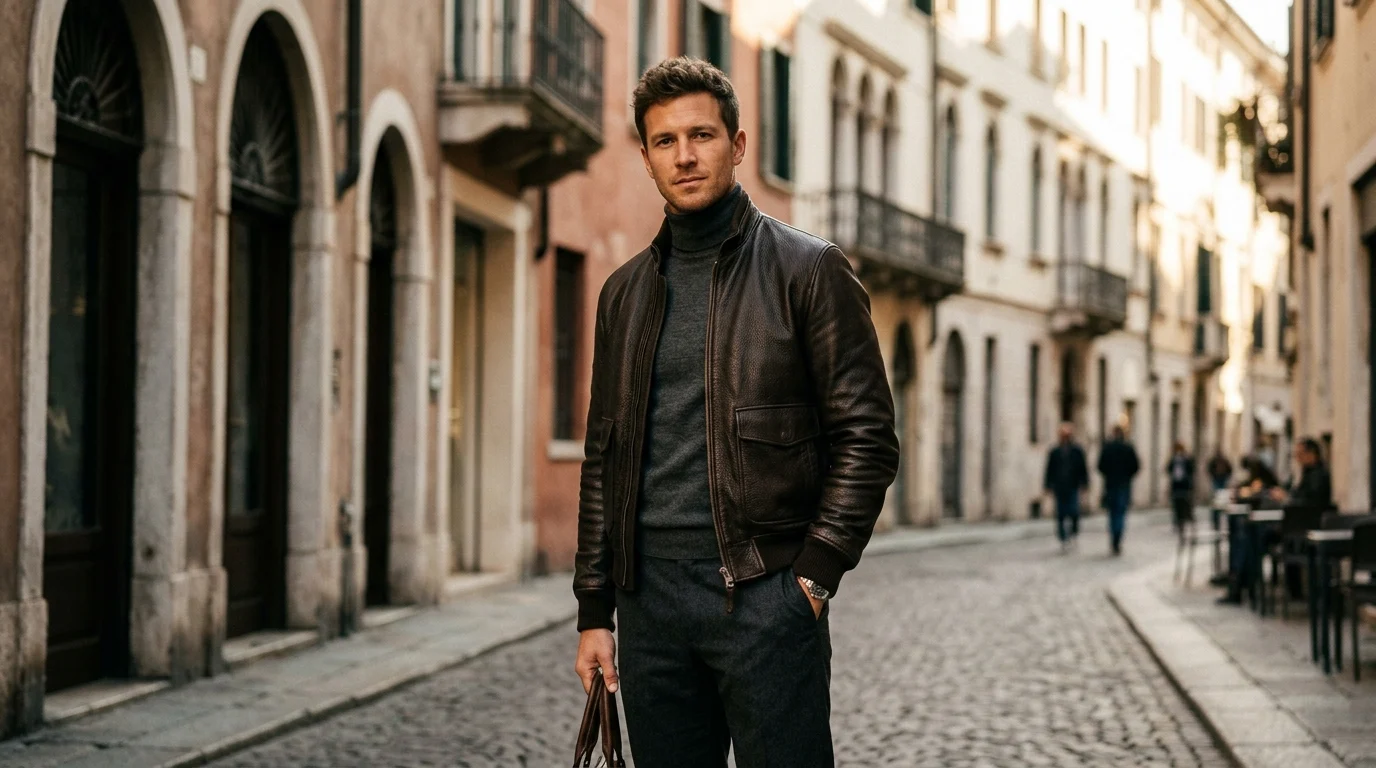
How to Choose Big and Tall Leather Jackets That Fit Perfectly
Master big and tall leather jacket sizing with expert tailoring rules. Learn shoulder offsets, sleeve reach formulas, hide drape, and custom fit options.
How to Choose Big and Tall Leather Jackets That Fit Perfectly
Finding a leather jacket that flatters a broad chest, athletic shoulders, or extended torso requires moving beyond arbitrary off-the-rack sizing metrics. Master leather artisans design outerwear around anatomical anchor points rather than uniform grading algorithms. Standard mass-production patterns simply scale chest circumference outward while ignoring bicep clearance, torso drop, and wrist reach. This comprehensive guide breaks down the precise engineering principles required to select a big and tall silhouette that balances physical proportions, delivers all-day mechanical comfort, and commands respect in every room you enter.
Key Takeaways
- Precise shoulder seam alignment on the acromion bone prevents unflattering upper-arm sagging while preserving full rotational reach across broad torsos.
- Selecting 1.1 to 1.4 mm full-grain cowhide maintains crisp vertical silhouettes, whereas 0.9 to 1.2 mm lambskin conforms smoothly without unnecessary bulk.
- Sizing formulas require adding exactly two inches of ease to raw chest measurements to ensure comfortable winter knitwear layering.
- Straight-hem car coats, structured truckers, and relaxed bombers elongate taller frames without creating horizontal midsection tension creases.
- Bespoke custom pattern making resolves disproportionate arm-to-torso ratios through personalized laser-cut hide grading and video sizing consultations.
What Defines Proper Shoulder Architecture on Big and Tall Outerwear?
Proper shoulder architecture on big and tall outerwear requires the jacket armscye seam to sit directly above the outer edge of your natural acromion bone. Aligning this structural pivot point prevents the sleeve head from sliding down the deltoid, eliminating sloppy visual droop while maintaining complete overhead mobility.
When a larger man purchases mass-market outerwear, standard grade-up charts inflate the shoulder width excessively just to accommodate a broad chest or stomach. This design flaw forces the shoulder pads or leather yoke to hang several inches past your frame, creating a bulky, disheveled profile. An authentic artisan cut positions the armhole higher and contours the chest canvas, ensuring that your silhouette looks sharp and deliberate rather than boxy.
Evaluating shoulder clearance also requires assessing sleeve pitch. A master cutter tilts the sleeve forward slightly to match the natural resting posture of human arms. When you examine curated mens leather jackets, verify that the back shoulder yoke features discrete action-pleats or bi-swing expansion gussets. These hidden internal pleats expand smoothly when you reach for a steering wheel or laptop bag, then retract flush against the spine when standing upright.
Furthermore, the slope of your shoulders dictates whether you require shoulder padding or a natural deconstructed shoulder. Men with heavily developed trapezius muscles or square athletic shoulders benefit immensely from a deconstructed seam that drapes directly over muscle contour without adding artificial loft. Conversely, gentlemen with sloping shoulders require a thin, high-density cotton pad beneath the leather yoke to restore horizontal shoulder balance and give the torso an authoritative presence.
How Should You Measure Chest and Midsection Circumference for Leather?
Measuring chest and midsection circumference for leather requires recording your anatomical dimensions over standard base layers with a flexible tailor tape pulled flat without skin compression. Adding exactly 1.5 to 2.5 inches of functional ease ensures comfortable zip closure without forming unsightly horizontal tension ripples across the abdominal panels.
To capture your baseline chest measurement, wrap the tape directly beneath your armpits across the fullest breadth of your pectorals and shoulder blades. Keep your breath natural and avoid puffing your ribcage. Next, lower the tape to the widest point of your midsection, which typically aligns with the navel rather than your trouser waistband. Many athletic men exhibit a dramatic drop between chest and waist, while heavier gentlemen carry greater fullness across the lower abdomen.
Compare your chest and abdominal measurements against our dedicated size and fit guide before selecting a pattern block. If your stomach measurement equals or exceeds your chest circumference, avoiding tapered motorcycle silhouettes is essential. Instead, focus on straight-drop silhouettes or request custom-graded waist panels that drop vertically from the sternum without cinching.
When measuring for winter outerwear, always take a secondary measurement wearing your thickest anticipated mid-layer, such as a chunky shaker-knit wool sweater or a heavyweight fleece pullover. Leather lacks the elastic stretch of woven cotton denim or synthetic softshells; failing to account for winter layering ease during initial sizing guarantees painful constriction under the armpits and across the shoulder blades during cold-weather commutes.
Why Does Sleeve Reach Architecture Matter for Tall Frames?
Sleeve reach architecture matters for tall frames because off-the-rack jackets frequently ride upward past the wrist bone during everyday arm movement and vehicle operation. A correctly engineered tall leather sleeve terminates exactly at the base of the thumb joint when your arm hangs relaxed at your side.
When driving, cycling, or reaching across a desk, elbows bend at roughly 90 degrees, pulling the sleeve cuff upward by 1.5 to 2 inches. If your jacket starts with barely enough wrist coverage while standing motionless, bending your arms exposes bare forearms or bunched shirt cuffs. Master leather tailors compensate for this mechanical pull by integrating subtle articulation curves into the two-piece sleeve pattern.
High-caliber mens classic leather jackets incorporate zippered wrist gussets or heavy-duty snap cuffs that secure the sleeve circumference around your wrist. This construction blocks freezing headwinds while preventing excess leather from sliding over the palm. If standard off-the-rack sleeves consistently fall short of your wrist bone, opting for bespoke pattern grading ensures sleeves match your exact arm length down to the millimeter.
In addition to overall sleeve length, bicep circumference grading represents a critical failure point in ready-to-wear garments. Athletic men with muscular arms frequently experience severe bicep binding when bending their elbows, which restricts blood circulation and strains forearm seams. Artisan pattern grading introduces incremental circumference ease through the upper bicep while maintaining a disciplined taper toward the wrist, ensuring effortless mobility without excess leather bunching around the forearms.
Silhouette Comparison for Big and Tall Silhouettes
Selecting the ideal outerwear cut requires matching garment geometry to your specific height, torso depth, and shoulder width. The following comparison table outlines how classic leather silhouettes perform on larger frames:
| Outerwear Silhouette | Ideal Body Proportions | Visual Aesthetic | Formality Rating | Torso Ease & Shoulder Offset | Price Range USD |
|---|---|---|---|---|---|
| Single-Breasted Car Coat | Broad Midsection, Tall Frames | Minimalist Vertical Streamline | Business Casual | 2.5 Inch Ease, Natural Shoulder | 249 to 399 |
| Classic Flight Bomber | Broad Shoulders, Athletic Build | Heritage Military Rugged | Casual Everyday | 3.0 Inch Ease, Relaxed Armscye | 249 to 399 |
| Western Ranch Trucker | Tall Torso, Broad Chest | Structured Americana | Smart Casual | 2.0 Inch Ease, Structured Yoke | 149 to 249 |
| Asymmetric Biker Moto | Athletic V-Taper, Long Arms | Rebellious Statement | Casual Weekend | 1.5 Inch Ease, Bi-Swing Gussets | 249 to 399 |
| Tailored Leather Blazer | Tall Lean Frames, Broad Shoulders | Modern Power Suiting | Formal Dressing | 2.0 Inch Ease, Padded Shoulders | 249 to 399 |
How Do Different Leather Hides Affect Silhouette Drape on Broad Frames?
Different leather hides affect silhouette drape on broad frames by determining how rigidly the garment holds its structure versus how softly it contours around torso curves. Heavy full-grain cowhide maintains structured vertical lines that mask midsection contours, whereas supple lambskin provides buttery drape without adding visual mass.
When an artisan cuts mens bomber flight jackets from full-grain cowhide measuring 1.1 to 1.4 mm, the natural hide density creates a crisp outer envelope. This hide structure resists sagging, keeping the chest and hemline cleanly defined throughout decades of wear. Conversely, lambskin measuring 0.9 to 1.2 mm offers an immediate, featherlight hand-feel that drapes close to the shoulders. Lambskin is ideal for men who prioritize effortless mobility and lightweight layering over heavy wind resistance.
Reviewing our detailed comparison of racing jacket vs biker jacket silhouettes highlights how hide stiffness directly shapes everyday wearability. Master pattern cutters selectively pair hide temper with garment architecture, ensuring larger silhouettes remain flattering without feeling like rigid armor.
Goatskin leather measuring 0.8 to 1.0 mm offers a remarkable middle ground for broad gentlemen. Characterized by high natural lanolin content, tight pebble grain, and exceptional tensile resistance, goatskin delivers military-spec abrasion resistance with substantially less bulk and weight than cowhide. Goatskin breaks in rapidly, molding comfortably across wide shoulder caps while providing inherent water repellency during blustery autumn commutes.
Material and Durability Matrix for Heirloom Leather
Every heirloom jacket handcrafted at Lux Wearz is bench-made from certified genuine full-grain hides, industrial brass hardware, and premium linings. The matrix below outlines our material specifications:
| Hide Specification | Material Thickness | Hardware Standard | Interior Lining | Standard Price USD | Production Lead Time | Craftsmanship Warranty |
|---|---|---|---|---|---|---|
| Genuine Cowhide Leather | 1.1 to 1.4 mm Thickness | YKK Brass Zippers | Polyester Satin Lining | 149 to 249 USD | 3 to 5 Business Days | 1-Year Comprehensive Warranty |
| Premium Full-Grain Lambskin | 0.9 to 1.2 mm Thickness | YKK Brass Zippers | Polyester Satin Lining | 249 to 399 USD | 3 to 5 Business Days | 1-Year Comprehensive Warranty |
| Full-Grain Goatskin Leather | 0.8 to 1.0 mm Thickness | YKK Brass Zippers | Polyester Satin Lining | 249 to 399 USD | 3 to 5 Business Days | 1-Year Comprehensive Warranty |
| Custom Made-to-Order Leather | Client Choice Hide | YKK Brass Zippers | Polyester Satin Lining | 299 to 499 USD | 7 to 14 Business Days | 1-Year Comprehensive Warranty |
| Genuine Shearling & Aviator | Natural Shearling Wool | Heavy Brass Hardware | Genuine Shearling Lining | 349 to 599 USD | 3 to 5 Business Days | 1-Year Comprehensive Warranty |
What Styling Formulas Best Flatter Big and Tall Silhouettes?
Styling formulas that best flatter big and tall silhouettes balance torso volume by pairing structured leather outerwear with streamlined, monochromatic base layers and straight-leg trousers. Creating uninterrupted vertical color columns draws the viewer gaze upward toward your shoulders, establishing an commanding presence.
The Executive Streamlined Formula:
- Outer Layer: Dark espresso full-grain car coat or structured single-breasted coat selected from our mens leather coats collection.
- Base Layer: Fine-gauge charcoal merino wool turtleneck or dark navy button-down shirt.
- Trousers: Tailored flat-front wool trousers in deep charcoal or midnight navy.
- Footwear: Polished black calfskin Chelsea boots or cap-toe dress oxfords.
- Artisan Styling Tip: Leave the bottom two buttons of the car coat unfastened to facilitate natural leg stride and prevent front bunching while seated.
The Heritage Casual Layering Formula:
- Outer Layer: Vintage washed cognac bomber jacket or relaxed suede overshirt chosen from our mens suede jackets catalog.
- Base Layer: Heavyweight oatmeal waffle-knit thermal over a breathable crewneck tee.
- Trousers: 14-ounce raw selvedge denim in a relaxed straight-leg cut that balances broad shoulders.
- Footwear: Goodyear-welted moc-toe heritage boots in matching oil-tanned leather.
- Artisan Styling Tip: Consult our comprehensive guide on how to style capsule wardrobe leather essentials for seamless seasonal wardrobe transitions.
The Modern Urban Commuter Formula:
- Outer Layer: Heavyweight black leather vest selected from our mens leather vests collection layered over an urban utility shell.
- Mid Layer: Dense 400 GSM French terry hoodie in heather grey with structured hood paneling.
- Trousers: Tapered black technical cargo pants with discrete low-profile side bellows.
- Footwear: Minimalist monochrome leather sneakers or rugged lug-sole combat boots.
- Artisan Styling Tip: Ensure the armholes of your leather vest offer generous circumference ease to prevent pulling when worn over thick hoodies.
The Sartorial Evening Power Formula:
- Outer Layer: Hand-cut black lambskin tailored two-button leather blazer from our curated leather blazers assortment.
- Base Layer: Crisp optical white dress shirt crafted from two-ply Egyptian cotton with a stiff semi-spread collar.
- Trousers: Pressed slim-straight wool flannel trousers in medium heather grey.
- Footwear: Mirror-shined black leather wholecut oxfords with leather soles.
- Artisan Styling Tip: Keep the bottom button of the leather blazer unbuttoned at all times to allow the front skirt panels to drape naturally over the hips.
How Does Torso Length Balance Proportions for Taller Men?
Torso length balances proportions for taller men by positioning the bottom hemline precisely between the mid-fly and lower waistband of your trousers. A jacket cut too short cuts your frame abruptly in half, while an overly long cut swallows your legs and creates a disproportionate visual weight.
For athletic gentlemen exceeding six feet in height, standard motorcycle jackets often terminate at the belt line, exposing midsections whenever arms are elevated. Pairing extended torso cuts with medium-to-high rise trousers restores balanced visual symmetry. When selecting rugged mens biker moto jackets, tall sizing blocks add roughly 1.5 to 2.5 inches of vertical body length without broadening the waist.
Exploring our technical breakdown of suede vs nubuck leather textures illustrates how surface nap reflects ambient lighting, further altering how body length is perceived. Smooth full-grain surfaces reflect light vertically, naturally accentuating height and elegance.
The placement of pockets along the front torso also directly impacts vertical proportion perception. Horizontal flap pockets placed directly across the widest point of the abdomen create a widening optical illusion that emphasizes stomach breadth. Conversely, master tailors angle front slash pockets at approximately 65 degrees, drawing the observer eye diagonally inward toward the sternum. Vertical welt chest pockets and discreet hidden interior breast pockets provide convenient everyday storage for large smartphones without distorting exterior leather drape.
What Collar Configurations Best Complement Broad Necklines?
Collar configurations that best complement broad necklines feature structured point collars, modest notch lapels, or clean mandarin bands that frame the jawline without crowding cervical muscles. Overly wide, oversized lapels add unnecessary horizontal bulk across the upper chest, while excessively tight snap-tab collars cause uncomfortable throat constriction.
A classic fold-down shirt collar constructed from full-grain leather provides versatile framing that pairs effortlessly with crewnecks, open-collar flannels, and dress shirts alike. On taller silhouettes, a slightly taller collar stand measuring approximately 1.75 inches elongates the neck line, preventing the outerwear from appearing truncated against a broad skull and wide shoulders.
When examining modern commuter outerwear like our mens hooded leather jackets, the integration of the hood collar requires precise anatomical consideration. An integrated leather hood must feature a generous neckline circumference so that when the hood rests lowered against your back, the collar lies completely flat without bunching against your nape. Dual drawstring adjusters with weighted brass stoppers allow you to cinch the hood during rain squalls while maintaining a disciplined drape when uncinched.
Why Should Broad-Shouldered Men Avoid Faux Leather Substitutes?
Broad-shouldered men should avoid faux leather substitutes because petroleum-based synthetic polyurethane lacks the tensile strength, natural breathability, and structural memory required to support larger athletic frames. Synthetic coatings crack along high-stress seams within single seasons and trap body heat, causing intense discomfort.
Genuine animal hides feature an interlocking fibrous collagen network that stretches microscopically across shoulder yokes and bicep curves, gradually molding to your personal anatomy like a second skin. Synthetic polyurethanes lack this organic matrix; under tension from broad pectorals, the artificial surface tears or peels away from its polyester knit backing.
Furthermore, authentic full-grain cowhide and lambskin breathe naturally, allowing body humidity to escape during active urban commutes. When you invest in heirloom pieces like our rugged mens canvas field jackets or bespoke leather outerwear, you acquire garments that grow softer, richer, and more handsome with every passing year. Faux leather deteriorates rapidly under heat and friction, transforming an initial budget purchase into landfill waste within twelve to eighteen months.
Real hides also possess superior tear resistance along needle puncture lines. In mass-manufactured synthetic jackets, heavy mechanical strain across broad back seams frequently causes the thread to pull through the fragile plastic film, creating irreparable rips. Handcrafted full-grain leather jackets feature heavy bonded nylon stitching anchored deep within fibrous dermal tissue, ensuring structural integrity under demanding daily wear.
How Can You Maintain Supple Grain on Larger Leather Garments?
Maintaining supple grain on larger leather garments requires conditioning hide surfaces twice annually with beeswax-based leather balms and storing jackets on broad-shouldered wooden hangers. Proper conditioning replenishes evaporated natural oils, preventing tensile creasing and stiffness across wide chest panels.
Because larger garments feature substantial surface area, moisture loss occurs more rapidly during dry winter heating cycles. Hang your outerwear away from direct sunlight and forced-air radiators. Use heavy wooden contoured coat hangers with wide shoulder flares measuring at least two inches across the bells to prevent unsightly hanger bumps from distorting delicate lambskin shoulder seams.
For step-by-step cleaning procedures, salt stain removal, and conditioning timelines, consult our official leather care guide. Caring for your hide preserves artisan stitching, protects brass hardware, and maintains rich color depth for decades of dependable service.
When applying leather conditioner to substantial garments like car coats or aviator bombers, work in disciplined six-inch circular sections using an untreated microfiber cloth. Allow the natural beeswax and lanolin formula to penetrate the open grain pores for twenty minutes before buffing the surface with a soft horsehair brush. Regular buffing distributes natural oils evenly, creating a soft, lustrous sheen that highlights authentic pebble grain while shielding hide fibers from rain droplets.
How Does Weight Distribution Affect Daily Comfort for Big Men?
Weight distribution affects daily comfort for big men by determining whether the substantial mass of heavyweight hide balances evenly across the clavicle and upper back or pulls uncomfortably backward against the cervical spine. A masterfully tailored leather jacket distributes several pounds of full-grain leather across the skeletal structure so seamlessly that the garment feels virtually weightless once fastened.
Inferior off-the-rack outerwear often places an excessive amount of leather volume in the lower hem or front lapels while skimping on shoulder canvas reinforcement. This imbalanced construction causes the jacket collar to drag backward against your throat, requiring constant manual tugging throughout the day. Premium artisan jackets counteract this issue by anchoring the internal canvas at the shoulder yoke, allowing the garment to pivot naturally with your torso stride.
Additionally, internal pocket distribution plays an understated yet critical role in garment balance. Distributing dual zippered chest pockets and lower welt pockets evenly across both interior facing panels prevents heavy accessories like smartphones, wallets, and keys from causing the jacket front to sag lopsidedly on one side. Breathable polyester satin lining allows the heavy exterior hide to glide friction-free over flannel shirts or textured knitwear, eliminating bunching across the lower back.
When Is Bespoke Custom Tailoring the Smartest Investment?
Bespoke custom tailoring is the smartest investment when off-the-rack sizing forces an unacceptable compromise between shoulder breadth, sleeve length, and midsection room. Master pattern cutting builds a one-of-a-kind garment pattern directly from your anatomical measurements, guaranteeing absolute perfection across every single seam.
Many tall or muscular men endure decades of ill-fitting outerwear, settling for sleeves that leave wrists bare or waists that billow like tents. Our bench-trained craftsmen construct tailored silhouettes from client-selected hides, incorporating individualized bicep curves, custom back lengths, and personalized hardware selections. Whether you are ordering rugged outerwear or classic tailored coats, bespoke engineering delivers confidence that off-the-rack garments cannot match.
Every custom commission includes a one-on-one virtual fitting consultation with our head master cutter to verify all fourteen anatomical points. Review genuine feedback from our global clientele across verified customer testimonials to see how bespoke craftsmanship elevates personal style. Investing in a tailored heirloom garment eliminates sizing frustration forever, providing outerwear that fits with precision from the very first day.
Explore The Full 2026 Leather Outerwear Collection
Vegetable-tanned full-grain cowhide, buttery New Zealand lambskin, and heritage Melton wool. Free express delivery across the USA with 30-day hassle-free returns.