
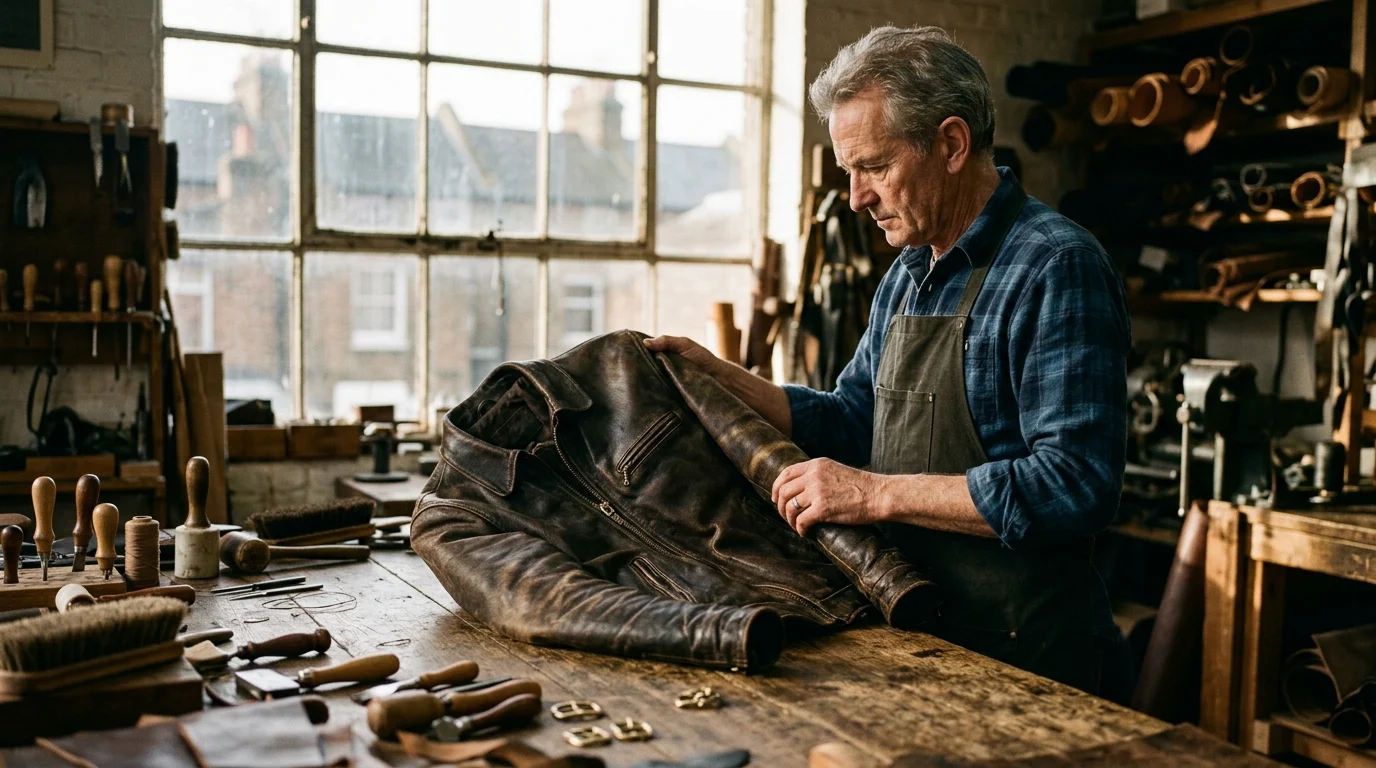
How to Break In a Stiff Leather Jacket Fast: 7 Artisan Methods
Learn how to break in a stiff leather jacket fast without ruining the hide. Master 7 proven artisan methods, break-in timelines, and leather science.
Breaking in a brand-new leather jacket transforms a rigid, armor-like animal hide into a supple second skin that mirrors your exact body contours. At Lux Wearz, our master craftsmen construct genuine full-grain cowhide, steerhide, calfskin, and lambskin jackets priced from $149 to $499 that soften gracefully through time and movement. While cheap synthetic PU outerwear degrades and peels over time, authentic leather contains densely interwoven collagen protein fibrils that yield to body warmth, physical tension, and proper conditioning without losing structural integrity.
Key Takeaways
- Wear your new leather jacket indoors for 2 to 3 hours daily to allow body heat and movement to mold stiff armholes and elbows.
- Practice manual dough-kneading and accordion rolls across the sleeves to fracture rigid tanning waxes without stressing surface grain.
- Apply a lightweight lanolin-based leather balm twice during the initial break-in phase to lubricate internal collagen fibrils.
- Avoid catastrophic internet shortcuts: never soak jackets in bathtubs, never use clothes dryers, and never apply direct heat guns.
- Invest in custom made-to-order sizing ($299–$499) to achieve anatomical armhole placement and shoulder slope that skips painful break-in pinch points.
Why Are New Full-Grain Leather Jackets Stiff
New full-grain leather jackets feel stiff because genuine animal hide consists of dense, tightly intertwined bundles of natural collagen protein fibers bound together by tanning agents and protective oils. Unlike corrected-grain or split leather that has had its top layer buffed away, full-grain hide preserves the full thickness and natural tensile strength of the epidermis.
During the tanning process—whether traditional vegetable tanning utilizing tree tannins or modern chrome tanning utilizing chromium salts—hides undergo intense mechanical compaction, drying, and surface sealing. This process stabilizes the organic proteins against bacterial rot, but temporarily locks the collagen fibrils into a rigid, planar alignment. When an artisan cuts and stitches these fresh panels into heavy outerwear, the jacket initially resists flexing.
Furthermore, premium outerwear makers intentionally specify heavyweight hides measuring 1.1 to 1.4mm in thickness for garments like men's biker & moto jackets to ensure maximum abrasion defense and wind resistance. This substantial material gauge requires dedicated kinetic friction and thermal energy from your body to soften. The initial stiffness is not a flaw; rather, it is the undeniable hallmark of genuine heirloom craftsmanship that will endure for thirty years.
The reward for enduring this break-in process is an intimate, bespoke drape that off-the-rack garments cannot match. As the leather flexes, the internal fibers separate slightly and slide across one another, forming permanent accordion creases around your elbows, softening across your shoulder blades, and settling cleanly around your waistline. Examining our guide on How to Choose a Leather Jacket: Leather Types, Styles and Fit clarifies how hide density directly dictates long-term silhouette memory.
7 Proven Artisan Methods to Break In a Stiff Leather Jacket Fast
Seven proven artisan methods accelerate the leather break-in process safely without damaging delicate stitching, lining fabrics, or surface dyes. By combining physical manipulation, ambient temperature control, and targeted conditioning, you can condense months of stiff wear into two weeks of comfortable adaptation.
1. Active Indoor Wear & Body Heat Molding
The safest and most reliable way to soften stiff leather is wearing the jacket inside your home during routine daily activities. Body heat warms the hide naturally to approximately 98.6°F (37°C), softening the natural tallow and oils embedded within the leather fibers. Wear your jacket while typing at your computer, reading on the sofa, or preparing meals for two to three hours each evening.
While wearing the jacket indoors, perform deliberate kinetic stretches. Cross your arms tightly over your chest to stretch the upper back seams. Reach upward toward the ceiling, roll your shoulders backward in wide circles, and bend your elbows repeatedly to establish initial hinge lines along the sleeves.
2. The Artisan Manual Dough-Knead & Accordion Roll Technique
Master leathercraft artisans never wait weeks for heavy hides to soften on their own; they manually manipulate the hide on the cutting table. Lay your unzipped jacket flat on a clean table or carpeted floor. Starting at the cuff of one sleeve, roll the leather tightly upward like an accordion or rolling pin toward the shoulder seam.
Hold the tightly rolled sleeve firmly with both hands for sixty seconds, then unroll it and roll it in the opposite direction. Next, grasp stiff sections—such as the collar points, pocket flaps, and elbow panels—and knead the leather firmly between your palms like bread dough. This mechanical flexing fractures micro-crystallized tanning waxes between the collagen bundles, imparting immediate suppleness without stretching the seams.
3. The Controlled Arm Resistance and Desk Flex Protocol
When seated at your desk or watching television, use your own body weight to apply static pressure against stiff leather panels. Rest your elbows on a table and interlock your fingers, leaning forward gently to exert concentrated pressure across the elbow creases. Hold this position for three to five minutes at a time.
Next, grasp the lapels with your hands and pull downward gently while flexing your shoulder blades backward. This controlled tension molds the armhole scye to the natural curve of your armpit, preventing the jacket from lifting uncomfortably off your shoulders whenever you raise your arms.
4. Safe Micro-Mist & Ambient Humidity Draping
Leather is a hydroscopic organic material that responds dramatically to ambient atmospheric moisture. Hang your jacket on a wide, contoured wooden hanger inside your bathroom while taking a hot, steamy shower. Ensure the jacket hangs at least six feet away from the shower stall so that water droplets do not splash directly onto the leather.
The warm water vapor relaxes the hide fibers gently without saturating the leather. Immediately after stepping out of the shower, put on the warm, humid jacket and wear it for thirty minutes while moving around your home. As the moisture evaporates from the hide while conforming to your body, the leather 'shrink-wraps' microscopically to your unique anatomy.
5. Penetrating Lanolin-Based Conditioning & Microfiber Buffing
If a new leather jacket feels excessively dry or cardboard-like straight out of the delivery box, the hide lacks adequate fat liquors. Apply a quarter-sized dollop of wax-free, lanolin-based leather conditioner onto a clean microfiber towel. Never apply conditioner directly from the bottle onto the leather, as this creates uneven dark spots.
Gently massage the conditioner into the stiffest areas: the armholes, sleeve elbows, collar base, and side waist panels. The lanolin oils penetrate the porous grain, lubricating the microscopic collagen fibrils so they slide smoothly past one another during movement. Allow the conditioner to absorb for one hour, then buff vigorously with a horsehair brush to create friction heat that distributes the oils deep into the hide matrix.
6. Gravity Molding on Contoured Hardwood Hangers
How you store your leather jacket between break-in sessions directly influences its resting drape. Never hang a stiff new jacket on a thin wire or plastic hanger, which concentrates the entire 4-pound garment weight onto a narrow quarter-inch strip, causing irreversible shoulder dimpling and sleeve distortion.
Store your jacket exclusively on a broad, contoured wooden hanger featuring at least two inches of shoulder width. The broad wooden profile mimics human shoulders, allowing gravity to gently pull downward on the torso panels while maintaining crisp collar definition. Button or zip the front closure halfway to prevent the chest facings from curling outward while drying.
7. Bespoke Custom Tailoring: Skipping the Break-In Battle Altogether
The most difficult break-in battles occur when an off-the-rack jacket has incorrectly positioned armholes or an overly narrow back breadth for your specific physique. When a jacket fits poorly, the stiff leather continually bites into your underarms, creating painful friction sores that no amount of conditioning can fix.
By ordering through our custom made-to-order jackets studio, master tailors draft an individualized paper pattern based on your exact shoulder slope, chest circumference, and bicep width. Our artisans pre-temper each hide on the workbench before assembly, delivering a supple, anatomical fit on day one that completely eliminates break-in misery.
| Break-In Technique | Effort Level | Time to Visible Softening | Primary Target Areas | Risk of Hide Damage |
|---|---|---|---|---|
| Active Indoor Wear | Low | 10 to 14 Days | Overall Torso, Armholes, Elbows | Zero (Completely Safe) |
| Manual Dough-Kneading | Moderate | 2 to 3 Days | Sleeves, Cuffs, Collar Points | Zero (When Done Cleanly) |
| Steamy Bathroom Humidity | Low | 1 to 2 Sessions | Upper Back, Chest Facings | Very Low (Keep Away from Direct Water) |
| Lanolin Conditioning | Moderate | 24 Hours | Stress Joints, Elbow Hinges | Low (Test Inconspicuous Spot First) |
| Gravity Wooden Hanger | Passive | 7 to 10 Days | Shoulder Slope, Back Yoke | Zero (Preserves Architecture) |
| Bespoke Custom Crafting | Zero | Immediate (Day One) | Complete Anatomic Geometry | Zero (Master Crafted) |
Destructive Internet Break-In Myths You Must Never Try
The internet is flooded with viral 'life hacks' and reckless shortcuts that promise to break in a stiff leather jacket overnight. In reality, these destructive methods permanently ruin expensive outerwear by stripping essential tanning oils, melting synthetic threads, and inducing irreversible structural cracking.
Myth 1: Soaking the Jacket in a Bathtub of Hot Water
Viral online forums often advise submerging a new leather jacket in a bathtub of hot water before wearing it dry. This practice is catastrophic for genuine leather. Immersion in water leaches out the water-soluble fat liquors that tanners infuse into the hide fibers.
As the saturated jacket dries, the depleted collagen fibers contract violently, turn brittle like cardboard, and shrink unpredictably. Furthermore, interior satin linings shrink at different rates than the outer leather shell, causing unsightly puckering and seam tearing.
Myth 2: Tumble Drying in a Household Clothes Dryer
Throwing a leather jacket into a clothes dryer—even on 'low heat' or with tennis balls—is an instant death sentence for luxury outerwear. The intense tumbling action abrades the delicate epidermal grain against the metal dryer drum, creating blotchy dull spots and scuffs.
More dangerously, temperatures inside a standard clothes dryer exceed 130°F (54°C). At these temperatures, the natural proteins in animal hide undergo irreversible gelatinization. The leather curls, shrinks by up to two full sizes, and becomes permanently brittle. Tumble drying also melts the heat-sensitive synthetic adhesives used in collar and lapel interfacings.
Myth 3: Hairdryers and Industrial Heat Guns
Applying concentrated hot air from a hairdryer or heat gun directly to stiff leather draws out natural moisture in seconds. Extreme localized heat causes the leather grain to blister and separate from the underlying corium layer, creating permanent air bubbles and flaking. Always rely on gentle body heat (98.6°F) rather than artificial heating appliances.
Myth 4: Harsh Chemicals, Alcohol, and Petroleum Distillates
Wiping a stiff jacket with rubbing alcohol, acetone, or petroleum jelly (Vaseline) will ruin the finish. Alcohol dissolves the protective acrylic topcoats and bleaches dyed pigments instantly. Petroleum jelly consists of heavy mineral hydrocarbons that sit on the leather surface without penetrating the pores, attracting atmospheric road grime that turns into sticky, abrasive black sludge.
Break-In Timeline Expectations Across Different Leather Hide Types
How long it takes to break in a leather jacket depends entirely on animal hide species, tanning method, and thickness gauge. A buttery lambskin jacket requires minimal effort, while a heavyweight horsehide or steerhide piece demands weeks of consistent dedication.
Buttery Full-Grain Lambskin (0.8–1.0mm)
Lambskin comes from young sheep and features an exceptionally fine cellular grain structure with low collagen density. It offers an immediate, glove-like drape straight out of the shipping box. Lambskin requires zero mechanical kneading and will mold completely to your body within three to five wears. It is the premier choice for women's leather jackets and refined blazers where instant comfort is paramount.
Supple Italian Calfskin (1.0–1.2mm)
Calfskin bridges the gap between delicate lambskin and rugged cowhide. It possesses tight, uniform grain fibers that resist surface abrasions while maintaining a pliable hand-feel. A calfskin jacket feels slightly structured for the first week of wear, but softens into buttery comfort within 10 to 14 days of active indoor use.
Rugged Full-Grain Cowhide (1.1–1.4mm)
Cowhide is the traditional workhorse of military flight jackets and motorcycle protective armor. Dense collagen fiber bundles create a rigid, highly protective barrier that withstands intense road abrasion. A heavy cowhide jacket requires 20 to 30 substantial wears—approximately four to six weeks—to break in fully. Once broken in, cowhide forms permanent memory creases that fit your torso like bespoke sculpture.
Ultra-Heavy Horsehide & Steerhide (1.3–1.6mm)
Horsehide features an exceptionally dense, non-porous grain that resists water and wind better than almost any other natural material. Breaking in authentic front-quarter horsehide is notoriously demanding; it can feel stiff and unyielding for two to three months of continuous wear. However, enthusiasts revere horsehide because its break-in patina is legendary, revealing rich undertones that last for half a century.
| Leather Hide Species | Thickness Range (mm) | Initial Temper / Rigidity | Typical Break-In Hours | Bally Flexometer Fatigue Cycles | Tensile Elongation at Break % |
|---|---|---|---|---|---|
| Full-Grain Lambskin | 0.8 - 1.0 mm | Soft & Supple | 10 - 15 Hours | >100,000 Cycles (No Cracking) | 45% - 60% Elastic Extension |
| Top-Grain Calfskin | 1.0 - 1.2 mm | Medium Firm | 30 - 45 Hours | >80,000 Cycles (High Flexibility) | 35% - 50% Elastic Extension |
| Full-Grain Cowhide | 1.1 - 1.4 mm | Firm & Structured | 60 - 90 Hours | >60,000 Cycles (Durable Memory) | 25% - 40% Elastic Extension |
| Full-Grain Horsehide | 1.3 - 1.6 mm | Very Stiff (Armor-Like) | 120 - 180 Hours | >50,000 Cycles (Extreme Density) | 20% - 30% Elastic Extension |
| Napped Goat Suede | 0.9 - 1.1 mm | Butter-Soft Velvet | 5 - 10 Hours | >90,000 Cycles (Immediate Drape) | 40% - 55% Elastic Extension |
How to Condition and Care for Leather During the Break-In Phase
Conditioning during the break-in phase serves a specific purpose: lubricating internal collagen fibrils to prevent surface grain micro-fissuring while the jacket learns to bend. Applying conditioner properly ensures that the leather flexes smoothly without becoming overly saturated or greasy.
Choosing the Right Conditioner Formulation
Select an all-natural conditioner formulated with lanolin, cosmetic-grade beeswax, and natural almond or jojoba oil. Avoid heavy liquid oils like pure neatsfoot or 100% mink oil during early break-in, as heavy oils will permanently darken light brown and tan leather by several shades. A balanced cream balm nourishes the leather without altering its dye tone.
The Two-Stage Break-In Conditioning Schedule
Do not over-condition your new jacket. Excessive conditioning clogs leather pores and makes the hide feel damp and spongy, which actually weakens tensile strength. Follow this disciplined two-stage schedule:
- Initial Conditioning (Day 3): After completing your first few sessions of indoor wear and manual dough-kneading, apply a thin coat of balm to high-stress areas (elbows, underarms, and collar). Buff off all excess after thirty minutes.
- Follow-Up Nourishment (Week 3): Once the jacket begins developing visible crease lines around your elbows and waist, apply a light, all-over conditioning treatment across the entire exterior shell. This locks in moisture and protects the freshly bent grain against premature scuffing.
For ongoing maintenance once your jacket is fully broken in, transition to our standard semi-annual care protocol outlined in our official leather care guide.
Hardware and Seam Care
While focusing on the leather hide, do not neglect the metal hardware and thread seams. Stiff new jackets often feature tight, unyielding zippers. Rub the teeth of your YKK brass zippers with a clean paraffin wax stick or natural beeswax candle, then zip and unzip the slider ten times. The wax lubricates the metal teeth, ensuring smooth gliding without catching on the leather storm flap.
Conclusion
Breaking in a stiff full-grain leather jacket is an authentic rite of passage that bridges historic craftsmanship with your personal lifestyle. By applying proven artisan methods—wearing the jacket actively, utilizing manual kneading, and nourishing the fibers with lanolin balms—you transform raw animal hide into a personalized heirloom that looks and feels better with every passing year.
Lux Wearz is located at 128 City Road London, EC1V 2NX, reachable by phone at +44 7446367457 or email at [email protected], with official updates available online at https://luxwearz.com. We proudly offer Men's Leather Jackets, Women's Leather Jackets, Bomber & Flight Jackets, Biker & Moto Jackets, Aviator & Shearling Jackets, Suede Jackets, Varsity Jackets, Leather Puffer Jackets, Hooded Leather Jackets, Cropped Leather Jackets, Leather Blazers, Vintage Leather Jackets, Classic Leather Jackets, Leather Bags, Leather Wallets & Cardholders, Leather Belts, and Custom Made-to-Order Jackets, serving clients across Lahore, Pakistan, and the USA with Free Shipping. Upgrade your wardrobe today and Shop Leather Jackets directly from our master artisans.
Explore The Full 2026 Leather Outerwear Collection
Vegetable-tanned full-grain cowhide, buttery New Zealand lambskin, and heritage Melton wool. Free express delivery across the USA with 30-day hassle-free returns.