
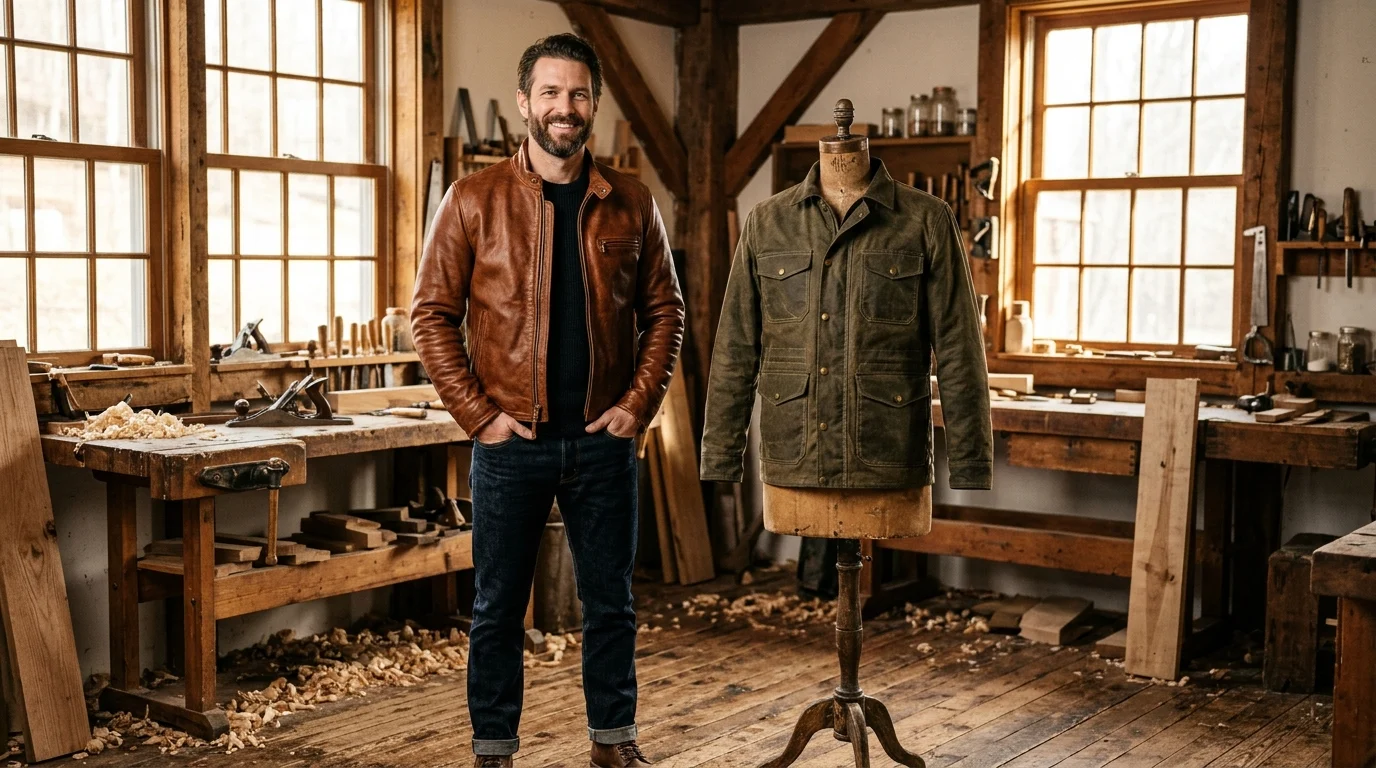
Waxed Canvas vs Leather Jacket Which Outerwear Should You Buy
Compare waxed canvas vs leather jackets for durability, weather resistance, and patina. Discover weight specs, artisan construction, and buying guidance.
Choosing between a waxed canvas jacket and a full-grain leather jacket represents one of the most significant investment dilemmas for outerwear enthusiasts, outdoor adventurers, and discerning urban commuters. Both heritage textiles share deep utilitarian histories rooted in maritime seafaring, aviation exploration, and military service, each earning legendary reputations for rugged durability and timeless masculine appeal. However, waxed cotton canvas and genuine animal hides interact fundamentally differently with rainfall, ambient temperature, wind chill, physical abrasion, and daily wear, creating distinct operational advantages across varied climates and lifestyle routines.
Key Takeaways
- Primary Functional Distinction: Waxed canvas delivers superior native water repellency for heavy rainfall, whereas full-grain leather offers unmatched multi-decade abrasion toughness, structural wind blocking, and heirloom lifespan.
- Material Substance: Full-grain cowhide measuring 1.1 to 1.4 millimeters provides heavy structural protection, while dense 10 to 14 ounce cotton canvas impregnated with paraffin wax offers lightweight wet-weather agility.
- Patina Development: Waxed canvas cultivates rapid high-contrast crease marbling within months of wear, while full-grain leather develops a deep, rich luster and supple drape that matures over decades.
- Maintenance Profiles: Waxed canvas requires manual cold-water spot cleaning and periodic re-waxing every one to three years, whereas genuine leather thrives on annual lanolin hydration and contoured storage.
- Price-to-Value Ratio: High-grade leather outerwear ranges from $149 to $399 for standard sizing and $299 to $499 for bespoke tailoring, delivering generational longevity that justifies its upfront investment.
How Do Waxed Canvas and Leather Jackets Differ in Material Architecture?
Waxed canvas and leather jackets differ fundamentally in their raw structural architecture: waxed canvas is a woven plant-based textile impregnated with paraffin or beeswax, while genuine leather is an organic animal hide consisting of a dense, three-dimensional collagen protein fiber network. This foundational difference dictates how each fabric responds to environmental moisture, tensile stress, internal breathability, and long-term physical aging.
The construction of waxed canvas begins with tightly woven heavyweight cotton duck cloth, typically weighing between 8.5 and 14 ounces per square yard. Artisans treat this dense cotton matrix by pressing liquid paraffin, beeswax, or proprietary petroleum wax blends deep into the yarn fibers. This wax saturation fills the microscopic voids between cotton threads, creating an impenetrable hydrophobic barrier that causes liquid water droplets to bead instantly and roll off the garment exterior. Because the base textile remains woven cotton, waxed canvas retains lightweight flexibility and rugged utility.
Conversely, full-grain leather represents nature's ultimate defensive envelope. Rather than individual threads woven together on a loom, genuine leather hide consists of millions of microscopic collagen protein fibers tightly bound in an interwoven, non-directional matrix. The outermost layer—the full grain—remains completely uncorrected and unbuffed, retaining the animal's natural epidermal strength. This organic protein architecture delivers phenomenal resistance against surface tearing, puncture wounds, and high-velocity friction, outlasting woven textiles by several decades under demanding daily conditions.
Explore rugged heritage outerwear in our men's canvas field jackets line, or review our comprehensive collection of handcrafted men's leather jackets engineered from 100% genuine full-grain hides.
What Are the Top Trending Silhouettes for Waxed Canvas and Leather Outerwear?
Trending silhouettes for waxed canvas and leather outerwear in 2026 center on military field jackets, chore work coats, drop-shoulder flight bombers, and minimalist motorcycle racers. Each functional design balances storage capacity, weatherproofing coverage, torso ease tolerances, and shoulder mobility to accommodate active outdoor exploration and elevated urban lifestyle rotations.
Both textiles excel within specific archival patterns, allowing wearers to align their outerwear choices with distinct lifestyle activities and stylistic aesthetics.
The Four-Pocket Field Utility Jacket
The M-65 inspired field jacket serves as the flagship silhouette for waxed canvas and utility leather alike. Featuring four generous bellows cargo pockets, a concealed storm placket, a stand collar with a stowed hood, and an interior waist drawcord, this silhouette provides exceptional storage utility. In waxed canvas, it functions as the quintessential wet-weather exploration shell. In full-grain cowhide, it becomes an indestructible outdoor shield capable of withstanding rough brush, thorn snags, and freezing winds.
The Heritage Chore Workwear Coat
Rooted in mid-century French and American agricultural labor, the chore coat highlights clean boxy lines, patch hip pockets, a point collar, and a button-front closure. Cut with approximately 3.0 to 4.0 inches of torso ease, a chore jacket layers effortlessly over heavy flannel shirts and chunky knitwear. The minimalist construction allows the natural patina of the fabric—whether creased wax marks or marbled leather grain—to take center stage.
The Aviation Flight Bomber
Aviation bombers feature snug knit ribbing at the collar, cuffs, and waist hem to trap body heat and seal out drafts. When crafted from supple lambskin or cowhide, the bomber delivers supreme athletic swagger and timeless casual styling. While less common in waxed canvas, canvas bombers provide a lightweight, water-resistant alternative for mild transitional months.
| Style Silhouette | Best Body Type Match | Primary Aesthetic | Formality Level | Shoulder Offset & Torso Ease | Price Range (USD) |
|---|---|---|---|---|---|
| M-65 Field Utility | Athletic, Tall & Broad-Shouldered | Rugged Heritage / Military Work | Casual to Outdoor Utility | 1.0 in dropped shoulder, 4.0 in chest ease | $249 - $399 |
| Classic Chore Coat | Rectangular, Average & Sturdy Builds | Workwear Savvy / Americana | Casual to Smart Casual | 1.5 in dropped shoulder, 3.5 in chest ease | $149 - $299 |
| Asymmetrical Moto | Lean, Athletic & Hourglass Frames | Modern Edge / Moto Streetwear | Casual to Evening Out | Natural shoulder seam, 2.0 in chest ease | $249 - $399 |
| Minimalist Cafe Racer | All Heights, Ideal for Athletic Frames | Streamlined Vintage / Biker Chic | Smart Casual / Everyday | 0.5 in structured pad, 2.0 in chest ease | $249 - $399 |
| Long Adventure Duster | Tall, Broad & Layering Enthusiasts | Expedition Heritage / Western | Casual to Severe Weather | 2.0 in dropped shoulder, 4.5 in chest ease | $299 - $499 |
Discover refined, timeless designs in our men's classic leather jackets archive, and explore specialized adventure gear within our adventure ADV jackets department.
How Does Weather Resistance Compare Between Waxed Canvas and Leather?
Waxed canvas provides superior water resistance during persistent rainstorms because its paraffin-saturated cotton fibers actively repel standing moisture, causing rain to bead effortlessly without saturating the base fabric. Full-grain leather offers unmatched windproofing and body heat retention in dry freezing climates, but absorbs moisture during prolonged downpours, requiring careful drying and conditioning to avoid hide stiffness.
Understanding how each material behaves under precipitation, wind exposure, and temperature extremes ensures you select the appropriate garment for your regional climate realities.
Wet Weather and Rain Performance
Waxed canvas was originally engineered by North Sea mariners who required garments that remained light and waterproof during fierce oceanic gales. When rain strikes a freshly waxed canvas jacket, the surface tension created by the wax barrier repels the water droplets immediately. You can hike through torrential rain or navigate wet city streets for hours without moisture penetrating to your inner layers. If the garment gets muddy, you simply rinse it with cold water and let it hang dry.
In contrast, untreated full-grain leather is a breathable, porous organic material. While a high-grade leather jacket comfortably deflects light misty drizzles for twenty to thirty minutes, sustained heavy precipitation will gradually penetrate the grain. Once soaked, water dissolves and carries away essential natural tanning oils from within the hide. When the jacket eventually dries, the collagen fibers can tighten, warp, and become brittle unless thoroughly conditioned. For climates characterized by frequent rain and damp maritime fog, waxed canvas holds an indisputable functional advantage.
Windproof Protection and Thermal Insulation
When the meteorological challenge shifts from rain to biting, sub-freezing winds, full-grain leather reigns supreme. The dense, non-porous structure of 1.1 to 1.4 millimeter cowhide forms an impermeable barrier against wind chill, preventing freezing drafts from robbing your body of warmth. Even at highway speeds on a motorcycle, leather completely blocks airflow. Waxed canvas, while wind-resistant, lacks the thermal mass and structural density of thick animal hide, making it feel noticeably cooler during winter cold snaps unless paired with heavy quilted linings.
| Environmental Factor | Waxed Cotton Canvas (10-14 oz) | Full-Grain Cowhide Leather (1.1-1.4 mm) | Performance Winner & Operational Context |
|---|---|---|---|
| Persistent Heavy Rain | Excellent (Wax barrier repels water continuously) | Poor to Moderate (Absorbs moisture, risks oil loss) | Waxed Canvas (Ideal for wet rainstorms) |
| Freezing Wind Chill | Moderate (Blocks drafts, but lacks thermal mass) | Outstanding (100% impermeable wind barrier) | Full-Grain Leather (Ideal for freezing winds) |
| Abrasion Resistance | High (Resists tears, easy to patch locally) | Indestructible (Generational tear and slide resistance) | Full-Grain Leather (Superior physical protection) |
| Warm-Weather Breathability | Moderate (Cotton breathes, but wax reduces airflow) | Variable (Porous grain breathes, but heavy weight) | Waxed Canvas (Lighter overall physical weight) |
| Snow and Sleet Defense | Excellent (Snow brushes off without soaking) | Good (Handles dry snow, requires conditioning) | Waxed Canvas (Zero risk of water-staining) |
For track-tested motorcycle protection engineered to endure severe headwinds, explore our men's motorbike jackets. Those who appreciate mid-century styling will enjoy our curated vintage leather jackets collection.
What Are the Technical Material and Durability Specs of Leather Outerwear?
Technical specifications of genuine leather outerwear include full-grain hide thicknesses ranging from 0.8 to 1.4 millimeters, solid YKK brass zippers, reinforced polyester satin linings, and handcrafted double-needle stitching. These concrete specifications ensure that premium leather pieces withstand multi-decade mechanical stress and provide generational heirloom value that synthetic jackets cannot match.
Every technical figure published by Lux Wearz reflects our master artisans' real-world manufacturing standards, ensuring transparent craftsmanship and uncompromised quality for every client.
Hide Thickness Benchmarks
Leather performance is directly governed by hide gauge. We cut lightweight garments such as tailored blazers and everyday casual coats from 0.9 to 1.2 millimeter full-grain lambskin, providing immediate buttery softness and zero break-in stiffness. For heavy-duty outerwear, utility coats, and motorcycle gear, we utilize 1.1 to 1.4 millimeter full-grain cowhide, ensuring maximum tensile strength, slide resistance, and structural armor. For supple flexibility with pebbled texture, 0.8 to 1.0 millimeter goatskin delivers balanced tear resistance and natural water repellency.
Hardware and Lining Architecture
All Lux Wearz garments incorporate heavy-duty YKK brass zippers equipped with self-locking sliders to prevent accidental opening under physical motion. Stress zones like pocket welts, collar tabs, and cuff gussets feature reinforced solid brass snaps and internal leather backing stays. Our interiors are lined with smooth, high-density polyester satin that allows the garment to glide effortlessly over chunky wool knits, fleece hoodies, and delicate cotton shirting.
| Leather Hide Type | Exact Thickness (mm) | Hardware Compatibility | Interior Lining Material | Durability Rating & Break-In | Standard Order Lead Time | Craftsmanship Warranty | Price Range (USD) |
|---|---|---|---|---|---|---|---|
| Full-Grain Lambskin | 0.9 - 1.2 mm | Heavy-Duty YKK Brass | Polyester Satin Lining | Immediate softness, zero break-in | 3 - 5 business days | 1-Year Full Warranty | $249 - $399 |
| Full-Grain Cowhide | 1.1 - 1.4 mm | Heavy-Duty YKK Brass | Polyester Satin Lining | Maximum abrasion resistance, 3-4 week break-in | 3 - 5 business days | 1-Year Full Warranty | $149 - $399 |
| Full-Grain Goatskin | 0.8 - 1.0 mm | Heavy-Duty YKK Brass | Polyester Satin Lining | High tensile flexibility, 1-2 week break-in | 3 - 5 business days | 1-Year Full Warranty | $249 - $399 |
| Bespoke Custom Made | Choice of 0.8 - 1.4 mm | Heavy-Duty YKK Brass | Polyester Satin Lining | Engineered to exact client specifications | 7 - 14 business days | 1-Year Full Warranty | $299 - $499 |
Before finalizing your outerwear selection, consult our accurate size guide to calculate your ideal chest ease and sleeve lengths. To protect your investment for decades to come, review the hydration protocols detailed in our leather care guide.
How Does Patina Development Compare Between Waxed Canvas and Leather?
Patina development on waxed canvas occurs rapidly through high-contrast crease marks, scuffs, and localized wax migration along high-friction zones within months of regular wear. In contrast, full-grain leather develops a gradual, multidimensional luster and amber undertone shift that deepens over decades, molding anatomically to the wearer's posture and movements.
Both materials are celebrated because they refuse to look worse as they age; rather, time and exposure to the elements enhance their beauty, creating a wearable record of the owner's adventures.
The Dynamic Aging of Waxed Canvas
Waxed canvas demonstrates aging almost immediately. Within the first two weeks of wearing, the stiff paraffin wax bends along the elbows, chest creases, and pocket seams, creating pale, chalky stress lines known as "craquelure" or "pull-up." Over several seasons, high-wear points like cuff edges and shoulder ridges shed their top wax layer, revealing the deeper, darker cotton weave underneath. This produces a rugged, high-contrast character that appeals to workwear devotees and outdoor trail enthusiasts. If you ever wish to reset the canvas back to its original uniform appearance, a quick application of heat from a hair dryer melts the wax, blending the creases away instantly.
The Generational Evolution of Full-Grain Leather
Leather patina is an irreversible, slow-motion art form. As full-grain cowhide or lambskin absorbs atmospheric light, natural skin oils from your hands, and ambient humidity, the outer epidermis undergoes gentle oxidation. High-contact areas burnish to a rich, glossy sheen while natural hide creases settle permanently into the shape of your elbows and torso. Rather than losing its finish, the leather becomes increasingly supple, soft, and comfortable with each passing year. A leather jacket worn for twenty years looks substantially more dignified, luxurious, and handsome than it did on the day it left the artisan workshop.
Discover rugged utility coats in our workwear jackets line, or explore authentic biker styling within our men's biker moto jackets collection.
What Are the Routine Maintenance and Cleaning Protocols for Each Textile?
Routine maintenance for waxed canvas requires brushing off dried dirt with cold water, avoiding all detergents or washing machines, and re-applying fabric wax every one to three years using heat. Leather maintenance requires wiping with a damp cloth, applying lanolin-rich leather balm once or twice annually, and hanging on contoured wooden hangers away from radiators.
Meticulous adherence to proper maintenance protocols represents the difference between a jacket that fails within five years and an heirloom garment that lasts for generations.
Waxed Canvas Maintenance Rules
- Never Machine Wash or Dry Clean: Detergents, chemical solvents, and hot water completely strip the embedded paraffin wax, destroying the garment's water repellency and leaving the raw cotton limp and vulnerable.
- Cold Water Spot Cleaning Only: To clean mud, dust, or trail debris, allow the dirt to dry completely, brush it off with a stiff nylon bristle brush, and sponge the spot with plain cold water.
- Periodic Re-Waxing Routine: Every one to three years—or whenever water stops beading on the shoulders and forearms—apply a tin of specialized canvas wax. Warm the jacket and wax tin in sunlight or with a hair dryer, rub the wax into the cotton in circular motions, and use gentle heat to melt the wax deep into the yarn fibers.
Leather Maintenance Protocols
- Dust Removal and Wipe-Down: Wipe the exterior hide every few months with a slightly damp microfiber towel to clear atmospheric dust and road pollution from the grain pores.
- Annual Lanolin Conditioning: Apply a neutral, wax-free leather conditioner once or twice each year. Work a dime-sized amount into the hide, allow the natural oils to absorb for two hours, and buff gently with a soft horsehair brush to restore an elegant satin glow.
- Contoured Storage: Always hang leather outerwear on wide, contoured wooden hangers that support the shoulder pads correctly. Storing leather on thin wire hangers creates permanent dimples that ruin the sleeve drape.
Explore relaxed streetwear staples in our casual jackets category, or review our handcrafted leather bags collection to pair your outerwear with matching travel accessories.
Which Jacket Delivers the Best Long-Term Return on Investment?
A full-grain leather jacket delivers superior long-term return on investment by providing an operational lifespan of thirty to fifty years or more, retaining timeless sartorial versatility across formal and casual environments. Waxed canvas delivers outstanding mid-tier utility with an average lifespan of ten to twenty years, providing excellent budget-friendly wet-weather performance for outdoor work and casual weekend adventures.
Evaluating return on investment requires calculating cost-per-wear over the complete operational lifespan of the garment rather than merely examining the initial retail purchase price.
Calculating Cost-Per-Wear
A premium full-grain cowhide leather jacket purchased at $249 to $399 and worn forty times per year across three decades yields an astonishingly low cost-per-wear of under thirty cents per outing. Because leather transitions effortlessly from rugged weekend hikes to upscale urban dinners, executive boardrooms, and nightlife events, its daily utility is nearly limitless. Furthermore, authentic full-grain leather retains significant secondary resale value on vintage markets due to its enduring heirloom status.
Waxed canvas typically retails at a more accessible entry price, making it an attractive purchase for outdoor enthusiasts who require immediate rain protection without significant financial outlay. However, because cotton fibers eventually fray, thin, and wear through at cuffs and pocket edges after ten to fifteen years of intense abrasion, waxed canvas coats rarely achieve the generational heirloom status of full-grain leather. For pure longevity, versatility, and enduring luxury, full-grain leather stands as the definitive investment winner.
Discover answers to common warranty and shipping inquiries by visiting our frequently asked questions page.
How Do You Decide Between Waxed Canvas and Leather for Your Lifestyle?
Decide between waxed canvas and leather by evaluating your local climate precipitation levels, your everyday style formality requirements, and your preferred physical garment weight. Choose waxed canvas if you encounter frequent heavy rain and prefer rugged outdoor utility; choose full-grain leather if you want lifetime durability, windproof warmth, and versatile styling that commands respect in urban environments.
To help you make the definitive choice for your wardrobe, review our straightforward decision framework:
Select a Waxed Canvas Jacket If:
- You live in the Pacific Northwest, the British Isles, or coastal regions characterized by frequent rain and persistent wet conditions.
- You spend significant time engaged in outdoor field activities like trail hiking, camping, woodworking, or gardening where garments encounter mud and bramble snags.
- Your personal wardrobe leans heavily into rugged Americana workwear, flannels, raw denim, and heavy-duty work boots.
- You prefer lightweight outerwear that provides water shedding without the heavy physical heft of dense animal hide.
Select a Full-Grain Leather Jacket If:
- You seek a lifetime investment piece that develops a personalized patina and can be handed down to the next generation.
- You need versatile outerwear that effortlessly transitions from casual daytime coffee runs to sharp evening galas and professional workplace settings.
- You face freezing autumn and winter winds where complete windproof armor and thermal insulation are paramount.
- You appreciate the tactile luxury, unmistakable aroma, and artisanal craftsmanship of genuine full-grain leather hides.
For related insights on leather silhouettes and styling, explore our guide on why espresso brown leather jackets dominate 2026 streetwear. You can also discover waist cinching techniques in our blueprint for how to style a belted leather jacket across every season, or review bomber patterns in our ultimate leather bomber jacket style and buying guide for 2026.
Looking for this trending silhouette? Explore our handcrafted leather jackets with complimentary shipping across the USA. Need custom sizing or custom sleeves? Design yours with our custom order service.
Explore The Full 2026 Leather Outerwear Collection
Vegetable-tanned full-grain cowhide, buttery New Zealand lambskin, and heritage Melton wool. Free express delivery across the USA with 30-day hassle-free returns.