
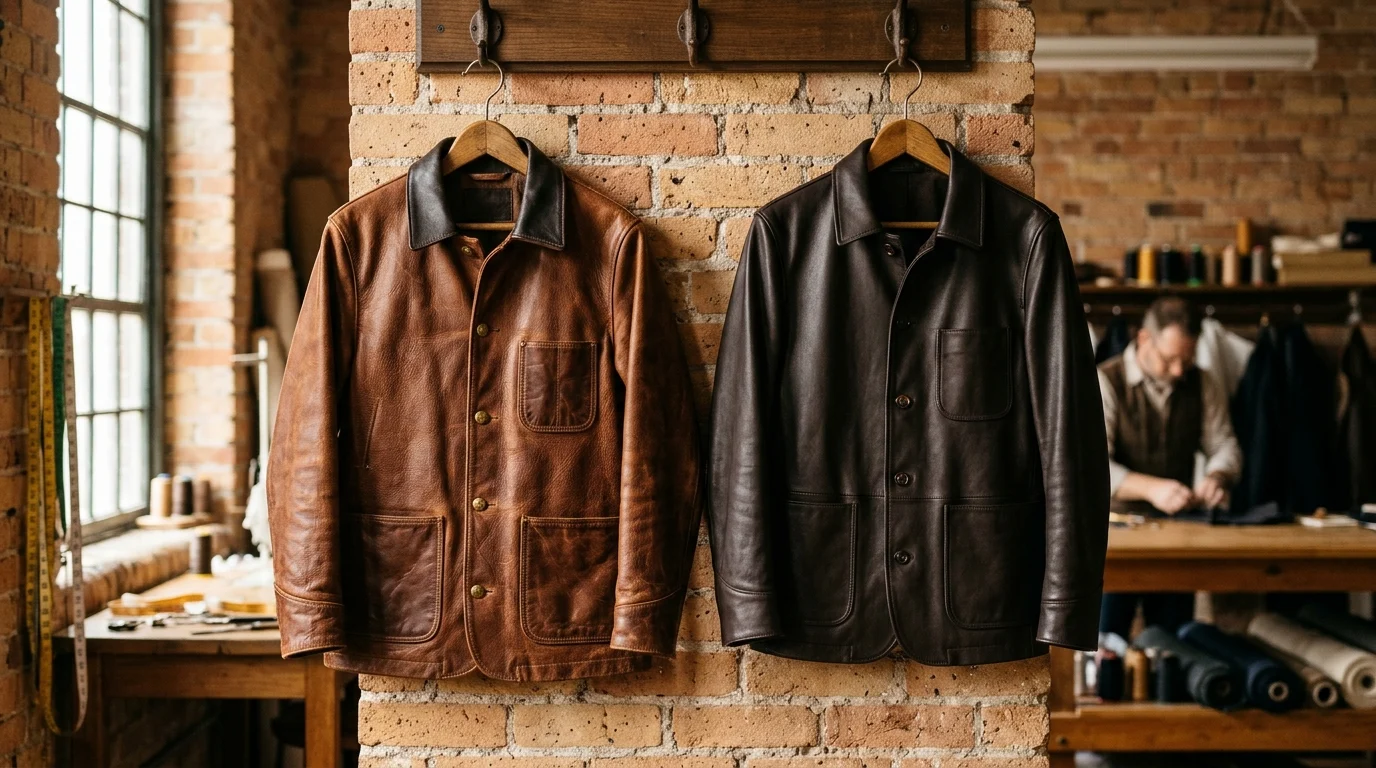
Leather Barn Jacket vs Chore Jacket: Which One Should You Buy? [2026]
Compare leather barn jackets vs chore jackets across leather hide thickness, collar styles, utilitarian pocket layouts, and modern 2026 streetwear outfits.
Leather Barn Jacket vs Chore Jacket: Which One Should You Buy? [2026]
Utilitarian workwear silhouettes constructed from full-grain leather have captured the pinnacle of 2026 outerwear fashion, transforming functional industrial equipment into coveted quiet-luxury wardrobe anchors. Among these rugged styles, two iconic silhouettes frequently spark intense debate among discerning outerwear enthusiasts: the American leather barn jacket and the French leather chore jacket. While both garments trace their ancestry to blue-collar agricultural and factory laborers who required indestructible garments, their modern sartorial expressions diverge sharply in proportion, pocket geometry, lining architecture, and daily wearability. Deciding which silhouette deserves an investment in your personal wardrobe requires dissecting the engineering distinctions between rural American weather protection and minimalist Continental workshop tailoring.
Key Takeaways Box
- Silhouette Intent: The leather barn jacket offers a longer, relaxed cut with substantial hip coverage and bellow storm pockets, whereas the chore jacket provides a compact, boxy torso with flat patch pockets and clean workwear lapels.
- Collar Architecture: Authentic barn jackets feature contrasting collars crafted from tactile corduroy or burnished split cowhide, while chore jackets maintain uniform matching-leather shirt collars that lay flat against knitwear.
- Thermal Performance: Barn jackets incorporate heavy full-grain cowhide measuring 1.1 to 1.4 mm paired with insulated linings for cold-weather protection, whereas chore jackets favor supple 0.9 to 1.2 mm lambskin for lightweight indoor-outdoor layering.
- Proportion Counterbalance: Style voluminous barn jackets with straight-leg selvedge denim or heavy corduroys, and pair tailored chore coats with pleated wool flannels or fluid wide-leg chinos for refined high-low contrast.
- Bespoke Value: Custom made-to-measure tailoring ensures that sleeve lengths and torso proportions harmonize perfectly with your anatomical height, avoiding the frumpy billow common in off-the-rack workwear.
What Are the Historical Origins of Leather Barn Jackets and Chore Jackets?
A leather barn jacket descends from twentieth-century North American farm and ranch outerwear designed to protect agricultural workers against harsh prairie winters and physical abrasion. In contrast, a leather chore jacket derives from nineteenth-century French industrial factory garments, known colloquially as the bleu de travail, engineered for artisan carpenters and machinists who needed lightweight indoor mobility.
American agricultural laborers required outerwear capable of enduring driving sleet, barbed wire friction, and sub-zero wind chill while riding horses or operating unheated machinery. Patternmakers responded by drafting longer coats that extended several inches past the buttocks, preventing cold drafts from entering the lower lumbar region when bending over. They reinforced high-friction collar zones with soft corduroy fabric to prevent neck chaffing and engineered expansive bellow pockets with drainage eyelets to carry veterinary tools and fencing staples.
Meanwhile, Continental European artisans working in urban ateliers prioritized clean line discipline and unrestricted upper-body reach. French chore jackets were cut shorter, terminating squarely at the upper thigh or beltline, with flat open patch pockets placed symmetrically across the chest and hips. When luxury fashion houses translated these blue-collar workwear garments into full-grain leather in late 2025 and 2026, the barn jacket emerged as the ultimate rugged winter shield, while the chore jacket evolved into an elegant, unstructured overshirt hybrid.
To understand the foundational evolution of French utility tailoring, explore our authoritative leather chore jacket buying and styling guide.
What Are the Key Architectural and Construction Differences Between Both Jackets?
The key architectural differences lie in jacket length, pocket construction, collar fabrication, and closure mechanics. Barn jackets feature an extended hip-covering hem, four-pocket storm configurations, and contrasting collars, whereas chore jackets employ a compact hip-length hem, three flat patch pockets, and a matching self-leather shirt collar.
Dissecting the garment construction reveals how each piece handles visual mass and mechanical utility:
- Torso Hemline and Proportions: A traditional leather barn jacket measures between 30 and 34 inches in back length, ensuring complete coverage of your trouser pockets and buttocks. This length prevents cold drafts from riding up the spine during outdoor movement. Conversely, a leather chore jacket measures between 26 and 29 inches in back length, framing the hips cleanly like an overshirt without restricting leg articulation.
- Pocket Architecture and Storage: Barn jackets feature dual-entry bellow storm pockets at the hips, reinforced with gusseted folds and brass snaps that expand to hold thick winter gloves or tech gear, accompanied by slanted fleece-lined hand-warmer pockets at the mid-chest. Chore jackets utilize flat, open-top patch pockets topstitched directly onto the front panels, providing an uncluttered, minimalist facade.
- Collar Facing and Neckline: Authentic barn coats incorporate contrasting collar facings—typically heavy 8-wale cotton corduroy or dark suede—that provide soft tactile warmth against the neck. Chore jackets feature an unembellished turn-down point collar cut from the same hide as the body, creating an uninterrupted vertical visual line.
- Front Closure Engineering: Barn jackets utilize heavy-duty antique brass YKK zippers concealed beneath a wide, wind-blocking storm placket secured with reinforced brass snaps. Chore jackets feature exposed central button closures with natural horn buttons or minimalist exposed brass zippers, maintaining an understated European workwear aesthetic.
For visual inspiration showcasing rural utility silhouettes, consult our curated lookbook on how to style a leather barn jacket.
Table 1: Silhouette Architecture and Utilitarian Matrix
| Design Specification | Leather Barn Jacket | Leather Chore Jacket |
|---|---|---|
| Historical Lineage | North American Farm & Ranch Utility | French Industrial Atelier (Bleu de Travail) |
| Back Length & Hemline | 30 to 34 Inches (Extended Hip & Seat Coverage) | 26 to 29 Inches (Upper Hip & Beltline Termination) |
| Collar Construction | Contrasting 8-Wale Corduroy or Suede Collar | Matching Full-Grain Leather Turn-Down Collar |
| Pocket Configuration | 4 Pockets: Dual Bellow Flaps + Mid-Chest Warmers | 3 Pockets: Single Chest Patch + Dual Lower Patches |
| Front Closure System | Heavy YKK Brass Zip with Snapped Storm Placket | Exposed Horn Buttons or Minimalist YKK Zipper |
| Optimal Body Types | Broad, Tall, and Stocky Muscular Frames | Lean, Slender, and Athletic Fashion Frames |
| Formality Spectrum | Rugged Casual to Elevated Weekend Outdoor | Smart Casual, Creative Office, and Evening Lounge |
| Price Range (USD) | $249 - $499 | $149 - $399 |
Which Leather Hide and Thickness Is Best for a Barn Jacket Versus a Chore Jacket?
Heavy cowhide measuring 1.1 to 1.4 mm is best for a leather barn jacket to provide rugged wind resistance, structure, and puncture protection in outdoor environments. Supple lambskin measuring 0.9 to 1.2 mm or goatskin measuring 0.8 to 1.0 mm is ideal for a leather chore jacket to guarantee fluid overshirt drape and lightweight comfort.
A barn jacket demands a dense, fibrous hide that can withstand inclement weather, freezing precipitation, and rough surface contact. Milled full-grain cowhide undergoes drum dyeing with natural waxes, creating an oil-rich pull-up finish that yields character-rich color variations across stress seams while repelling moisture naturally. The sheer weight of a 1.2mm cowhide shell establishes an authoritative, protective drape that drapes handsomely over heavy winter knitwear.
Conversely, a chore jacket functions predominantly as a transitional layer or indoor overshirt. Crafting a chore coat from stiff heavyweight steerhide causes the flat patch pockets to bulge awkwardly and restricts arm movement when seated at a desk. Aniline full-grain lambskin or goatskin provides the supple, glove-like temper required for the neat shirt-style collar to roll softly around your neck without rigidity.
Review our dedicated breakdown on modern workwear proportions in 7 leather workwear jacket outfits that actually flatter.
Table 2: Material and Durability Specification Matrix
| Leather Grade Specification | Certified Hide Thickness | Standard Hardware Specification | Interior Lining Material | Standard Order Lead Time | Craftsmanship Guarantee |
|---|---|---|---|---|---|
| Full-Grain Cowhide Leather | 1.1 to 1.4 mm Cowhide | Heavy-Duty Brass YKK Fasteners | Breathable Polyester Satin Lining | 3 to 5 Business Days | 1-Year Craftsmanship Warranty |
| Full-Grain Lambskin Leather | 0.9 to 1.2 mm Lambskin | Solid Antiqued Brass YKK Zips | Smooth Polyester Satin Lining | 3 to 5 Business Days | 1-Year Craftsmanship Warranty |
| Full-Grain Goatskin Leather | 0.8 to 1.0 mm Goatskin | Reinforced Brass Metal Hardware | Polyester Satin Thermal Lining | 3 to 5 Business Days | 1-Year Craftsmanship Warranty |
| Bespoke Custom Made-to-Order | Choice of Full-Grain Hide | Premium Solid Brass YKK Hardware | Hand-Stitched Polyester Satin | 7 to 14 Business Days | 1-Year Craftsmanship Warranty |
How Should You Style a Leather Barn Jacket for Modern Heritage Streetwear?
Styling a leather barn jacket for modern streetwear requires pairing its voluminous rural silhouette with rugged, grounded wardrobe staples like heavyweight raw selvedge denim, chunky waffle henleys, and Goodyear-welted service boots. The contrasting collar provides an immediate focal point that anchors earthy autumn and winter color palettes.
Because a barn jacket features generous torso ease and an extended hem, wearing it with skinny or tapered trousers creates an ungrounded, top-heavy silhouette. Instead, select straight-leg or relaxed-fit Japanese raw selvedge denim in dark indigo, rolling the cuffs once to display the internal selvedge ticker line. Beneath the jacket, layer a 300 GSM heather oatmeal waffle-knit henley or a brushed cotton buffalo plaid flannel button-down.
For footwear, choose oil-tanned leather service boots or rugged moc-toe work boots equipped with Vibram lug soles. The substantial boot profile balances the jacket hem, establishing an authentic heritage aesthetic that bridges vintage workwear functionality with modern metropolitan luxury. If temperatures plummet, accessorize with a ribbed wool watch cap and durable full-grain leather gloves.
Discover versatile foundational pieces across our handcrafted mens leather jackets and womens leather jackets.
How Should You Style a Leather Chore Jacket for Contemporary Smart-Casual Settings?
Styling a leather chore jacket for contemporary smart-casual settings requires treating the garment as an elevated sport coat alternative, pairing it with double-pleated wool trousers, fine-gauge merino rollnecks, and polished leather loafers. The minimalist patch pockets and compact length convey refined artistic sophistication.
To achieve effortless smart-casual polish, leave the front buttons or zipper partially open, allowing your knitwear to create clean vertical layers. Choose monochrome foundations such as charcoal grey wool flannels, pleated taupe chinos, or dark washed black denim. A fine-gauge merino wool turtleneck in black, navy, or ecru adds neck height that complements the neat shirt-style leather collar.
Complete the look with polished calfskin penny loafers, sleek Chelsea boots, or minimalist white leather sneakers. This juxtaposition of utilitarian workwear heritage and luxury European tailoring makes the leather chore jacket an exceptional choice for creative studios, gallery receptions, and upscale evening dining.
Explore curated vintage silhouettes within our vintage leather jackets and womens classic leather jackets collections.
6 Definitive Outfit Formulas: Barn Jacket vs Chore Jacket Face-Off
Here are six runway-tested outfit formulas highlighting the distinct strengths of both silhouettes across varying lifestyle settings:
1. The Barn Jacket Country Heritage Formula
The country heritage formula balances outdoor ruggedness with refined weekend comfort.
- The Outerwear: Tobacco brown full-grain cowhide barn jacket with dark brown corduroy collar and brass snaps.
- The Base Layer: Forest green brushed flannel button-down worn over a cream waffle-knit thermal tee.
- The Bottoms: 15oz straight-leg dark indigo raw selvedge denim with a single turn-up cuff.
- The Footwear: Amber harness Goodyear-welted work boots with durable oil-resistant outsoles.
- The Accessories: Heavy canvas tool bag and an oiled leather belt with an antiqued brass roller buckle.
- Why It Works: The interplay between dark green flannel, indigo denim, and rich tobacco leather establishes a timeless Americana palette.
2. The Chore Jacket Parisian Atelier Formula
The Parisian atelier formula captures effortless Continental elegance for modern urban professionals.
- The Outerwear: Espresso brown full-grain lambskin chore jacket with three clean patch pockets.
- The Base Layer: Off-white 200 GSM fine-gauge merino wool crewneck sweater.
- The Bottoms: Double-pleated charcoal wool flannel trousers tailored with a clean no-break hem.
- The Footwear: Polished black calfskin penny loafers with Blake-stitched leather soles.
- The Accessories: Architectural stainless steel dress watch and a full-grain leather laptop portfolio.
- Why It Works: Clean lines and flat pocket placement allow the chore jacket to drape like a tailored blazer.
3. The Barn Jacket Winter Commuter Layer
The winter commuter formula delivers uncompromising thermal insulation against freezing metropolitan winds.
- The Outerwear: Distressed black cowhide barn jacket featuring an insulated polyester satin interior lining.
- The Base Layer: Chunky charcoal cable-knit fisherman sweater (450 GSM).
- The Bottoms: Heavy olive drab wool cavalry twill trousers with relaxed leg lines.
- The Footwear: Waterproof black leather boots with heavy commando traction lugs.
- The Accessories: Cashmere-lined deerskin gloves and a charcoal ribbed knit scarf.
- Why It Works: Bellow pockets provide ample room for transit essentials while the extended hem blocks bitter winter drafts.
4. The Chore Jacket Monochromatic Minimalist Look
The monochromatic minimalist formula creates a streamlined, statuesque silhouette for evening art events.
- The Outerwear: Pitch black nappa lambskin chore jacket with tonal matte black horn buttons.
- The Base Layer: Fitted black modal long-sleeve turtleneck sweater.
- The Bottoms: Jet black straight-leg coated denim with zero whiskering.
- The Footwear: Chiseled-toe black leather side-zip Chelsea boots.
- The Accessories: Sterling silver ring and a minimalist black leather cardholder.
- Why It Works: Eliminating color breaks directs visual focus to the subtle textural contrast between lambskin, knitwear, and coated denim.
5. The Barn Jacket Weekend Rancher Formula
The weekend rancher formula celebrates Western craftsmanship and rugged versatility.
- The Outerwear: Cognac pull-up leather barn jacket with contrasting suede collar trim.
- The Base Layer: Denim western snap-front shirt with pointed pocket flaps.
- The Bottoms: Khaki heavy-duty duck canvas utility pants with reinforced knees.
- The Footwear: Brown roughout leather roper boots with stacked leather heels.
- The Accessories: Western-buckled leather belt from our workshop and a felt fedora hat.
- Styling Insight: Leaving the lower two snaps open ensures easy pocket access while sitting or driving.
6. The Chore Jacket Elevated Casual Tee and Chino Look
The elevated casual look transitions effortlessly from casual Friday meetings to weekend rooftop drinks.
- The Outerwear: Olive drab full-grain goatskin chore jacket with textured pebble grain.
- The Base Layer: Heavyweight 240 GSM combed white cotton crewneck t-shirt, tucked neatly.
- The Bottoms: Relaxed stone-washed cotton twill chinos with a subtle ankle taper.
- The Footwear: Low-profile white calfskin leather sneakers with vulcanized rubber soles.
- The Accessories: Canvas tote bag with leather carry handles and tortoiseshell sunglasses.
- Why It Works: The textural richness of goatskin leather transforms simple white tees and chinos into a luxury ensemble.
Which Jacket Should You Buy Based on Your Climate, Body Type, and Lifestyle?
Choose a leather barn jacket if you live in a colder climate, have a broad or tall muscular build, and seek a heavy-duty winter coat with maximum pocket storage. Choose a leather chore jacket if you reside in a temperate climate, possess a lean or athletic frame, and desire a lightweight, versatile overshirt for smart-casual indoor-outdoor wear.
To determine your ideal investment, evaluate these three lifestyle criteria:
- Regional Climate and Seasonality: If your winters involve biting winds, freezing sleet, and sub-zero temperatures, the barn jacket's extended hip coverage, storm placket, and heavier cowhide shell provide indispensable thermal defense. If you live in a mild coastal city or require an all-season layering piece that transitions from spring breezes into autumn evenings, the chore jacket offers far superior breathability.
- Body Frame Ergonomics: The generous ease, dropped shoulders, and wide torso of a barn jacket flatter broader shoulders, muscular physiques, and stockier builds, draping comfortably over bulky sweaters without clinging. The straighter, boxier profile of a chore jacket flatters lean, athletic, and average height frames by framing the torso symmetrically without overwhelming shorter proportions.
- Primary Use Environment: If you spend substantial time outdoors, commute on foot, or take weekend country getaways, the barn jacket's deep bellow pockets and durable cowhide construction offer unmatched utility. If your days center on creative offices, client meetings, coffee shops, and restaurant dining, the chore jacket integrates seamlessly into urban luxury wardrobes.
For tailored women's utility options, explore our casual jackets womens leather jackets, and for men's foundational layers, view our casual jackets and leather vests collections. You can also explore specialized utility vests in our mens leather vests and discover rugged heritage pieces across our western leather jackets womens leather jackets women gallery.
How Do You Care for and Clean Heavy Workwear Leather Outerwear?
Caring for heavy workwear leather requires regular brushing with a natural horsehair brush, wiping surface mud with a damp microfiber cloth, and nourishing the hide with beeswax-based conditioners every six months. Never machine-wash leather workwear or expose wet hides to heated hair dryers or radiators.
Heavy cowhide and lambskin workwear garments accumulate dust, environmental pollutants, and surface abrasions through daily wear. After outdoor excursions in wet weather, allow your jacket to hang naturally on an extra-wide contoured wooden coat hanger in a well-ventilated room at ambient temperature. Applying a natural conditioner replenishes internal collagen lipids, preserving the leather's tensile strength and ensuring that surface scuffs buff out effortlessly into a rich, storied patina.
For step-by-step cleaning recipes, conditioning schedules, and storage advice, consult our comprehensive artisan leather care guide. For specific questions regarding hardware durability or order processing, explore our frequently asked questions portal and view our comprehensive size and fit guide.
Why Invest in Handcrafted Workwear Outerwear at Lux Wearz?
Investing in handcrafted workwear outerwear at Lux Wearz guarantees uncompromised full-grain leather selection, artisanal bench tailoring, and honest workshop pricing without retail distributor markups. Every jacket is individually cut and sewn by master artisans possessing over two decades of specialized leathercraft experience.
Mass-market commercial brands routinely cut corners on workwear silhouettes by utilizing thin corrected-grain leathers, hollow plastic buttons, and synthetic polyurethane coatings that crack after minimal wear. At Lux Wearz, our master tailors build heirloom outerwear engineered to endure decades of daily utility. From heavy-duty YKK brass hardware to double-needle bonded nylon stitching, every detail reflects pure craftsmanship discipline.
Through our bespoke custom tailoring program, you can commission a barn jacket or chore coat customized to your exact sleeve length, torso dimensions, and pocket specifications. We back every garment with a 30-day hassle-free return guarantee, an unconditional 1-year craftsmanship warranty, and complimentary insured shipping across the United States. Read what satisfied clients share about our tailoring standards by visiting our verified client testimonials, explore complementary handcrafted leather bags, and experience genuine artisanal leatherwear crafted for a lifetime.
Explore The Full 2026 Leather Outerwear Collection
Vegetable-tanned full-grain cowhide, buttery New Zealand lambskin, and heritage Melton wool. Free express delivery across the USA with 30-day hassle-free returns.